

Newlywed Financial Guide: Money Management for Married Couples (2026 Guide)
Gabay sa Pinansya ng Bagong Kasal: Pamamahala ng Pera para sa Mag-asawa (2026 Gabay)

5 Things to Know
Newlywed finance in five facts.



Quick Summary
Mabilis na Buod
Important Disclaimer
This guide is for educational purposes only and does not constitute financial advice. Individual circumstances vary. Consult a licensed financial advisor for personalized guidance.
Mahalagang Disclaimer
Ang gabay na ito ay para sa layuning pang-edukasyon lamang at hindi bumubuo ng financial advice. Iba-iba ang sitwasyon ng bawat tao. Kumonsulta sa isang lisensyadong financial advisor para sa personalized na gabay.
Table of Contents
Talaan ng Nilalaman
First 30 Days: Administrative Tasks
Unang 30 Araw: Mga Administrative Tasks
Marriage changes your legal identity and financial records. Within the first month, tackle the name change cascade — updating your surname across all government and financial accounts. Do these in order, kasi each step often requires the previous one.
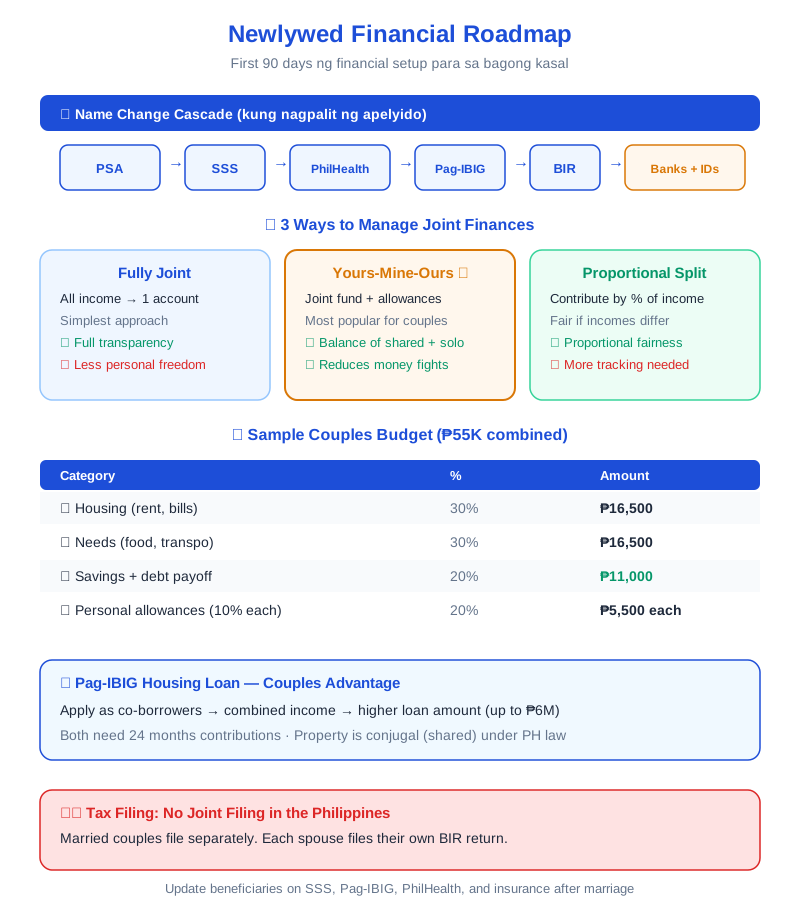
Name Change Cascade (Recommended Order)
- PSA Marriage Certificate — Secure your PSA-authenticated copy first. This is your primary proof of marriage for everything else. Processing takes 5-10 business days via PSA Serbilis.
- SSS — Update name, civil status, and beneficiary. Use the My.SSS portal or visit a branch with PSA Marriage Certificate + valid ID.
- PhilHealth — Update member data record (MDR). Your spouse can now be listed as a dependent. Bring PSA Marriage Certificate to any PhilHealth office.
- Pag-IBIG — Update records and beneficiary info via the Virtual Pag-IBIG portal or at a branch. Critical if you plan to apply for a housing loan as co-borrowers.
- BIR — File BIR Form 1905 to update your civil status and name. This affects your tax records and Certificate of Registration.
- Banks & financial accounts — Update name on all bank accounts, credit cards, insurance policies, and investment accounts. Each bank has its own process — bring PSA Marriage Certificate + 2 valid IDs.
- Employer HR — Submit updated BIR 2305 (for tax withholding changes), update company records, health card, and emergency contacts.
Update All Beneficiaries
This is the step most newlyweds forget. Review and update the beneficiary on:
- SSS — death and funeral benefit beneficiary
- Pag-IBIG — provident fund and housing loan beneficiary
- Life insurance policies
- Company benefits (HMO, group life insurance)
- Bank accounts with payable-on-death designations
- Investment accounts (stocks, mutual funds, UITFs)
Combine or Coordinate Bank Accounts
You don't have to merge everything immediately. Many couples start by opening a joint savings account for shared expenses (rent, groceries, bills) while keeping individual accounts for personal spending. See the next section for three approaches to managing your combined finances.
Binabago ng kasal ang legal identity at financial records mo. Sa loob ng unang buwan, tapusin ang name change cascade — pag-update ng apelyido sa lahat ng government at financial accounts. Gawin ang mga ito sa tamang pagkakasunod, kasi madalas kailangan ng nauna para sa susunod.
Name Change Cascade (Inirerekomendang Pagkakasunod)
- PSA Marriage Certificate — Kunin muna ang PSA-authenticated copy. Ito ang pangunahing patunay ng kasal para sa lahat. 5-10 business days ang processing sa PSA Serbilis.
- SSS — I-update ang pangalan, civil status, at beneficiary. Gamitin ang My.SSS portal o pumunta sa branch na may PSA Marriage Certificate + valid ID.
- PhilHealth — I-update ang member data record (MDR). Pwede nang ilista ang asawa bilang dependent. Dalhin ang PSA Marriage Certificate sa kahit anong PhilHealth office.
- Pag-IBIG — I-update ang records at beneficiary info sa Virtual Pag-IBIG portal o sa branch. Kritikal ito kung mag-a-apply kayo ng housing loan bilang co-borrowers.
- BIR — I-file ang BIR Form 1905 para i-update ang civil status at pangalan. Naaapektuhan nito ang tax records at Certificate of Registration mo.
- Banks at financial accounts — I-update ang pangalan sa lahat ng bank accounts, credit cards, insurance policies, at investment accounts. Iba-iba ang proseso ng bawat bangko — dalhin ang PSA Marriage Certificate + 2 valid IDs.
- Employer HR — I-submit ang updated BIR 2305 (para sa tax withholding changes), i-update ang company records, health card, at emergency contacts.
I-update Lahat ng Beneficiaries
Ito ang step na madalas nakakalimutan ng mga bagong kasal. I-review at i-update ang beneficiary sa:
- SSS — death at funeral benefit beneficiary
- Pag-IBIG — provident fund at housing loan beneficiary
- Life insurance policies
- Company benefits (HMO, group life insurance)
- Bank accounts na may payable-on-death designations
- Investment accounts (stocks, mutual funds, UITFs)
Pagsasamahin o I-coordinate ang Bank Accounts
Hindi kailangang pagsamahin ang lahat agad. Maraming mag-asawa ang nagsisimula sa pag-open ng joint savings account para sa shared expenses (renta, groceries, bills) habang pinapanatili ang individual accounts para sa personal spending. Tingnan ang susunod na seksyon para sa tatlong approach sa pamamahala ng combined finances ninyo.
What You Need
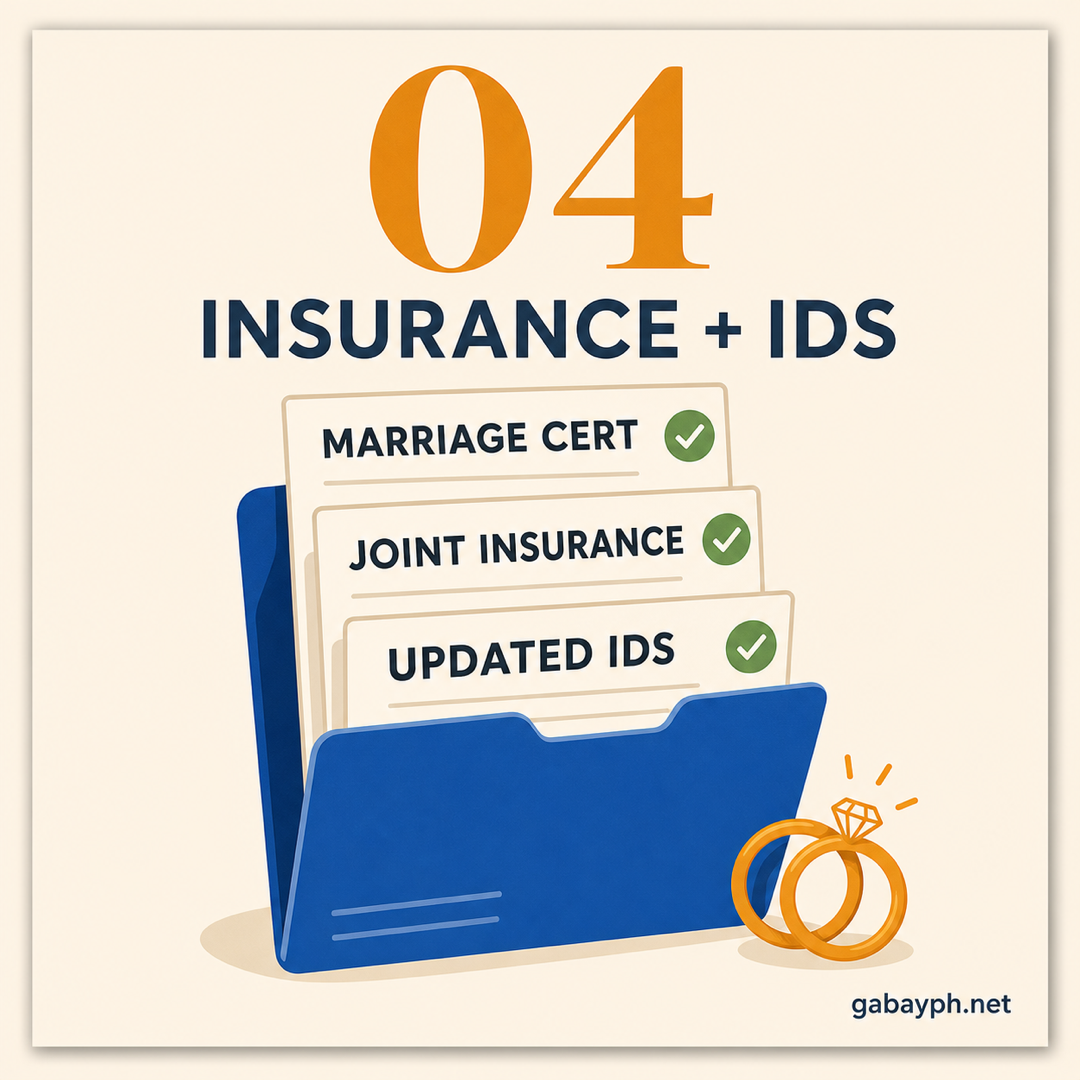
- PSA Marriage Certificate — Authenticated copy, the foundation document for all name changes and legal updates
- Updated IDs with new name — At least 2 government-issued IDs reflecting your married name (start with SSS/PhilHealth/Pag-IBIG IDs)
- Combined income documentation — Latest payslips or income records from both spouses for loan applications and budgeting
- Joint savings account — Open one together for shared household expenses (any major bank will do)
Mga Kakailanganin Mo
- PSA Marriage Certificate — Authenticated copy, ang pundasyon na dokumento para sa lahat ng name changes at legal updates
- Updated IDs na may bagong pangalan — Hindi bababa sa 2 government-issued IDs na nagreflect ng married name (magsimula sa SSS/PhilHealth/Pag-IBIG IDs)
- Combined income documentation — Pinakabagong payslips o income records mula sa parehong mag-asawa para sa loan applications at budgeting
- Joint savings account — Mag-open ng isa para sa shared household expenses (kahit anong major bank)
Setting Up Joint Finances
Pag-set Up ng Joint Finances
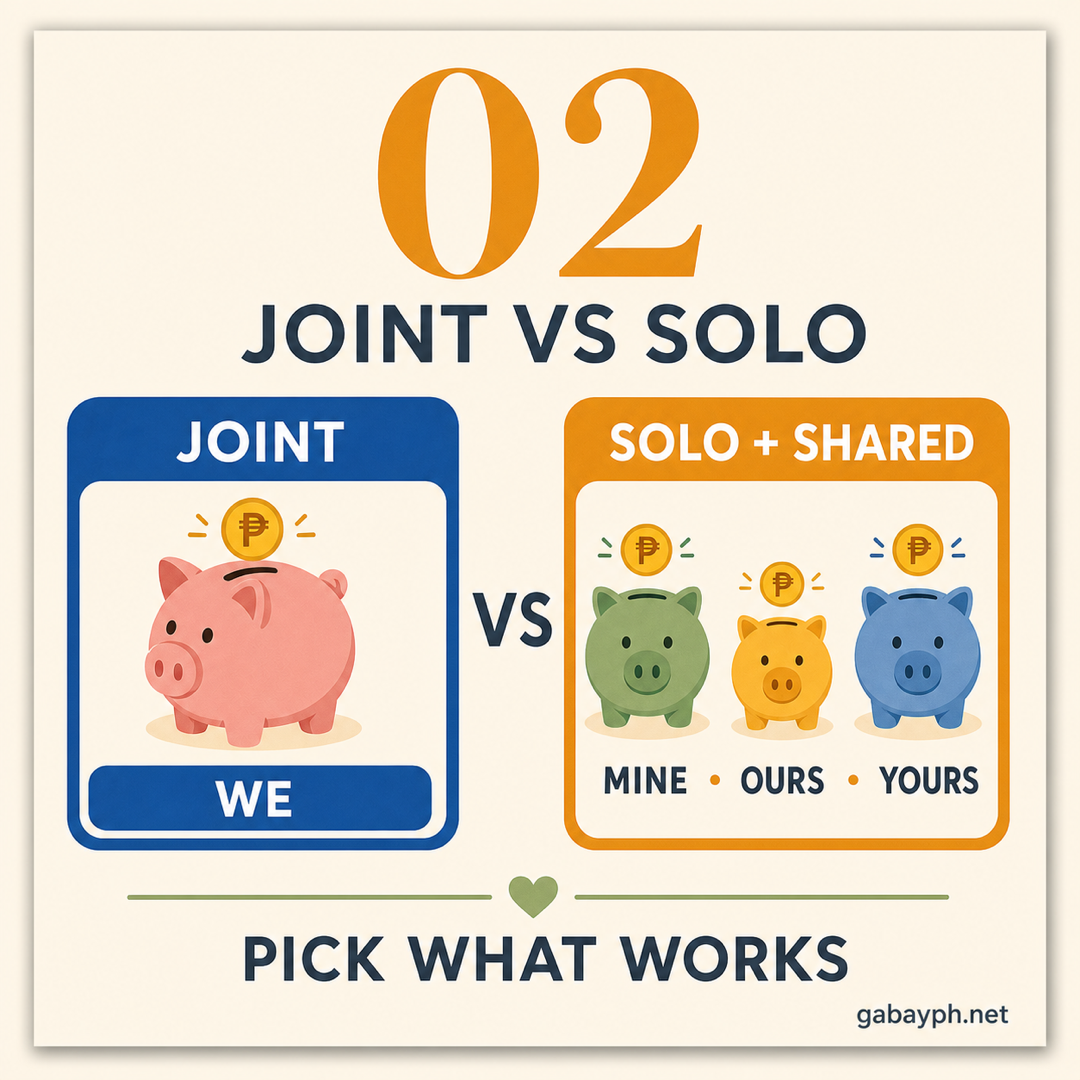
There's no single "right" way to merge finances as a married couple. What matters is that you both agree on the system. Here are three common approaches:
Approach 1: Fully Joint (All-In Together)
Both incomes go into one shared account. All bills, savings, and spending come from this pool.
- Pros: Full transparency, simpler tracking, easier to work toward shared goals
- Cons: Less personal spending freedom, requires high trust, every purchase is visible
Best for: Couples who are very aligned on spending habits and don't need separate "personal money."
Approach 2: Proportional Split
Each spouse contributes to shared expenses based on their income percentage. If one earns 60% of total household income, they cover 60% of shared bills.
- Pros: Fair when incomes are unequal, keeps some personal autonomy
- Cons: More complex to track, can feel transactional
Best for: Couples with significantly different income levels.
Approach 3: Yours-Mine-Ours
Each spouse keeps their own account. You both contribute a fixed amount to a joint "ours" account for shared expenses (rent, bills, groceries, savings goals). Anything left in your personal accounts is yours to spend freely.
- Pros: Personal freedom preserved, clear boundaries, reduces money arguments
- Cons: Shared goals can get less priority, requires discipline to fund the joint account first
Best for: Couples who value financial independence or have different spending styles.
Practical Example: ₱55,000 Combined Income
Spouse A earns ₱30,000, Spouse B earns ₱25,000. Using the Yours-Mine-Ours approach:
- Joint account contribution: ₱35,000 total (Spouse A: ₱19,100 or 63.6%, Spouse B: ₱15,900 or 36.4% — proportional to income)
- Joint account covers: Rent ₱12,000 + food ₱8,000 + utilities ₱4,000 + joint savings ₱8,000 + insurance ₱3,000
- Personal allowance: Spouse A keeps ₱10,900, Spouse B keeps ₱9,100
Whatever you keep personally is yours — no questions asked. This eliminates the "why did you buy that?" arguments.
Walang iisang "tamang" paraan para pagsamahin ang pinansya bilang mag-asawa. Ang mahalaga ay parehong sang-ayon kayo sa sistema. Narito ang tatlong karaniwang approach:
Approach 1: Fully Joint (Lahat Sama-sama)
Parehong kita ay napupunta sa iisang shared account. Lahat ng bills, ipon, at gastos ay galing sa pool na ito.
- Pros: Buong transparency, mas simpleng tracking, mas madaling magtrabaho patungo sa shared goals
- Cons: Mas kaunting personal spending freedom, kailangan ng mataas na tiwala, nakikita ang bawat purchase
Best para sa: Mag-asawa na sobrang aligned sa spending habits at hindi kailangan ng hiwalay na "personal money."
Approach 2: Proportional Split
Bawat asawa ay nag-co-contribute sa shared expenses batay sa percentage ng kita nila. Kung 60% ng total household income ang kinikita ng isa, siya ang sumasagot sa 60% ng shared bills.
- Pros: Patas kapag hindi pantay ang kita, may natitirang personal autonomy
- Cons: Mas kumplikadong i-track, pwedeng parang transactional
Best para sa: Mag-asawa na malaki ang pagkakaiba ng kita.
Approach 3: Yours-Mine-Ours
Pinapanatili ng bawat asawa ang sariling account. Pareho kayong nag-co-contribute ng fixed amount sa joint "ours" account para sa shared expenses (renta, bills, groceries, savings goals). Kahit anong matira sa personal accounts ninyo ay para sa inyo na gastusin nang malaya.
- Pros: Nananatili ang personal freedom, malinaw ang boundaries, nababawasan ang mga away sa pera
- Cons: Maaaring mas hindi maprioritize ang shared goals, kailangan ng disiplina para pondohan muna ang joint account
Best para sa: Mag-asawa na pinahahalagahan ang financial independence o iba ang spending styles.
Practical Example: ₱55,000 Combined Income
Si Spouse A ay kumikita ng ₱30,000, si Spouse B ay kumikita ng ₱25,000. Gamit ang Yours-Mine-Ours approach:
- Joint account contribution: ₱35,000 total (Spouse A: ₱19,100 o 63.6%, Spouse B: ₱15,900 o 36.4% — proporsyonal sa kita)
- Sakop ng joint account: Renta ₱12,000 + pagkain ₱8,000 + utilities ₱4,000 + joint savings ₱8,000 + insurance ₱3,000
- Personal allowance: Si Spouse A ay nag-ke-keep ng ₱10,900, si Spouse B ay nag-ke-keep ng ₱9,100
Kahit ano ang itinatabi mo nang personal ay sa iyo — walang tanungan. Inaalis nito ang mga "bakit mo binili iyon?" na away.
Couples Budget Template
Template ng Budget para sa Mag-asawa
A good starting framework for couples: the 30/30/20/10/10 split. This works well for most Filipino households earning ₱40,000-₱70,000 combined. Adjust as needed — see our Household Budget guide for income-level templates.
The 30/30/20/10/10 Framework
- Housing (30%): Rent or amortization, condo dues, home insurance
- Needs (30%): Food, utilities, transportation, medicine, basic phone/internet
- Savings & Debt (20%): Emergency fund, Pag-IBIG MP2, investments, debt payoff
- Personal Allowance — Spouse A (10%): Spend however they want, no questions asked
- Personal Allowance — Spouse B (10%): Spend however they want, no questions asked
Sample: ₱55,000 Combined Monthly Income
- Housing: ₱16,500 (rent, condo dues)
- Needs: ₱16,500 (food ₱8,000, utilities ₱4,000, transpo ₱3,000, misc ₱1,500)
- Savings & debt: ₱11,000 (EF ₱5,000, MP2 ₱3,000, investment ₱3,000)
- Spouse A personal: ₱5,500
- Spouse B personal: ₱5,500
The personal allowance is non-negotiable. Both spouses need guilt-free spending money. This is what prevents resentment and budget burnout. Track your budget with our Expense Tracker tool.
Isang magandang starting framework para sa mag-asawa: ang 30/30/20/10/10 split. Gumagana ito para sa karamihan ng pamilyang Pilipino na kumikita ng ₱40,000-₱70,000 combined. I-adjust kung kailangan — tingnan ang aming gabay sa Household Budget para sa mga template ayon sa income level.
Ang 30/30/20/10/10 Framework
- Tirahan (30%): Renta o amortization, condo dues, home insurance
- Pangangailangan (30%): Pagkain, utilities, pamasahe, gamot, basic phone/internet
- Ipon at Utang (20%): Emergency fund, Pag-IBIG MP2, investments, debt payoff
- Personal Allowance — Spouse A (10%): Gastusin kung paano niya gusto, walang tanungan
- Personal Allowance — Spouse B (10%): Gastusin kung paano niya gusto, walang tanungan
Sample: ₱55,000 Combined Monthly Income
- Tirahan: ₱16,500 (renta, condo dues)
- Pangangailangan: ₱16,500 (pagkain ₱8,000, utilities ₱4,000, pamasahe ₱3,000, iba pa ₱1,500)
- Ipon at utang: ₱11,000 (EF ₱5,000, MP2 ₱3,000, investment ₱3,000)
- Personal ni Spouse A: ₱5,500
- Personal ni Spouse B: ₱5,500
Ang personal allowance ay non-negotiable. Parehong mag-asawa ay kailangan ng guilt-free spending money. Ito ang pumipigil sa resentment at budget burnout. I-track ang budget ninyo gamit ang aming Expense Tracker tool.
Pag-IBIG Housing Loan as a Couple
Pag-IBIG Housing Loan Bilang Mag-asawa
One of the biggest advantages of being married is the co-borrower option for Pag-IBIG housing loans. Combined income means a higher loan amount — potentially the difference between affording a home or not. For the full Pag-IBIG membership and contribution guide, see our Pag-IBIG guide. For the complete homebuying process, see How to Buy Your First Home.
Co-Borrower Advantage
When you apply as co-borrowers, Pag-IBIG combines both incomes to determine your maximum loanable amount. Example:
- Spouse A earns ₱30,000 alone = max loan ~₱1.2M
- Combined ₱55,000 = max loan ~₱2.2M
That's nearly double the borrowing power. Both spouses must be Pag-IBIG members with at least 24 monthly contributions.
Joint vs Single Borrower
- Joint (co-borrower): Higher loan amount, shared liability, both credit histories considered. If one has bad credit, it can hurt the application.
- Single borrower: Lower loan amount but only one spouse is liable. The other spouse's credit history doesn't matter. May be better if one spouse has credit issues.
Property Title for Married Couples
Under Philippine law, property acquired during marriage is generally considered conjugal property (or community property under the Family Code). This means:
- The property belongs to both spouses regardless of who paid
- Both names should appear on the title
- Neither spouse can sell or mortgage the property without the other's written consent
- In case of death, the surviving spouse automatically inherits their conjugal share
Isa sa mga pinakamalaking advantage ng pagiging kasal ay ang co-borrower option para sa Pag-IBIG housing loans. Ang combined income ay nangangahulugan ng mas mataas na loan amount — posibleng pagkakaiba ng kayang bumili ng bahay o hindi. Para sa buong Pag-IBIG membership at contribution guide, tingnan ang aming gabay sa Pag-IBIG. Para sa kumpletong homebuying process, tingnan ang Paano Bumili ng Unang Bahay.
Co-Borrower Advantage
Kapag nag-apply bilang co-borrowers, pinagsasama ng Pag-IBIG ang parehong kita para malaman ang maximum loanable amount. Halimbawa:
- Si Spouse A ay kumikita ng ₱30,000 mag-isa = max loan ~₱1.2M
- Combined ₱55,000 = max loan ~₱2.2M
Halos doble ang borrowing power. Parehong mag-asawa ay dapat Pag-IBIG members na may hindi bababa sa 24 monthly contributions.
Joint vs Single Borrower
- Joint (co-borrower): Mas mataas na loan amount, shared liability, parehong credit histories ang ikokonsidera. Kung may masamang credit ang isa, pwedeng makaapekto sa application.
- Single borrower: Mas mababang loan amount pero isang asawa lang ang liable. Hindi mahalaga ang credit history ng isa pang asawa. Pwedeng mas maganda kung may credit issues ang isang asawa.
Property Title para sa Married Couples
Sa ilalim ng batas ng Pilipinas, ang property na nakuha habang kasal ay karaniwang itinuturing na conjugal property (o community property sa ilalim ng Family Code). Ibig sabihin nito:
- Pag-aari ng parehong mag-asawa ang property kahit sino ang nagbayad
- Dapat lumabas ang parehong pangalan sa title
- Hindi pwedeng ibenta o i-mortgage ng isang asawa ang property nang walang nakasulat na pahintulot ng isa
- Sa kaganapan ng kamatayan, awtomatikong namana ng natitirang asawa ang conjugal share nila
Tax Filing for Married Couples
Tax Filing para sa Married Couples
Good news: tax filing for married couples in the Philippines is straightforward because there is no joint filing. Unlike the US, the Philippines requires each spouse to file their own income tax return separately.
Key Rules
- File separately. Each spouse files their own BIR Form 1700 (employed) or 1701 (self-employed/mixed income). Your marriage doesn't change your filing method.
- Each claims own exemptions. The TRAIN Law removed personal exemptions, so there's no "additional exemption for spouse" anymore. Both spouses are taxed on their own income using the same graduated rates.
- No joint filing option in the Philippines. Don't be confused by US-style advice online. Sa Pilipinas, walang joint return.
- Update your BIR records. File BIR Form 1905 to change your civil status from single to married. This updates your TIN record but doesn't change how you're taxed.
For the complete tax filing walkthrough, see our How to File Taxes (BIR) guide.
Magandang balita: ang tax filing para sa married couples sa Pilipinas ay diretso lang dahil walang joint filing. Hindi tulad ng US, kinakailangan ng Pilipinas na mag-file ang bawat asawa ng sariling income tax return nang hiwalay.
Mga Mahahalagang Patakaran
- Mag-file nang hiwalay. Bawat asawa ay nagfa-file ng sariling BIR Form 1700 (employed) o 1701 (self-employed/mixed income). Hindi binabago ng kasal ang paraan ng filing mo.
- Bawat isa ay nagke-claim ng sariling exemptions. Tinanggal ng TRAIN Law ang personal exemptions, kaya wala nang "additional exemption for spouse." Parehong mag-asawa ay binu-buwis sa sariling kita gamit ang parehong graduated rates.
- Walang joint filing option sa Pilipinas. Huwag malito sa US-style advice online. Sa Pilipinas, walang joint return.
- I-update ang BIR records. I-file ang BIR Form 1905 para baguhin ang civil status mula single patungong married. Ina-update nito ang TIN record pero hindi nagbabago kung paano ka binubuwisan.
Para sa kumpletong tax filing walkthrough, tingnan ang aming gabay sa Pag-file ng Taxes (BIR).
Insurance & Protection
Insurance at Proteksyon
Marriage means someone else now depends on your financial stability — and vice versa. Review your protection strategy together. For a deeper dive, see our Insurance guide.
Update Life Insurance Beneficiaries
If you had life insurance before getting married, your beneficiary might still be a parent or sibling. Update it to your spouse immediately. Under Philippine insurance law, the designated beneficiary receives the payout regardless of who "should" get it legally — so if your ex is still listed, they get the money.
Combined Health Coverage
Check if one spouse's employer HMO covers dependents. Many company health plans allow adding a spouse at reduced cost or for free. Compare both employer plans and choose the better one for family coverage. This can save you ₱10,000-₱30,000/year vs buying separate individual plans.
Emergency Fund Target for Couples
As a 2-person household, your emergency fund target is higher: 3-6 months of combined household expenses. If your monthly expenses are ₱35,000, aim for ₱105,000-₱210,000. If only one spouse earns income, lean toward 6 months. See our Emergency Fund guide for strategies to build it faster.
Ang kasal ay nangangahulugan na may ibang tao na ngayon na umaasa sa financial stability mo — at vice versa. I-review ang protection strategy ninyo nang magkasama. Para sa mas malalim na pag-aaral, tingnan ang aming gabay sa Insurance.
I-update ang Life Insurance Beneficiaries
Kung may life insurance ka bago mag-asawa, pwedeng magulang o kapatid pa ang nakalistang beneficiary. I-update ito sa asawa mo agad. Sa ilalim ng Philippine insurance law, ang designated beneficiary ang tumatanggap ng payout kahit sino ang "dapat" na makakuha nito ayon sa batas — kaya kung nakalista pa ang ex mo, sila ang makakakuha ng pera.
Combined Health Coverage
I-check kung ang employer HMO ng isang asawa ay nagco-cover ng dependents. Maraming company health plans ang nagpapahintulot na magdagdag ng asawa sa reduced cost o libre. I-compare ang parehong employer plans at piliin ang mas magandang family coverage. Makakatipid ito ng ₱10,000-₱30,000/taon kumpara sa pagbili ng magkahiwalay na individual plans.
Emergency Fund Target para sa Mag-asawa
Bilang 2-person household, mas mataas ang emergency fund target ninyo: 3-6 na buwan ng combined household expenses. Kung ₱35,000 ang buwanang gastos ninyo, target ang ₱105,000-₱210,000. Kung isang asawa lang ang kumikita, mag-lean sa 6 na buwan. Tingnan ang aming gabay sa Emergency Fund para sa mga strategy na mas mabilis itong mapundar.
Saving for Major Goals
Pag-iipon para sa Malalaking Goals
As a couple, you likely have multiple competing financial goals. The key is prioritization, not perfection. Here's a practical order:
Priority 1: Emergency Fund (Months 1-12)
Before investing or saving for anything else, build your safety net. Target: 3 months of expenses first, then grow to 6 months. Keep it liquid — high-yield savings or a digital bank with 4-6% interest.
Priority 2: House Downpayment (Months 6-36)
If homeownership is the goal, start saving for a 10-20% downpayment alongside your EF. For a ₱2M Pag-IBIG housing loan property, you'll need ₱200,000-₱400,000 for downpayment. Pag-IBIG MP2 is ideal here — tax-free and higher returns than regular savings. See our First Home guide for the full process.
Priority 3: Baby Fund (When Planning)
Hospital delivery costs ₱30,000-₱80,000 (normal) or ₱80,000-₱200,000 (cesarean) even with PhilHealth coverage. Start setting aside ₱3,000-₱5,000/month at least 6 months before trying. Don't forget: maternity leave pay covers only SSS/PhilHealth members. See our Maternity Benefits guide.
Priority 4: Travel & Lifestyle Goals
Create a separate "fun fund" — even ₱1,000-₱2,000/month adds up. Use a dedicated savings account or digital bank sub-wallet. Having this fund means you can enjoy life without derailing your other goals.
Priority 5: Retirement (Ongoing)
If you're both in your 20s-30s, time is your biggest asset. Even ₱2,000/month invested in a diversified stock index fund at 8% average returns grows to ~₱1.8M over 20 years. Start small, increase contributions as your income grows.
Bilang mag-asawa, malamang na marami kayong magkakasamang financial goals. Ang susi ay prioritization, hindi perfection. Narito ang praktikal na pagkakasunod:
Priority 1: Emergency Fund (Buwan 1-12)
Bago mag-invest o mag-ipon para sa kahit ano, buuin muna ang safety net ninyo. Target: 3 buwang gastos muna, tapos palakihin hanggang 6 na buwan. Panatilihing liquid — high-yield savings o digital bank na may 4-6% interest.
Priority 2: House Downpayment (Buwan 6-36)
Kung homeownership ang goal, magsimulang mag-ipon para sa 10-20% downpayment kasabay ng EF. Para sa ₱2M na Pag-IBIG housing loan property, kakailanganin ninyo ng ₱200,000-₱400,000 para sa downpayment. Ang Pag-IBIG MP2 ang ideal dito — tax-free at mas mataas ang returns kaysa sa regular savings. Tingnan ang aming gabay sa Unang Bahay para sa buong proseso.
Priority 3: Baby Fund (Kapag Nagpaplano)
Ang hospital delivery ay nagkakahalaga ng ₱30,000-₱80,000 (normal) o ₱80,000-₱200,000 (cesarean) kahit may PhilHealth coverage. Magsimulang magtabi ng ₱3,000-₱5,000/buwan kahit 6 na buwan bago mag-try. Huwag kalimutan: ang maternity leave pay ay para lang sa SSS/PhilHealth members. Tingnan ang aming gabay sa Maternity Benefits.
Priority 4: Travel at Lifestyle Goals
Gumawa ng hiwalay na "fun fund" — kahit ₱1,000-₱2,000/buwan ay naiipon. Gumamit ng dedicated savings account o digital bank sub-wallet. Ang pagkakaroon ng fund na ito ay nangangahulugan na pwede kayong mag-enjoy ng buhay nang hindi nasisira ang ibang goals ninyo.
Priority 5: Retirement (Tuloy-tuloy)
Kung pareho kayong nasa 20s-30s, ang oras ang pinakamalaking asset ninyo. Kahit ₱2,000/buwan na ini-invest sa diversified stock index fund sa 8% average returns ay lumalaki sa ~₱1.8M sa loob ng 20 taon. Magsimula nang maliit, dagdagan ang contributions habang lumalaki ang kita.
Pro Tips
Mga Payo
- Schedule a monthly "money date." Set a recurring date (e.g., every 1st Sunday) to review finances together — bills, savings progress, upcoming expenses. Keep it light and judgment-free. Couples who communicate about money regularly have fewer financial conflicts.
- Set a spending threshold for "big purchases." Agree that any purchase above a certain amount (e.g., ₱3,000) requires a quick discussion with your spouse first. This prevents surprise expenses while still allowing daily spending freedom.
- Automate your joint contributions. Set up automatic transfers to your joint account on payday. If the money moves automatically, you'll never "forget" to contribute. Treat it like a bill — it gets paid first.
- Name your savings accounts. "Emergency Fund," "House Downpayment," "Honeymoon 2027" — labeled accounts make saving feel tangible. Most digital banks (CIMB, Tonik, Maya) let you create multiple sub-wallets for free.
- Get your marriage certificate copies early. Order at least 5-6 PSA-authenticated copies. You'll need them for every government agency, bank, and employer update. Running out mid-cascade and waiting for new copies slows everything down.
- Discuss worst-case scenarios early. What happens if one spouse loses their job? What if someone gets seriously ill? Having a plan for these scenarios (even a rough one) reduces anxiety and ensures you're both protected. This is also why insurance and emergency funds come before investing.
- Mag-schedule ng monthly "money date." Magtakda ng recurring date (hal., tuwing 1st Sunday) para i-review ang pinansya nang magkasama — bills, savings progress, paparating na gastos. Panatilihing magaan at walang judgement. Ang mga mag-asawa na regular na nag-uusap tungkol sa pera ay mas kaunti ang mga financial conflict.
- Magtakda ng spending threshold para sa "big purchases." Mag-agree na ang anumang purchase na lampas sa isang halaga (hal., ₱3,000) ay kailangan ng mabilisang usapan muna sa asawa. Pinipigilan nito ang surprise expenses habang pinapahintulutan pa rin ang araw-araw na spending freedom.
- I-automate ang joint contributions ninyo. Mag-set up ng automatic transfers sa joint account sa araw ng sweldo. Kung awtomatikong gumagalaw ang pera, hindi kayo "makakalimutan" mag-contribute. Tratuhin itong parang bill — binabayaran muna.
- Pangalanan ang savings accounts ninyo. "Emergency Fund," "House Downpayment," "Honeymoon 2027" — ang mga labeled accounts ay nagpapagaan ng pakiramdam sa pag-iipon. Karamihan ng digital banks (CIMB, Tonik, Maya) ay nagpapahintulot na gumawa ng maraming sub-wallets nang libre.
- Kumuha ng marriage certificate copies nang maaga. Mag-order ng hindi bababa sa 5-6 PSA-authenticated copies. Kakailanganin ang mga ito para sa bawat government agency, bangko, at employer update. Ang pag-ubos sa gitna ng cascade at paghihintay ng mga bagong kopya ay nagpapabagal ng lahat.
- Pag-usapan ang worst-case scenarios nang maaga. Ano ang mangyayari kung mawalan ng trabaho ang isang asawa? Paano kung malubhang magkasakit ang isa? Ang pagkakaroon ng plano para sa mga scenarios na ito (kahit rough) ay nagbabawas ng anxiety at tinitiyak na parehong protektado kayo. Ito rin ang dahilan kung bakit ang insurance at emergency funds ay nauna bago mag-invest.
Frequently Asked Questions
Mga Madalas Itanong
Can we open a joint bank account in the Philippines?
Yes. Most major banks (BDO, BPI, Metrobank, etc.) offer joint "AND" or "OR" accounts for married couples. An "OR" account lets either spouse transact alone — more convenient for daily use. An "AND" account requires both signatures — better for large savings you don't want touched impulsively. Bring your PSA Marriage Certificate and 2 valid IDs each when opening.
Pwede ba kaming mag-open ng joint bank account sa Pilipinas?
Oo. Karamihan ng major banks (BDO, BPI, Metrobank, atbp.) ay nag-o-offer ng joint "AND" o "OR" accounts para sa married couples. Ang "OR" account ay nagpapahintulot sa alinmang asawa na mag-transact mag-isa — mas convenient para sa araw-araw na gamit. Ang "AND" account ay kailangan ng parehong pirma — mas maganda para sa malaking ipon na ayaw mong magalaw nang biglaan. Dalhin ang PSA Marriage Certificate at 2 valid IDs bawat isa kapag nag-o-open.
Who claims the kids for tax purposes?
Under the TRAIN Law (effective 2018), personal and additional exemptions were removed. Neither spouse claims children as tax deductions anymore — the graduated income tax rates apply equally to all individual taxpayers regardless of dependents. This simplified things for married couples: just file separately, no need to decide who "claims" the kids.
Sino ang nagke-claim ng mga anak para sa tax purposes?
Sa ilalim ng TRAIN Law (effective 2018), tinanggal na ang personal at additional exemptions. Wala nang asawa na nagke-claim ng mga anak bilang tax deductions — ang graduated income tax rates ay pantay na nag-a-apply sa lahat ng individual taxpayers kahit may dependents. Naging simple ito para sa married couples: mag-file lang nang hiwalay, hindi na kailangang mag-decide kung sino ang "magke-claim" sa mga bata.
How long does the name change process take?
The full cascade typically takes 2-3 months if you stay on top of it. PSA Marriage Certificate takes 5-10 business days. SSS, PhilHealth, and Pag-IBIG each take 1-2 weeks for processing. BIR can take 2-4 weeks. Banks vary from same-day to 2 weeks. The biggest delays come from waiting for updated IDs — start with agencies that issue IDs fastest.
Gaano katagal ang proseso ng name change?
Ang buong cascade ay karaniwang tumatagal ng 2-3 buwan kung tutukan mo. Ang PSA Marriage Certificate ay 5-10 business days. Ang SSS, PhilHealth, at Pag-IBIG ay tig-1-2 linggo ang processing. Ang BIR ay pwedeng tumagal ng 2-4 na linggo. Iba-iba ang banks mula same-day hanggang 2 linggo. Ang pinakamalaking delays ay galing sa paghihintay ng updated IDs — magsimula sa mga ahensya na pinakamabilis mag-issue ng IDs.
Can my spouse be a co-borrower on my existing Pag-IBIG loan?
If you already have an existing Pag-IBIG housing loan taken before marriage, you generally cannot add a co-borrower to an existing loan. The co-borrower arrangement must be set up at the time of application. However, you can refinance or apply for a new loan together if you want to upgrade or move to a different property.
Pwede bang maging co-borrower ang asawa ko sa existing Pag-IBIG loan ko?
Kung mayroon ka nang existing Pag-IBIG housing loan na kinuha bago ikasal, karaniwang hindi ka na makapagdadagdag ng co-borrower sa existing loan. Ang co-borrower arrangement ay kailangang i-set up sa oras ng application. Gayunpaman, pwede kayong mag-refinance o mag-apply ng bagong loan nang magkasama kung gusto ninyong mag-upgrade o lumipat sa ibang property.
Does having a prenup affect our finances?
A prenuptial agreement can change the default property regime. Without a prenup, the Absolute Community of Property (Family Code) applies — meaning almost all property acquired during marriage is shared 50/50. With a prenup, you can opt for Complete Separation of Property or Conjugal Partnership of Gains. A prenup must be signed before the wedding and registered with the local civil registrar. Consult a family lawyer if you're considering one.
Nakakaapekto ba ang prenup sa pinansya namin?
Ang prenuptial agreement ay pwedeng baguhin ang default property regime. Kapag walang prenup, ang Absolute Community of Property (Family Code) ang nag-a-apply — ibig sabihin halos lahat ng property na nakuha habang kasal ay shared 50/50. Sa prenup, pwede kayong pumili ng Complete Separation of Property o Conjugal Partnership of Gains. Ang prenup ay kailangang pirmahan bago ang kasal at irehistro sa local civil registrar. Kumonsulta sa family lawyer kung ikinokonsiderang ninyo ito.
What if we have very different spending habits?
This is one of the top causes of money fights among couples. The Yours-Mine-Ours approach works best here: agree on shared obligations first (bills, savings, goals), contribute fairly to the joint pot, then let each person spend their personal allowance however they want — no judgment. The monthly money date (see Pro Tips) is where you align on the big picture without micromanaging each other's daily spending.
Paano kung magkaiba ang spending habits namin?
Isa ito sa mga pangunahing dahilan ng away sa pera ng mga mag-asawa. Ang Yours-Mine-Ours approach ang pinakamagandang gumagana dito: mag-agree muna sa shared obligations (bills, ipon, goals), mag-contribute nang patas sa joint pot, tapos hayaan ang bawat tao na gastusin ang personal allowance nila kung paano nila gusto — walang judgement. Ang monthly money date (tingnan ang Mga Payo) ang lugar kung saan kayo nag-a-align sa malaking larawan nang hindi micro-managing ang pang-araw-araw na gastos ng isa't isa.