

Know Your Labor Rights in the Philippines (2026 DOLE Guide)
Alamin ang mga Karapatan Mo sa Trabaho sa Pilipinas (2026 DOLE Gabay)

5 Things to Know
Labor rights in five facts.

Quick Summary
Mabilis na Buod
Table of Contents
Talaan ng Nilalaman
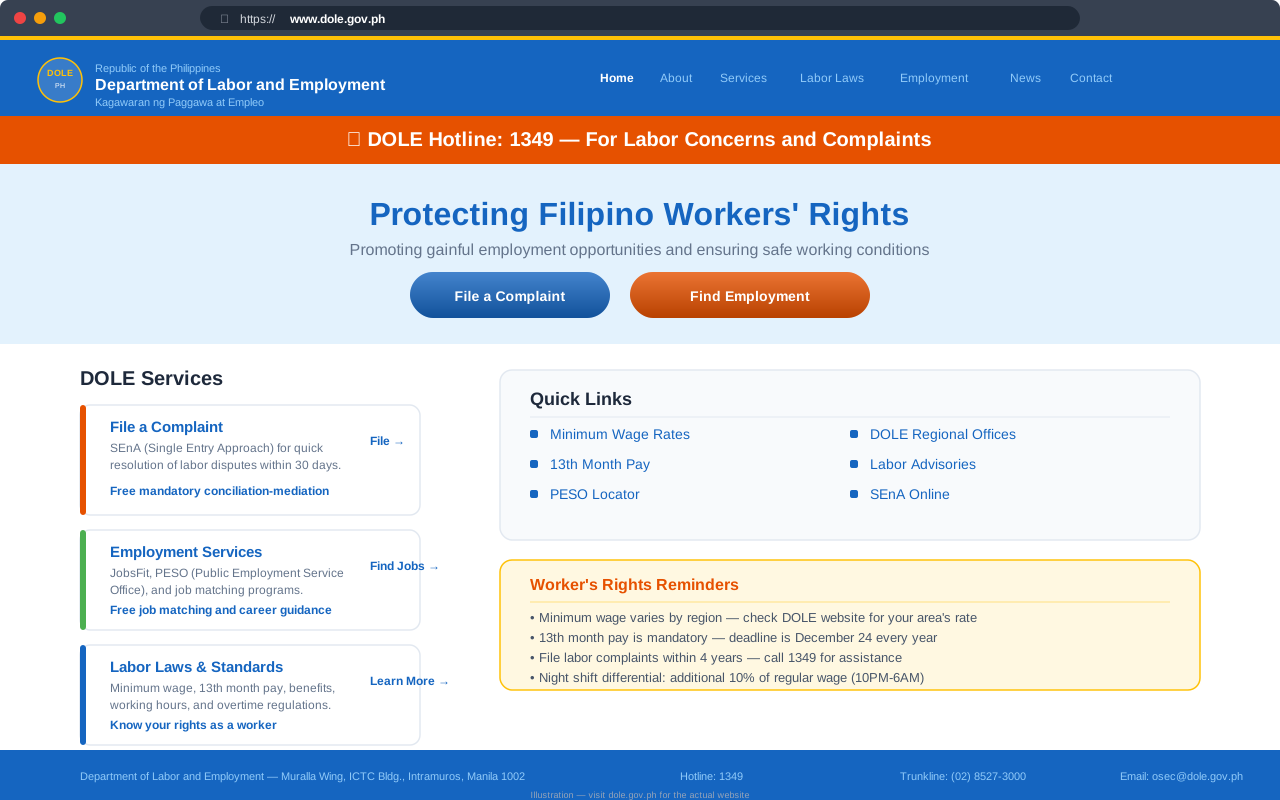
This guide covers the most important labor rights every Filipino worker should know — minimum wage, 13th month pay, overtime, leave benefits, illegal dismissal protection, and how to file a DOLE complaint.
Saklaw ng gabay na ito ang pinakamahalagang karapatan sa trabaho na dapat malaman ng bawat Pilipinong manggagawa — minimum wage, 13th month pay, overtime, leave benefits, proteksyon mula sa illegal dismissal, at kung paano mag-file ng reklamo sa DOLE.
Overview of Philippine Labor Law
Pangkalahatang Tingin sa Batas Paggawa ng Pilipinas
Workers' rights are governed by the Labor Code (PD 442). DOLE enforces labor standards and mediates disputes (SEnA); the NLRC handles formal cases like illegal dismissal. Call the DOLE hotline at 1349 for any labor concern.
Ang mga karapatan ng manggagawa ay nasa ilalim ng Labor Code (PD 442). Ang DOLE ang nagpapatupad ng labor standards at nagme-mediate ng disputes (SEnA); ang NLRC ang humahawak ng pormal na kaso tulad ng illegal dismissal. Tumawag sa DOLE hotline sa 1349 para sa kahit anong labor concern.
Minimum Wage by Region
Minimum na Sahod Ayon sa Rehiyon
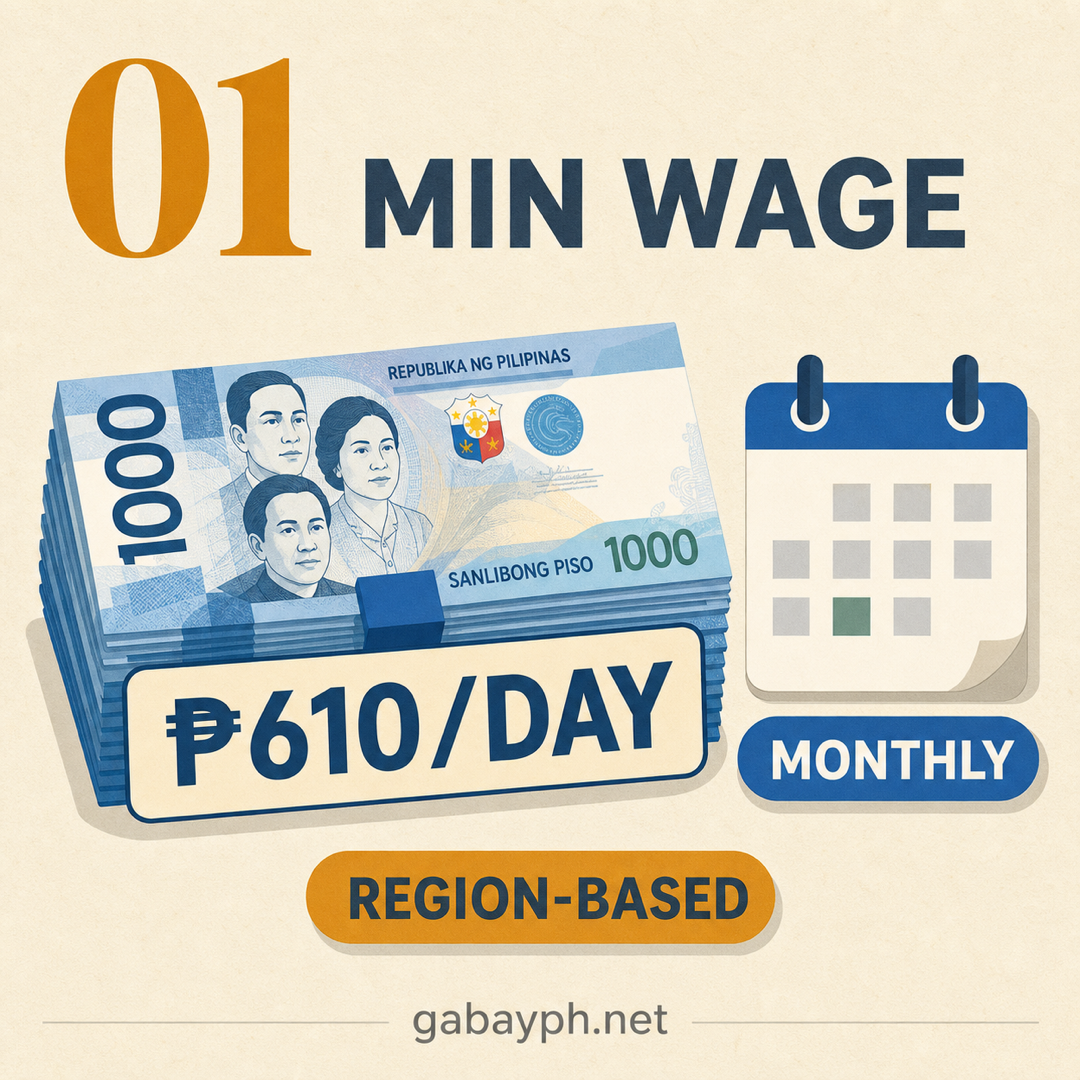
The Philippines does not have a single national minimum wage. Instead, each region sets its own minimum wage rate through the Regional Tripartite Wages and Productivity Boards (RTWPBs). Rates vary significantly depending on the cost of living in each area. Below are the daily minimum wage rates for non-agricultural workers as of 2026:
Ang Pilipinas ay walang iisang national minimum wage. Sa halip, bawat rehiyon ang nagtatalaga ng sariling minimum wage rate sa pamamagitan ng Regional Tripartite Wages and Productivity Boards (RTWPBs). Malaki ang pagkakaiba ng mga rate depende sa gastos ng pamumuhay sa bawat lugar. Nasa ibaba ang daily minimum wage rates para sa non-agricultural workers noong 2026:
| Region | Rehiyon | Daily Minimum Wage | Arawang Minimum na Sahod |
|---|---|---|---|
| NCR (Metro Manila) | NCR (Metro Manila) | ₱695 | ₱695 |
| Region IV-A (CALABARZON) | Region IV-A (CALABARZON) | ₱600 | ₱600 |
| Region III (Central Luzon) | Region III (Central Luzon) | ₱570 – ₱600 | ₱570 – ₱600 |
| Region VII (Central Visayas) | Region VII (Central Visayas) | ₱500 – ₱540 | ₱500 – ₱540 |
| Region XI (Davao Region) | Region XI (Davao Region) | ₱510 – ₱540 | ₱510 – ₱540 |
| Region VI (Western Visayas) | Region VI (Western Visayas) | ₱450 – ₱480 | ₱450 – ₱480 |
| CAR (Cordillera) | CAR (Cordillera) | ₱430 – ₱460 | ₱430 – ₱460 |
| BARMM | BARMM | ₱380 – ₱411 | ₱380 – ₱411 |
Important: These rates are for non-agricultural workers. Agricultural and retail/service establishments employing fewer than 10 workers may have different (lower) rates. Ranges indicate variations within the region based on city class or industry. Check the DOLE website (dole.gov.ph) or call 1349 for the exact rate in your area.
Mahalaga: Ang mga rate na ito ay para sa non-agricultural workers. Ang mga agricultural at retail/service establishments na may mas kaunti sa 10 na empleyado ay maaaring may ibang (mas mababang) rate. Ang mga range ay nagpapakita ng pagkakaiba sa loob ng rehiyon batay sa klase ng lungsod o industriya. I-check ang DOLE website (dole.gov.ph) o tumawag sa 1349 para sa eksaktong rate sa lugar mo.
13th Month Pay
13th Month Pay
The 13th month pay is mandatory under Presidential Decree No. 851. It is not a bonus — it is a legal right. Every rank-and-file employee who has worked for at least one month during the calendar year is entitled to receive it. Ito ang isa sa pinaka-common na nababalewala ng employers, kaya alamin mo ang rights mo.
Ang 13th month pay ay mandatory sa ilalim ng Presidential Decree No. 851. Hindi ito bonus — karapatan ito sa batas. Bawat rank-and-file na empleyado na nagtrabaho ng hindi bababa sa isang buwan sa loob ng calendar year ay may karapatang tumanggap nito. Ito ang isa sa pinaka-common na nababalewala ng employers, kaya alamin mo ang rights mo.
Who qualifies: All rank-and-file employees regardless of status (regular, probationary, contractual, project-based). Even if you resigned mid-year, you are entitled to a prorated amount.
Sino ang kwalipikado: Lahat ng rank-and-file na empleyado regardless ng status (regular, probationary, contractual, project-based). Kahit nag-resign ka mid-year, may karapatan ka sa prorated na halaga.
How to compute:
Paano i-compute:
Total basic salary earned during the year ÷ 12 = 13th month pay. For example, if your monthly salary is ₱20,000 and you worked the entire year, your 13th month pay is ₱20,000. If you only worked for 8 months, it is ₱20,000 × 8 ÷ 12 = ₱13,333.33.
Total na basic salary na kinita sa buong taon ÷ 12 = 13th month pay. Halimbawa, kung ang buwanang sahod mo ay ₱20,000 at nagtrabaho ka buong taon, ang 13th month pay mo ay ₱20,000. Kung 8 buwan ka lang nagtrabaho, ito ay ₱20,000 × 8 ÷ 12 = ₱13,333.33.
Deadline: Employers must pay the 13th month pay on or before December 24 of each year. DOLE strictly enforces this deadline. Kung hindi mo natanggap by December 24, may karapatan kang mag-file ng complaint.
Deadline: Dapat ibigay ng mga employer ang 13th month pay on or before December 24 ng bawat taon. Mahigpit na ipinapatupad ng DOLE ang deadline na ito. Kung hindi mo natanggap by December 24, may karapatan kang mag-file ng complaint.
Overtime & Holiday Pay
Overtime at Holiday Pay
Under the Labor Code, a normal work day is 8 hours. Any work performed beyond 8 hours in a day is considered overtime and must be compensated at a higher rate. Pero maraming employer ang hindi nagbabayad ng tama — kaya importante na alam mo ang computation.
Sa ilalim ng Labor Code, ang normal na araw ng trabaho ay 8 oras. Anumang trabahong ginawa nang lampas sa 8 oras sa isang araw ay overtime at kailangang bayaran sa mas mataas na rate. Pero maraming employer ang hindi nagbabayad ng tama — kaya importante na alam mo ang computation.
Overtime and premium pay rates:
Mga rate ng overtime at premium pay:
| Scenario | Sitwasyon | Rate | Rate |
|---|---|---|---|
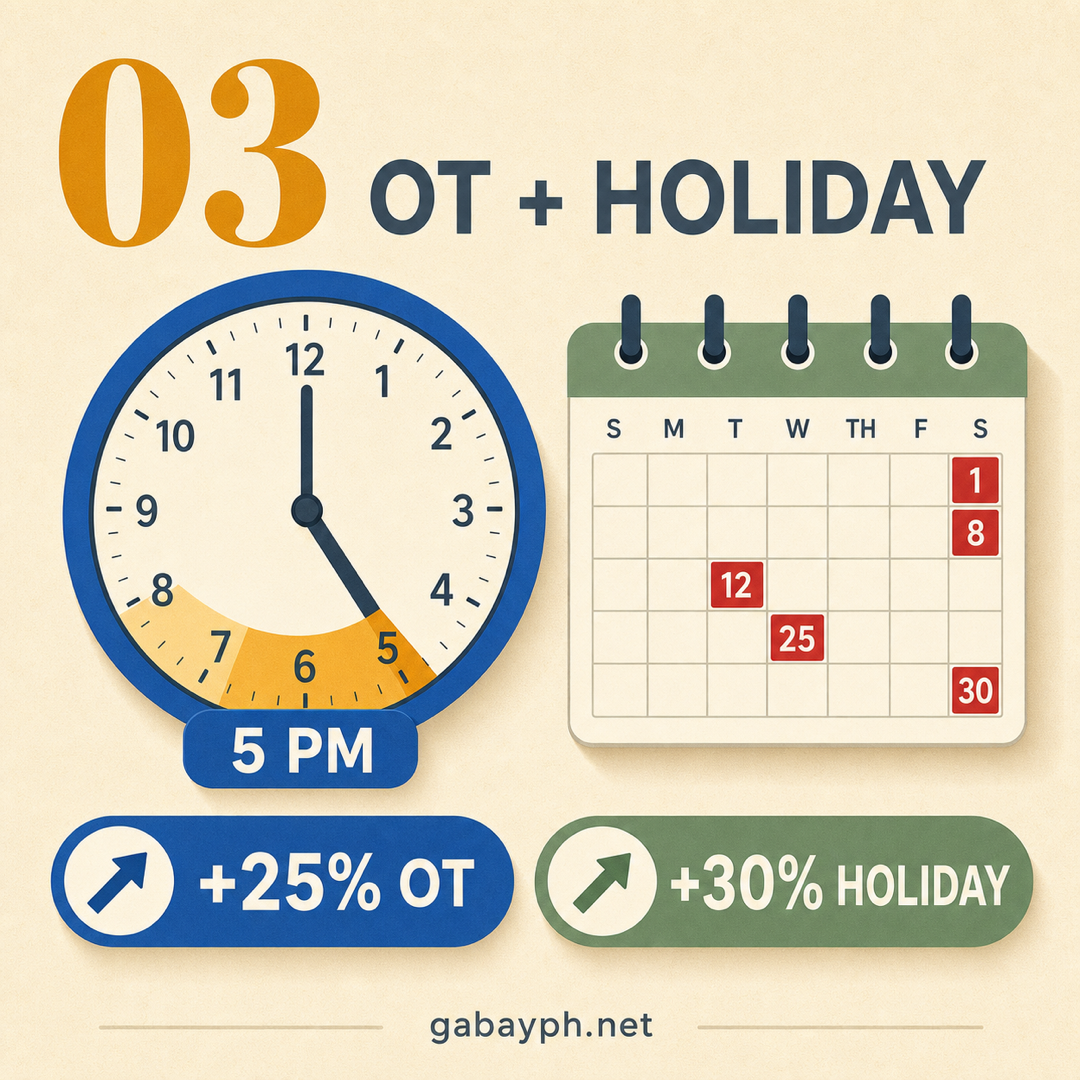
| Regular day overtime (beyond 8 hrs) | Regular day overtime (lampas sa 8 oras) | 125% of hourly rate | 125% ng hourly rate |
| Rest day / Special non-working holiday | Rest day / Special non-working holiday | 130% of daily rate | 130% ng daily rate |
| Rest day + special holiday overtime | Rest day + special holiday overtime | 150% + 30% per OT hr | 150% + 30% bawat OT hr |
| Regular holiday (worked) | Regular holiday (nagtrabaho) | 200% of daily rate | 200% ng daily rate |
| Regular holiday + overtime | Regular holiday + overtime | 200% + 30% per OT hr | 200% + 30% bawat OT hr |
| Night shift differential (10 PM – 6 AM) | Night shift differential (10 PM – 6 AM) | +10% of hourly rate | +10% ng hourly rate |
Regular holidays with pay even if not worked: If a regular holiday falls on your workday and you do not work, you are still entitled to 100% of your daily wage. This is different from special non-working holidays, where you only get paid if you actually work. Examples of regular holidays include New Year's Day, Araw ng Kagitingan, Labor Day, Independence Day, Bonifacio Day, Christmas Day, and Rizal Day.
Mga regular holiday na may bayad kahit hindi nagtrabaho: Kung ang regular holiday ay nahulog sa araw ng trabaho mo at hindi ka nagtrabaho, may karapatan ka pa rin sa 100% ng daily wage mo. Iba ito sa mga special non-working holidays, kung saan binabayaran ka lang kung talagang nagtrabaho ka. Mga halimbawa ng regular holidays: New Year's Day, Araw ng Kagitingan, Labor Day, Independence Day, Bonifacio Day, Christmas Day, at Rizal Day.
Leave Benefits
Mga Benepisyo sa Leave
Philippine law provides several types of mandatory leave benefits. Hindi lahat ng company ay generous sa leave — pero ito ang mga minimum na required by law:
Ang batas ng Pilipinas ay nagbibigay ng ilang uri ng mandatory leave benefits. Hindi lahat ng company ay generous sa leave — pero ito ang mga minimum na required by law:
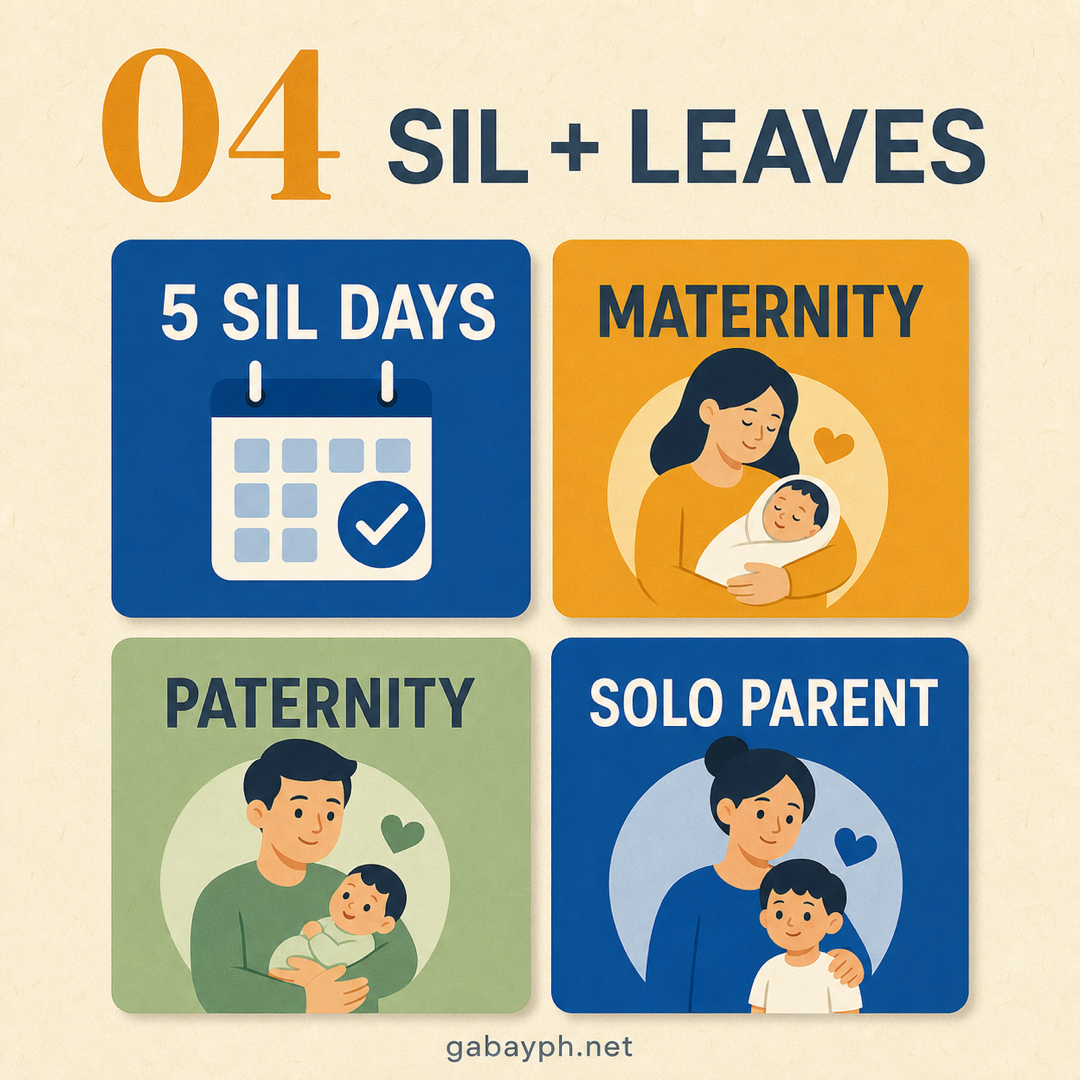
- Service Incentive Leave (SIL) — 5 days per year
All employees with at least 1 year of service get 5 days of paid leave (vacation or sick). Unused SIL is commutable to cash at year-end. - Maternity Leave — 105 days
Under the Expanded Maternity Leave Law (RA 11210), all female workers — whether in the public or private sector — are entitled to 105 days of paid maternity leave for live childbirth. Solo mothers get an additional 15 days (120 days total). For miscarriage or emergency termination of pregnancy, the leave is 60 days. The benefit is paid through SSS. - Paternity Leave — 7 days
Under the Paternity Leave Act (RA 8187), married male employees are entitled to 7 days of paid paternity leave for the first four deliveries of their legitimate spouse. Must be used within 60 days after delivery. - Solo Parent Leave — 7 days
Under the Solo Parents' Welfare Act (RA 8972), solo parents who have rendered at least 1 year of service are entitled to 7 working days of parental leave per year, in addition to other leave benefits. You need a Solo Parent ID from your DSWD office. - VAWC Leave — 10 days (RA 9262) — for women victims of violence; requires a protection order.
- Special Leave for Women — up to 2 months (RA 9710) — for surgery due to gynecological disorders, with full pay after 6 months of service.
- Service Incentive Leave (SIL) — 5 araw bawat taon
Lahat ng empleyado na nagtrabaho ng hindi bababa sa 1 taon ay may karapatan sa 5 araw ng paid leave bawat taon. Maaari itong gamitin para sa vacation o sick leave. Ang hindi nagamit na SIL ay maaaring i-convert sa cash sa katapusan ng taon. - Maternity Leave — 105 araw
Sa ilalim ng Expanded Maternity Leave Law (RA 11210), lahat ng babaeng manggagawa ay may karapatan sa 105 araw na paid maternity leave para sa live childbirth. Solo mothers: 120 araw. Miscarriage: 60 araw. Binabayaran sa pamamagitan ng SSS. - Paternity Leave — 7 araw
Sa ilalim ng Paternity Leave Act (RA 8187), ang mga kasal na lalaking empleyado ay may karapatan sa 7 araw na paid paternity leave para sa unang apat na delivery ng kanilang lehitimong asawa. - Solo Parent Leave — 7 araw
Sa ilalim ng Solo Parents' Welfare Act (RA 8972), ang mga solo parent na nagtrabaho ng hindi bababa sa 1 taon ay may karapatan sa 7 working days na parental leave bawat taon. Kailangan ng Solo Parent ID mula sa DSWD. - VAWC Leave — 10 araw (RA 9262) — para sa mga babaeng biktima ng karahasan; kailangan ng protection order.
- Special Leave for Women — hanggang 2 buwan (RA 9710) — para sa surgery dahil sa gynecological disorders, may buong sahod pagkatapos ng 6 na buwan ng serbisyo.
Illegal Dismissal & Due Process
Illegal Dismissal at Due Process
One of the most important protections for employees is the right to security of tenure. An employer cannot simply fire you for no reason. The Labor Code specifies two categories of valid grounds for termination, and requires due process in both cases.
Isa sa pinakamahalagang proteksyon para sa mga empleyado ang karapatan sa security of tenure. Hindi basta-basta maaring tanggalin ka ng employer nang walang dahilan. Tinutukoy ng Labor Code ang dalawang kategorya ng valid na dahilan para sa pagtanggal, at kinakailangan ang due process sa parehong kaso.
Just causes (fault of the employee):
Mga just causes (kasalanan ng empleyado):
- Serious misconduct — Grave misbehavior related to work duties
- Willful disobedience — Deliberately refusing lawful and reasonable orders
- Gross and habitual neglect of duties — Repeatedly failing to perform your job
- Fraud or breach of trust — Dishonesty, especially for those in positions of trust (cashiers, accountants, etc.)
- Commission of a crime — Against the employer, their family, or a representative
- Serious misconduct — Malalang misbehavior na may kinalaman sa tungkulin sa trabaho
- Willful disobedience — Sinasadyang pagtanggi sa mga legal at makatwirang utos
- Gross and habitual neglect of duties — Paulit-ulit na pagpapabaya sa trabaho
- Fraud o paglabag sa tiwala — Pagtataksil, lalo na para sa mga nasa posisyon ng tiwala (cashiers, accountants, atbp.)
- Paggawa ng krimen — Laban sa employer, pamilya nito, o kinatawan
Authorized causes (not the fault of the employee):
Mga authorized causes (hindi kasalanan ng empleyado):
- Redundancy — The position is no longer needed
- Retrenchment — The company needs to reduce workforce to prevent losses
- Closure of business — The company is shutting down
- Disease — The employee has a disease that makes continued employment harmful
- Installation of labor-saving devices — Technology replaces the position
- Redundancy — Hindi na kailangan ang posisyon
- Retrenchment — Kailangan bawasan ng kumpanya ang workforce para maiwasan ang mga pagkalugi
- Pagsasara ng negosyo — Nagsasara ang kumpanya
- Sakit — May sakit ang empleyado na mapanganib ang patuloy na pagtatrabaho
- Pag-install ng labor-saving devices — Pinapalitan ng teknolohiya ang posisyon
The Two-Notice Rule: For just causes, the employer must follow the two-notice rule. First notice: A written notice specifying the grounds for termination and giving you at least 5 days to explain your side (chance to be heard). Second notice: A written notice of the decision to terminate, after evaluating your explanation. Kung walang two notices, illegal ang dismissal kahit may valid reason pa. Para sa authorized causes, the employer must give you a 30-day written notice before the effectivity of termination, plus separation pay.
Ang Two-Notice Rule: Para sa mga just causes, kailangan sundin ng employer ang two-notice rule. Unang notice: Isang nakasulat na abiso na nagsasaad ng mga dahilan ng pagtanggal at binibigyan ka ng hindi bababa sa 5 araw para ipaliwanag ang panig mo (chance to be heard). Pangalawang notice: Isang nakasulat na abiso ng desisyon na tanggalin ka, pagkatapos suriin ang paliwanag mo. Kung walang two notices, illegal ang dismissal kahit may valid reason pa. Para sa mga authorized causes, kailangan bigyan ka ng employer ng 30-day written notice bago mag-effectivity ang pagtanggal, kasama ang separation pay.
Constructive dismissal: If your employer makes conditions so unbearable you are forced to resign (e.g., demotion without cause, drastic pay cuts), that is constructive dismissal and is also illegal.
Constructive dismissal: Kung ginawang sobrang hirap ng employer mo ang kondisyon na napilitan kang mag-resign (hal., demotion nang walang dahilan, matinding pagbawas ng sahod), iyon ay constructive dismissal at illegal din.
How to File a DOLE Complaint
Paano Mag-file ng Reklamo sa DOLE
If your employer is violating your labor rights — hindi nagbabayad ng minimum wage, walang 13th month, no overtime pay, or you were illegally dismissed — you have the right to file a complaint. Here is how:
Kung nilalabag ng employer mo ang mga karapatan mo sa trabaho — hindi nagbabayad ng minimum wage, walang 13th month, no overtime pay, o illegally dismissed ka — may karapatan kang mag-file ng reklamo. Narito kung paano:
-
Call the DOLE Hotline: 1349
Call the DOLE 24/7 hotline at 1349 to report violations and get advice. They can refer you to the correct regional office.
-
File a Request for Assistance (SEnA)
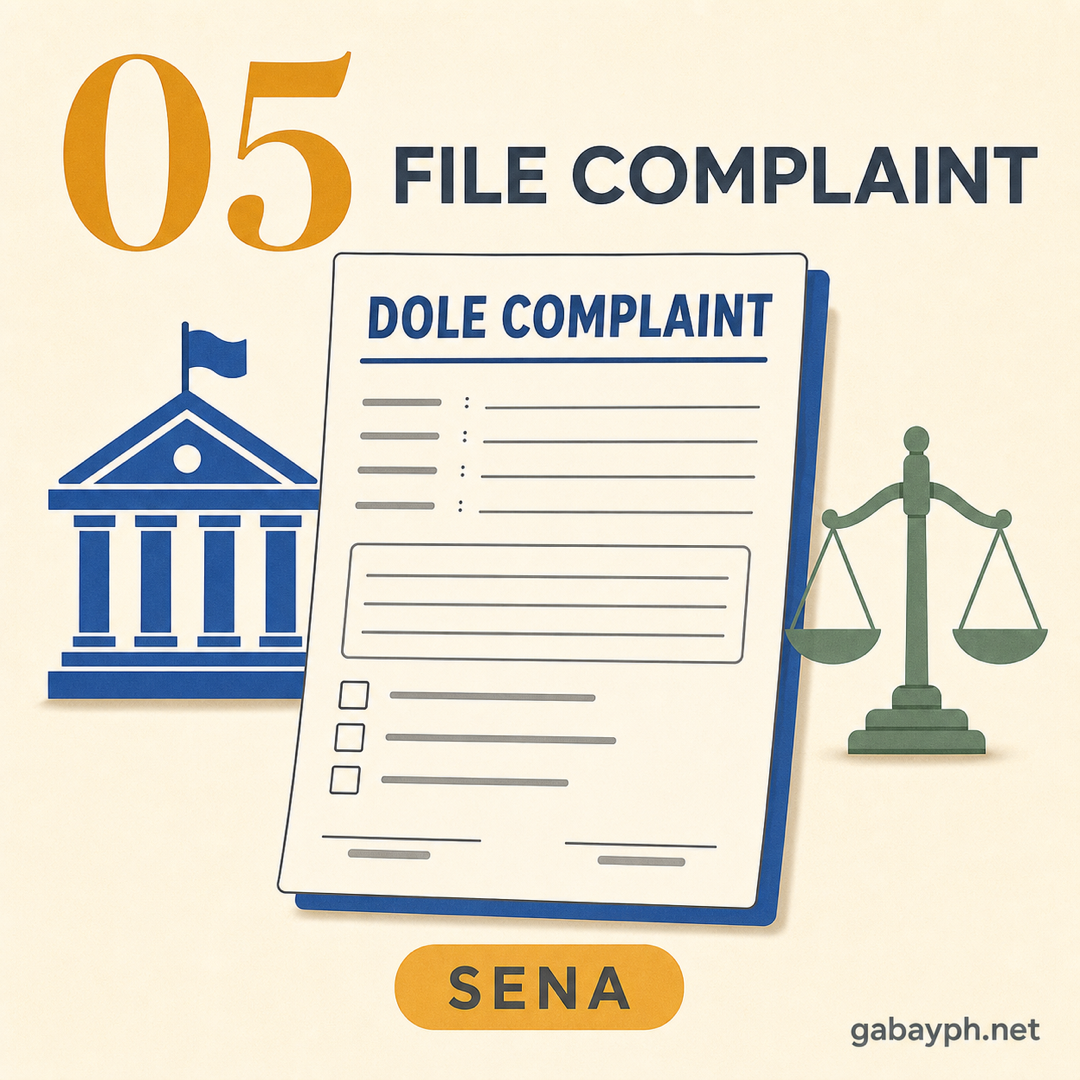
For disputes involving money claims (unpaid wages, 13th month, overtime, separation pay), the first formal step is the SEnA (Single Entry Approach). This is a mandatory 30-day conciliation-mediation process handled by a DOLE officer called a SEnA Desk Officer (SEADO).
- Visit your nearest DOLE regional or field office and file a Request for Assistance (RFA)
- You can also file online through the DOLE website (sena.dole.gov.ph)
- Bring your ID, employment records (payslips, contract, company ID), and a summary of your complaint
- The SEADO will schedule a conference between you and your employer to attempt a settlement
- If a settlement is reached, it is signed and binding. Kung hindi, you receive a referral to proceed to the next step
SEnA is free, and most labor disputes are actually resolved at this stage. Wag matakot mag-file — the process is designed to help workers like you.
-
Escalate to NLRC (for Formal Cases)
If SEnA mediation fails, you can file a formal complaint with the NLRC (National Labor Relations Commission). This is for cases like:
- Illegal dismissal
- Money claims exceeding ₱5,000
- Unfair labor practices
- Claims for damages arising from employer-employee relations
At the NLRC, your case will be heard by a Labor Arbiter. You can represent yourself or hire a lawyer — many labor cases are won by employees representing themselves. The process involves filing a complaint, mandatory conference, submission of position papers, and then a decision. Kung panalo ka, the employer may be ordered to reinstate you with full back wages, or pay you separation pay if reinstatement is not feasible.
-
Tumawag sa DOLE Hotline: 1349
Tumawag sa DOLE 24/7 hotline sa 1349 para mag-report ng mga paglabag at humingi ng payo. Maaari ka nilang i-refer sa tamang regional office.
-
Mag-file ng Request for Assistance (SEnA)
Para sa mga dispute na may kinalaman sa money claims (unpaid wages, 13th month, overtime, separation pay), ang unang pormal na hakbang ay ang SEnA (Single Entry Approach). Ito ay isang mandatory na 30-day na conciliation-mediation process na hinahawakan ng DOLE officer na tinatawag na SEnA Desk Officer (SEADO).
- Bumisita sa pinakamalapit mong DOLE regional o field office at mag-file ng Request for Assistance (RFA)
- Maaari ka ring mag-file online sa pamamagitan ng DOLE website (sena.dole.gov.ph)
- Dalhin ang ID mo, mga employment records (payslips, kontrata, company ID), at buod ng reklamo mo
- Magse-schedule ang SEADO ng conference sa pagitan mo at ng employer mo para subukang mag-settle
- Kung mayroon settlement, pipirmahan ito at binding. Kung hindi, makakatanggap ka ng referral para magpatuloy sa susunod na hakbang
Libre ang SEnA, at karamihan ng mga labor disputes ay nareresolba sa hakbang na ito. Wag matakot mag-file — dinisenyo ang prosesong ito para tulungan ang mga manggagawa tulad mo.
-
I-escalate sa NLRC (para sa Formal Cases)
Kung hindi nagtagumpay ang SEnA mediation, maaari kang mag-file ng pormal na reklamo sa NLRC (National Labor Relations Commission). Ito ay para sa mga kaso tulad ng:
- Illegal dismissal
- Money claims na higit sa ₱5,000
- Unfair labor practices
- Claims for damages na nagmumula sa employer-employee relations
Sa NLRC, ang kaso mo ay didinggin ng isang Labor Arbiter. Maaari mong representahan ang sarili mo o kumuha ng abogado — maraming labor cases ang nananalo ng mga empleyadong nagrerepresenta ng sarili nila. Kasama sa proseso ang pag-file ng reklamo, mandatory conference, submission ng position papers, at pagkatapos ay desisyon. Kung panalo ka, maaaring utusan ang employer na i-reinstate ka na may buong back wages, o bayaran ka ng separation pay kung hindi posible ang reinstatement.
Workers' Rights Checklist
Checklist ng mga Karapatan ng Manggagawa
- Regular employment status after 6 months of continuous service (no more "end of contract" — endo)
- Minimum wage as set by your region's RTWPB
- 13th month pay on or before December 24
- Overtime pay at 125% for work beyond 8 hours on regular days
- Holiday pay at 200% for work on regular holidays
- Night shift differential of +10% for work between 10 PM and 6 AM
- Service Incentive Leave of at least 5 paid days per year after 1 year of service
- SSS, PhilHealth, and Pag-IBIG contributions paid by employer
- Safe and healthy workplace (Occupational Safety and Health Standards Act, RA 11058)
- No excessive or unauthorized salary deductions
- Protection from sexual harassment (RA 7877 and the Safe Spaces Act RA 11313)
- Right to self-organization and collective bargaining
- Due process before termination (two-notice rule)
- Separation pay for authorized-cause terminations
- Regular employment status pagkatapos ng 6 na buwan ng tuloy-tuloy na serbisyo (wala nang "end of contract" — endo)
- Minimum wage na itinakda ng RTWPB ng iyong rehiyon
- 13th month pay on or before December 24
- Overtime pay sa 125% para sa trabahong lampas sa 8 oras sa regular days
- Holiday pay sa 200% para sa trabaho sa mga regular holidays
- Night shift differential na +10% para sa trabaho mula 10 PM hanggang 6 AM
- Service Incentive Leave na hindi bababa sa 5 paid days bawat taon pagkatapos ng 1 taon ng serbisyo
- SSS, PhilHealth, at Pag-IBIG contributions na binabayaran ng employer
- Ligtas at malusog na lugar ng trabaho (Occupational Safety and Health Standards Act, RA 11058)
- Walang labis o hindi awtorisadong mga kaltas sa sahod
- Proteksyon mula sa sexual harassment (RA 7877 at ang Safe Spaces Act RA 11313)
- Karapatan sa self-organization at collective bargaining
- Due process bago tanggalin (two-notice rule)
- Separation pay para sa authorized-cause terminations
Pro Tips
Mga Payo
- Save the DOLE Hotline — 1349 — This is your most powerful tool. Available 24/7, it can answer questions, verify employer compliance, and guide you through filing a complaint. I-save mo ito agad sa phone mo.
- Keep your payslips and employment records — Save every payslip, contract, memo, and company communication. In a labor dispute, documentation is everything. Kung walang payslip ang company mo, that itself is already a violation you can report.
- Do not sign a resignation letter under pressure — If you are being pressured to resign, do not sign. Consult DOLE first. Kahit pumirma ka na under duress, may remedyo pa rin.
- I-save ang DOLE Hotline — 1349 — Ito ang pinaka-powerful mong tool. Available 24/7, masasagot nito ang mga tanong mo, mare-verify kung sumusunod ang employer mo, at gagabayan ka sa pag-file ng reklamo. I-save mo ito agad sa phone mo.
- I-keep ang mga payslip at employment records mo — I-save ang bawat payslip, kontrata, memo, at company communication. Sa labor dispute, documentation is everything. Kung walang payslip ang company mo, iyon mismo ay violation na na maaari mong i-report.
- Huwag pumirma ng resignation letter under pressure — Kung pine-pressure kang mag-resign, huwag pumirma. Kumonsulta muna sa DOLE. Kahit pumirma ka na under duress, may remedyo pa rin.
Frequently Asked Questions
Mga Madalas Itanong
Am I entitled to 13th month pay if I resigned before December?
Yes. You are entitled to a prorated 13th month pay based on the number of months you actually worked during the calendar year. For example, if you resigned in August and your monthly salary was ₱18,000, your prorated 13th month pay would be ₱18,000 × 8 ÷ 12 = ₱12,000. Your employer should include this in your final pay. Kung hindi binigay, file a complaint with DOLE.
May karapatan ba ako sa 13th month pay kung nag-resign ako bago mag-Disyembre?
Oo. May karapatan ka sa prorated na 13th month pay batay sa bilang ng buwan na talagang nagtrabaho ka sa loob ng calendar year. Halimbawa, kung nag-resign ka noong Agosto at ang buwanang sahod mo ay ₱18,000, ang prorated 13th month pay mo ay ₱18,000 × 8 ÷ 12 = ₱12,000. Dapat isama ito ng employer mo sa iyong final pay. Kung hindi binigay, mag-file ng reklamo sa DOLE.
What should I do if my employer is not paying minimum wage?
Paying below the minimum wage is a criminal offense. You can report it by calling the DOLE Hotline at 1349 or visiting your nearest DOLE field office. Bring your payslips or any proof of what you are being paid. DOLE can conduct a labor inspection on the establishment. You can also file a Request for Assistance (RFA) through SEnA to recover the wage differential — the difference between what you were paid and what you should have been paid.
Ano ang dapat kong gawin kung hindi nagbabayad ng minimum wage ang employer ko?
Ang pagbabayad ng mas mababa sa minimum wage ay isang criminal offense. Maaari mo itong i-report sa pamamagitan ng pagtawag sa DOLE Hotline sa 1349 o pagbisita sa pinakamalapit mong DOLE field office. Dalhin ang mga payslip mo o kahit anong proof ng binabayaran sa iyo. Maaaring magsagawa ang DOLE ng labor inspection sa establishment. Maaari ka ring mag-file ng Request for Assistance (RFA) sa pamamagitan ng SEnA para mabawi ang wage differential — ang pagkakaiba sa pagitan ng binayaran sa iyo at ng dapat sana ay binayad sa iyo.
Is endo (end of contract after 5 months) legal?
No, endo is illegal. The practice of hiring workers on short-term contracts (usually 5 months) and then terminating them before they reach 6 months to avoid regularization is a violation of the Labor Code. Under DOLE Department Order No. 174, Series of 2017, employers who engage in this practice can be sanctioned. If you have been subjected to endo, you can file a complaint with DOLE. You may be entitled to regularization and back benefits.
Legal ba ang endo (end of contract pagkatapos ng 5 buwan)?
Hindi, illegal ang endo. Ang kasanayan ng pagkuha ng mga manggagawa sa short-term contracts (karaniwang 5 buwan) at pagkatapos ay tinatanggal sila bago maabot ang 6 na buwan para maiwasan ang regularization ay paglabag sa Labor Code. Sa ilalim ng DOLE Department Order No. 174, Series of 2017, ang mga employer na gumagawa nito ay maaaring ma-sanction. Kung na-subject ka sa endo, maaari kang mag-file ng reklamo sa DOLE. Maaaring may karapatan ka sa regularization at back benefits.
Can my employer deduct from my salary without my consent?
Generally, no. The Labor Code prohibits employers from making unauthorized deductions from employees' wages. The only deductions allowed without written consent are those required by law — SSS, PhilHealth, Pag-IBIG contributions, and withholding tax. For other deductions (loans, damages, uniforms, etc.), the employer must have your written authorization. Even with consent, deductions should not reduce your take-home pay below the minimum wage. If your employer is making unauthorized deductions, file a complaint with DOLE.
Maaari bang magkaltas ang employer ko sa sahod ko nang walang pahintulot ko?
Sa pangkalahatan, hindi. Ipinagbabawal ng Labor Code ang mga employer na gumawa ng mga hindi awtorisadong kaltas sa sahod ng mga empleyado. Ang mga kaltas lang na pinapayagan nang walang nakasulat na pahintulot ay ang mga kinakailangan ng batas — SSS, PhilHealth, Pag-IBIG contributions, at withholding tax. Para sa ibang kaltas (loans, damages, uniforms, atbp.), kailangan ng employer ang iyong nakasulat na pahintulot. Kahit may consent, ang mga kaltas ay hindi dapat magpababa ng take-home pay mo sa ibaba ng minimum wage. Kung gumagawa ng hindi awtorisadong kaltas ang employer mo, mag-file ng reklamo sa DOLE.
How long does a DOLE complaint take to resolve?
It depends on the process. SEnA mediation has a mandatory 30-day period, and most disputes are resolved within this timeframe — sometimes in just one or two conferences. If your case goes to the NLRC, it can take several months to over a year, depending on the complexity and the caseload of the Labor Arbiter. However, the mandatory conference stage at the NLRC often leads to settlements even before a full hearing. The key is to file early and bring complete documentation.
Gaano katagal bago maresolba ang reklamo sa DOLE?
Depende ito sa proseso. Ang SEnA mediation ay may mandatory na 30-day period, at karamihan ng mga dispute ay nareresolba sa loob ng panahong ito — minsan sa isa o dalawang conference lang. Kung mapunta ang kaso mo sa NLRC, maaari itong tumagal ng ilang buwan hanggang higit sa isang taon, depende sa complexity at caseload ng Labor Arbiter. Gayunpaman, ang mandatory conference stage sa NLRC ay madalas na humahantong sa mga settlement kahit bago pa ang buong hearing. Ang susi ay mag-file nang maaga at magdala ng kumpletong dokumentasyon.
Do contractual or probationary employees have labor rights?
Yes, absolutely. All employees — whether regular, probationary, contractual, casual, or project-based — are entitled to basic labor rights including minimum wage, 13th month pay, overtime pay, holiday pay, SSS/PhilHealth/Pag-IBIG coverage, and safe working conditions. The main difference is that probationary employees may be terminated for failing to meet reasonable standards made known to them at the start, but they still cannot be dismissed without due process. Contractual employees are also entitled to all statutory benefits for the duration of their contract.
May karapatan ba sa trabaho ang mga contractual o probationary na empleyado?
Oo, sigurado. Lahat ng empleyado — regular man, probationary, contractual, casual, o project-based — ay may karapatan sa mga basic labor rights kabilang ang minimum wage, 13th month pay, overtime pay, holiday pay, SSS/PhilHealth/Pag-IBIG coverage, at ligtas na kondisyon sa trabaho. Ang pangunahing pagkakaiba ay ang mga probationary employees ay maaaring tanggalin kung hindi natugunan ang mga makatwirang pamantayan na ipinaalam sa kanila sa simula, pero hindi pa rin sila maaaring tanggalin nang walang due process. Ang mga contractual employees ay may karapatan din sa lahat ng statutory benefits sa tagal ng kontrata nila.
 Quick Check: Take the Job Loss Readiness Quiz to see how prepared you are.
Quick Check: I-take ang Job Loss Readiness Quiz para malaman kung gaano ka ka-preparado.
Quick Check: Take the Job Loss Readiness Quiz to see how prepared you are.
Quick Check: I-take ang Job Loss Readiness Quiz para malaman kung gaano ka ka-preparado.