

What to Do When You're Pregnant in the Philippines — Prenatal to Birth (2026 Guide)
Ano ang Gagawin Kapag Buntis Ka sa Pilipinas — Prenatal Hanggang Panganganak (2026 Gabay)
5 Things to Know
Pregnancy in five facts.
Quick Summary
Mabilis na Buod
Important Medical Disclaimer: This guide is for general information only and is NOT a substitute for professional medical advice. GabayPH is not a medical provider. Always consult a licensed OB-GYN or healthcare professional for prenatal care, delivery decisions, and postnatal care. If you experience any emergency symptoms, go to the nearest hospital immediately.
Mahalagang Medical Disclaimer: Ang gabay na ito ay para sa pangkalahatang impormasyon lamang at HINDI kapalit ng propesyonal na medical advice. Ang GabayPH ay hindi isang medical provider. Laging kumonsulta sa isang lisensyadong OB-GYN o healthcare professional para sa prenatal care, desisyon sa panganganak, at postnatal care. Kung makaranas ka ng anumang emergency symptoms, pumunta kaagad sa pinakamalapit na ospital.
Table of Contents
- Confirming Your Pregnancy & First Checkup
- Choosing Your Healthcare Provider
- What You Need to Prepare
- Step-by-Step: Your Pregnancy Journey
- Hospital Costs: Public vs Private
- PhilHealth Maternity Coverage
- SSS Maternity Benefit
- Hospital Bag Checklist
- After Birth: Registration & Newborn Care
- Maternity Leave Rights (RA 11210)
- Pro Tips
- Frequently Asked Questions
Talaan ng Nilalaman
- Pagkukumpirma ng Pagbubuntis at Unang Checkup
- Pagpili ng Iyong Healthcare Provider
- Mga Kakailanganin Mong Ihanda
- Hakbang-Hakbang: Ang Iyong Pregnancy Journey
- Mga Gastos sa Ospital: Public vs Private
- PhilHealth Maternity Coverage
- SSS Maternity Benefit
- Hospital Bag Checklist
- Pagkatapos Manganak: Registration at Newborn Care
- Mga Karapatan sa Maternity Leave (RA 11210)
- Mga Payo
- Mga Madalas Itanong
Confirming Your Pregnancy & First Checkup
Pagkukumpirma ng Pagbubuntis at Unang Checkup
If you suspect you're pregnant (missed period, nausea, breast tenderness), here's what to do:
Step 1: Take a Home Pregnancy Test
Buy a home pregnancy test kit from any pharmacy (P50-P200). Test using your first morning urine for the most accurate result. Two lines = positive. If positive, schedule a doctor's visit as soon as possible.
Step 2: Visit a Doctor for Confirmation
Go to an OB-GYN (Obstetrician-Gynecologist) or a health center for confirmation. The doctor will typically:
- Perform a urine pregnancy test (more sensitive than home tests)
- Order a transvaginal or abdominal ultrasound to confirm pregnancy and estimate gestational age
- Calculate your estimated due date (EDD)
- Start your prenatal record/maternal card
- Prescribe prenatal vitamins (folic acid, iron, calcium)
Your first prenatal checkup should ideally happen within the first 8-12 weeks of pregnancy.
Kung pinaghihinalaan mong buntis ka (delayed period, pagduduwal, pananakit ng dibdib), ito ang gagawin:
Hakbang 1: Gumamit ng Home Pregnancy Test
Bumili ng home pregnancy test kit sa kahit anong parmasya (P50-P200). Mag-test gamit ang unang ihi mo sa umaga para sa pinakatumpak na resulta. Dalawang linya = positibo. Kung positibo, mag-schedule agad ng pagbisita sa doktor.
Hakbang 2: Bumisita sa Doktor para sa Kumpirmasyon
Pumunta sa OB-GYN (Obstetrician-Gynecologist) o health center para sa kumpirmasyon. Karaniwang gagawin ng doktor ang mga sumusunod:
- Magsasagawa ng urine pregnancy test (mas sensitive kaysa home tests)
- Mag-oorder ng transvaginal o abdominal ultrasound para kumpirmahin ang pagbubuntis at tantiyahin ang gestational age
- Kalkulahin ang iyong estimated due date (EDD)
- Simulan ang iyong prenatal record/maternal card
- Magreseta ng prenatal vitamins (folic acid, iron, calcium)
Ang iyong unang prenatal checkup ay dapat mangyari sa loob ng unang 8-12 linggo ng pagbubuntis.
Choosing Your Healthcare Provider
Pagpili ng Iyong Healthcare Provider
You have several options for prenatal care and delivery in the Philippines:
OB-GYN (Obstetrician-Gynecologist)
- Specialist doctor for pregnancy and delivery
- Consultation fee: P500-P1,500 per visit (private clinic) or free at public hospitals
- Can handle both normal and high-risk pregnancies
- Required for cesarean section (CS) deliveries
Midwife (Hilot/Licensed Midwife)
- Can handle normal, low-risk pregnancies only
- More affordable — consultation is usually free or minimal cost at birthing clinics
- Available at barangay health centers and lying-in clinics
- Must refer high-risk pregnancies to an OB-GYN
Where to Deliver
- Public hospital (government) — Free or very low cost for charity patients. PhilHealth members get full coverage for normal delivery. Long wait times but affordable
- Private hospital — Higher quality rooms, shorter wait times, choice of OB-GYN. Costs P30,000-P200,000+ depending on delivery type and room
- Lying-in clinic / Birthing center — For normal deliveries only. Costs P8,000-P25,000. A good middle-ground option
May ilang opsyon ka para sa prenatal care at panganganak sa Pilipinas:
OB-GYN (Obstetrician-Gynecologist)
- Espesyalistang doktor para sa pagbubuntis at panganganak
- Consultation fee: P500-P1,500 bawat bisita (private clinic) o libre sa mga public hospital
- Kayang hawakan ang parehong normal at high-risk na pagbubuntis
- Kinakailangan para sa cesarean section (CS) deliveries
Midwife (Hilot/Licensed Midwife)
- Kayang hawakan ang normal at low-risk na pagbubuntis lamang
- Mas abot-kaya — ang konsultasyon ay karaniwang libre o minimal ang gastos sa mga birthing clinic
- Available sa barangay health centers at lying-in clinics
- Dapat i-refer ang mga high-risk pregnancy sa OB-GYN
Saan Manganganak
- Public hospital (gobyerno) — Libre o napakababa ng gastos para sa charity patients. Ang mga PhilHealth members ay nakakakuha ng buong coverage para sa normal delivery. Mahabang pila pero abot-kaya
- Private hospital — Mas magandang kalidad ng kwarto, mas maikling pila, pagpili ng OB-GYN. Gastos na P30,000-P200,000+ depende sa uri ng panganganak at kwarto
- Lying-in clinic / Birthing center — Para sa normal deliveries lamang. Gastos na P8,000-P25,000. Magandang middle-ground na opsyon
What You Need to Prepare
- PhilHealth membership (active) — Ensure you have at least 3 monthly contributions within the 12 months before delivery. See our PhilHealth guide
- SSS membership (if employed/voluntary) — Need at least 3 monthly contributions within the 12-month period before your semester of delivery. See our SSS guide
- Valid government ID — For hospital admission and benefits processing
- PhilHealth MDR (Member Data Record) — Download from the PhilHealth portal or request from your employer
- Prenatal vitamins — Folic acid (start immediately), iron, calcium as prescribed by your doctor
- Maternal/Prenatal record book — Given by your OB-GYN or health center at your first checkup. Bring to every prenatal visit
- Budget plan — Estimate your delivery costs and plan for prenatal expenses (checkups, labs, vitamins). See our Budget guide
- Hospital bag — Pack by week 36 (see checklist below)
Mga Kakailanganin Mong Ihanda
- PhilHealth membership (active) — Siguraduhing mayroon kang hindi bababa sa 3 buwanang kontribusyon sa loob ng 12 buwan bago manganak. Tingnan ang aming gabay sa PhilHealth
- SSS membership (kung empleyado/voluntary) — Kailangan ng hindi bababa sa 3 buwanang kontribusyon sa loob ng 12-buwang panahon bago ang semester ng iyong panganganak. Tingnan ang aming gabay sa SSS
- Valid government ID — Para sa hospital admission at pagpoproseso ng benepisyo
- PhilHealth MDR (Member Data Record) — I-download sa PhilHealth portal o hingin sa employer mo
- Prenatal vitamins — Folic acid (simulan kaagad), iron, calcium ayon sa reseta ng doktor mo
- Maternal/Prenatal record book — Ibibigay ng OB-GYN o health center mo sa unang checkup. Dalhin sa bawat prenatal visit
- Budget plan — Tantiyahin ang mga gastos sa panganganak at planuhin para sa mga prenatal expenses (checkups, labs, vitamins). Tingnan ang aming gabay sa Budget
- Hospital bag — I-pack bago mag-week 36 (tingnan ang checklist sa ibaba)
Step-by-Step: Your Pregnancy Journey
Hakbang-Hakbang: Ang Iyong Pregnancy Journey
-
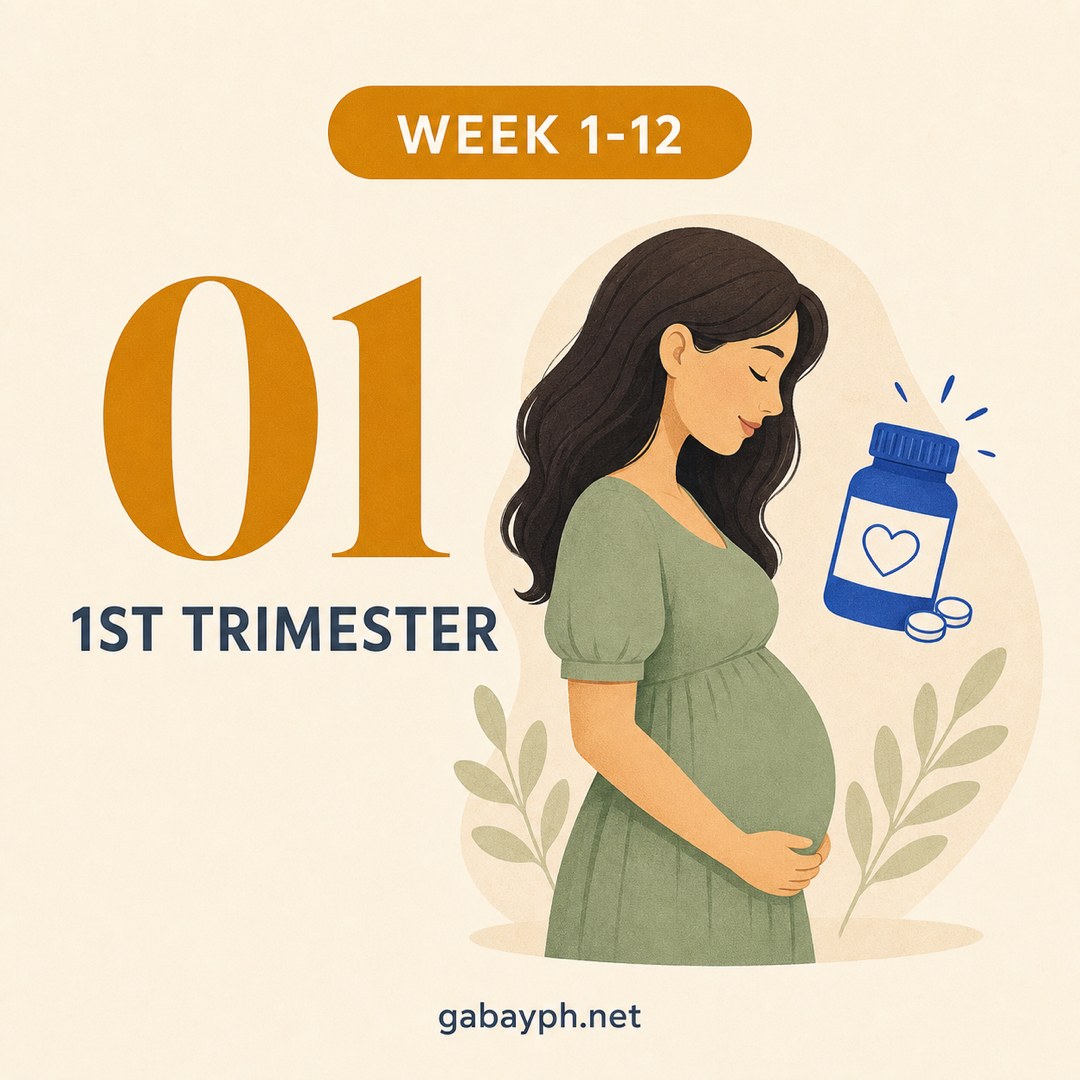
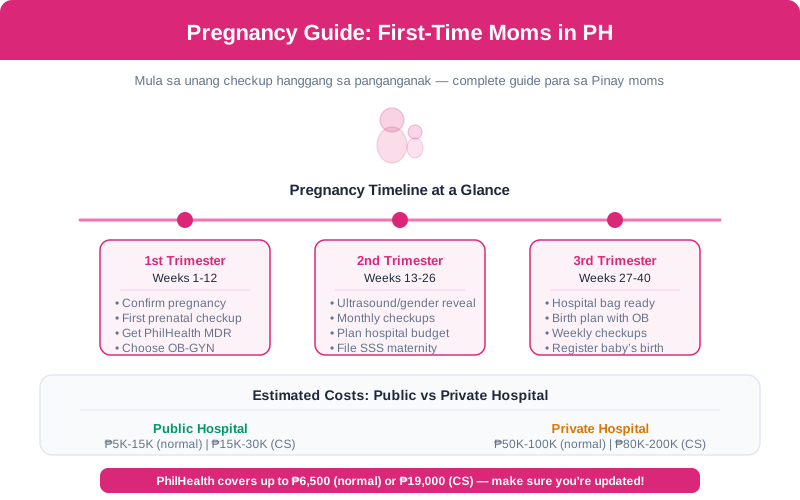
First Trimester (Weeks 1-12): Confirm and Start Prenatal Care
After confirming your pregnancy, your OB-GYN will order baseline laboratory tests:
- Complete Blood Count (CBC)
- Urinalysis
- Blood typing and Rh factor
- Hepatitis B screening
- HIV screening (with consent)
- Blood sugar (fasting or random)
Start taking prenatal vitamins daily — especially folic acid (400-800 mcg) which is critical in the first trimester to prevent neural tube defects. Your first ultrasound is usually done at weeks 8-12 to confirm viability and due date.
Prenatal visit schedule: Once a month during the first trimester.
-
Second Trimester (Weeks 13-27): Regular Monitoring
This is often called the "golden trimester" as morning sickness usually subsides. During this period:
- Congenital anomaly scan (anatomy scan) at weeks 18-22 — A detailed ultrasound to check baby's organs and development
- Glucose Challenge Test (GCT) at weeks 24-28 — Screens for gestational diabetes
- Continue monthly prenatal visits
- Your doctor will monitor your weight gain, blood pressure, and baby's heartbeat at each visit
This is a good time to register with PhilHealth if you haven't yet, and start processing your SSS maternity notification. Also begin researching hospitals and their delivery packages.
Prenatal visit schedule: Once a month (or every 2-4 weeks as advised).
-
Third Trimester (Weeks 28-40): Prepare for Delivery
As you enter the final stretch, your prenatal visits become more frequent:
- Weeks 28-36: Every 2 weeks
- Weeks 36-40: Weekly visits
Your doctor will monitor for signs of pre-eclampsia (high blood pressure, protein in urine), gestational diabetes, and preterm labor. You'll also have:
- Third trimester ultrasound — Check baby's position, size, amniotic fluid levels, and placenta location
- Non-Stress Test (NST) — May be ordered in the final weeks to monitor baby's heart rate
- Internal exam — Checks cervical dilation as you approach your due date
Important tasks in the third trimester:
- Pack your hospital bag by week 36
- Finalize your birth plan (delivery preference, pain management, who will be in the room)
- Pre-register at your chosen hospital
- Submit your PhilHealth documents to the hospital
- Know the signs of labor: regular contractions, water breaking, bloody show
-
Unang Trimester (Linggo 1-12): Kumpirmahin at Simulan ang Prenatal Care
Pagkatapos kumpirmahin ang pagbubuntis mo, mag-oorder ang OB-GYN mo ng baseline laboratory tests:
- Complete Blood Count (CBC)
- Urinalysis
- Blood typing at Rh factor
- Hepatitis B screening
- HIV screening (may pahintulot)
- Blood sugar (fasting o random)
Simulan ang pag-inom ng prenatal vitamins araw-araw — lalo na ang folic acid (400-800 mcg) na kritikal sa unang trimester para maiwasan ang neural tube defects. Ang unang ultrasound mo ay karaniwang ginagawa sa linggo 8-12 para kumpirmahin ang viability at due date.
Schedule ng prenatal visit: Isang beses sa isang buwan sa unang trimester.
-
Pangalawang Trimester (Linggo 13-27): Regular na Monitoring
Ito ay madalas tawaging "golden trimester" dahil ang morning sickness ay karaniwang humuhupa. Sa panahong ito:
- Congenital anomaly scan (anatomy scan) sa linggo 18-22 — Isang detalyadong ultrasound para suriin ang mga organ at pag-unlad ng sanggol
- Glucose Challenge Test (GCT) sa linggo 24-28 — Sinusuri para sa gestational diabetes
- Ipagpatuloy ang buwanang prenatal visits
- Imo-monitor ng doktor mo ang iyong pagtaas ng timbang, blood pressure, at tibok ng puso ng sanggol sa bawat bisita
Ito ay magandang pagkakataon para magparehistro sa PhilHealth kung hindi mo pa nagawa, at simulan ang pagpoproseso ng iyong SSS maternity notification. Simulan din ang pag-research ng mga ospital at mga delivery package nila.
Schedule ng prenatal visit: Isang beses sa isang buwan (o tuwing 2-4 na linggo ayon sa payo).
-
Pangatlong Trimester (Linggo 28-40): Paghahanda para sa Panganganak
Habang papasok ka sa huling bahagi, nagiging mas madalas ang iyong mga prenatal visit:
- Linggo 28-36: Tuwing 2 linggo
- Linggo 36-40: Lingguhang bisita
Imo-monitor ng doktor mo ang mga senyales ng pre-eclampsia (mataas na blood pressure, protein sa ihi), gestational diabetes, at preterm labor. Magkakaroon ka rin ng:
- Third trimester ultrasound — I-check ang posisyon ng sanggol, laki, amniotic fluid levels, at lokasyon ng placenta
- Non-Stress Test (NST) — Maaaring i-order sa mga huling linggo para i-monitor ang heart rate ng sanggol
- Internal exam — Sinusuri ang cervical dilation habang papalapit ang due date mo
Mga mahalagang gawain sa pangatlong trimester:
- I-pack ang iyong hospital bag bago mag-week 36
- I-finalize ang iyong birth plan (preference sa delivery, pain management, sino ang nasa kwarto)
- Mag-pre-register sa napiling ospital
- Isumite ang iyong mga dokumento sa PhilHealth sa ospital
- Alamin ang mga senyales ng labor: regular na contraction, pagtulo ng tubig, bloody show
-
Labor and Delivery
When you experience regular contractions (every 5 minutes, lasting 1 minute each, for at least 1 hour), water breaking, or heavy bleeding, go to the hospital immediately. Bring your hospital bag, prenatal record, PhilHealth documents, and valid ID.
At the hospital, you'll be assessed by the OB-GYN or attending physician. For normal delivery (NSD), you'll be monitored until full dilation (10 cm) and then proceed to the delivery room. For cesarean section (CS), the surgical team will prepare the operating room.
Pain management options:
- Epidural anesthesia — Available in most private hospitals (P15,000-P25,000 additional)
- Breathing techniques — Taught during prenatal classes
- Water birth — Available in select birthing centers and private hospitals
-
Postnatal Recovery and Checkup
After delivery, you and your baby will be monitored:
- Normal delivery: Hospital stay of 24-48 hours
- Cesarean section: Hospital stay of 3-5 days
Before discharge, the hospital will conduct newborn screening (heel prick test) on your baby — this is mandated by law (RA 9288). You'll also receive instructions for postnatal care (wound care for CS, breastfeeding support, etc.).
Schedule a postnatal checkup with your OB-GYN 2-6 weeks after delivery to check your recovery, discuss family planning, and address any concerns.
-
Labor at Panganganak
Kapag nakaranasan mo ang regular na contractions (tuwing 5 minuto, tumatagal ng 1 minuto bawat isa, sa loob ng hindi bababa sa 1 oras), pagtulo ng tubig, o mabigat na pagdurugo, pumunta sa ospital kaagad. Dalhin ang hospital bag mo, prenatal record, mga dokumento sa PhilHealth, at valid ID.
Sa ospital, ia-assess ka ng OB-GYN o attending physician. Para sa normal delivery (NSD), imo-monitor ka hanggang sa buong dilation (10 cm) at saka magpapatuloy sa delivery room. Para sa cesarean section (CS), ihahanda ng surgical team ang operating room.
Mga opsyon sa pain management:
- Epidural anesthesia — Available sa karamihan ng private hospitals (P15,000-P25,000 karagdagan)
- Breathing techniques — Itinuturo sa mga prenatal classes
- Water birth — Available sa ilang piling birthing centers at private hospitals
-
Postnatal Recovery at Checkup
Pagkatapos manganak, pareho kayo ng sanggol mo na imo-monitor:
- Normal delivery: Hospital stay na 24-48 oras
- Cesarean section: Hospital stay na 3-5 araw
Bago ma-discharge, magsasagawa ang ospital ng newborn screening (heel prick test) sa iyong sanggol — ito ay mandato ng batas (RA 9288). Makakatanggap ka rin ng mga instruksyon para sa postnatal care (wound care para sa CS, breastfeeding support, atbp.).
Mag-schedule ng postnatal checkup sa OB-GYN mo 2-6 linggo pagkatapos manganak para suriin ang iyong recovery, pag-usapan ang family planning, at tugunan ang anumang alalahanin.
Hospital Costs: Public vs Private
Mga Gastos sa Ospital: Public vs Private
Here are typical delivery costs in the Philippines (2026 estimates):
Normal Delivery (NSD)
- Public hospital: P8,000-P15,000 (often fully covered by PhilHealth)
- Lying-in clinic: P8,000-P25,000
- Private hospital (ward): P30,000-P60,000
- Private hospital (private room): P50,000-P100,000
Cesarean Section (CS)
- Public hospital: P20,000-P40,000
- Private hospital (ward): P80,000-P120,000
- Private hospital (private room): P100,000-P200,000+
These costs typically include: room, OB-GYN professional fee, anesthesiologist (for CS), operating room, medicines, laboratory tests, and newborn care. Ask your hospital for a delivery package — many private hospitals offer all-inclusive packages that are more affordable than paying per item.
Ito ang mga karaniwang gastos sa panganganak sa Pilipinas (2026 estimates):
Normal Delivery (NSD)
- Public hospital: P8,000-P15,000 (madalas na ganap na sakop ng PhilHealth)
- Lying-in clinic: P8,000-P25,000
- Private hospital (ward): P30,000-P60,000
- Private hospital (private room): P50,000-P100,000
Cesarean Section (CS)
- Public hospital: P20,000-P40,000
- Private hospital (ward): P80,000-P120,000
- Private hospital (private room): P100,000-P200,000+
Ang mga gastos na ito ay karaniwang kasama ang: kwarto, OB-GYN professional fee, anesthesiologist (para sa CS), operating room, gamot, laboratory tests, at newborn care. Magtanong sa ospital mo para sa delivery package — maraming private hospital ang nag-o-offer ng all-inclusive packages na mas abot-kaya kaysa sa pagbayad bawat item.
PhilHealth Maternity Coverage
PhilHealth Maternity Coverage
PhilHealth provides maternity benefit packages for all female members. Here's what you need to know:
Coverage Amounts (verify current PhilHealth circulars)
The figures below are indicative case-rate amounts from prior PhilHealth circulars and are subject to revision under the Konsulta and Z-benefit programs. Confirm current case rates at philhealth.gov.ph or with your hospital's PhilHealth desk before relying on these numbers:
- Normal Spontaneous Delivery (NSD): roughly ₱6,500 (Level 1 hospital) to ₱9,000 (Level 3-4 hospital)
- Cesarean Section: roughly ₱19,000
- Maternity complications: Additional coverage depending on the condition
- Newborn care package: roughly ₱1,750
Requirements
- Must be an active PhilHealth member with at least 3 monthly contributions within the 12 months before delivery
- Dependents (spouse) can also avail if the principal member meets contribution requirements
- Applicable to the first 4 deliveries only (subsequent deliveries may not be covered)
How to Use PhilHealth
When you're admitted to the hospital, present your PhilHealth ID or MDR and valid government ID. The hospital will process the PhilHealth claim directly, and the coverage amount will be deducted from your hospital bill. You only pay the remaining balance.
For more details, read our PhilHealth guide.
Nagbibigay ang PhilHealth ng maternity benefit packages para sa lahat ng babaeng miyembro. Ito ang kailangan mong malaman:
Mga Halaga ng Coverage (2026)
- Normal Spontaneous Delivery (NSD): P6,500 (Level 1 hospital) hanggang P9,000 (Level 3-4 hospital)
- Cesarean Section: P19,000
- Maternity complications: Karagdagang coverage depende sa kondisyon
- Newborn care package: P1,750
Mga Kinakailangan
- Dapat ay isang active na PhilHealth member na may hindi bababa sa 3 buwanang kontribusyon sa loob ng 12 buwan bago manganak
- Ang mga dependent (asawa) ay maaari ring mag-avail kung ang principal member ay nakakatugon sa mga kinakailangan sa kontribusyon
- Naaangkop sa unang 4 na panganganak lamang (ang mga kasunod na panganganak ay maaaring hindi sakop)
Paano Gamitin ang PhilHealth
Kapag na-admit ka sa ospital, ipakita ang iyong PhilHealth ID o MDR at valid government ID. Ipoproseso ng ospital ang PhilHealth claim nang direkta, at ang halaga ng coverage ay ibabawas sa hospital bill mo. Ikaw na lang ang magbabayad ng natitirang balanse.
Para sa karagdagang detalye, basahin ang aming gabay sa PhilHealth.
SSS Maternity Benefit
SSS Maternity Benefit
The SSS maternity benefit is a daily cash allowance paid to female SSS members who are unable to work due to childbirth or miscarriage. This is separate from PhilHealth coverage.
How Much You'll Receive
The benefit is computed as your average daily salary credit x number of days:
- Normal delivery: 105 days x average daily salary credit
- Cesarean section: 78 days x average daily salary credit
- Miscarriage: 60 days x average daily salary credit
For example, if your monthly salary credit is ₱35,000, your average daily salary credit is approximately ₱1,166.67. For live childbirth: ₱1,166.67 x 105 days = ₱122,500. For miscarriage: ₱1,166.67 x 60 days = ₱70,000. The maximum monthly salary credit is ₱35,000, meaning the maximum maternity benefit is ₱122,500 for live childbirth.
Requirements
- Must have at least 3 monthly contributions within the 12-month period before the semester of delivery
- Must have filed a Maternity Notification with SSS (submit online via My.SSS or at any SSS branch)
- Must not be working during the period of claim
How to File
- File your Maternity Notification online at sss.gov.ph (My.SSS portal) or at any SSS branch — ideally during your pregnancy, before delivery
- After delivery, submit the Maternity Benefit Reimbursement Application along with your baby's birth certificate or hospital records
- For employed members, your employer pays the maternity benefit first and then gets reimbursed by SSS
- For voluntary/self-employed members, file directly with SSS after delivery
For more details, read our SSS guide and Maternity Benefits guide.
Ang SSS maternity benefit ay isang araw-araw na cash allowance na ibinabayad sa mga babaeng SSS member na hindi makapagtrabaho dahil sa panganganak o pagkalaglag. Ito ay hiwalay sa PhilHealth coverage.
Magkano ang Matatanggap Mo
Ang benepisyo ay kinokompyut bilang iyong average daily salary credit x bilang ng araw:
- Normal delivery: 105 days x average daily salary credit (per RA 11210)
- Cesarean section: 105 days x average daily salary credit (cesarean uses the same 105-day base under RA 11210)
- Miscarriage: 60 days x average daily salary credit
Halimbawa, kung ang iyong buwanang salary credit ay ₱35,000, ang average daily salary credit mo ay humigit-kumulang ₱1,166.67. Para sa live childbirth: ₱1,166.67 x 105 araw = ₱122,500. Para sa miscarriage: ₱1,166.67 x 60 araw = ₱70,000. Ang maximum monthly salary credit ay ₱35,000, ibig sabihin ang maximum maternity benefit ay ₱122,500 para sa live childbirth.
Mga Kinakailangan
- Dapat may hindi bababa sa 3 buwanang kontribusyon sa loob ng 12-buwang panahon bago ang semester ng panganganak
- Dapat ay nag-file ng Maternity Notification sa SSS (isumite online sa My.SSS o sa kahit anong SSS branch)
- Dapat hindi nagtatrabaho sa panahon ng claim
Paano Mag-file
- Mag-file ng iyong Maternity Notification online sa sss.gov.ph (My.SSS portal) o sa kahit anong SSS branch — mas mainam sa panahon ng pagbubuntis mo, bago manganak
- Pagkatapos manganak, isumite ang Maternity Benefit Reimbursement Application kasama ang birth certificate ng sanggol o hospital records
- Para sa mga employed members, ang iyong employer ang unang magbabayad ng maternity benefit at saka mare-reimburse ng SSS
- Para sa voluntary/self-employed members, mag-file nang direkta sa SSS pagkatapos manganak
Para sa karagdagang detalye, basahin ang aming gabay sa SSS at gabay sa Maternity Benefits.
Hospital Bag Checklist
Hospital Bag Checklist
Pack your hospital bag by week 36. Here's what you need:
For Mom
Pack standard toiletries and comfortable clothes, plus:
- Maternity pads or adult diapers (hospitals often don't provide enough)
- Nursing bra and breast pads
- Duster/house dress for labor and recovery
- Snacks and water bottle (labor can take hours)
For Baby
- Newborn clothes (3-4 sets of onesies or tie-side shirts)
- Receiving blankets (2-3 pieces)
- Newborn diapers (1 pack)
- Mittens and booties
- Baby cap/bonnet
- Going-home outfit
- Car seat (if going home by car)
Documents
- Prenatal record / maternal card
- PhilHealth ID / MDR
- Valid government IDs (both parents)
- Marriage certificate (if married)
- Hospital pre-registration forms
- Cash or credit card for hospital deposit
I-pack ang iyong hospital bag bago mag-week 36. Ito ang mga kakailanganin mo:
Para sa Nanay
I-pack ang mga standard na toiletries at kumportableng damit, dagdag pa ang:
- Maternity pads o adult diapers (madalas hindi sapat ang sa ospital)
- Nursing bra at breast pads
- Duster/house dress para sa labor at recovery
- Meryenda at water bottle (maaaring tumagal ng oras ang labor)
Para sa Sanggol
- Mga damit ng newborn (3-4 set ng onesies o tie-side shirts)
- Receiving blankets (2-3 piraso)
- Newborn diapers (1 pack)
- Mittens at booties
- Baby cap/bonnet
- Going-home outfit
- Car seat (kung uuwi sa sasakyan)
Mga Dokumento
- Prenatal record / maternal card
- PhilHealth ID / MDR
- Valid government IDs (parehong magulang)
- Marriage certificate (kung kasal)
- Hospital pre-registration forms
- Cash o credit card para sa hospital deposit
After Birth: Registration & Newborn Care
Pagkatapos Manganak: Registration at Newborn Care
Birth Certificate Registration
The birth certificate must be registered within 30 days of the baby's birth at the Local Civil Registrar (LCR) where the baby was born. In most hospitals, the staff will help you fill out the Certificate of Live Birth form before discharge. The hospital usually submits it to the LCR on your behalf.
After registration, the LCR forwards the record to PSA. You can order a PSA-authenticated birth certificate approximately 2-3 months after registration from PSAHelpline.ph. See our PSA Birth Certificate guide.
Newborn Screening
Newborn screening (heel prick test) is mandatory under RA 9288 (Newborn Screening Act). It tests for 29 conditions including thyroid disorders, metabolic disorders, and blood disorders. The test is done 24-48 hours after birth, before hospital discharge. Cost is approximately P550-P1,750 (often covered by PhilHealth's newborn care package).
Results are usually available within 7-14 days. If there's an abnormal result, the hospital will contact you immediately for follow-up testing.
Baby's First Vaccines
The Philippine immunization schedule starts at birth:
- At birth: BCG (tuberculosis) + Hepatitis B (first dose)
- 6 weeks: Pentavalent vaccine (DPT-HepB-Hib), OPV, PCV, Rotavirus
- 10 weeks: Pentavalent (2nd dose), OPV (2nd), PCV (2nd), Rotavirus (2nd)
- 14 weeks: Pentavalent (3rd dose), OPV (3rd), PCV (3rd), IPV
- 9 months: Measles-Rubella (MR), Japanese Encephalitis
- 12 months: MMR, Japanese Encephalitis (2nd)
Vaccines under the Expanded Program on Immunization (EPI) are free at government health centers and barangay health stations. Always bring your baby's immunization card to every visit.
Pagpaparehistro ng Birth Certificate
Ang birth certificate ay dapat ma-register sa loob ng 30 araw pagkatapos ipanganak ang sanggol sa Local Civil Registrar (LCR) kung saan ipinanganak ang sanggol. Sa karamihan ng mga ospital, tutulungan ka ng staff na punan ang Certificate of Live Birth form bago ma-discharge. Karaniwang isinusumite ng ospital ito sa LCR para sa iyo.
Pagkatapos ng registration, ipinapadala ng LCR ang record sa PSA. Maaari kang umorder ng PSA-authenticated na birth certificate mga 2-3 buwan pagkatapos ng registration mula sa PSAHelpline.ph. Tingnan ang aming gabay sa PSA Birth Certificate.
Newborn Screening
Ang newborn screening (heel prick test) ay mandato sa ilalim ng RA 9288 (Newborn Screening Act). Sinusuri nito ang 29 na kondisyon kabilang ang mga thyroid disorder, metabolic disorder, at blood disorder. Ang test ay ginagawa 24-48 oras pagkatapos ipanganak, bago ma-discharge sa ospital. Ang gastos ay humigit-kumulang P550-P1,750 (madalas na sakop ng PhilHealth's newborn care package).
Ang mga resulta ay karaniwang available sa loob ng 7-14 araw. Kung may abnormal na resulta, agad kang kokontak ng ospital para sa follow-up testing.
Mga Unang Bakuna ng Sanggol
Ang Philippine immunization schedule ay nagsisimula sa kapanganakan:
- Sa kapanganakan: BCG (tuberculosis) + Hepatitis B (unang dose)
- 6 na linggo: Pentavalent vaccine (DPT-HepB-Hib), OPV, PCV, Rotavirus
- 10 linggo: Pentavalent (2nd dose), OPV (2nd), PCV (2nd), Rotavirus (2nd)
- 14 na linggo: Pentavalent (3rd dose), OPV (3rd), PCV (3rd), IPV
- 9 na buwan: Measles-Rubella (MR), Japanese Encephalitis
- 12 buwan: MMR, Japanese Encephalitis (2nd)
Ang mga bakuna sa ilalim ng Expanded Program on Immunization (EPI) ay libre sa mga government health centers at barangay health stations. Palaging dalhin ang immunization card ng sanggol mo sa bawat bisita.
Maternity Leave Rights (RA 11210)
Mga Karapatan sa Maternity Leave (RA 11210)
The Expanded Maternity Leave Law (RA 11210), signed in 2019, grants Filipino working mothers expanded maternity leave benefits:
Key Provisions
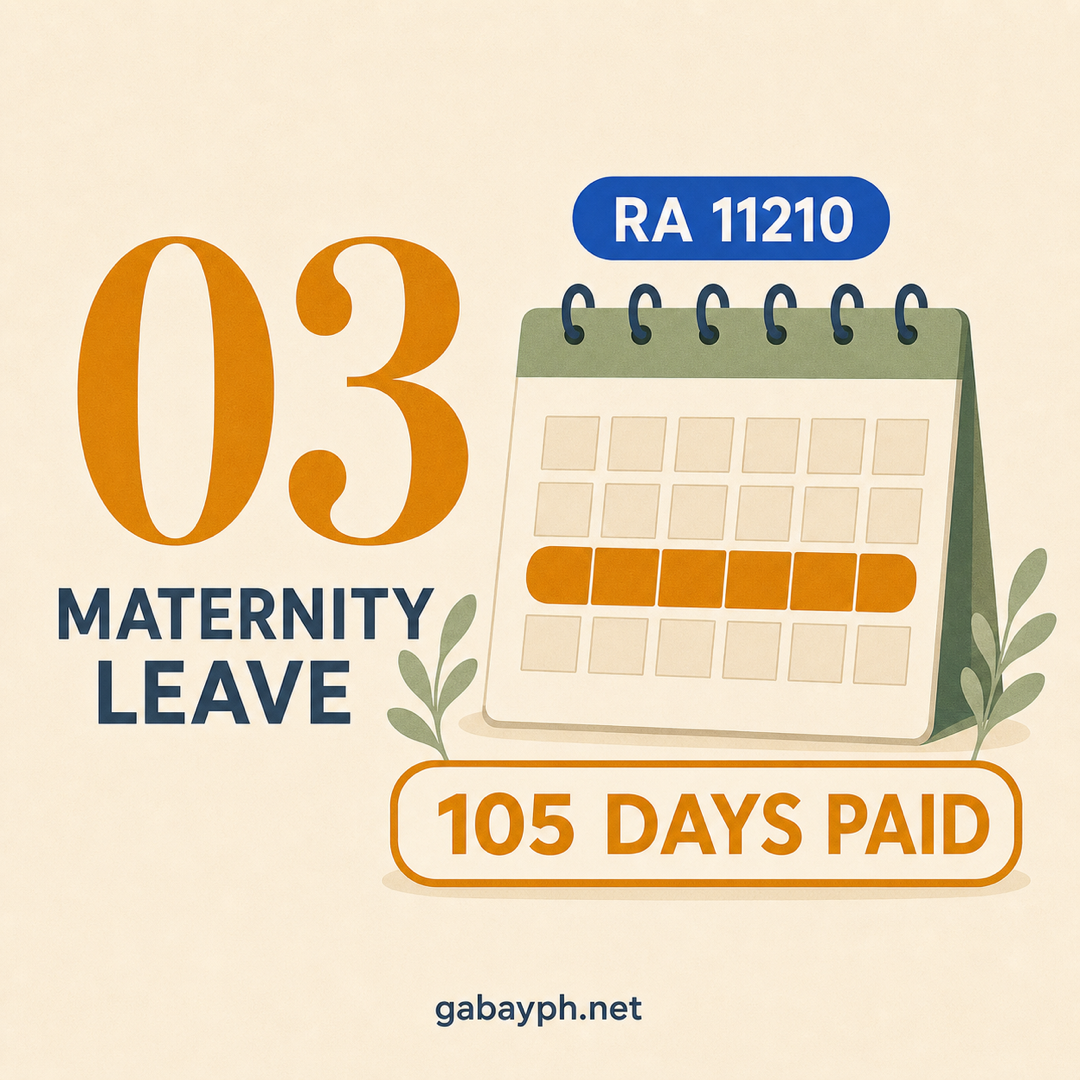
- 105 days of paid maternity leave for live childbirth (both normal delivery and CS)
- Additional 15 days for solo parents (total of 120 days)
- 60 days for miscarriage or emergency termination
- Option to extend an additional 30 days without pay
- Allocate up to 7 days of maternity leave to the child's father or an alternate caregiver
Who Is Covered
- All female workers in the private sector (regardless of civil status or legitimacy of child)
- Government employees (covered under separate rules)
- Voluntary SSS members and self-employed — eligible for SSS maternity benefit (cash), but leave entitlement applies only to employed women
- Applies to every instance of pregnancy — no limit on the number of times you can avail
How It Works for Employed Women
Your employer is legally required to grant you 105 days of maternity leave. The SSS maternity benefit is based on 105 days for live childbirth or 60 days for miscarriage. Your employer pays the salary differential for the remaining days to ensure you receive your full pay for 105 days. You cannot be fired, demoted, or discriminated against for taking maternity leave.
Ang Expanded Maternity Leave Law (RA 11210), na nilagdaan noong 2019, ay nagbibigay sa mga Pilipinang nagtatrabaho ng mga pinalawak na benepisyo sa maternity leave:
Mga Pangunahing Probisyon
- 105 araw na bayad na maternity leave para sa live childbirth (parehong normal delivery at CS)
- Karagdagang 15 araw para sa mga solo parent (kabuuang 120 araw)
- 60 araw para sa miscarriage o emergency termination
- Opsyon na i-extend ng karagdagang 30 araw nang walang bayad
- Maaaring ilaan ang hanggang 7 araw ng maternity leave sa ama ng bata o isang alternatibong tagapag-alaga
Sino ang Sakop
- Lahat ng babaeng manggagawa sa private sector (anuman ang civil status o legitimacy ng anak)
- Mga empleyado ng gobyerno (sakop sa ilalim ng hiwalay na mga patakaran)
- Voluntary SSS members at self-employed — kwalipikado para sa SSS maternity benefit (cash), pero ang leave entitlement ay naaangkop lamang sa mga employed na babae
- Naaangkop sa bawat pagkakataon ng pagbubuntis — walang limitasyon sa bilang ng beses na maaari mong i-avail
Paano Ito Gumagana para sa mga Employed na Babae
Legal na kinakailangan ng employer mo na bigyan ka ng 105 araw na maternity leave. Ang SSS maternity benefit ay base sa 105 araw para sa live childbirth o 60 araw para sa miscarriage. Binabayaran ng employer mo ang salary differential para sa natitirang mga araw upang matiyak na matatanggap mo ang iyong buong sahod sa loob ng 105 araw. Hindi ka maaaring tanggalin, i-demote, o idiskrimina dahil sa paggamit ng maternity leave.
Pro Tips
Mga Payo
- File your SSS Maternity Notification early — ideally during the first or second trimester. Don't wait until after delivery, as this may delay your benefit.
- Verify your PhilHealth contributions before your third trimester. You need at least 3 monthly contributions in the past 12 months. Check via the PhilHealth online portal.
- Ask your hospital for a delivery package — all-inclusive packages are almost always cheaper than paying per item. Compare packages across 2-3 hospitals before deciding.
- Take advantage of free prenatal checkups at your barangay health center or city health office, especially if budget is a concern. Government health centers provide free vitamins and basic prenatal care.
- Know the signs of pregnancy emergencies — severe headache, blurred vision, sudden swelling (face/hands), heavy bleeding, or severe abdominal pain require immediate hospital attention.
- Register your baby's birth immediately — late registration (after 30 days) requires additional documents and a more complicated process. The hospital usually handles this for you, but follow up to confirm.
- Start breastfeeding within the first hour after birth ("unang yakap"). This is encouraged by the DOH and provides crucial colostrum to your newborn.
- Keep all receipts and medical records — you'll need them for your SSS maternity claim, PhilHealth processing, and future medical references.
- Mag-file ng SSS Maternity Notification nang maaga — mas mainam sa unang o pangalawang trimester. Huwag hintayin pagkatapos manganak, dahil maaari nitong ma-delay ang iyong benepisyo.
- I-verify ang iyong mga PhilHealth contributions bago ang pangatlong trimester mo. Kailangan mo ng hindi bababa sa 3 buwanang kontribusyon sa nakaraang 12 buwan. I-check sa PhilHealth online portal.
- Magtanong sa ospital mo ng delivery package — ang mga all-inclusive packages ay halos palaging mas mura kaysa sa pagbayad bawat item. Ikumpara ang mga package sa 2-3 ospital bago magdesisyon.
- Samantalahin ang mga libreng prenatal checkup sa iyong barangay health center o city health office, lalo na kung concern ang budget. Ang mga government health centers ay nagbibigay ng libreng vitamins at basic prenatal care.
- Alamin ang mga senyales ng pregnancy emergencies — matinding sakit ng ulo, malabong paningin, biglaang pamamaga (mukha/kamay), mabigat na pagdurugo, o matinding sakit ng tiyan ay nangangailangan ng agarang atensyon sa ospital.
- I-register kaagad ang kapanganakan ng sanggol — ang late registration (pagkatapos ng 30 araw) ay nangangailangan ng karagdagang dokumento at mas kumplikadong proseso. Karaniwang hawak ito ng ospital para sa iyo, pero mag-follow up upang kumpirmahin.
- Simulan ang pagpapasuso sa loob ng unang oras pagkatapos manganak ("unang yakap"). Ito ay hinihikayat ng DOH at nagbibigay ng mahalagang colostrum sa iyong bagong silang.
- Itabi ang lahat ng resibo at medical records — kakailanganin mo ang mga ito para sa iyong SSS maternity claim, PhilHealth processing, at mga sangguniang medikal sa hinaharap.
Frequently Asked Questions
Mga Madalas Itanong
How much does it cost to give birth in the Philippines?
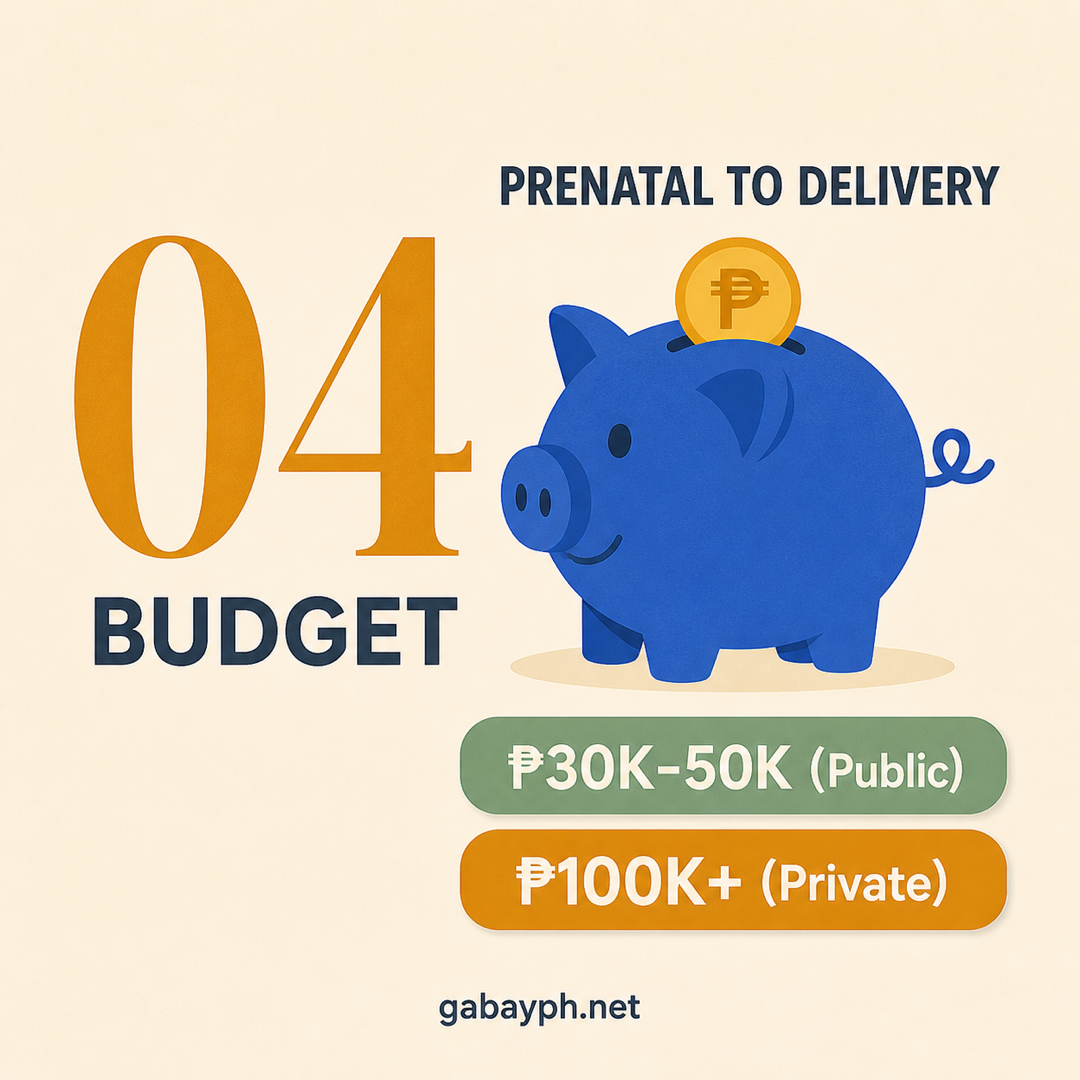
The total cost varies widely depending on the facility and delivery type. A normal delivery in a public hospital can be as low as P8,000-P15,000 (often fully covered by PhilHealth). A CS in a private hospital with a private room can cost P100,000-P200,000+. Including prenatal checkups, lab tests, vitamins, and supplies, budget a total of P30,000-P50,000 for public/lying-in or P80,000-P250,000 for private hospital throughout the entire pregnancy and delivery. PhilHealth coverage (P6,500-P19,000) and SSS maternity benefit (up to ₱122,500) significantly offset these costs.
Magkano ang gastos sa panganganak sa Pilipinas?
Ang kabuuang gastos ay malaki ang pagkakaiba depende sa pasilidad at uri ng panganganak. Ang normal delivery sa public hospital ay maaaring mababa ng P8,000-P15,000 (madalas na ganap na sakop ng PhilHealth). Ang CS sa private hospital na may private room ay maaaring gumastos ng P100,000-P200,000+. Kasama ang mga prenatal checkup, lab tests, vitamins, at supplies, mag-budget ng kabuuang P30,000-P50,000 para sa public/lying-in o P80,000-P250,000 para sa private hospital sa buong pagbubuntis at panganganak. Ang PhilHealth coverage (P6,500-P19,000) at SSS maternity benefit (hanggang ₱122,500) ay malaking bawas sa mga gastos na ito.
Can I claim both PhilHealth and SSS maternity benefits?
Yes! PhilHealth and SSS maternity benefits are separate and can both be claimed. PhilHealth coverage is deducted directly from your hospital bill (it covers hospital fees). SSS maternity benefit is a cash allowance for income replacement while on maternity leave. They serve different purposes and you should claim both. Make sure you meet the contribution requirements for each — at least 3 monthly contributions within the last 12 months for both PhilHealth and SSS.
Maaari ko bang i-claim ang parehong PhilHealth at SSS maternity benefits?
Oo! Ang PhilHealth at SSS maternity benefits ay hiwalay at maaaring parehong i-claim. Ang PhilHealth coverage ay ibinabawas nang direkta sa hospital bill mo (sinasakop nito ang mga hospital fees). Ang SSS maternity benefit ay isang cash allowance para sa pagpapalit ng kita habang nasa maternity leave. Magkaibang layunin ang pinaglilingkuran nila at dapat mong i-claim ang dalawa. Siguraduhing natutugunan mo ang mga kinakailangan sa kontribusyon para sa bawat isa — hindi bababa sa 3 buwanang kontribusyon sa loob ng huling 12 buwan para sa parehong PhilHealth at SSS.
What if I don't have PhilHealth or SSS?
If you're not yet a member, register as soon as possible. For PhilHealth, you can register as a voluntary member or through your employer. For SSS, register at any SSS branch or online. Even if you register during pregnancy, you may still qualify if you can make 3 monthly contributions before delivery.
If you cannot qualify for benefits, you can still give birth at a public hospital as a charity patient where delivery services are subsidized or free. You can also apply for DSWD financial assistance through your barangay. See our DSWD assistance guide.
Paano kung wala akong PhilHealth o SSS?
Kung hindi ka pa miyembro, magparehistro sa lalong madaling panahon. Para sa PhilHealth, maaari kang magparehistro bilang voluntary member o sa pamamagitan ng employer mo. Para sa SSS, magparehistro sa kahit anong SSS branch o online. Kahit magparehistro ka sa panahon ng pagbubuntis, maaari ka pa ring maging kwalipikado kung makakapag-ambag ka ng 3 buwanang kontribusyon bago manganak.
Kung hindi ka maging kwalipikado para sa mga benepisyo, maaari ka pa ring manganak sa isang public hospital bilang charity patient kung saan ang mga serbisyo sa panganganak ay subsidized o libre. Maaari ka ring mag-apply para sa DSWD financial assistance sa pamamagitan ng iyong barangay. Tingnan ang aming gabay sa DSWD assistance.
When should I go to the hospital during labor?
Go to the hospital when you experience any of the following:
- Regular contractions that are 5 minutes apart, lasting 1 minute each, for at least 1 hour (the "5-1-1 rule")
- Water breaking (rupture of membranes) — a gush or steady trickle of clear fluid
- Heavy vaginal bleeding
- Decreased baby movement — if you notice fewer kicks than usual
- Severe headache, visual changes, or sudden swelling — these could be signs of pre-eclampsia
If your water breaks, go to the hospital immediately regardless of whether you feel contractions. For first-time mothers, early labor can last many hours, but it's better to go early and be sent home than to arrive too late.
Kailan dapat pumunta sa ospital habang nanganganak?
Pumunta sa ospital kapag naranasan mo ang alinman sa mga sumusunod:
- Regular na contractions na 5 minuto ang agwat, tumatagal ng 1 minuto bawat isa, sa loob ng hindi bababa sa 1 oras (ang "5-1-1 rule")
- Pagtulo ng tubig (rupture of membranes) — isang buhos o tuloy-tuloy na pagtulo ng malinaw na likido
- Mabigat na vaginal bleeding
- Nabawasan ang paggalaw ng sanggol — kung napansin mong mas kaunti ang mga sipa kaysa karaniwan
- Matinding sakit ng ulo, pagbabago sa paningin, o biglaang pamamaga — maaaring senyales ito ng pre-eclampsia
Kung nabasag ang tubig mo, pumunta sa ospital kaagad kahit hindi ka pa nakakaramdam ng contractions. Para sa mga unang beses na nanay, ang early labor ay maaaring tumagal ng maraming oras, pero mas mabuting pumunta nang maaga at pauwiin kaysa dumating nang huli.
What is the 105-day maternity leave and who qualifies?
Under RA 11210 (Expanded Maternity Leave Law), all female workers in the private sector are entitled to 105 days of paid maternity leave for every pregnancy (live childbirth), regardless of civil status or number of children. Solo parents get an additional 15 days (120 total). This applies to:
- Regular, casual, contractual, and probationary employees
- Both married and unmarried mothers
- Every pregnancy — no limit on number of availments
The employer pays the full salary during the leave period. SSS reimburses the employer for the SSS maternity benefit portion (60-78 days). The employer covers the salary differential for the remaining days. You can also allocate up to 7 days to the father or an alternate caregiver.
Ano ang 105-araw na maternity leave at sino ang kwalipikado?
Sa ilalim ng RA 11210 (Expanded Maternity Leave Law), lahat ng babaeng manggagawa sa private sector ay may karapatang sa 105 araw na bayad na maternity leave para sa bawat pagbubuntis (live childbirth), anuman ang civil status o bilang ng mga anak. Ang mga solo parent ay nakakakuha ng karagdagang 15 araw (120 kabuuan). Ito ay naaangkop sa:
- Regular, casual, contractual, at probationary na empleyado
- Parehong kasal at hindi kasal na mga ina
- Bawat pagbubuntis — walang limitasyon sa bilang ng availments
Binabayaran ng employer ang buong sahod sa panahon ng leave. Nire-reimburse ng SSS ang employer para sa bahagi ng SSS maternity benefit (60-78 araw). Sinasakop ng employer ang salary differential para sa natitirang mga araw. Maaari mo ring ilaan ang hanggang 7 araw sa ama o isang alternatibong tagapag-alaga.