

Post-Disaster Response Guide: What to Do After a Typhoon, Flood, or Earthquake (2026)
Gabay sa Pagresponde sa Kalamidad: Ano ang Gagawin Pagkatapos ng Bagyo, Baha, o Lindol (2026)
5 Things to Know
Calamity response in five facts.
Quick Summary
Mabilis na Buod
Disclaimer & Safety Note
This guide is for informational purposes only. During an active disaster, your priority is physical safety — follow NDRRMC, PAGASA, PHIVOLCS, and LGU instructions first. Program amounts and windows (DSWD, Pag-IBIG, SSS, GSIS) change per event. Always verify current assistance with the respective agency before relying on specific amounts. GabayPH is not a government agency or emergency responder.
Disclaimer at Safety Note
Ang gabay na ito ay para sa impormasyon lamang. Sa gitna ng kalamidad, ang priyoridad ay physical safety — sundin ang NDRRMC, PAGASA, PHIVOLCS, at LGU. Nagbabago ang halaga at windows ng tulong (DSWD, Pag-IBIG, SSS, GSIS) per event. Palaging i-verify sa ahensya. Ang GabayPH ay hindi gobyerno o emergency responder.
Table of Contents
- Post-Disaster Timeline (Hour 0 to Month 1)
- DSWD Emergency Cash Transfer (ECT)
- Family Food Pack & Ready-to-Eat Food
- DSWD AICS Walk-In Assistance
- Pag-IBIG Calamity Loan
- SSS Calamity Loan
- GSIS Emergency Loan (Government Employees)
- Non-Life Insurance Claims
- Utility Bill Relief (Electricity)
- Shelter & Rebuilding Programs
- Pro Tips
- Frequently Asked Questions
Talaan ng Nilalaman
Post-Disaster Timeline (Hour 0 to Month 1)
Timeline (Oras 0 hanggang Buwan 1)
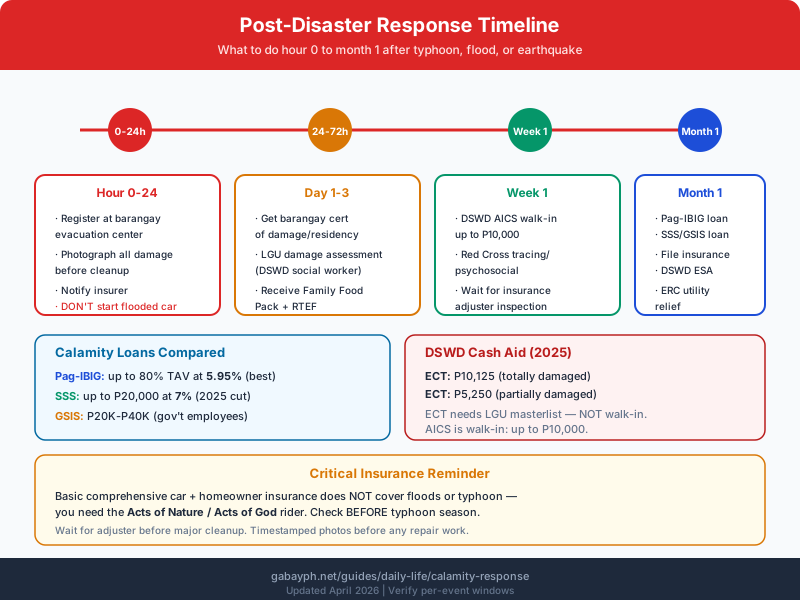
The actions you take in the first 24-72 hours determine what assistance you can access weeks and months later. Missing the evacuation registration window can disqualify your family from ECT and food packs even if your home was destroyed.
Ang ginawa mo sa unang 24-72 oras ang magde-decide ng tulong na makukuha mo sa mga susunod na linggo. Kung na-miss mo ang evacuation registration window, pwede kang mawalan ng ECT at food packs kahit nasira ang bahay mo.
Hour 0-24: Get Registered
Oras 0-24: Magpa-register
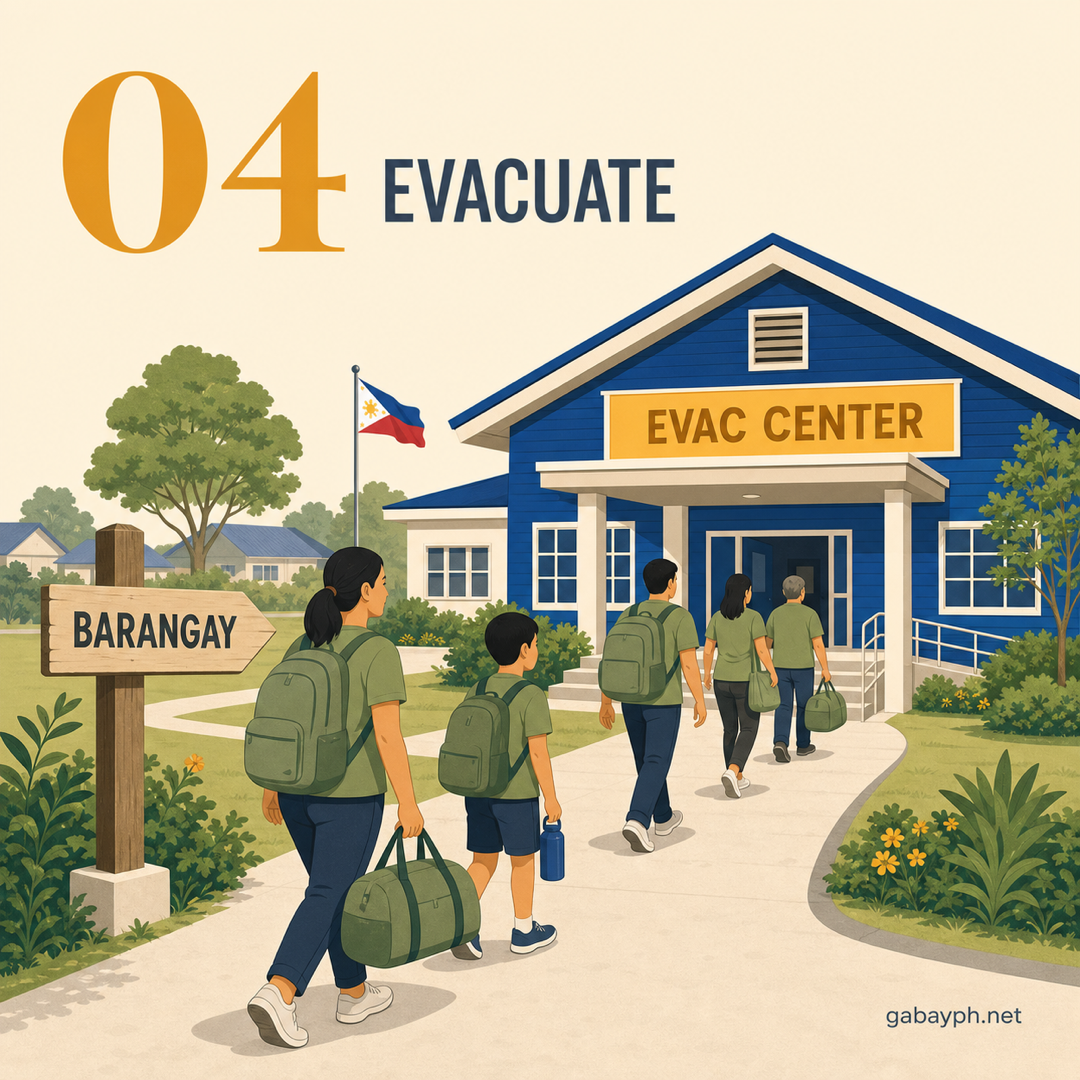
- Register at the barangay evacuation center — this triggers ECT and food pack eligibility
- Mag-register sa barangay evacuation center — ito ang trigger para sa ECT at food pack
- Photograph all damage with timestamps before any cleanup
- Kunan ng litrato lahat ng sira bago maglinis
- Notify your insurance company if you have non-life coverage
- I-report sa insurance company kung may non-life coverage ka
- Do not start a flooded vehicle — this hydrolocks the engine and voids insurance
- Huwag buhayin ang na-baha na sasakyan — hydrolock at mawawalan ng insurance
Hours 24-72: Documentation
Oras 24-72: Dokumentasyon
- Secure a barangay certificate of residency + damage — needed for every aid program
- Kunin ang barangay certificate of residency + damage — kailangan ng bawat programa
- Attend LGU damage assessment (DSWD social worker interview)
- Dumalo sa LGU damage assessment (DSWD social worker interview)
- Access DSWD FFP and RTEF through evacuation center
- I-access ang DSWD FFP at RTEF sa evacuation center
Week 1: Walk-In Assistance
Linggo 1: Walk-In Assistance
- Walk in to DSWD Field Office for AICS if additional cash is needed
- Mag walk-in sa DSWD Field Office para sa AICS
- Contact Red Cross chapter for tracing (missing family) or psychosocial support
- Kontakin ang Red Cross para sa tracing o psychosocial
- Get repair quotes but don't start work if insurance claim is pending
- Kumuha ng repair quotes pero huwag magsimula kung may insurance claim
- Wait for insurance adjuster inspection before major cleanup
- Hintayin ang insurance adjuster bago maglinis
Month 1: Calamity Loans & Insurance
Buwan 1: Calamity Loans at Insurance
- File Pag-IBIG Calamity Loan (window typically 90 days post-declaration)
- Mag-file ng Pag-IBIG Calamity Loan (90 araw post-declaration)
- File SSS Calamity Loan (within 30 days of SSS announcement)
- Mag-file ng SSS Calamity Loan (sa loob ng 30 araw mula announcement)
- GSIS members: check GSIS Touch app for emergency loan activation
- GSIS members: tingnan ang GSIS Touch app para sa emergency loan
- File non-life insurance claim — payment due 30 days (agreed) or 90 days (negotiated) per Insurance Code
- Mag-file ng non-life insurance claim — bayad sa loob ng 30 araw (agreed) o 90 araw (negotiated)
- Apply for DSWD ESA if house damaged
- Mag-apply ng DSWD ESA kung nasira ang bahay
- Check if ERC disconnection moratorium applies to your area
- I-check kung saklaw ka ng ERC disconnection moratorium
DSWD Emergency Cash Transfer (ECT)
DSWD Emergency Cash Transfer (ECT)
Cash aid pushed to families affected by declared disasters. This is NOT a walk-in program — you must be on the LGU's barangay masterlist generated in the first 72 hours.
Cash na ibinibigay sa mga pamilyang naapektuhan ng declared disaster. HINDI walk-in — kailangan nakalista ka sa LGU barangay masterlist na ginawa sa unang 72 oras.
Indicative Amounts (verify with DSWD per event)
Tinatayang Halaga (i-verify sa DSWD per event)
- ₱10,125 per family — totally damaged house (per 2025 DSWD circular; verify against the current administrative order)
- ₱10,125 per pamilya — totally damaged house (per 2025 DSWD circular; i-verify sa kasalukuyang administrative order)
- ₱5,250 per family — partially damaged house (per 2025 DSWD circular)
- ₱5,250 per pamilya — partially damaged house (per 2025 DSWD circular)
Trigger: State of Calamity declaration (national or LGU). ECT starts only when local markets are operational enough to support cash-based response. If markets are non-functional, DSWD pivots to in-kind aid (food packs) first.
Trigger: State of Calamity declaration. Nag-aactivate lang ang ECT kapag may mga bukas na palengke. Kung walang bukas, food pack muna ang ibibigay.
How to qualify: Be counted in the LGU damage assessment masterlist. This happens via barangay registration at evacuation centers and door-to-door assessment by DSWD social workers. Families who don't register are often missed entirely — especially in rural areas with poor LGU coverage.
Paano maging kwalipikado: Dapat nakabilang ka sa LGU damage assessment masterlist. Gawin via barangay registration sa evacuation centers at door-to-door na pag-assess ng DSWD social worker. Ang mga hindi nag-register ay madalas na-miss — lalo na sa probinsiya.
Family Food Pack (FFP) & Ready-to-Eat Food (RTEF)
Family Food Pack (FFP) at Ready-to-Eat Food (RTEF)
Contents of one FFP:
Nasa isang FFP:
- Two 3kg vacuum-sealed packs of rice (6kg total)
- Dalawang 3kg vacuum-sealed packs ng bigas (6kg)
- 4 cans of corned beef
- 4 na lata ng corned beef
- 4 cans of tuna
- 4 na lata ng tuna
- 2 cans of sardines
- 2 na lata ng sardinas
- Sachets of coffee and chocolate malt drink
- Mga sachet ng kape at chocolate malt
Designed for a family of 5, good for about 2 days. Distributed through LGU/DSWD coordination at evacuation centers and affected barangays.
Para sa pamilyang 5, tatagal ng mga 2 araw. Binibigay sa evacuation centers at mga naapektuhang barangay.
Ready-to-Eat Food (RTEF) is a separate Halal-certified no-prep box for the first 48 hours when cooking is impossible.
Ang RTEF (Ready-to-Eat Food) ay hiwalay na Halal-certified na boxes para sa unang 48 oras kung hindi pa pwedeng magluto.
DSWD AICS Walk-In Assistance
DSWD AICS Walk-In Assistance
Unlike ECT, AICS (Assistance to Individuals in Crisis Situations) IS a walk-in program. If you need additional cash help and weren't covered by ECT, or if you were but still need more, go to your nearest DSWD Field Office with documentation.
Iba sa ECT — walk-in ang AICS (Assistance to Individuals in Crisis Situations). Kung kailangan mo ng dagdag na tulong, pumunta sa DSWD Field Office na may dokumento.
Typical disaster-related amount: ₱1,000-₱10,000 assessed by a social worker. Medical-type cases can reach up to ₱150,000 guarantee letter for grave cases, but the disaster cash component is usually the smaller bracket.
Karaniwang disaster-related amount: ₱1,000-₱10,000. Ang medical cases ay pwedeng umabot sa ₱150,000 guarantee letter para sa grave cases.
Documents: barangay certificate of residency/indigency; valid ID (if lost, barangay cert alone is acceptable); LGU calamity declaration or police report/blotter.
Dokumento: barangay certificate of residency/indigency; valid ID (kung nawala, tanggap ang barangay cert lang); LGU calamity declaration o police blotter.
Official: dswd.gov.ph/aics
Opisyal: dswd.gov.ph/aics
Pag-IBIG Calamity Loan
Pag-IBIG Calamity Loan
- Eligibility: active member, at least 24 monthly savings (1 in last 6 months), reside or work in declared calamity LGU, no defaulted Pag-IBIG loans
- Eligibility: active member, at least 24 monthly savings, may tirahan/trabaho sa declared calamity LGU, walang default
- Amount: up to 80% of Total Accumulated Value (TAV)
- Halaga: hanggang 80% ng Total Accumulated Value (TAV)
- Interest: 5.95% per annum — lowest among calamity programs
- Interest: 5.95% kada taon — pinakamura
- Term: 24 months with 3-month grace period on first payment
- Term: 24 buwan, 3-month grace sa unang bayad
- Application window: typically 90 days post-calamity declaration
- Window: 90 araw mula declaration
- How to apply: Virtual Pag-IBIG online portal or any Pag-IBIG branch
- Paano: Virtual Pag-IBIG o kahit anong Pag-IBIG branch
Pag-IBIG often offers a one-month housing loan moratorium for borrowers in calamity areas. All Pag-IBIG housing loans have built-in fire and allied perils insurance — check if typhoon/flood is covered in your specific policy.
Kadalasang may isang buwang housing loan moratorium ang Pag-IBIG. May built-in na fire at allied perils insurance ang lahat ng Pag-IBIG housing loan — i-check kung kasama ang typhoon/flood.
Official: pagibigfund.gov.ph/STL_MPL_Calamity.html
SSS Calamity Loan
SSS Calamity Loan
- Eligibility: at least 36 monthly contributions (6 in last 12 months); reside in NDRRMC/LGU-declared area; no past-due SSS loans; under age 65; not a final benefit claimant; My.SSS account
- Eligibility: at least 36 monthly contributions (6 sa last 12 months); sa declared area; walang past-due; under 65; may My.SSS
- Amount: up to ₱20,000 OR one Monthly Salary Credit (MSC, average of last 12 rounded to nearest ₱1,000), whichever is LOWER
- Halaga: hanggang ₱20,000 O isang MSC, alin ang MAS MABABA
- Interest: 7% per annum (reduced from 10% under SSS Circular 2025-006, August 2025)
- Interest: 7% (dating 10%, sa SSS Circular 2025-006 Agosto 2025)
- Term: 24 equal monthly installments starting 2nd month after approval
- Term: 24 buwan, magsisimula ang bayad sa 2nd month
- Window: 30 days from SSS announcement in newspaper
- Window: 30 araw mula announcement sa newspaper
- How to apply: online via My.SSS or mobile app; bank account must be enrolled in DAEM
- Paano: online via My.SSS o mobile app; bank account nasa DAEM
Official: sss.gov.ph/calamity-loan
Opisyal: sss.gov.ph/calamity-loan
GSIS Emergency Loan (Government Employees)
GSIS Emergency Loan (Empleyado ng Gobyerno)
For government employees and pensioners in calamity-declared areas. Typical amounts: ₱20,000-₱40,000 depending on existing loan balance. GSIS often adds a grace period on amortizations tied to the event. Each activation window is event-specific — check the GSIS Touch app or gsis.gov.ph for the current window.
Para sa empleyado at pensionado ng gobyerno sa declared calamity area. Karaniwang halaga: ₱20,000-₱40,000 depende sa existing loan balance. Karaniwang may grace period din ang GSIS sa amortization. Bawat activation ay event-specific — i-check ang GSIS Touch app o gsis.gov.ph para sa kasalukuyang window.
Apply via GSIS Touch app or nearest GSIS branch.
Apply via GSIS Touch app o GSIS branch.
Non-Life Insurance Claims (Flood/Typhoon/Earthquake)
Non-Life Insurance Claims (Baha/Bagyo/Lindol)
Critical: Acts of Nature / Acts of God coverage (flood, typhoon, earthquake) is NOT included in basic non-life policies for vehicles or property — it is an optional add-on. Check your policy schedule BEFORE disaster strikes to know if you're covered.
Importante: Ang Acts of Nature / Acts of God coverage (baha, bagyo, lindol) ay HINDI kasama sa basic non-life policy — optional add-on ito. Tingnan ang policy schedule mo BAGO mangyari ang kalamidad.
Standard deductible for Acts of Nature claims: 2% of the affected item's value.
Standard deductible: 2% ng halaga ng naapektuhang bagay.
Insurance Code (PD 1460, Art. 249) payment deadlines: insurer must pay within 30 days if loss amount is agreed upon; within 90 days if still being ascertained.
Insurance Code (PD 1460, Art. 249): kailangang bayaran sa loob ng 30 araw kung napagkasunduan; 90 araw kung ina-assess pa.
Claim Steps
Mga Hakbang sa Claim
- Immediately notify insurer/broker
- Agad ipagbigay-alam sa insurer/broker
- Photograph everything before any cleanup — timestamped, all damage angles
- Litratuhan lahat bago maglinis — may timestamp, lahat ng anggulo
- Don't start a flood-damaged vehicle engine
- Huwag buhayin ang na-baha na sasakyan
- Get barangay or LGU calamity certification
- Kumuha ng barangay o LGU calamity cert
- File claim form with adjuster inspection
- Mag-file ng claim form at adjuster inspection
- Wait for adjuster before major repairs — starting repairs first forfeits the claim
- Hintayin ang adjuster bago magpa-repair — kung nag-umpisa na, mawawalan ng karapatan sa claim
Utility Bill Relief (Electricity)
Utility Relief (Kuryente)
The Energy Regulatory Commission (ERC) issues disconnection moratoriums for distribution utilities in calamity-declared areas on a per-event basis. Recent example: ERC November 2025 order (Typhoon Tino) banned disconnections Nov 4-Dec 31, 2025 and allowed staggered billing for customers consuming ≤100 kWh/month — pay in at least 2 equal installments, no interest.
Ang Energy Regulatory Commission (ERC) ay naglalabas ng disconnection moratorium sa declared calamity area per event. Halimbawa: ERC Nov 2025 (Typhoon Tino) — no disconnection Nov 4-Dec 31, 2025; staggered billing para sa ≤100 kWh/buwan (2 equal installments, walang interest).
This is NOT automatic nationwide — only areas named in the specific ERC advisory get relief. Watch for the ERC advisory for your specific typhoon/earthquake, not just the general NDRRMC declaration.
Hindi automatic nationwide — ang mga nakapangalan lang sa ERC advisory. Hanapin ang ERC advisory para sa tiyak na typhoon/earthquake, hindi lang ang general NDRRMC.
Telecoms (Globe, Smart, PLDT): no fixed regulatory framework like ERC. Each provider offers relief case-by-case — contact them directly to request billing extension.
Telecom (Globe, Smart, PLDT): walang fixed regulatory framework. Kontakin ng diretso para humiling ng extension.
Shelter & Rebuilding Programs
Shelter at Rebuilding Programs
- DSWD Emergency Shelter Assistance (ESA): cash for house repair materials. Typical range: ₱10,000-₱30,000 per household — amount is set per-disaster by DSWD circular and varies by severity and scale. Verify your specific event's ESA amount with your DSWD Field Office.
- DSWD Emergency Shelter Assistance (ESA): cash para sa pag-aayos. Karaniwang range: ₱10,000-₱30,000 per pamilya — itinatakda per-disaster ng DSWD circular at nag-iiba batay sa tindi ng kalamidad. I-verify ang halaga sa DSWD Field Office.
- DSWD Core Shelter Assistance Program (CSAP): DSWD coordinates with LGU to build core shelter units. Takes months to years to deliver.
- DSWD Core Shelter Assistance Program (CSAP): DSWD at LGU magbubuo ng core shelter. Buwan hanggang taon ang tagal.
- NHA Emergency Shelter: parallel program targeting the same beneficiaries. DSWD handles immediate cash for materials; NHA handles transitional/permanent shelter.
- NHA Emergency Shelter: parallel program. Ang DSWD ay para sa immediate cash; NHA para sa transitional/permanent shelter.
- Access: through barangay/LGU damage assessment masterlist — same entry point as ECT. Must be in declared calamity area with documented house damage.
- Access: sa barangay/LGU damage assessment masterlist — parehas ng ECT. Kailangan ay sa declared area at may dokumentadong sira.
Pro Tips
Mga Payo
- The barangay registration is the single most important post-disaster action. It unlocks ECT, food packs, and shelter assistance. Families who wait too long or never register are often missed from the LGU masterlist — which is compiled in the first 72 hours and rarely revisited.
- Ang barangay registration ang pinakamahalagang gagawin pagkatapos ng kalamidad. Ito ang nag-unlock sa ECT, food pack, at shelter assistance. Kung matagal ka bago mag-register o hindi mag-register, madalas na-miss ka sa LGU masterlist — compiled sa unang 72 oras lang at bihirang balikan.
- Check your insurance policy schedule BEFORE typhoon season. Basic comprehensive car insurance doesn't cover flood. Basic homeowner's insurance doesn't cover typhoon wind. You need the Acts of Nature rider. Adding it after the storm is forecast is often refused or massively repriced.
- I-check ang insurance policy BAGO ang typhoon season. Ang basic comprehensive car insurance ay hindi kasama ang baha. Ang basic homeowner ay hindi kasama ang bagyo. Kailangan ang Acts of Nature rider. Kung idadagdag mo ito matapos na mag-forecast ng bagyo, madalas tinatanggihan o mas mahal ang singil.
- Pag-IBIG has the cheapest calamity interest rate at 5.95%. Compare this to SSS at 7% and GSIS Ginhawa Go at 6%. If you have Pag-IBIG membership with enough TAV, prioritize this loan over the others.
- Pinakamura ang Pag-IBIG calamity interest rate sa 5.95%. Ikumpara sa SSS 7% at GSIS Ginhawa Go 6%. Kung may Pag-IBIG membership ka at sapat ang TAV, una mong kunin ito.
- DSWD ECT and AICS are additive, not mutually exclusive. You can receive FFP + ECT + AICS in the same disaster if you qualify separately. Many families think receiving ECT disqualifies them from AICS — it doesn't.
- Magkasabay ang DSWD ECT at AICS, hindi pinipiling isa lang. Pwede kang tumanggap ng FFP + ECT + AICS sa isang disaster kung kwalipikado sa bawat isa. Akala ng marami, kapag ECT, disqualified sa AICS — hindi.
- Use your phone to photograph damage with GPS/timestamp metadata ON. Insurance adjusters and DSWD social workers trust timestamped photos. Turn off "Live Photo" or burst mode — you want clear static images with visible metadata.
- Gamitin ang phone sa paglitrato na naka-GPS/timestamp metadata. Trusted ng insurance adjusters at DSWD social workers ang timestamped photos. I-off ang "Live Photo" o burst mode — kailangan malinaw na static images na may metadata.
- For a flooded car, don't turn the key. Hydrolock destroys the engine. Insurance does cover this under Acts of Nature IF you didn't start the engine — but trying to start it converts the damage to negligence, voiding the claim.
- Sa baha na sasakyan, huwag buhayin. Sinisira ng hydrolock ang engine. Saklaw ito ng Acts of Nature insurance KUNG hindi mo nabuhay — pero kung sinubukan mong buhayin, nagiging negligence at mawawala ang claim.
Frequently Asked Questions
Mga Madalas Itanong
Can I apply for SSS and Pag-IBIG calamity loans at the same time?
Yes — they're from different agencies with different rules. If eligible for both, apply to both to stack the relief. Pag-IBIG gives you more money (up to 80% of TAV) at the lower rate (5.95%); SSS gives you up to ₱20,000 at 7%.
Pwede bang mag-apply sa SSS at Pag-IBIG calamity loan ng sabay?
Oo — magkaibang ahensya, magkaibang rules. Kung kwalipikado sa dalawa, mag-apply sa dalawa. Pag-IBIG: mas malaki (hanggang 80% ng TAV), mas mura (5.95%). SSS: hanggang ₱20,000 sa 7%.
What if my house was destroyed and I don't have IDs anymore?
A barangay certificate of residency and damage is accepted in lieu of government IDs for most calamity assistance. Your barangay captain and DSWD social worker can vouch for your identity. For longer-term ID replacement, PSA and PSA Help Line still issue certificates from the central database.
Paano kung nasira ang bahay at nawala lahat ng ID?
Tinatanggap ang barangay certificate of residency at damage bilang kapalit ng ID para sa karamihan ng calamity assistance. Ang barangay captain at DSWD social worker ay pwedeng magpatunay sa iyong identity. Para sa long-term ID replacement, ang PSA at PSA Help Line ay mag-iisyu pa rin ng certificates.
How long does the ECT window stay open?
ECT is tied to the LGU damage assessment masterlist, typically compiled in the first 72 hours and finalized within 1-2 weeks. Families missed from the masterlist can sometimes be added through a late barangay endorsement, but this depends on LGU flexibility. Register as early as possible.
Gaano katagal bukas ang ECT window?
Ang ECT ay nakakabit sa LGU damage assessment masterlist, ginagawa sa unang 72 oras at natatapos sa 1-2 linggo. Ang mga na-miss ay minsan pwede pang maisama via late barangay endorsement, pero depende sa LGU. Mag-register agad.
Does my basic comprehensive car insurance cover typhoon damage?
No. Basic comprehensive covers theft, vandalism, collision, and own damage from accidents — but NOT Acts of Nature (flood, typhoon, earthquake). You need a specific Acts of Nature rider or AON coverage to claim for flood/typhoon damage.
Saklaw ba ng basic comprehensive car insurance ang typhoon damage?
Hindi. Ang basic comprehensive ay nakuha laban sa pagnanakaw, vandalism, banggaan, at own damage — hindi ang Acts of Nature (baha, bagyo, lindol). Kailangan ng Acts of Nature rider o AON coverage para ma-claim ang flood/typhoon damage.