

Food Business Permits Philippines: The Complete Integrated Guide (2026)
Mga Permit sa Food Business sa Pilipinas: Kumpletong Gabay (2026)
The 5-Step Walkthrough
Food business permits in five steps.
Quick Summary
Mabilis na Buod
Disclaimer
Permit fees and requirements vary by LGU and are updated by DTI, BIR, FDA, BFP, and local governments. Always verify the latest fees and requirements at your LGU's Business Permit and Licensing Office (BPLO) or Business One-Stop Shop (BOSS). GabayPH is not affiliated with any government agency. This guide is informational only.
Disclaimer
Ang bayad at requirements sa permit ay nag-iiba per LGU at ina-update ng DTI, BIR, FDA, BFP, at lokal na gobyerno. Palaging i-verify ang pinakabagong bayad at requirements sa LGU Business Permit and Licensing Office (BPLO) o Business One-Stop Shop (BOSS). Ang GabayPH ay hindi kaanib ng gobyerno. Pang-impormasyon lang ang gabay na ito.
Table of Contents
- Which Permits Apply to Your Food Business Type
- The Correct Sequence (Why Order Matters)
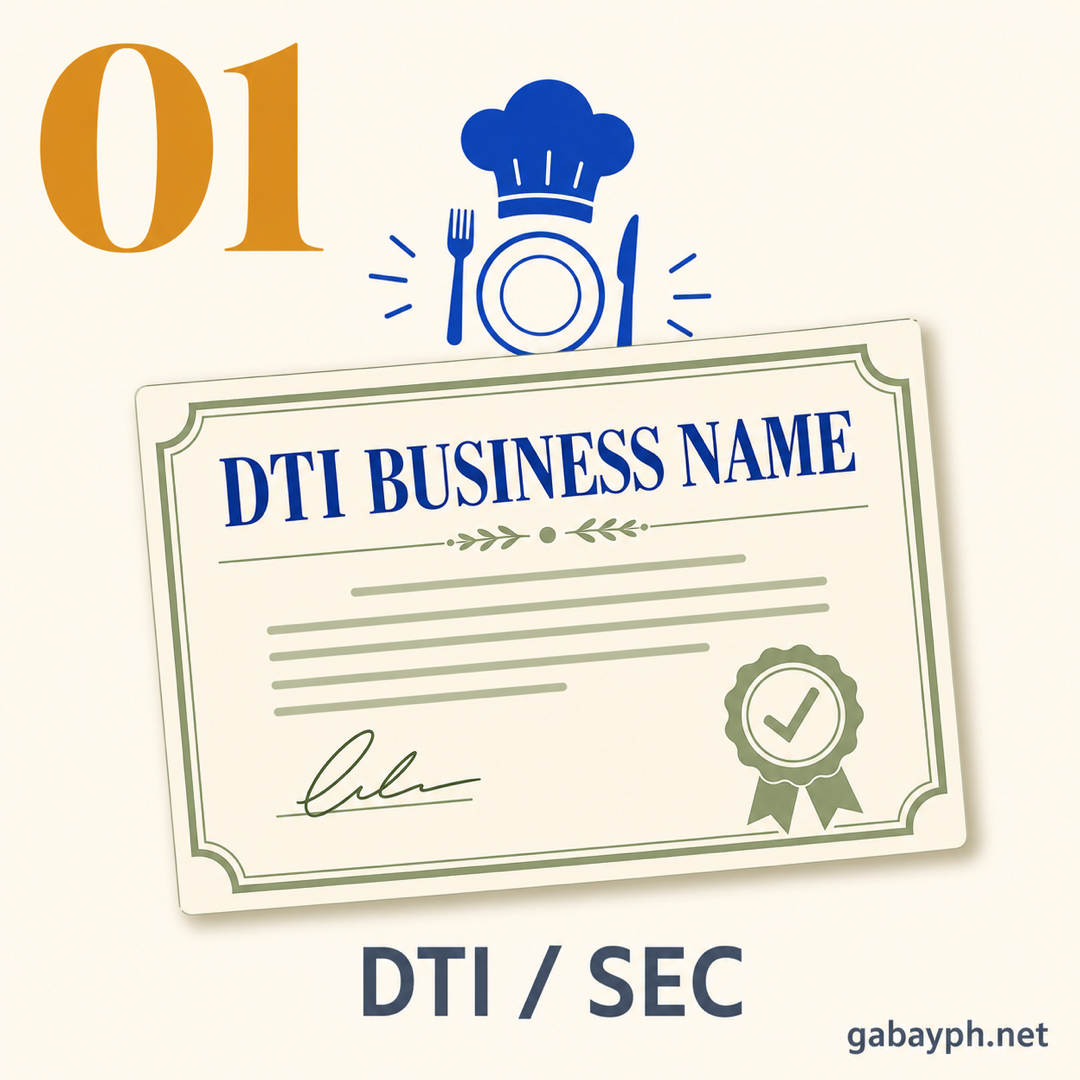
- Step 1: DTI Business Name Registration
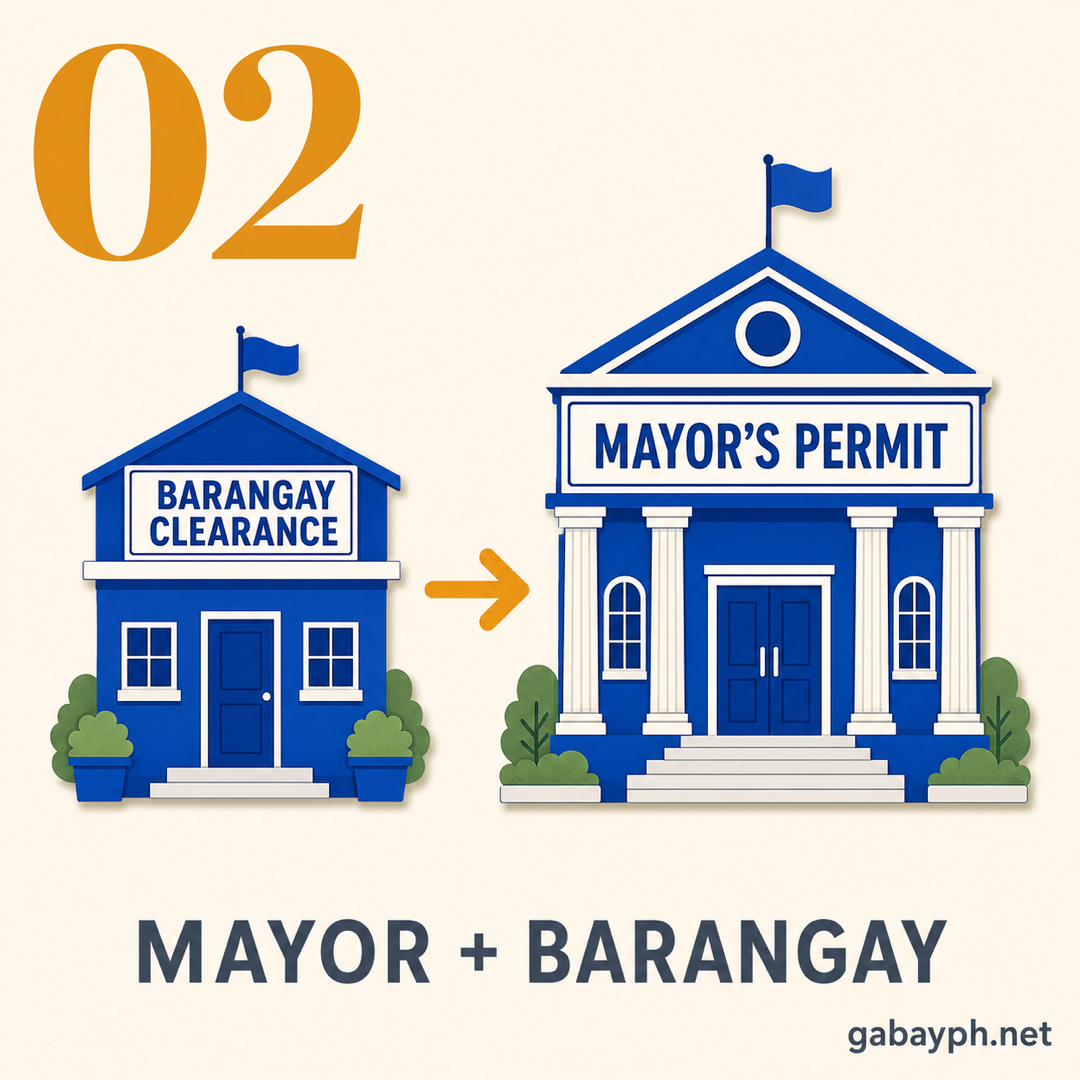
- Step 2: Barangay Business Clearance
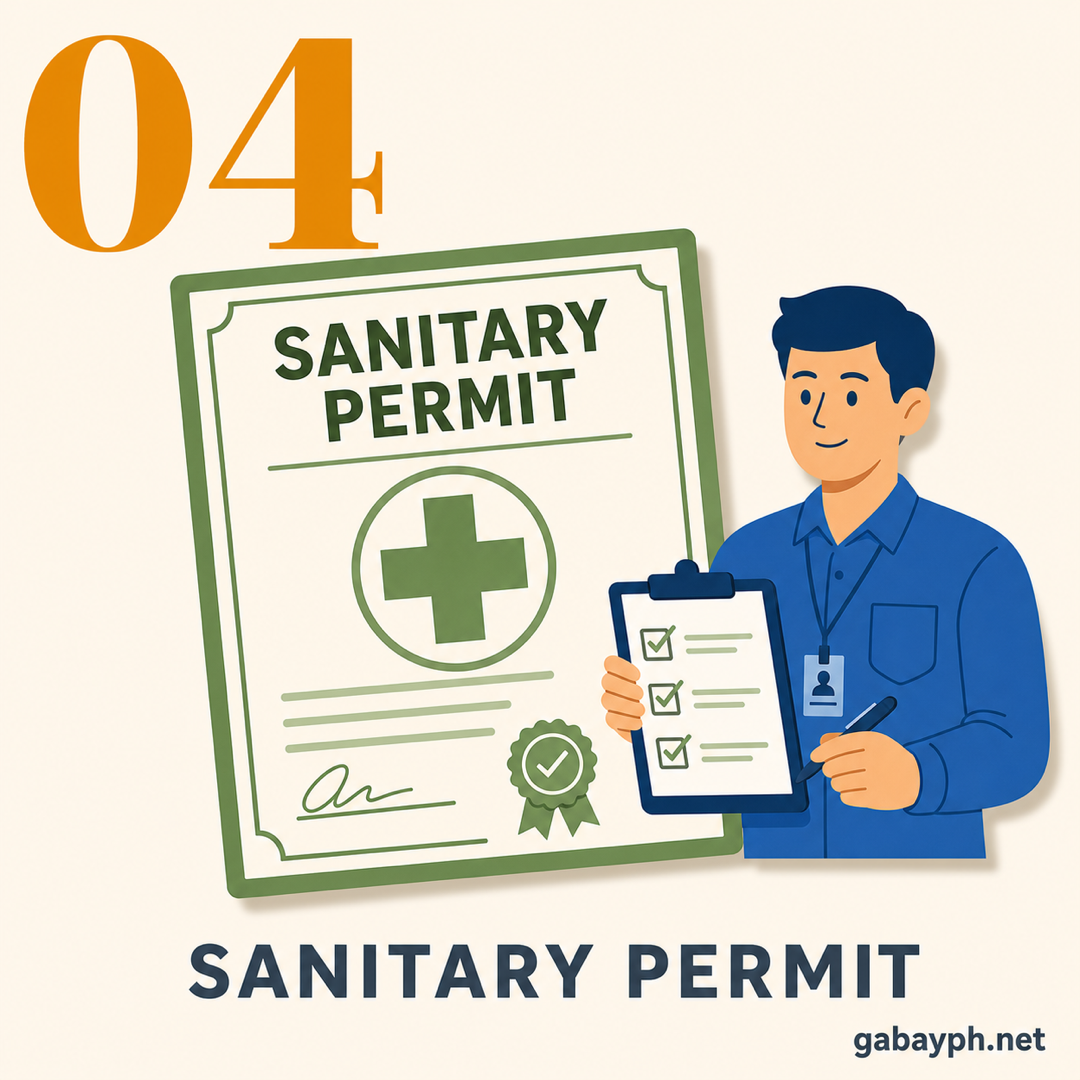
- Step 3: Mayor's Permit & Sanitary Permit
- Step 4: Food Handler's Health Certificate
- Step 5: BFP Fire Safety Inspection Certificate
- Step 6: BIR Registration (After Mayor's Permit)
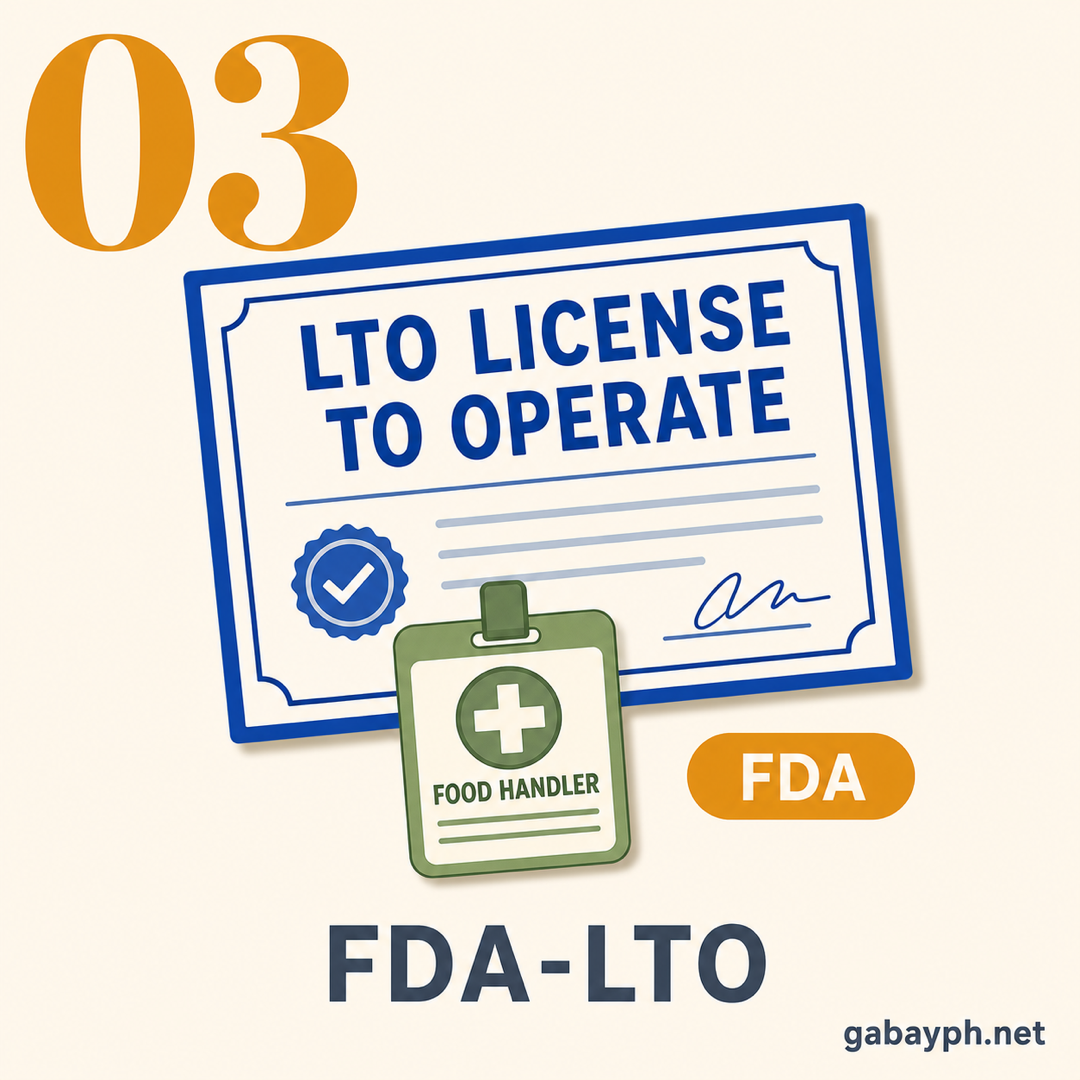
- Step 7 (Conditional): FDA LTO & CPR
- Home-Based & Online Food Sellers
- Pro Tips
- Frequently Asked Questions
Talaan ng Nilalaman
- Aling Permit sa Iyong Uri ng Negosyo
- Tamang Pagkakasunod-sunod
- Step 1: DTI Business Name
- Step 2: Barangay Clearance
- Step 3: Mayor's Permit at Sanitary
- Step 4: Food Handler's Cert
- Step 5: BFP Fire Safety
- Step 6: BIR Registration
- Step 7: FDA LTO at CPR
- Home-Based at Online Sellers
- Mga Payo
- Mga Madalas Itanong
Which Permits Apply to Your Food Business Type
Aling Permit ang Kailangan Mo
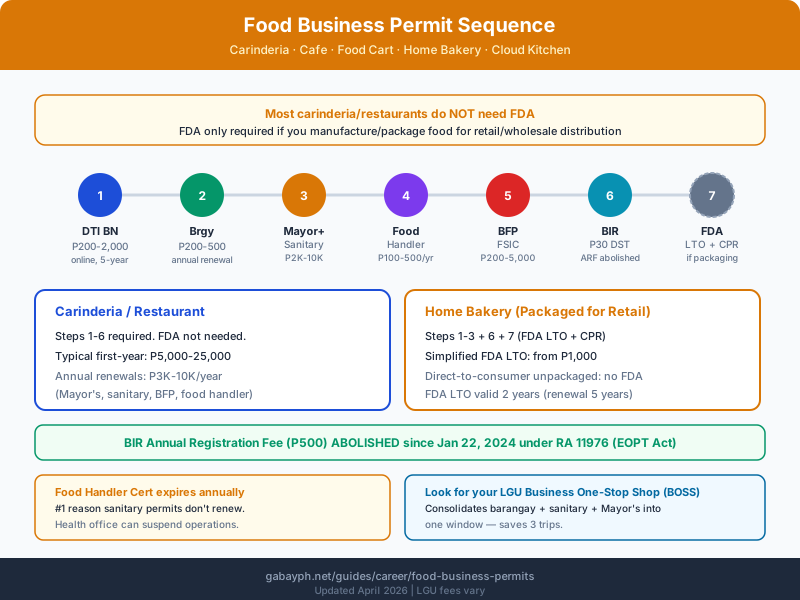
Not every food business needs every permit. The single most important decision is whether you're freshly-prepped for direct consumption (restaurant, carinderia, food cart) OR packaging for retail/wholesale (home bakery selling sealed products on Shopee). The first group doesn't need FDA. The second group does.
Hindi lahat ng food business ay kailangan ng lahat ng permit. Ang pinakamahalagang tanong: freshly-prepped ba para sa direct consumption (restaurant, carinderia, food cart) O nagpa-package para sa retail/wholesale (home bakery na nagbebenta sa Shopee)? Ang una ay hindi kailangan ng FDA. Ang pangalawa ay kailangan.
| Business TypeUri ng Negosyo | DTI | Brgy | Mayor's | BIR | Sanitary | BFP | FDA LTO | FDA CPR |
|---|---|---|---|---|---|---|---|---|
| Carinderia / dine-in restaurantCarinderia / dine-in | Y | Y | Y | Y | Y | Y | — | — |
| Takeout-only / cloud kitchenTakeout / cloud kitchen | Y | Y | Y | Y | Y | Y | — | — |
| Food cart (no on-site cooking)Food cart (walang luto) | Y | Y | Y | Y | Y | ? | — | — |
| Home bakery (FB, direct-to-consumer, unpackaged)Home bakery (FB, direct, hindi naka-package) | Y | Y | ? | Y | R | — | — | — |
| Home bakery selling packaged goods online/storesHome bakery, naka-package, retail | Y | Y | Y | Y | Y | — | Y | Y |
| Food truck (mobile)Food truck (mobile) | Y | Y | Y+ | Y | Y | ? | — | — |
Y = required | ? = depends on setup (e.g., fire hazard) | R = recommended | — = not required | Y+ = plus mobility/route permits
Y = kailangan | ? = depende sa setup | R = inirerekomenda | — = hindi kailangan | Y+ = dagdag ng mobility permit
The Correct Sequence (Why Order Matters)
Tamang Pagkakasunod-sunod
The permits must be obtained in the right order because each subsequent agency asks for the previous permit as proof. The universal sequence is:
Dapat maiayos ang permits sa tamang pagkakasunod dahil hinihingi ng susunod na ahensya ang nakaraang permit bilang proof. Ang universal na sequence:
- DTI Business Name (sole prop) or SEC (corp) — legal name registration(sole prop) o SEC (corp) — legal name registration
- Barangay Business Clearance — local authority sign-off— permiso ng barangay
- Mayor's/Business Permit + Sanitary Permit — LGU one-stop window (BPLO/BOSS)— LGU one-stop window
- Food Handler's Health Certificate (for all employees handling food)(lahat ng humahawak ng pagkain)
- BFP Fire Safety Inspection Certificate (FSIC) — usually bundled with Mayor's Permit window— karaniwang kasama na sa Mayor's Permit
- BIR Registration — must come after DTI + Mayor's Permit— matapos ang DTI at Mayor's Permit
- FDA LTO + CPR — ONLY if packaging for retail/wholesale— KUNG naka-package para sa retail/wholesale
Good news (since RA 11032 Ease of Doing Business): the barangay clearance is no longer a prerequisite for BIR registration (but is still needed for Mayor's Permit). Many LGUs now have a Business One-Stop Shop (BOSS) that consolidates barangay, sanitary, and Mayor's Permit into one window — ask at your LGU BPLO.
Magandang balita (simula ng RA 11032 Ease of Doing Business): hindi na kailangan ng barangay clearance bago mag-BIR (pero kailangan pa rin sa Mayor's Permit). Maraming LGU may Business One-Stop Shop (BOSS) na nagsasama ng barangay, sanitary, at Mayor's Permit sa iisang window — itanong sa LGU BPLO.
Step 1: DTI Business Name Registration
Step 1: DTI Business Name Registration
For sole proprietorships. Corporations/partnerships register with SEC instead.
Para sa sole proprietorship. Ang corporation/partnership ay sa SEC.
Fees (plus ₱30 documentary stamp tax):
Bayad (may dagdag ₱30 documentary stamp tax):
- Barangay scope: ₱200
- Barangay scope: ₱200
- City/Municipal: ₱500
- City/Municipal: ₱500
- Regional: ₱1,000
- Regional: ₱1,000
- National: ₱2,000
- National: ₱2,000
Valid for 5 years. Apply fully online at bnrs.dti.gov.ph. Results in minutes if name is available.
5 taon ang bisa. Mag-apply online sa bnrs.dti.gov.ph. Instant ang result kung available ang pangalan.
Step 2: Barangay Business Clearance
Step 2: Barangay Business Clearance
Go to your barangay hall with: DTI certificate, valid ID, proof of business address (lease contract or deed if home-based). Fee: ₱200-₱500 depending on LGU. Valid 1 year.
Pumunta sa barangay hall dala: DTI certificate, valid ID, proof of business address (lease contract o deed kung home-based). Bayad: ₱200-₱500 depende sa LGU. 1 taon ang bisa.
If home-based in a condo or HOA: the barangay may ask for HOA/condo clearance first. Home-based food businesses are legal but HOA rules may restrict commercial activity.
Kung home-based sa condo o HOA: maaaring hilingin muna ng barangay ang HOA/condo clearance. Legal ang home-based food business pero may mga HOA na nagbabawal.
Step 3: Mayor's Permit & Sanitary Permit
Step 3: Mayor's Permit at Sanitary Permit
Processed at the Business Permits and Licensing Office (BPLO) or Business One-Stop Shop (BOSS). For food businesses, the Sanitary Permit from the City/Municipal Health Office is issued as part of or alongside the Mayor's Permit.
Pinoproseso sa Business Permits and Licensing Office (BPLO) o Business One-Stop Shop (BOSS). Para sa food business, ang Sanitary Permit mula sa City/Municipal Health Office ay bahagi o kasabay ng Mayor's Permit.
Bring:
Dalhin:
- DTI certificate
- DTI certificate
- Barangay business clearance
- Barangay business clearance
- Lease contract or land title (for business address)
- Lease contract o land title
- 2 valid IDs
- 2 valid IDs
- Community Tax Certificate (cedula)
- Community Tax Certificate (cedula)
- Occupancy permit (for new construction)
- Occupancy permit (kung bagong tayo)
Fees: Mayor's Permit ₱2,000-₱10,000 for small food businesses in Metro Manila (LGU-variable). Sanitary Permit ₱500-₱5,000. Annual renewal every January.
Bayad: Mayor's Permit ₱2,000-₱10,000 sa maliit na food business sa Metro Manila (iba sa bawat LGU). Sanitary Permit ₱500-₱5,000. Annual renewal tuwing Enero.
Expect a premises inspection. The sanitary inspector checks water supply, waste disposal, and food handling facilities. Plan for at least 1-2 weeks between application and release.
May premises inspection. Cine-check ng sanitary inspector ang water supply, waste disposal, at food handling facilities. Asahan ang 1-2 linggo mula application hanggang release.
Step 4: Food Handler's Health Certificate
Step 4: Food Handler's Health Certificate
Required for all employees who handle food. Process: attend a DOH-recognized food safety training (1 day, ~₱100-₱500 per person), pass the exam, undergo physical + stool exam at the local health office. The certificate is issued by the City/Municipal Health Office and is valid for 1 year only — this is the most commonly lapsed permit.
Kailangan sa lahat ng empleyado na humahawak ng pagkain. Proseso: dumalo sa DOH-recognized food safety training (1 araw, ~₱100-₱500 kada tao), pumasa sa exam, magpa-physical at stool exam sa local health office. Iniisyu ng City/Municipal Health Office at 1 taon lang ang bisa — ito ang pinakapalagiang nakakalampas.
Training providers (DOH-accredited): FoodSHAP Inc. (foodshap.com) is a common one; your local health office maintains a list.
Mga training provider (DOH-accredited): FoodSHAP Inc. (foodshap.com) ay isa sa mga karaniwan; may listahan ang inyong local health office.
Step 5: BFP Fire Safety Inspection Certificate (FSIC)
Step 5: BFP Fire Safety Inspection Certificate (FSIC)
Required for all food businesses with physical premises. Covers LPG setup (cylinder distance from cooking, ventilation), electrical wiring, fire extinguishers, emergency exits. New: BFP launched an online FSIC application portal in December 2024: fsis.e-bfp.com.
Kailangan sa lahat ng food business na may pisikal na lugar. Sumasaklaw ng LPG setup (layo ng tangke, bentilasyon), electrical wiring, fire extinguisher, emergency exit. Bago: may online FSIC application portal na ang BFP mula Disyembre 2024: fsis.e-bfp.com.
Fee: typically 10% of your Mayor's Permit fee, OR a minimum of ₱500. Small stalls (≤50 sqm): ₱200-₱520. Annual renewal with your business permit.
Bayad: karaniwang 10% ng Mayor's Permit fee, O minimum na ₱500. Maliit na stall (≤50 sqm): ₱200-₱520. Annual renewal kasabay ng business permit.
Step 6: BIR Registration (After Mayor's Permit)
Step 6: BIR Registration (Matapos ang Mayor's Permit)
Register at the BIR Revenue District Office (RDO) covering your business address, OR online via NewBizReg.
Mag-register sa BIR Revenue District Office (RDO) ng business address, O online sa NewBizReg.
Form: 1901 for sole proprietor, 1903 for partnership/corporation.
Form: 1901 sa sole proprietor, 1903 sa partnership/corporation.
Big 2024 update: The ₱500 BIR Annual Registration Fee (ARF) has been abolished since January 22, 2024 under RA 11976 (Ease of Paying Taxes Act). Many old guides still say to pay ARF — you don't. Only ₱30 documentary stamp on the Certificate of Registration (COR) remains.
Malaking update 2024: Ang ₱500 BIR Annual Registration Fee (ARF) ay inalis na simula Enero 22, 2024 sa ilalim ng RA 11976 (Ease of Paying Taxes Act). Maraming lumang guide ang nagsasabing bayaran — hindi na. ₱30 documentary stamp lang sa Certificate of Registration (COR).
After registration, you also need to:
Matapos mag-register, kailangan mo rin:
- Register books of accounts (manual journals/ledgers or loose-leaf authorization for computerized records) — non-registration penalty is ₱1,000-₱50,000 per book
- I-register ang books of accounts (manual o loose-leaf authorization) — may ₱1,000-₱50,000 parusa kada book
- Apply for Authority to Print (ATP) official receipts/invoices
- Mag-apply ng Authority to Print (ATP) official receipts
- Post your BIR Certificate of Registration (Form 2303) visibly at your premises
- Ipaskil ang BIR Certificate of Registration (Form 2303) sa lugar
VAT or Percentage Tax: If annual gross sales > ₱3M = VAT registration required. Below ₱3M = 3% percentage tax OR 8% flat income tax option (individuals only).
VAT o Percentage Tax: Kung annual gross sales > ₱3M = VAT registration. Under ₱3M = 3% percentage tax O 8% flat income tax (sole prop lang).
Step 7 (Conditional): FDA LTO & CPR
Step 7 (Kung Kailangan): FDA LTO at CPR
Most carinderia/restaurant operators do NOT need FDA LTO. FDA is only required if you are a food manufacturer, processor, repacker, or distributor of pre-packaged goods for retail/wholesale distribution. This catches a lot of home bakers off-guard:
Karamihan ng carinderia/restaurant ay HINDI kailangan ng FDA LTO. Kailangan lang ang FDA kung manufacturer, processor, repacker, o distributor ka ng naka-package na pagkain para sa retail/wholesale. Madalas na surprise ito sa mga home baker:
- If you bake cakes at home and sell them freshly to friends, family, or direct-to-consumer via Facebook — NO FDA LTO needed.
- Kung nagbe-bake ka ng cake at nagbebenta fresh sa kaibigan/pamilya via FB direct — HINDI kailangan ng FDA LTO.
- If you bake, PACKAGE into sealed boxes, and sell wholesale to stores or retail via Shopee/Lazada — YES FDA LTO + CPR needed.
- Kung nag-bake, NAG-PACKAGE sa sealed boxes, at nagbebenta sa Shopee/Lazada o wholesale sa tindahan — OO kailangan ng FDA LTO at CPR.
FDA LTO (License to Operate) — FDA offers a simplified micro-enterprise classification with lower fees (starts at around ₱1,000) compared to the standard ₱2,000-₱20,000 range. Initial LTO valid 2 years; renewal valid 5 years. Verify the current fee schedule at fda.gov.ph before applying.
FDA LTO (License to Operate) — may simplified micro-enterprise classification ang FDA na mas mababa ang bayad (~₱1,000) kumpara sa standard na ₱2,000-₱20,000. Initial LTO 2 taon; renewal 5 taon. I-verify ang kasalukuyang fee schedule sa fda.gov.ph bago mag-apply.
FDA CPR (Certificate of Product Registration) — per packaged product. You need LTO first. Processing ~20 working days. Cost: ₱500-₱5,000 per product (government fee; higher if using an agency).
FDA CPR (Certificate of Product Registration) — bawat naka-package na produkto. Kailangan muna ng LTO. Proseso ~20 working days. Bayad: ₱500-₱5,000 per product.
Official site: fda.gov.ph
Opisyal na site: fda.gov.ph
Home-Based & Online Food Sellers
Home-Based at Online Food Sellers
If you sell baked goods, bottled sauces, or any food items via Facebook, Instagram, Shopee, Lazada, or TikTok Shop, here's the minimum you need:
Kung nagbebenta ka ng baked goods, bottled sauces, o kahit anong food item sa Facebook, Instagram, Shopee, Lazada, o TikTok Shop, ito ang minimum:
- DTI Business Name Registration — required even for Facebook-only sellers
- DTI Business Name Registration — kailangan kahit FB-only seller
- Barangay Clearance — for home address as business address
- Barangay Clearance — para sa home address bilang business address
- BIR Registration — mandatory for any food business regardless of sales volume. The ₱250K income exemption is separate from the registration obligation.
- BIR Registration — kailangan kahit gaano kaliit ang benta. Iba ang ₱250K income exemption sa registration obligation.
- Food Handler's Certificate — recommended; some LGUs require it even for home-based
- Food Handler's Certificate — inirerekomenda; ilang LGU ay hinihingi kahit home-based
- Mayor's Permit — depending on LGU rules for home-based businesses (check your BPLO)
- Mayor's Permit — depende sa LGU rules (itanong sa BPLO)
- FDA LTO + CPR — only if you package for retail/wholesale (see Step 7 above)
- FDA LTO + CPR — kung naka-package para sa retail/wholesale (tingnan Step 7)
Pro Tips
Mga Payo
- Ask at your LGU BOSS first. Business One-Stop Shops consolidate barangay + sanitary + Mayor's Permit into one window — you can get 3 permits in one visit instead of bouncing between offices.
- Tanungin muna ang LGU BOSS. Ang Business One-Stop Shop ay nagsasama ng barangay + sanitary + Mayor's Permit sa iisang window — 3 permits sa isang bisita.
- Food Handler's Certificate expires annually — set a calendar reminder. It's the #1 cause of sanitary permit non-renewal. Health office can suspend operations at inspection if staff cert is lapsed.
- Kada taon nag-e-expire ang Food Handler's Cert — maglagay ng calendar reminder. Ito ang #1 dahilan ng hindi maibigay na sanitary permit. Puwedeng patigilin ng health office ang operation kung expired.
- Skip FDA if you're not packaging. Many carinderia owners waste weeks trying to get FDA LTO when they don't need one. Freshly-prepped food for direct consumption = no FDA.
- Laktawan ang FDA kung hindi ka nagpa-package. Maraming carinderia owner ang nagsasayang ng linggo sa FDA LTO na hindi naman kailangan. Fresh na pagkain para sa direct consumption = walang FDA.
- Visit a DTI Negosyo Center for free help. Negosyo Centers provide free one-on-one business advisory, assist with BN registration, and help with BMBE (Barangay Micro Business Enterprise) certificate — which exempts micro businesses from income tax for 2 years.
- Pumunta sa DTI Negosyo Center para sa libreng tulong. May libreng advisory, BN registration assistance, at BMBE certificate — na nag-exempt sa income tax ng micro business sa loob ng 2 taon.
- Old guides still cite ₱500 BIR ARF — it was abolished January 2024. Don't pay it. If someone asks, refer them to RA 11976 (EOPT Act) and RMC 14-2024.
- Ang lumang guide ay nagsasabing magbayad ng ₱500 BIR ARF — inalis na ito January 2024. Huwag bayaran. Kung tanungin, ituro ang RA 11976 (EOPT Act) at RMC 14-2024.
- For cloud kitchen tenants, clarify permit ownership in writing. Some commissary landlords hold certain permits (like BFP); the tenant may need separate DTI, BIR, and food handler certs.
- Para sa cloud kitchen tenants, linawin ang may-ari ng bawat permit. May commissary landlord na hawak ang ilang permit (BFP); ang tenant ay kailangan ng hiwalay na DTI, BIR, at food handler cert.
Frequently Asked Questions
Mga Madalas Itanong
How much total does a small carinderia spend on permits?
Typical range for a small Metro Manila carinderia: ₱5,000-₱25,000 for first-year registration across DTI, barangay, Mayor's Permit, sanitary, food handler cert, BFP, and BIR. Rural LGUs are usually cheaper. Annual renewals (Mayor's, sanitary, BFP, food handler) average ₱3,000-₱10,000/year.
Magkano ang gastos sa permit ng maliit na carinderia?
Sa maliit na carinderia sa Metro Manila: ₱5,000-₱25,000 para sa unang taon (DTI, barangay, Mayor's, sanitary, food handler, BFP, BIR). Sa probinsiya mas mura. Annual renewals: ₱3,000-₱10,000/taon.
Can I register a food business at my home address?
Yes, home-based food businesses are legal. The barangay may require HOA/condo clearance if you live in a shared residential building. Home address as business address is accepted by DTI and BIR.
Pwede bang mag-register ng food business sa home address?
Oo, legal ang home-based food business. Maaaring hilingin ng barangay ang HOA/condo clearance kung nasa shared residential building ka. Tinatanggap ng DTI at BIR ang home address.
Do I need FDA if I bake cakes and sell them on Facebook?
If you bake fresh and deliver directly to buyers without sealed packaging — NO FDA needed. If you package the cakes in sealed boxes and distribute to stores or sell on Shopee/Lazada — YES, FDA LTO + CPR required.
Kailangan ba ng FDA kung nagbe-bake ako ng cake at nagbebenta sa FB?
Kung fresh at direct-to-buyer ang delivery, walang sealed packaging — HINDI kailangan ng FDA. Kung naka-package sa sealed boxes para sa tindahan o Shopee/Lazada — OO, kailangan ng FDA LTO at CPR.
How long does the full permit process take?
Under RA 11032 (Ease of Doing Business), simple transactions are capped at 3 working days, but realistic end-to-end timeline with premises inspection and food handler training is 2-4 weeks for a small food business. Larger establishments or those needing FDA LTO can take 2-3 months.
Gaano kabilis ang buong process?
Sa RA 11032 (Ease of Doing Business), 3 working days ang limit sa simple transactions, pero realistic end-to-end (may inspection at training) ay 2-4 linggo para sa maliit na food business. Mas malaki o may FDA LTO: 2-3 buwan.