

How to Prepare Your Career for AI in the Philippines (2026 Guide)
Paano Maghanda ng Karera Mo para sa AI sa Pilipinas (2026 Gabay)

5 Things to Know
AI career in five facts.
Quick Summary
Mabilis na Buod
Table of Contents
Talaan ng Nilalaman
What is AI Displacement?
Ano ang AI Displacement?
AI displacement happens when artificial intelligence tools and automation replace tasks that humans used to do — and the Philippines is directly in the path. The country's IT-BPM industry employs ~1.9 million workers and generated about $40 billion in 2024 (IBPAP industry roadmap), but AI chatbots and voice agents are already handling Tier 1 customer support at major outsourcing firms. This guide gives you a concrete plan: which jobs are at risk, which are growing, how to upskill, and exactly what to do if you have already been affected.
Ang AI displacement ay nangyayari kapag ang artificial intelligence tools at automation ay pumapalit sa mga gawaing dati ay ginagawa ng tao — at ang Pilipinas ay direktang apektado. Ang IT-BPM industry ng bansa ay may ~1.9 milyong manggagawa at kumita ng mga $40 bilyon noong 2024 (IBPAP industry roadmap), pero ang mga AI chatbot at voice agent ay ginagamit na para sa Tier 1 customer support sa mga malalaking outsourcing firms. Ang gabay na ito ay magbibigay sa iyo ng kongkretong plano: aling mga trabaho ang at risk, alin ang lumalaki, paano mag-upskill, at eksaktong gagawin kung apektado ka na.
Philippine Jobs Most at Risk from AI
Mga Trabaho sa Pilipinas na Pinaka-At Risk sa AI
These roles involve repetitive, rule-based tasks that AI can already perform at scale:
Ang mga tungkuling ito ay may paulit-ulit at rule-based na gawain na kaya nang gawin ng AI nang malakihan:
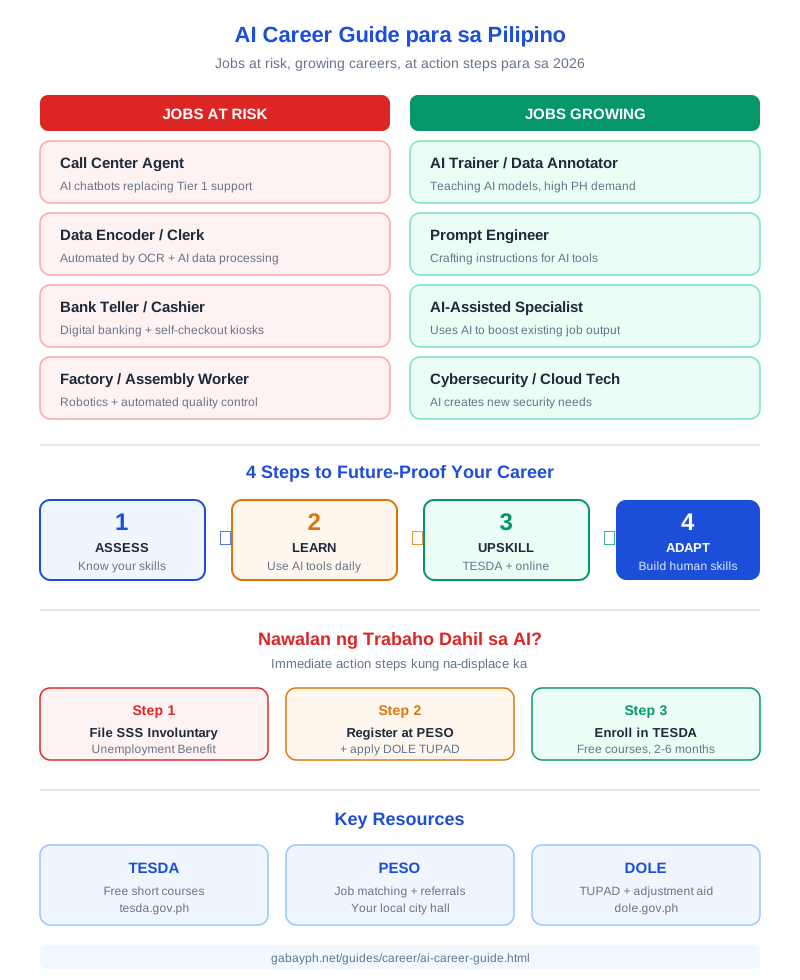
- Call center agents (Tier 1 support) — AI chatbots like those from major BPO clients now handle password resets, order tracking, and basic FAQs. Companies are reducing headcount for simple queries while keeping agents for complex issues.
- Data encoders and clerks — OCR and AI data extraction tools process documents faster and cheaper than manual encoding. Government and private offices are rapidly automating these roles.
- Bank tellers and cashiers — GCash, Maya, and digital banking have reduced foot traffic. Self-checkout kiosks are appearing in SM, Robinsons, and other malls.
- Factory and assembly workers — Automated quality control and robotic assembly are expanding in Philippine manufacturing, especially in electronics and food processing.
- Bookkeepers and basic accounting — AI accounting software automates invoicing, reconciliation, and basic financial reporting. Smaller firms no longer need dedicated bookkeepers.
- Call center agents (Tier 1 support) — Ang mga AI chatbot mula sa mga malalaking BPO client ay nag-hahandle na ng password resets, order tracking, at basic FAQs. Binabawasan ng mga kumpanya ang tao para sa simpleng queries habang kinokeep ang mga agent para sa complex issues.
- Data encoders at clerks — Ang OCR at AI data extraction tools ay nagpo-process ng documents nang mas mabilis at mura kaysa manual encoding. Ang mga opisina ng gobyerno at private sector ay mabilis na inautomate ang mga role na ito.
- Bank tellers at cashiers — Ang GCash, Maya, at digital banking ay nagpabawas ng foot traffic. Lumilitaw na ang self-checkout kiosks sa SM, Robinsons, at iba pang malls.
- Factory at assembly workers — Ang automated quality control at robotic assembly ay lumalawak sa Philippine manufacturing, lalo na sa electronics at food processing.
- Bookkeepers at basic accounting — Ang AI accounting software ay inautomate ang invoicing, reconciliation, at basic financial reporting. Hindi na kailangan ng mas maliliit na firms ng dedicated bookkeeper.
Jobs Growing Because of AI
Mga Trabahong Lumalaki Dahil sa AI
AI does not just eliminate jobs — it creates new ones, and Filipinos are well-positioned for many of them:
Hindi lang nag-aalis ng trabaho ang AI — gumagawa rin ito ng bago, at maganda ang posisyon ng mga Pilipino para sa marami sa mga ito:
- AI trainers and data annotators — Companies like Scale AI, Remotasks, and Telus International hire thousands of Filipinos to label data, evaluate AI responses, and train models. English fluency and cultural knowledge are competitive advantages.
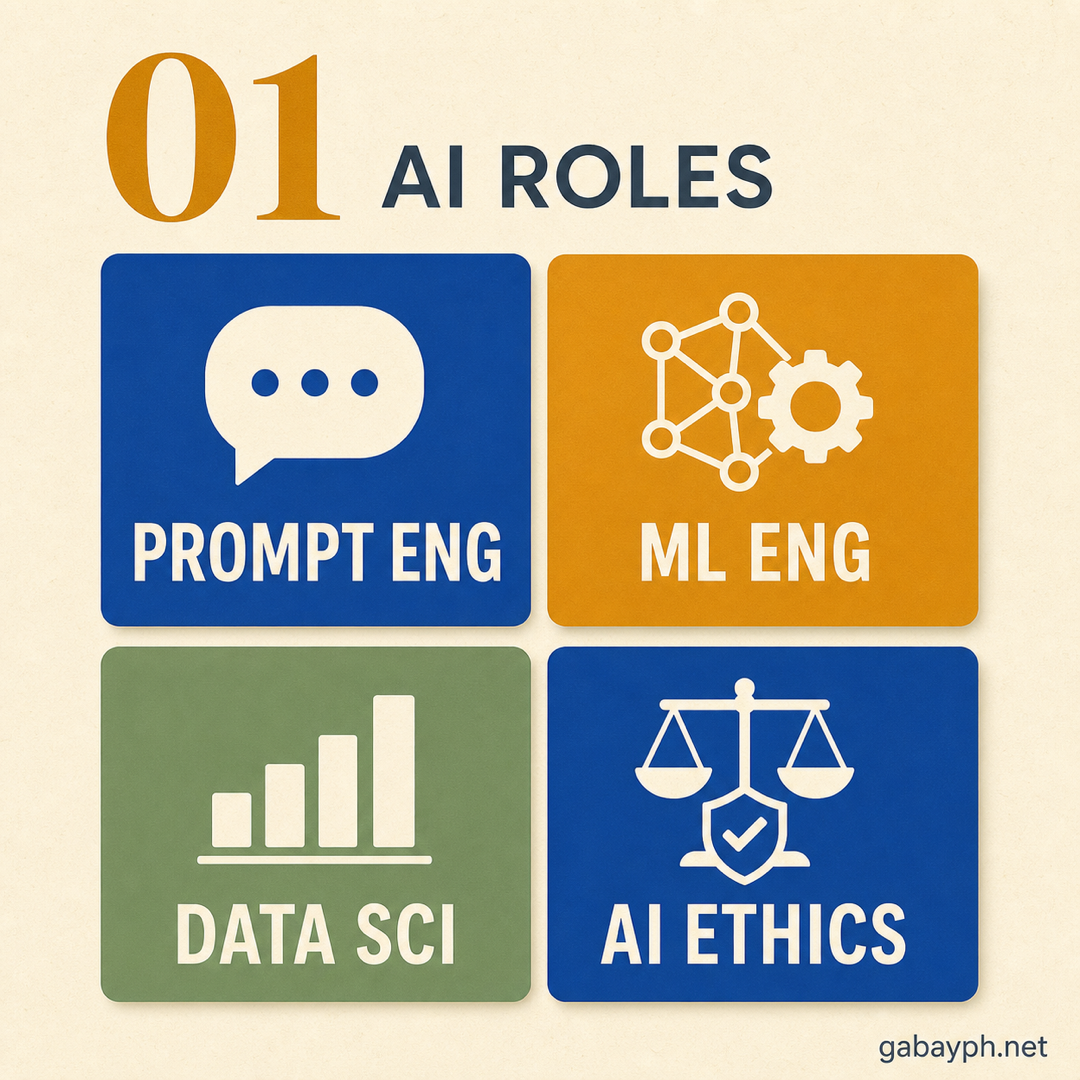
- Prompt engineers — A new role focused on writing effective instructions for AI tools. Demand is high in marketing agencies, tech companies, and BPO firms transitioning to AI-augmented operations.
- AI-assisted specialists — Customer service agents who use AI as a co-pilot, graphic designers using Canva AI or Midjourney, writers using AI for research — these hybrid roles are growing fast.
- Cybersecurity and cloud technicians — AI adoption creates new attack surfaces. Philippine companies need people who understand both security and AI systems.
- Healthcare and caregiving — AI cannot replace the empathy, physical presence, and cultural sensitivity of Filipino nurses, caregivers, and therapists. Demand continues to grow globally.
- Skilled trades — Electricians, plumbers, HVAC technicians, and construction workers are largely immune to AI automation. TESDA programs train for these roles.
- AI trainers at data annotators — Ang mga kumpanya tulad ng Scale AI, Remotasks, at Telus International ay kumukuha ng libu-libong Pilipino para mag-label ng data, mag-evaluate ng AI responses, at mag-train ng models. Ang English fluency at cultural knowledge ay mga competitive advantages.
- Prompt engineers — Isang bagong role na nakatuon sa pagsulat ng epektibong instructions para sa AI tools. Mataas ang demand sa marketing agencies, tech companies, at BPO firms na nagta-transition sa AI-augmented operations.
- AI-assisted specialists — Customer service agents na gumagamit ng AI bilang co-pilot, graphic designers na gumagamit ng Canva AI o Midjourney, writers na gumagamit ng AI para sa research — mabilis na lumalaki ang mga hybrid roles na ito.
- Cybersecurity at cloud technicians — Ang AI adoption ay gumagawa ng bagong attack surfaces. Kailangan ng mga kumpanyang Pilipino ang mga taong nakakaunawa sa parehong security at AI systems.
- Healthcare at caregiving — Hindi kayang palitan ng AI ang empathy, pisikal na presensya, at cultural sensitivity ng mga Pilipinong nurses, caregivers, at therapists. Patuloy na lumalaki ang demand sa buong mundo.
- Skilled trades — Ang mga electrician, plumber, HVAC technician, at construction worker ay halos hindi ma-automate ng AI. Ang mga TESDA program ay nagte-train para sa mga role na ito.
Step-by-Step: How to Future-Proof Your Career
Hakbang-hakbang: Paano I-future-proof ang Karera Mo
-
Assess Your Current Skills vs AI Capabilities
Write down your daily work tasks and honestly ask: can AI do this faster or cheaper? Tasks involving data entry, basic customer queries, scheduling, or template-based writing are high-risk. Tasks involving negotiation, physical work, creative judgment, or relationship-building are safer. The goal is not to panic — it is to know exactly where you stand.
-
Learn AI Tools for Your Industry
The fastest career insurance is knowing how to use AI, not compete against it. Start with these tools based on your field:
- Office workers: ChatGPT or Microsoft Copilot for drafting emails, reports, and summaries
- Designers and creatives: Canva AI, Midjourney, or Adobe Firefly for generating layouts and visuals
- Customer service: Learn how AI ticketing systems work (Zendesk AI, Freshdesk) so you can supervise them
- Sales and marketing: AI copywriting tools, social media schedulers with AI, and CRM automation
- Accountants: Xero, QuickBooks AI features, or local tools like JuanTax for automated tax filing
Spend 30 minutes a day practicing with one tool. In 2 weeks, you will be more skilled than 90% of your coworkers.
-
Upskill Through TESDA and Online Programs
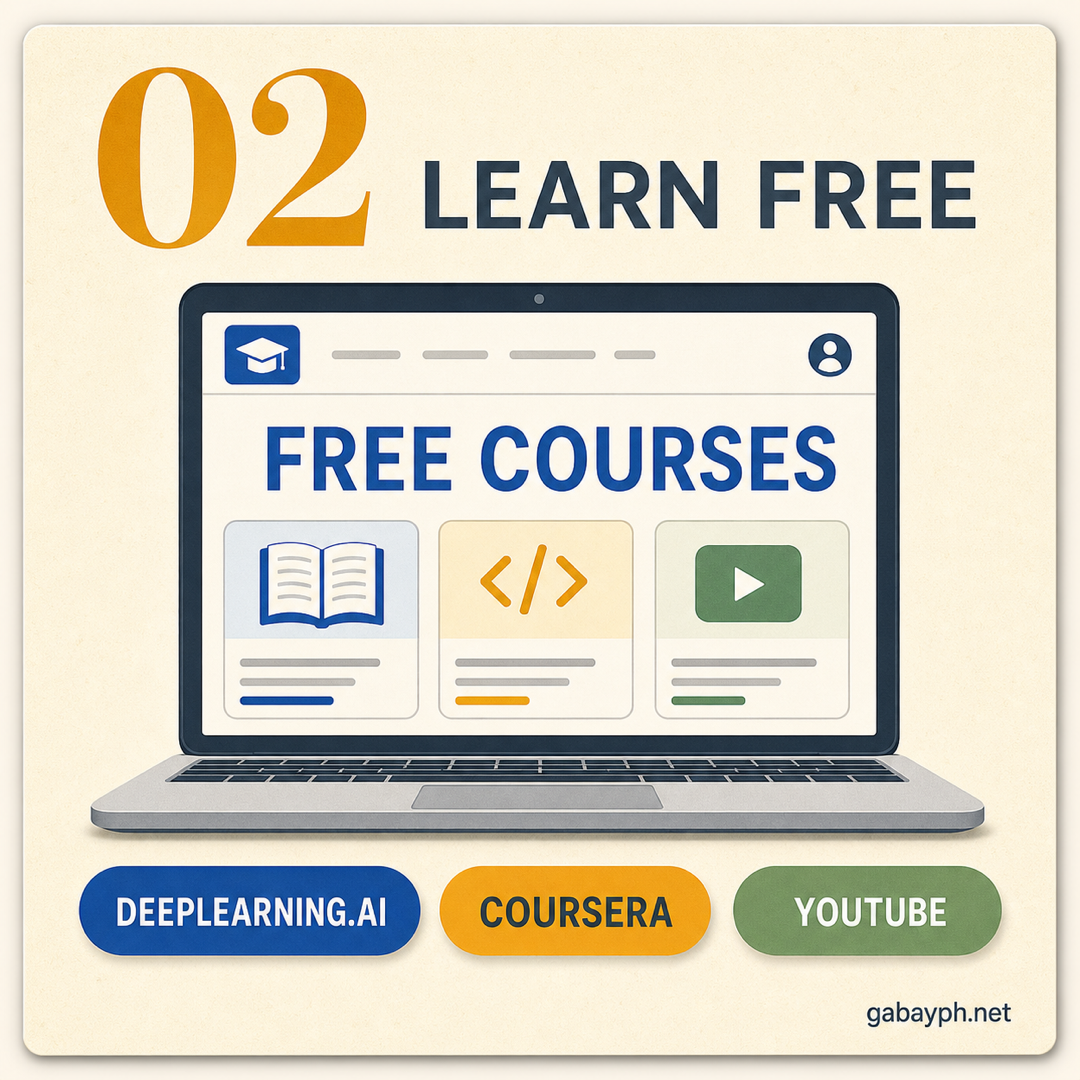
TESDA offers free short courses (2 to 6 months) in high-demand areas like IT, electronics, and healthcare. Many are available online through TESDA Online Program (TOP) at e-tesda.gov.ph. For AI-specific skills, Coursera (free to audit, or apply for financial aid for certificates), Google Digital Garage, and DICT's free ICT training programs are excellent starting points. See our complete TESDA guide for how to enroll.
-
I-assess ang Kasalukuyang Skills Mo vs AI Capabilities
Isulat ang mga daily work tasks mo at tanungin nang matapat: kaya ba itong gawin ng AI nang mas mabilis o mas mura? Ang mga gawaing may data entry, basic customer queries, scheduling, o template-based writing ay high-risk. Ang mga gawaing may negotiation, pisikal na trabaho, creative judgment, o relationship-building ay mas ligtas. Ang layunin ay hindi mag-panic — kundi malaman kung saan ka eksaktong nakatayo.
-
Matuto ng AI Tools para sa Industry Mo
Ang pinakamabilis na career insurance ay ang marunong gumamit ng AI, hindi makipagkumpetensya dito. Magsimula sa mga tools na ito batay sa field mo:
- Office workers: ChatGPT o Microsoft Copilot para sa paggawa ng emails, reports, at summaries
- Designers at creatives: Canva AI, Midjourney, o Adobe Firefly para sa paggawa ng layouts at visuals
- Customer service: Alamin kung paano gumagana ang AI ticketing systems (Zendesk AI, Freshdesk) para ma-supervise mo sila
- Sales at marketing: AI copywriting tools, social media schedulers na may AI, at CRM automation
- Accountants: Xero, QuickBooks AI features, o local tools tulad ng JuanTax para sa automated tax filing
Maglaan ng 30 minuto araw-araw para mag-practice ng isang tool. Sa loob ng 2 linggo, mas magiging skilled ka na kaysa sa 90% ng mga katrabaho mo.
-
Mag-upskill sa TESDA at Online Programs
Nag-aalok ang TESDA ng libreng short courses (2 hanggang 6 na buwan) sa high-demand areas tulad ng IT, electronics, at healthcare. Marami ang available online sa TESDA Online Program (TOP) sa e-tesda.gov.ph. Para sa AI-specific skills, Coursera (libre ang pag-audit, o mag-apply ng financial aid para sa certificates), Google Digital Garage, at DICT's free ICT training programs ay mahusay na simula. Tingnan ang aming kumpletong TESDA gabay para sa kung paano mag-enroll.
-
Build Skills AI Cannot Replace
AI is excellent at pattern recognition and data processing but poor at these distinctly human skills:
- Empathy and emotional intelligence — Understanding a customer's frustration, comforting a patient, or negotiating a deal requires human connection
- Creative problem-solving — AI generates based on patterns; humans innovate when rules do not apply
- Filipino cultural knowledge — Pakikisama, hiya, bayanihan, and local context are massive advantages in roles involving Filipino clients or communities
- Leadership and team management — AI cannot inspire a team, resolve interpersonal conflicts, or mentor junior employees
- Physical dexterity — Plumbing, electrical work, cooking, caregiving, and construction require hands and judgment that robots cannot match in Philippine settings
-
Explore Freelancing and Remote Work
The global demand for Filipino freelancers who can use AI tools is booming. Platforms like Upwork, OnlineJobs.ph, and Fiverr have categories specifically for AI-assisted work: content writing with AI, AI-enhanced virtual assistance, data annotation, and more. Freelancing lets you diversify income while building new skills. For tax guidance, see our freelancer tax guide. For overseas opportunities, check our OFW application guide.
-
Start a Side Income or Micro-Business
Do not put all your eggs in one basket. Use AI tools to accelerate a side business: AI can help you write product descriptions, manage social media, create marketing materials, and handle basic bookkeeping. A side income creates a safety net if your primary job is affected. For a step-by-step plan, see our guide to starting a small business or sari-sari store guide.
-
Buuin ang mga Skills na Hindi Kayang Palitan ng AI
Magaling ang AI sa pattern recognition at data processing pero mahina sa mga distinctly human skills na ito:
- Empathy at emotional intelligence — Ang pag-unawa sa frustration ng customer, pag-aliw sa pasyente, o pag-negotiate ng deal ay nangangailangan ng human connection
- Creative problem-solving — Gumagawa ang AI batay sa patterns; nag-iimbento ang tao kapag hindi applicable ang rules
- Filipino cultural knowledge — Ang pakikisama, hiya, bayanihan, at local context ay napakalaking advantages sa mga role na may Filipino clients o communities
- Leadership at team management — Hindi kaya ng AI na mag-inspire ng team, mag-resolve ng interpersonal conflicts, o mag-mentor ng junior employees
- Physical dexterity — Ang plumbing, electrical work, pagluluto, caregiving, at construction ay nangangailangan ng mga kamay at judgment na hindi mapapantayan ng robots sa Philippine setting
-
Mag-explore ng Freelancing at Remote Work
Ang global demand para sa mga Pilipinong freelancer na marunong gumamit ng AI tools ay bumuboom. Ang mga platform tulad ng Upwork, OnlineJobs.ph, at Fiverr ay may mga category na espesipiko para sa AI-assisted work: content writing gamit ang AI, AI-enhanced virtual assistance, data annotation, at iba pa. Ang freelancing ay nagbibigay-daan sa iyo na mag-diversify ng income habang nagbubuild ng bagong skills. Para sa tax guidance, tingnan ang aming gabay sa freelancer tax. Para sa overseas opportunities, tingnan ang aming gabay sa OFW application.
-
Magsimula ng Side Income o Micro-Business
Huwag ilagay ang lahat ng itlog mo sa isang basket. Gamitin ang AI tools para pabilisin ang side business: matutulungan ka ng AI na magsulat ng product descriptions, mag-manage ng social media, gumawa ng marketing materials, at mag-handle ng basic bookkeeping. Ang side income ay gumagawa ng safety net kung maapektuhan ang pangunahing trabaho mo. Para sa hakbang-hakbang na plano, tingnan ang aming gabay sa pagsisimula ng maliit na negosyo o gabay sa sari-sari store.
What to Do If You Already Lost Your Job to AI
Ano ang Gagawin Kung Nawalan Ka Na ng Trabaho Dahil sa AI
If you have already been laid off or your position was eliminated due to automation, here is your immediate action plan:
Kung na-lay off ka na o tinanggal ang posisyon mo dahil sa automation, narito ang immediate action plan mo:
-
File for SSS Involuntary Separation Unemployment Benefit
If you were a contributing SSS member and were terminated due to retrenchment, redundancy, or company closure (including AI-driven downsizing), you may qualify for the SSS Unemployment Benefit — 50% of your average monthly salary credit (AMSC) for 2 months, up to ₱20,000/month depending on your contribution history. You must file within 1 year of separation. See our SSS guide for the complete process and requirements.
-
Register at Your Local PESO
The Public Employment Service Office (PESO) is in every city and municipality. Registration is free and gives you access to job matching, referrals to companies hiring, career counseling, and livelihood programs. Bring your resume, valid ID, and Certificate of Employment from your previous employer. PESO also connects you to DOLE programs below.
-
Apply for DOLE TUPAD Emergency Employment
Tulong Panghanapbuhay sa Ating Disadvantaged/Displaced Workers (TUPAD) provides emergency employment for 10 to 30 days at minimum wage. This is meant as a bridge while you retrain. Apply at your nearest DOLE Field Office or through your PESO. Requirements: valid ID, proof of displacement or unemployment, and barangay certificate.
-
Enroll in TESDA Short Courses (Free, 2-6 Months)
TESDA offers free training in over 200 qualifications. For displaced workers, priority courses include: IT and web development, electronics servicing, healthcare (caregiving, medical transcription), and skilled trades. The TESDA Online Program lets you start immediately from home. After completing a course, you receive a National Certificate (NC) recognized by employers. See our TESDA guide for the full enrollment process.
-
Explore Government Adjustment Programs
Several government programs assist displaced workers:
- DOLE Adjustment Measures Program — Financial assistance of up to ₱5,000–₱10,000 for workers displaced by company closures or retrenchment, plus retraining support
- CHED Expanded Tertiary Education Equivalency and Accreditation Program (ETEEAP) — Earn a college degree based on work experience and training, even without finishing formal schooling
- DICT Free ICT Training — The Department of Information and Communications Technology offers free digital skills courses through various programs nationwide
- DSWD Sustainable Livelihood Program — Microenterprise development assistance for low-income households including skills training and seed capital
-
Mag-file ng SSS Involuntary Separation Unemployment Benefit
Kung ikaw ay contributing SSS member at tinanggal dahil sa retrenchment, redundancy, o company closure (kasama ang AI-driven downsizing), maaari kang maging kuwalipikado para sa SSS Unemployment Benefit — 50% ng iyong average monthly salary credit (AMSC) sa loob ng 2 buwan, hanggang ₱20,000/buwan depende sa contribution history mo. Kailangan mong mag-file sa loob ng 1 taon pagkatapos ng separation. Tingnan ang aming gabay sa SSS para sa kumpletong proseso at requirements.
-
Magparehistro sa Local PESO Mo
Ang Public Employment Service Office (PESO) ay nasa bawat lungsod at munisipalidad. Libre ang registration at nagbibigay-daan sa job matching, referrals sa mga kumpanyang kumukuha, career counseling, at livelihood programs. Magdala ng resume, valid ID, at Certificate of Employment mula sa dating employer. Ikinokonekta ka rin ng PESO sa mga DOLE program sa ibaba.
-
Mag-apply para sa DOLE TUPAD Emergency Employment
Ang Tulong Panghanapbuhay sa Ating Disadvantaged/Displaced Workers (TUPAD) ay nagbibigay ng emergency employment sa loob ng 10 hanggang 30 araw sa minimum wage. Ito ay pansamantalang tulong habang nagre-retrain ka. Mag-apply sa pinakamalapit na DOLE Field Office o sa pamamagitan ng PESO mo. Requirements: valid ID, pruweba ng displacement o kawalan ng trabaho, at barangay certificate.
-
Mag-enroll sa TESDA Short Courses (Libre, 2-6 Buwan)
Nag-aalok ang TESDA ng libreng training sa mahigit 200 qualifications. Para sa displaced workers, ang mga priority courses ay: IT at web development, electronics servicing, healthcare (caregiving, medical transcription), at skilled trades. Ang TESDA Online Program ay nagbibigay-daan sa iyong magsimula kaagad mula sa bahay. Pagkatapos ng kurso, makakatanggap ka ng National Certificate (NC) na kinikilala ng mga employer. Tingnan ang aming gabay sa TESDA para sa kumpletong proseso ng enrollment.
-
Mag-explore ng Government Adjustment Programs
Maraming programa ng gobyerno ang tumutulong sa mga displaced workers:
- DOLE Adjustment Measures Program — Pinansyal na tulong na hanggang ₱5,000–₱10,000 para sa mga workers na na-displace dahil sa company closures o retrenchment, kasama ang retraining support
- CHED Expanded Tertiary Education Equivalency and Accreditation Program (ETEEAP) — Kumita ng college degree batay sa work experience at training, kahit hindi nakatapos ng pormal na pag-aaral
- DICT Free ICT Training — Ang Department of Information and Communications Technology ay nag-aalok ng libreng digital skills courses sa iba't ibang programa sa buong bansa
- DSWD Sustainable Livelihood Program — Microenterprise development assistance para sa low-income households kasama ang skills training at seed capital
Free and Low-Cost Resources for Filipinos
Libre at Murang Resources para sa mga Pilipino
- TESDA Online Program (e-tesda.gov.ph) — Free courses in IT, entrepreneurship, agriculture, and more. Self-paced, accessible from any device.
- Coursera — Free to audit most courses; apply for financial aid to get certificates at no cost. Popular choices include Google IT Support, Data Analytics, and Project Management certificates.
- Google Digital Garage — Free certification in digital marketing fundamentals, recognized by employers globally.
- DICT ICT Programs — Free training in web development, cybersecurity, and data science offered through regional training centers.
- Microsoft Learn — Free learning paths in AI fundamentals, Azure cloud, and productivity tools.
- LinkedIn Learning (via public libraries) — Some Philippine public libraries provide free access. Check your local library.
- freeCodeCamp.org — Completely free coding curriculum. Learn JavaScript, Python, or data visualization at your own pace.
- TESDA Online Program (e-tesda.gov.ph) — Libreng courses sa IT, entrepreneurship, agriculture, at iba pa. Self-paced, accessible mula sa kahit anong device.
- Coursera — Libre ang pag-audit ng karamihan ng courses; mag-apply ng financial aid para makuha ang certificates nang walang bayad. Mga popular na pagpipilian: Google IT Support, Data Analytics, at Project Management certificates.
- Google Digital Garage — Libreng certification sa digital marketing fundamentals, kinikilala ng mga employer sa buong mundo.
- DICT ICT Programs — Libreng training sa web development, cybersecurity, at data science na ino-offer sa mga regional training centers.
- Microsoft Learn — Libreng learning paths sa AI fundamentals, Azure cloud, at productivity tools.
- LinkedIn Learning (sa pamamagitan ng public libraries) — May ilang Philippine public libraries na nagbibigay ng libreng access. I-check ang local library mo.
- freeCodeCamp.org — Ganap na libreng coding curriculum. Matuto ng JavaScript, Python, o data visualization sa sarili mong bilis.
Pro Tips
Mga Payo
- "AI-proof" does not mean "tech job" — A plumber who can troubleshoot smart home systems, a caregiver who documents patient data digitally, or a sari-sari store owner using inventory apps are all AI-proof. The goal is to combine your existing skills with digital literacy.
- Join Filipino AI communities — Facebook groups like "AI Philippines," "Prompt Engineers PH," and "Data Annotation Jobs PH" share real job leads, free resources, and advice from Filipinos who have successfully transitioned.
- Document your AI skills on your resume — Employers now specifically look for lines like "Proficient in ChatGPT for customer communications" or "Experience with AI-assisted content creation." Add these even for small wins.
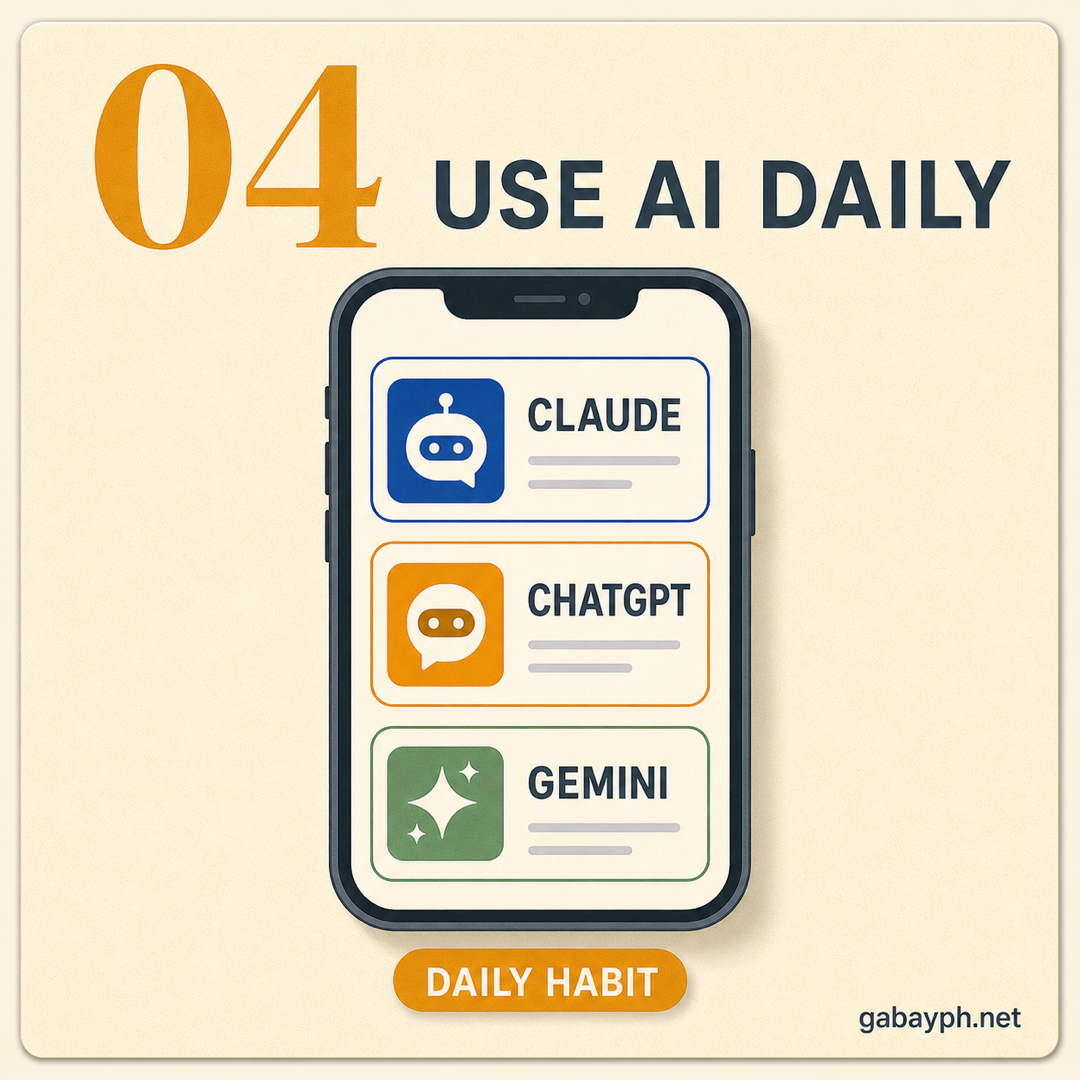
- Use the "30-minute rule" — Spend 30 minutes daily learning one AI tool. Consistency beats cramming. In 3 months, you will have practical skills most people only talk about wanting.
- Negotiate AI into your current role — Before your company automates your job, propose using AI tools to make your team more productive. The person who brings the solution keeps the seat.
- "AI-proof" ay hindi ibig sabihin na "tech job" — Ang isang plumber na kayang i-troubleshoot ang smart home systems, isang caregiver na digitally nagdo-document ng patient data, o isang sari-sari store owner na gumagamit ng inventory apps ay lahat AI-proof. Ang layunin ay pagsamahin ang existing skills mo sa digital literacy.
- Sumali sa Filipino AI communities — Ang mga Facebook groups tulad ng "AI Philippines," "Prompt Engineers PH," at "Data Annotation Jobs PH" ay nagbabahagi ng totoong job leads, libreng resources, at payo mula sa mga Pilipinong matagumpay na nag-transition.
- I-document ang AI skills mo sa resume — Hinahanap na ngayon ng mga employer ang mga linyang tulad ng "Proficient in ChatGPT for customer communications" o "Experience with AI-assisted content creation." Idagdag ang mga ito kahit para sa maliliit na tagumpay.
- Gamitin ang "30-minute rule" — Maglaan ng 30 minuto araw-araw sa pag-aaral ng isang AI tool. Mas maganda ang consistency kaysa cramming. Sa 3 buwan, magkakaroon ka ng practical skills na karamihan ng tao ay pinag-uusapan lang na gusto.
- I-negotiate ang AI sa kasalukuyang role mo — Bago i-automate ng kumpanya mo ang trabaho mo, mag-propose na gumamit ng AI tools para gawing mas productive ang team mo. Ang taong nagdadala ng solusyon ang nananatili sa upuan.
Frequently Asked Questions
Mga Madalas Itanong
Will AI take all jobs in the Philippines?
No. AI will transform many roles but not eliminate all of them. Jobs requiring physical presence, empathy, complex decision-making, and cultural context are resistant to automation. The bigger risk is refusing to adapt — workers who learn to use AI alongside their skills will be in higher demand, not lower.
Kukunin ba ng AI ang lahat ng trabaho sa Pilipinas?
Hindi. Babaguhin ng AI ang maraming role pero hindi aalisin lahat. Ang mga trabahong nangangailangan ng pisikal na presensya, empathy, complex decision-making, at cultural context ay resistant sa automation. Ang mas malaking risk ay ang pagtanggi na mag-adapt — ang mga workers na matutong gumamit ng AI kasabay ng skills nila ay mas magiging in demand, hindi bababa.
What is the safest career path right now?
Healthcare (nursing, caregiving, therapy), skilled trades (electrician, plumber, HVAC), and roles that combine human judgment with AI tools (AI-assisted customer success, AI-enhanced project management) are among the safest. No single career is 100% safe — the safest strategy is continuous learning.
Ano ang pinaka-safe na career path ngayon?
Healthcare (nursing, caregiving, therapy), skilled trades (electrician, plumber, HVAC), at mga role na nagko-combine ng human judgment sa AI tools (AI-assisted customer success, AI-enhanced project management) ang kabilang sa pinaka-safe. Walang iisang career na 100% safe — ang pinaka-safe na strategy ay patuloy na pag-aaral.
Do I need to learn coding to be AI-proof?
Not necessarily. Coding is valuable but not required. Knowing how to use AI tools (prompting, evaluating output, integrating into workflows) is more important for most roles. If you want to go deeper into tech, start with Python through freeCodeCamp — it is the most AI-relevant language.
Kailangan ko bang matuto ng coding para maging AI-proof?
Hindi naman. Valuable ang coding pero hindi required. Mas importante para sa karamihan ng roles ang marunong gumamit ng AI tools (prompting, pag-evaluate ng output, pag-integrate sa workflows). Kung gusto mong mas lumalim sa tech, magsimula sa Python sa freeCodeCamp — ito ang pinaka-AI-relevant na language.
Is the BPO industry in the Philippines dying?
It is transforming, not dying. Simple voice and chat support roles are declining, but the industry is shifting toward higher-value services: AI training, content moderation, complex problem resolution, and AI-augmented operations. BPO workers who upskill into these areas will remain employable.
Namamatay na ba ang BPO industry sa Pilipinas?
Nagbabago ito, hindi namamatay. Ang mga simpleng voice at chat support roles ay bumababa, pero ang industriya ay lumilipat sa higher-value services: AI training, content moderation, complex problem resolution, at AI-augmented operations. Ang mga BPO workers na mag-upskill sa mga area na ito ay mananatiling employable.
How do I get started as an AI trainer or data annotator?
Sign up on platforms like Remotasks, Scale AI, Telus International, or Appen. Most require only a laptop, stable internet, and English proficiency — no degree needed. Pay ranges from ₱15,000 to ₱40,000/month depending on project complexity. Search Facebook groups for "Data Annotation PH" for community tips and job leads.
Paano ako magsisimula bilang AI trainer o data annotator?
Mag-sign up sa mga platform tulad ng Remotasks, Scale AI, Telus International, o Appen. Karamihan ay nangangailangan lang ng laptop, stable na internet, at English proficiency — walang degree na kailangan. Ang sahod ay mula ₱15,000 hanggang ₱40,000/buwan depende sa complexity ng project. Maghanap sa Facebook groups ng "Data Annotation PH" para sa community tips at job leads.
Can I use AI tools for my current job without getting in trouble?
Check your company's AI policy first — some employers restrict AI use for sensitive data. For general productivity (drafting emails, summarizing documents, brainstorming), most companies are encouraging AI adoption. When in doubt, ask your manager and never input confidential company data into public AI tools.
Puwede ko bang gamitin ang AI tools sa kasalukuyang trabaho ko nang walang problema?
I-check muna ang AI policy ng kumpanya mo — may mga employer na naglilimita sa paggamit ng AI para sa sensitive data. Para sa general productivity (pag-draft ng emails, pag-summarize ng documents, brainstorming), karamihan ng kumpanya ay hinihikayat ang AI adoption. Kapag hindi sigurado, magtanong sa manager mo at huwag kailanman mag-input ng confidential company data sa public AI tools.