

How to Contest an MMDA Traffic Violation (2026 Guide)
Paano I-contest ang MMDA Traffic Violation (2026 Guide)
The 5-Step Walkthrough
Dispute an MMDA violation in five steps.
Quick Summary
Mabilis na Buod
Table of Contents
- The Short Answer
- Physical Apprehension vs NCAP
- NCAP Current Status (2026)
- The 7-Day Window — Start the Clock Right
- Step-by-Step: Contest in Person at TAB
- Step-by-Step: Contest NCAP Online
- 4 Common Grounds to Dispute
- What Enforcers CANNOT Do
- MMDA Fines Schedule
- What Happens at the Hearing
- Pro Tips
- Frequently Asked Questions
Talaan ng Nilalaman
- Maikling Sagot
- Physical Apprehension vs NCAP
- Kasalukuyang Status ng NCAP (2026)
- Ang 7-Araw na Window — Simulan Mo Tama
- Hakbang-Hakbang: Mag-contest sa TAB
- Hakbang-Hakbang: Mag-contest ng NCAP Online
- 4 na Karaniwang Grounds para Mag-dispute
- Hindi Pwedeng Gawin ng Enforcer
- MMDA Fines Schedule
- Ano ang Mangyayari sa Hearing
- Mga Payo
- Mga Madalas Itanong
The Short Answer
Maikling Sagot
Inihabol ka ng MMDA enforcer, or you got an NCAP notice in the mail? You have 7 calendar days from the date of apprehension (or from when you received the NCAP notice) to formally contest the violation. File your protest at the MMDA Traffic Adjudication Board (TAB) inside the MMDA Main Office in Pasig City. Bring your Ordinance Violation Receipt (OVR) or Traffic Violation Report (TVR) or NCAP notice, your driver's license, the vehicle's OR/CR, and any evidence you have (dashcam footage, photos, witness statements). If you miss the 7-day window, the violation generally becomes final and you will have to pay the fine before you can renew your license or registration.
Inihabol ka ng MMDA enforcer, o may NCAP notice ka sa koreo? Mayroon kang 7 araw mula sa petsa ng apprehension (o mula nung nareceive mo ang NCAP notice) para pormal na i-contest ang violation. I-file ang iyong protest sa MMDA Traffic Adjudication Board (TAB) sa loob ng MMDA Main Office sa Pasig City. Dalhin ang iyong Ordinance Violation Receipt (OVR) o Traffic Violation Report (TVR) o NCAP notice, ang driver's license mo, ang OR/CR ng sasakyan, at anumang evidence (dashcam footage, photos, witness statements). Kapag na-miss mo ang 7-day window, magiging final na ang violation at kailangan mong magbayad bago ka maka-renew ng license o registration.
Physical Apprehension vs NCAP — What's Different
Physical Apprehension vs NCAP — Ano ang Pinagkaiba
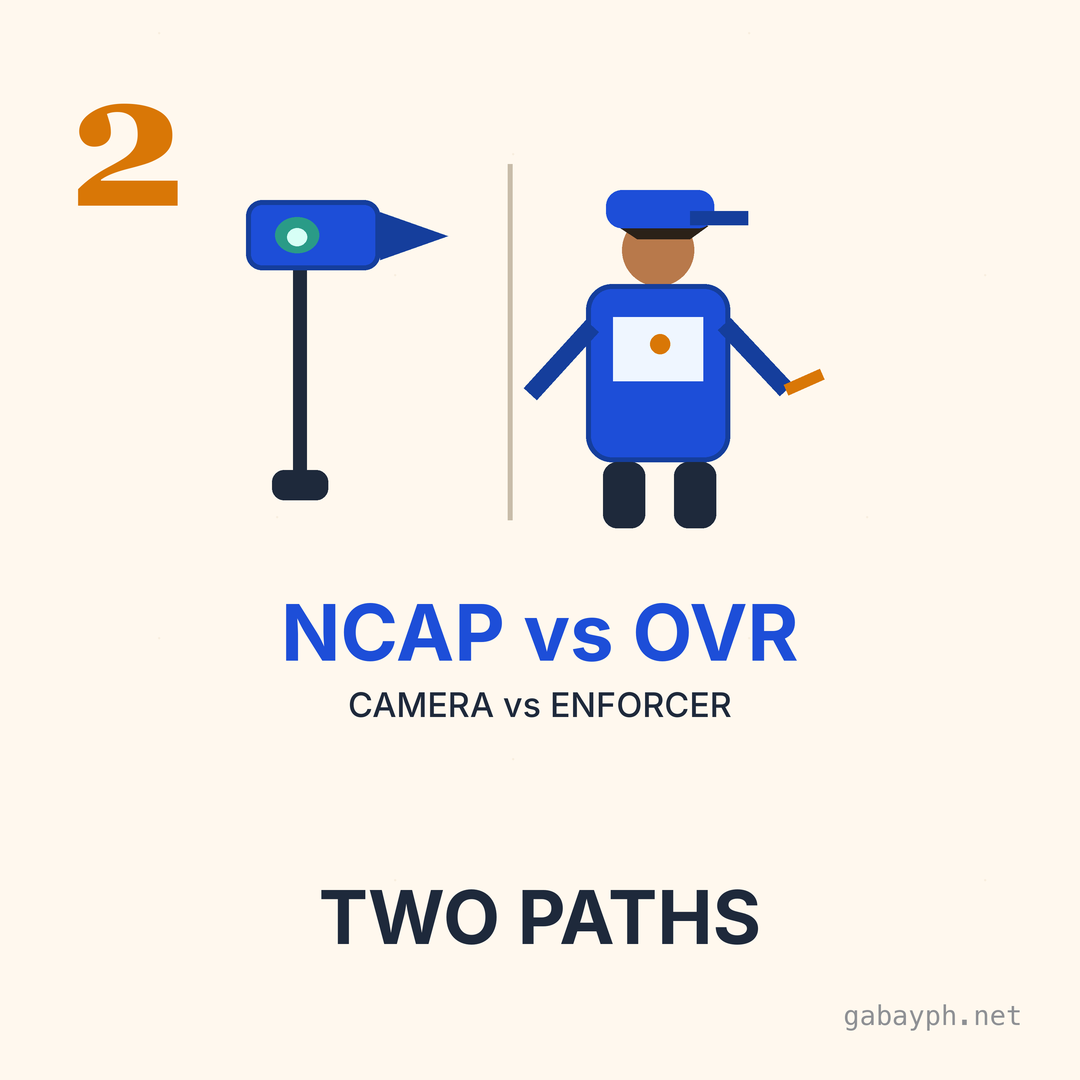
There are two ways the MMDA can cite you for a violation, and the contest process is slightly different for each.
Dalawang paraan ang pwedeng gamitin ng MMDA para ma-cite ka, at iba-iba ang contest process para sa bawat isa.
Physical Apprehension (Flagged Down by an Enforcer)
Physical Apprehension (Inihabol ng Enforcer)
An MMDA enforcer flags you down on the road. They are required to issue you an Ordinance Violation Receipt (OVR) or Traffic Violation Report (TVR) at the scene. The OVR/TVR lists the violation, the date and time, the location, the enforcer's name and badge number, and the fine. You should still be able to drive away — the enforcer cannot impound your vehicle or confiscate your driver's license for ordinary violations. Your 7-day window starts from the date written on the OVR/TVR.
Inihabol ka ng MMDA enforcer sa kalsada. Required silang mag-issue ng Ordinance Violation Receipt (OVR) o Traffic Violation Report (TVR) sa lugar mismo. Nakasulat sa OVR/TVR ang violation, petsa at oras, lokasyon, pangalan at badge number ng enforcer, at multa. Pwede ka pa rin tumuloy magmaneho — hindi pwedeng i-impound ng enforcer ang sasakyan mo o kumpiskahin ang license mo para sa mga ordinaryong violation. Magsisimula ang 7-day window mo sa petsa na nasa OVR/TVR.
NCAP (Camera-Based Citation)
NCAP (Camera-Based Citation)
The No Contact Apprehension Policy uses CCTV and traffic cameras to catch violations. No enforcer flags you down — instead, weeks later, a Notice of Violation arrives by mail at the address of the vehicle's registered owner (per the LTO database). The notice includes a photo of the alleged violation, your plate number, the date and location, the violation, and the fine. Your 7-day window starts from the date you received the notice, not the date of the violation itself. Hold on to the envelope — the postmark proves when you received it, in case of a dispute about timing.
Gumagamit ang No Contact Apprehension Policy ng CCTV at traffic cameras para mahuli ang mga violation. Walang enforcer na hihinto sa iyo — sa halip, makakatanggap ka ng Notice of Violation via koreo sa address ng registered owner ng sasakyan (per LTO database) kalaunan. May photo ng alleged violation, plate number mo, petsa at lokasyon, violation, at multa. Magsisimula ang 7-day window mo mula sa petsa nang na-receive mo ang notice, hindi mula sa petsa ng violation mismo. Itago ang envelope — patunay ang postmark kung kailan mo nareceive, in case may dispute sa timing.
NCAP Current Status (2026)
Kasalukuyang Status ng NCAP (2026)
NCAP has had a complicated legal history. Here is what you need to know as of May 2026:
May kumplikadong legal history ang NCAP. Eto ang kailangan mong malaman as of Mayo 2026:
- August 2022: The Supreme Court issued a Temporary Restraining Order (TRO) suspending NCAP implementation by the MMDA and five LGUs (Manila, Quezon City, Valenzuela, Parañaque, and Muntinlupa).
- May 2025: The Supreme Court partially lifted the TRO, allowing the MMDA to resume NCAP enforcement on Metro Manila thoroughfares while it manages the EDSA rehabilitation. The original five LGUs that were named in the 2022 case remain under suspension.
- As of 2026: MMDA NCAP is active on major roads like EDSA, C-5, Roxas Boulevard, and other primary Metro Manila routes under MMDA jurisdiction. Always verify the current status at mmda.gov.ph before assuming a notice is valid — a violation issued during a period when NCAP was suspended in your area is itself contestable.
- Agosto 2022: Nag-issue ang Supreme Court ng Temporary Restraining Order (TRO) na sinuspende ang NCAP ng MMDA at limang LGU (Manila, Quezon City, Valenzuela, Parañaque, at Muntinlupa).
- Mayo 2025: Partially lifted ng SC ang TRO, pinapayagan ang MMDA na ipagpatuloy ang NCAP sa Metro Manila thoroughfares habang minamanage nila ang EDSA rehabilitation. Ang limang LGU sa 2022 case ay suspended pa rin.
- As of 2026: Aktibo ang MMDA NCAP sa major roads gaya ng EDSA, C-5, Roxas Boulevard, at iba pang primary Metro Manila routes na nasa MMDA jurisdiction. Palaging i-verify ang current status sa mmda.gov.ph bago mong assume na valid ang notice — kung naissue ang violation habang suspended ang NCAP sa area mo, contestable rin yun.
MMDA has jurisdiction over primary Metro Manila roads — but not all LGU roads. If your violation was issued on a barangay road or an LGU-controlled street, the citing authority may not be MMDA at all. Check the OVR/TVR or NCAP notice carefully — different agencies have different contestation procedures.
May jurisdiction ang MMDA sa primary Metro Manila roads — pero hindi sa lahat ng LGU roads. Kung naissue ang violation mo sa barangay road o LGU-controlled street, maaaring hindi MMDA ang citing authority. Tingnan mabuti ang OVR/TVR o NCAP notice — magkaiba ang contestation procedures ng iba't-ibang ahensya.
The 7-Day Window — Start the Clock Right
Ang 7-Araw na Window — Simulan Mo Tama
This is the single most important rule: you have 7 calendar days to contest. Day 0 is the trigger date, and you must file your protest within the next 7 days. Miss it and the violation usually becomes final.
Ito ang pinakaimportanteng rule: mayroon kang 7 calendar days para mag-contest. Day 0 ang trigger date, at kailangan mo nang i-file ang protest mo sa loob ng susunod na 7 araw. Pag na-miss mo, magiging final na ang violation.
- Physical apprehension: Day 0 = the date on the OVR/TVR (the day the enforcer flagged you down).
- NCAP notice: Day 0 = the date you received the notice. Keep the envelope with the postmark. If the LTO database has an outdated address and the notice took weeks to reach you, the delay is on the MMDA, not on you.
- Saturday, Sunday, holiday? The MMDA TAB office is typically open weekdays only. If your day 7 falls on a weekend or holiday, file the next business day — but it is safer to go earlier rather than test that exception.
- Physical apprehension: Day 0 = ang petsa sa OVR/TVR (ang araw na inihabol ka).
- NCAP notice: Day 0 = ang petsa nang na-receive mo ang notice. Itago ang envelope na may postmark. Kung outdated ang address mo sa LTO database at nag-ilang linggo ang notice bago dumating sa iyo, kasalanan yun ng MMDA, hindi mo.
- Sabado, Linggo, holiday? Karaniwang weekdays lang bukas ang MMDA TAB office. Kung sa weekend o holiday tumama ang day 7 mo, mag-file sa susunod na business day — pero mas safe na maaga ka pumunta kaysa subukan yung exception.
If you missed the 7-day window because of a legitimate reason (you were hospitalized, abroad, or never actually received the notice), you can still try filing a motion for reconsideration with a sworn affidavit explaining the delay. TAB may or may not entertain it — but it costs you nothing to try.
Kung na-miss mo ang 7-day window dahil sa legitimate reason (na-confine ka, nasa abroad, o talagang hindi mo nareceive ang notice), pwede ka pa rin mag-file ng motion for reconsideration na may sworn affidavit na nag-eexplain sa delay. Maaaring entertain o hindi yan ng TAB — pero walang masama sa pag-try.
Step-by-Step: How to Contest in Person at TAB
Hakbang-Hakbang: Paano Mag-contest sa TAB
-
Gather Your Evidence Within 24 Hours
Mag-ipon ng Evidence sa Loob ng 24 Oras
Memory and digital evidence fade fast. Within 24 hours of getting the OVR/TVR or NCAP notice, secure everything that could help your case:
Mabilis kumupas ang memory at digital evidence. Sa loob ng 24 oras matapos kumuha ng OVR/TVR o NCAP notice, i-secure ang lahat na pwedeng makatulong sa case mo:
- Dashcam footage — back it up immediately to a phone or cloud drive. Some dashcams overwrite after a few days.
- Phone photos — if you took any during the apprehension or visited the location later, save them.
- The OVR/TVR or NCAP notice — photograph both sides, save the envelope and postmark for NCAP.
- Witness contact info — passengers, drivers nearby, anyone who saw what happened.
- Google Maps screenshot — of the alleged location, useful when challenging signage, lane markings, or whether the road is even under MMDA jurisdiction.
- Dashcam footage — i-backup agad sa phone o cloud drive. May mga dashcam na nag-o-overwrite after ilang araw.
- Phone photos — kung may nakuha ka habang inihahabol o nung bumalik ka sa location, i-save.
- Ang OVR/TVR o NCAP notice — i-photograph parehong gilid, i-save ang envelope at postmark para sa NCAP.
- Witness contact info — pasahero, malapit na driver, sino mang nakakita.
- Google Maps screenshot — ng alleged location, useful sa pag-challenge ng signage, lane markings, o kung talagang nasa MMDA jurisdiction ba ang kalsada.
-
Write Your Contest Letter
Sumulat ng Contest Letter
A formal contest letter (also called a "protest letter") is the document you submit to TAB. It should be short, clear, and focused on facts. Include:
Ang formal contest letter (tinatawag ding "protest letter") ang dokumentong i-submit mo sa TAB. Dapat maikli, malinaw, at focused sa facts. Isama ang:
- Your full name, address, contact number, and driver's license number
- The OVR/TVR number or NCAP citation number
- The date, time, and location of the alleged violation
- A factual statement of what actually happened (or didn't happen) — short, no drama
- Your specific ground for contesting (no violation occurred, wrong plate, wrong driver, due process violation — see 4 grounds below)
- A list of attached evidence
- Your signature and the date
- Buong pangalan mo, address, contact number, at driver's license number
- Ang OVR/TVR number o NCAP citation number
- Petsa, oras, at lokasyon ng alleged violation
- Factual statement kung ano ang talagang nangyari (o hindi nangyari) — maikli, walang drama
- Ang specific ground mo sa pag-contest (no violation, mali ang plate, mali ang driver, due process violation — tignan ang 4 grounds sa baba)
- Listahan ng nakalakip na evidence
- Pirma mo at ang petsa
If your defense relies on a sworn statement — for example, "I was not the driver, my brother was" — that part should be in a separate notarized affidavit. Notarization costs around ₱100–₱300 at most law offices. Without notarization, sworn statements carry much less weight at the hearing.
Kung ang depensa mo ay nakasalig sa sworn statement — halimbawa, "hindi ako ang driver, ang kapatid ko" — dapat nasa hiwalay na notarized affidavit yan. Mga ₱100–₱300 ang notarization sa karamihan ng law offices. Kapag walang notarization, mahina ang bigat ng sworn statement sa hearing.
-
Go to the MMDA Traffic Adjudication Board
Pumunta sa MMDA Traffic Adjudication Board
The MMDA main office is in Pasig City, at the intersection of Doña Julia Vargas Avenue and Molave Street, Ugong (across the EDSA-Ortigas area). The MMDA moved here in 2022 from the old Guadalupe Nuevo address — some online guides still point to the old location, so go to mmda.gov.ph for the latest map and office hours before you head out.
Nasa Pasig City ang MMDA main office, sa intersection ng Doña Julia Vargas Avenue at Molave Street, Ugong (katapat ng EDSA-Ortigas area). Lumipat dito ang MMDA noong 2022 mula sa lumang Guadalupe Nuevo address — may mga online guide na sa lumang lokasyon pa rin nagpapunta, kaya tingnan muna sa mmda.gov.ph ang latest map at office hours bago ka umalis.
Bring with you:
Dalhin ang:
- Original OVR/TVR or NCAP notice (plus a photocopy)
- Your valid driver's license (or photo of it — they cannot keep it)
- Vehicle's OR/CR (or photocopy)
- Your contest letter and notarized affidavit (if applicable)
- All evidence: dashcam footage on a USB stick, printed photos, witness affidavits
- Two valid IDs (sometimes a second ID is asked for cross-verification)
- Original na OVR/TVR o NCAP notice (kasama ang photocopy)
- Valid na driver's license (o photo nito — hindi nila pwedeng itago)
- OR/CR ng sasakyan (o photocopy)
- Contest letter at notarized affidavit (kung applicable)
- Lahat ng evidence: dashcam footage sa USB, printed photos, witness affidavits
- Dalawang valid ID (minsan may second ID na hinihingi para sa cross-verification)
-
Submit and Get a Hearing Date
I-submit at Kumuha ng Hearing Date
At the TAB office, you will submit your contest letter and supporting documents to the receiving clerk. They will stamp your copy as "received" with the date — keep that stamped copy. It is your proof that you filed within the 7-day window.
Sa TAB office, isusumite mo ang contest letter at supporting documents sa receiving clerk. Ita-stamp nila ang kopya mo bilang "received" with the date — itago mo yung stamped copy. Ito ang patunay na nag-file ka within the 7-day window.
You will then be assigned a hearing date. Hearings are usually scheduled within a few weeks of filing. The TAB clerk will give you the date, time, and the room number. Save it in your phone and set a reminder.
Bibigyan ka ng hearing date. Karaniwang ilang linggo lang from filing ang schedule. Bibigyan ka ng TAB clerk ng petsa, oras, at room number. I-save mo sa phone at mag-set ng reminder.
-
Attend the Hearing
Pumunta sa Hearing
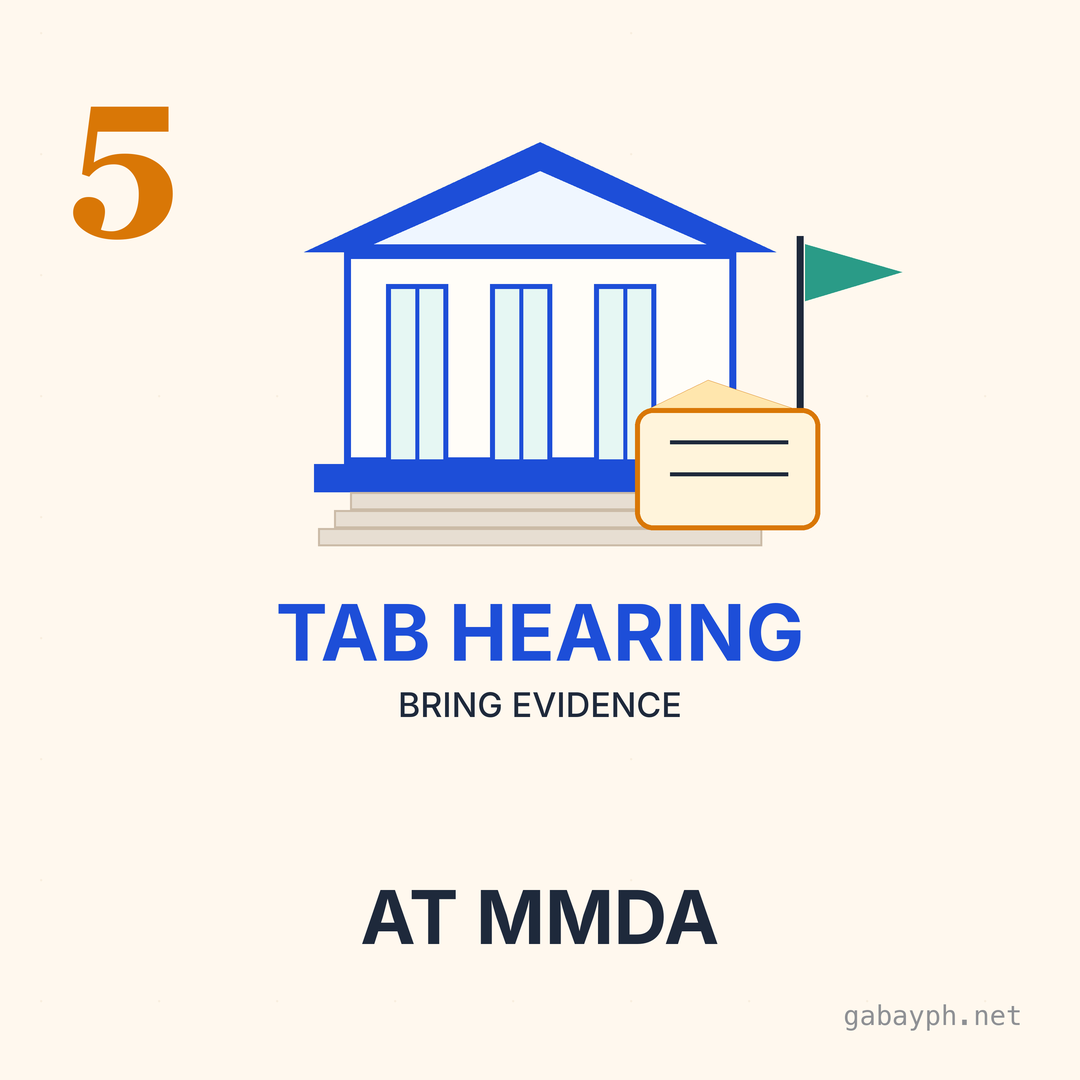
On your hearing date, show up at least 30 minutes early. Bring all originals and photocopies. The hearing is informal — see "What Happens at the Hearing" below for details. In most cases, the TAB will issue a decision on the same day or within a few weeks.
Sa hearing date mo, mag-show up at least 30 minutes early. Dalhin lahat ng original at photocopy. Informal ang hearing — tignan ang "Ano ang Mangyayari sa Hearing" sa baba. Sa karamihan ng cases, magde-desisyon ang TAB sa parehong araw o ilang linggo lang.
Step-by-Step: How to Contest NCAP Online
Hakbang-Hakbang: Paano Mag-contest ng NCAP Online
The MMDA has periodically offered an online contestation option for NCAP violations to reduce TAB foot traffic. The URL and availability change frequently — verify the current portal at mmda.gov.ph before relying on this route. The "May Huli Ka" platform at mayhulika.mmda.gov.ph is typically used to check whether you have any outstanding violations.
May periodic online contestation option ang MMDA para sa NCAP violations para mabawasan ang foot traffic sa TAB. Madalas magpalit ang URL at availability — i-verify ang current portal sa mmda.gov.ph bago umasa dito. Ang "May Huli Ka" platform sa mayhulika.mmda.gov.ph ay karaniwang ginagamit para tingnan kung may outstanding violations ka.
The general online process looks like this:
Ganito karaniwan ang online process:
- Go to the current NCAP contestation portal (verify URL at mmda.gov.ph — it has changed multiple times).
- Enter your citation number from the NCAP notice, plus your plate number and the date of violation.
- View the official NCAP photo evidence. This alone is often enough to win a contest — many notices have unclear photos, wrong plate readings, or photos that do not actually show the violation.
- Fill in the protest form with your statement and the ground for contest.
- Upload your evidence (dashcam, photos, affidavit) — usually PDF or JPG, with a file size limit.
- Submit and screenshot the acknowledgment page immediately. Online systems sometimes lose entries; that screenshot is your only proof.
- Wait for an email or SMS with the TAB decision or a notice to attend an in-person hearing.
- Pumunta sa current NCAP contestation portal (i-verify ang URL sa mmda.gov.ph — ilang beses na ito nagpalit).
- I-enter ang citation number mula sa NCAP notice, plus plate number at petsa ng violation.
- Tingnan ang official NCAP photo evidence. Madalas, sapat na ito para manalo sa contest — maraming notice na malabo ang photo, mali ang plate reading, o hindi naman talaga ipinapakita ng photo ang violation.
- Punan ang protest form with your statement at ang ground sa pag-contest.
- I-upload ang evidence mo (dashcam, photos, affidavit) — karaniwang PDF o JPG, may file size limit.
- I-submit at i-screenshot agad ang acknowledgment page. Minsan nawawala ang entries sa online systems; yung screenshot lang ang patunay mo.
- Maghintay ng email o SMS with the TAB decision o notice na pumunta sa in-person hearing.
If the online portal is unavailable or down on your day 6 or 7, go directly to the TAB in Pasig — do not let a broken website cost you the 7-day window. The in-person filing is the authoritative path.
Kung down o unavailable ang online portal sa day 6 o 7 mo, dumiretso ka sa TAB sa Pasig — huwag hayaan na ma-miss mo ang 7-day window dahil sa sirang website. Ang in-person filing ang authoritative na path.
4 Common Grounds to Dispute
4 na Karaniwang Grounds para Mag-dispute
Your contest letter should clearly state which of these grounds applies. Pick the strongest one — you can list more than one, but a focused argument usually wins over a scattered one.
Dapat malinaw sa contest letter mo kung alin sa mga ground na ito ang applicable. Piliin ang pinakamalakas — pwede kang mag-list ng higit sa isa, pero mas nananalo ang focused na argument kaysa scattered.
1. No Actual Violation Occurred
1. Walang Aktwal na Violation na Nangyari
You have evidence the cited act did not happen. Examples: your dashcam shows the light was still green when you crossed (so you were not "beating the red"), GPS data shows you were not in the cited location at the cited time, or photos show your vehicle was already in the lane before the no-entry sign. This is the strongest ground because it is a factual challenge supported by independent evidence.
May evidence kang hindi nangyari ang act na cited. Mga halimbawa: ipinapakita ng dashcam mo na green pa ang ilaw nung tumawid ka (hindi ka "beating the red"), nagpapakita ang GPS data na hindi ka nasa cited location sa cited time, o ipinapakita ng photos na nasa lane ka na bago ang no-entry sign. Ito ang pinakamalakas na ground kasi factual challenge na supported ng independent evidence.
2. NCAP Photo Is Unclear, Wrong Plate, or Doesn't Show the Violation
2. Malabo ang NCAP Photo, Mali ang Plate, o Hindi Nakikita ang Violation
NCAP photos must clearly show your plate number AND the violation itself. Common defects: the plate is partially obscured by another vehicle, the photo is taken from too far away, motion blur makes the plate ambiguous, or the photo shows the vehicle but not the violation (e.g., a "swerving" citation with no second photo showing the lane change). Demand the original raw image, not just the compressed PDF that came with the notice — many contests are won simply because the raw image cannot be produced or doesn't actually show what the notice claims.
Dapat malinaw na nakikita sa NCAP photos ang plate number AT ang violation mismo. Mga karaniwang depekto: na-block ng ibang sasakyan ang plate, masyadong malayo ang kuha, blur dahil sa motion, o nakikita ang sasakyan pero hindi ang violation (hal., "swerving" citation na walang second photo na nagpapakita ng lane change). I-demand ang original raw image, hindi yung compressed PDF na kasama sa notice — maraming nanalo dahil hindi mai-produce ang raw image o hindi naman talaga ipinapakita ng raw image ang ini-allege.
3. Wrong Driver or Wrong Vehicle
3. Mali ang Driver o Mali ang Sasakyan
The NCAP notice goes to the registered owner of the vehicle, but the registered owner may not be the actual driver at the time. If a family member, friend, or employee was driving, you can file a notarized affidavit identifying the actual driver. Include the actual driver's name, address, and license number. Once the actual driver is identified, the citation transfers to them.
Ang NCAP notice ay napupunta sa registered owner ng sasakyan, pero hindi laging siya ang driver sa oras na yon. Kung family member, kaibigan, o empleyado ang nagmamaneho, pwede kang mag-file ng notarized affidavit na nag-identify sa actual driver. Isama ang pangalan, address, at license number ng actual driver. Pag na-identify na ang actual driver, lilipat sa kanya ang citation.
A separate but related case: if your vehicle was sold but not yet transferred in the LTO records, file an affidavit with a copy of the deed of sale and the buyer's details. If your vehicle was stolen, file the police report from the stolen-vehicle incident along with your affidavit.
Hiwalay pero related na case: kung nabenta na pero hindi pa na-transfer sa LTO ang sasakyan mo, mag-file ng affidavit kasama ang kopya ng deed of sale at details ng bumili. Kung nanakaw ang sasakyan mo, i-file ang police report ng stolen-vehicle incident kasama ng affidavit mo.
4. Due Process Violation by the MMDA
4. Due Process Violation ng MMDA
MMDA enforcers have to follow their own rules — when they skip those rules, the citation itself becomes contestable. Common due-process defects:
Kailangang sundin ng MMDA enforcers ang sarili nilang rules — pag nilampasan nila yon, contestable na rin ang citation mismo. Mga karaniwang due-process depekto:
- No OVR/TVR was issued at the scene — for physical apprehension, the enforcer must hand you a paper citation on the spot. A verbal "may violation ka" with no paper trail is not a valid citation.
- NCAP notice received past a reasonable time — if the notice arrives months after the alleged violation due to delayed mailing, you can argue the delay itself is a due-process problem.
- Enforcer refused to identify themselves — you have the right to ask for the enforcer's name, badge number, and assigned station, and they must provide it.
- NCAP citation issued during a TRO-suspension period — if your alleged violation occurred while NCAP was legally suspended in that LGU or jurisdiction, the citation is void.
- Walang OVR/TVR na in-issue sa scene — para sa physical apprehension, dapat binibigyan ka ng enforcer ng paper citation sa lugar mismo. Hindi valid citation ang verbal "may violation ka" na walang paper trail.
- Late ang NCAP notice nang ilang buwan — kapag late nang ilang buwan ang notice dahil sa delayed mailing, pwede mong i-argue na due-process problem ito.
- Tumanggi ang enforcer na ipakilala ang sarili — karapatan mo na hingin ang pangalan ng enforcer, badge number, at assigned station, at obligado siyang ibigay.
- NCAP citation na in-issue habang TRO-suspended ang NCAP — kung naissue ang alleged violation habang suspended ang NCAP sa LGU o jurisdiction na yon, void ang citation.
What MMDA Enforcers CANNOT Do
Hindi Pwedeng Gawin ng MMDA Enforcers
Knowing what the law actually allows is half the battle. MMDA enforcers do have authority under RA 7924 to cite violations and impose fines, but they do NOT have authority to do any of the following on the spot:
Malaki ang tulong ng pagkaalam mo kung ano talaga ang pinapayagan ng batas. May authority ang MMDA enforcers under RA 7924 na mag-cite ng violations at mag-impose ng fines, pero WALA silang authority na gawin ang mga sumusunod sa lugar mismo:
- Confiscate your driver's license. Under LTO Memorandum Circular series guidance and the Boysillo doctrine, MMDA enforcers cannot keep your physical license card for ordinary violations. You should be issued the OVR/TVR and allowed to keep your license. If they try to take it, ask politely but firmly for the legal basis, and note the enforcer's name and badge number. (Verify current LTO/MMDA policy with mmda.gov.ph and lto.gov.ph — there have been multiple back-and-forth memos.)
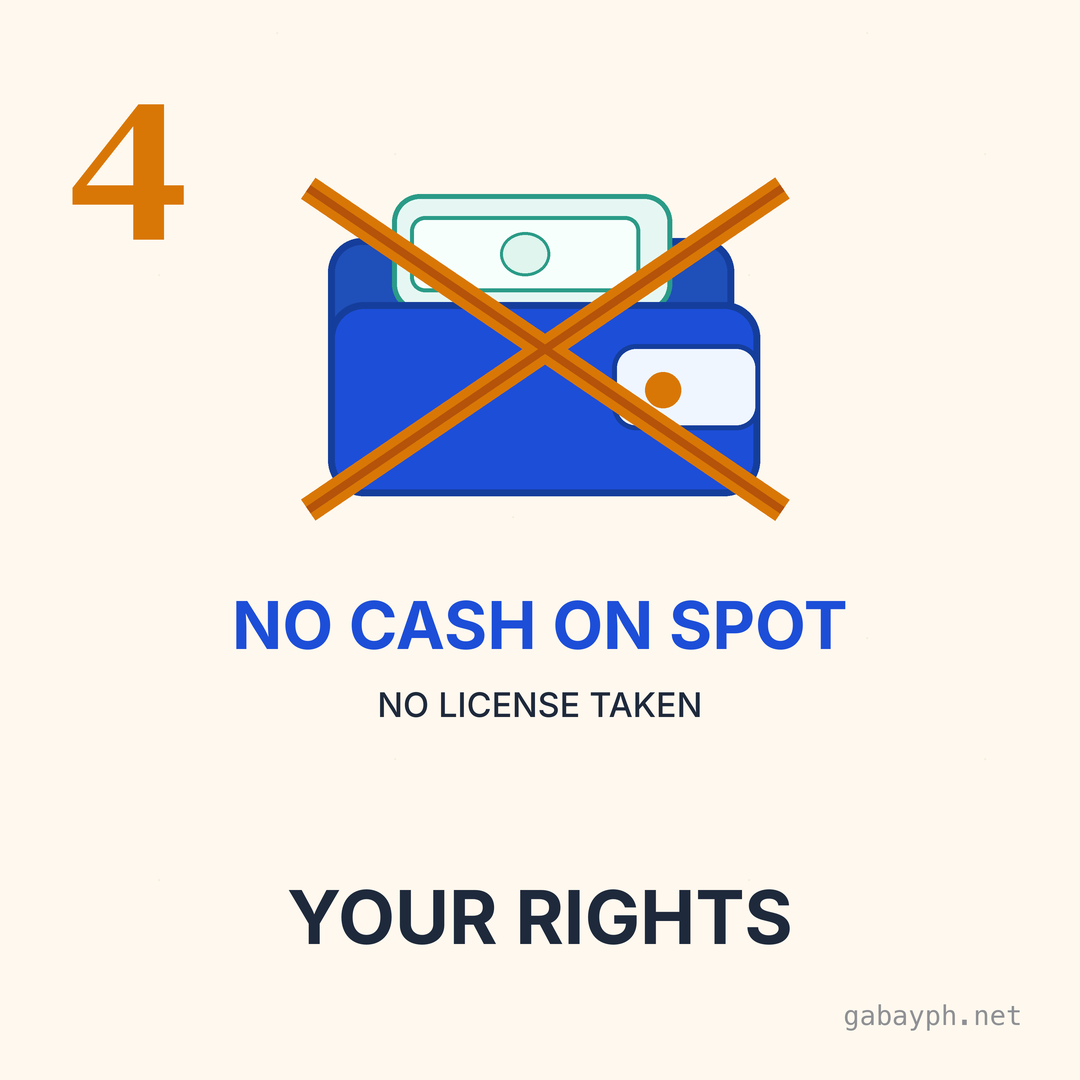
- Demand cash payment "on the spot." All fines must be paid at official MMDA payment counters, partner banks, or accredited online payment channels. An enforcer asking for cash on the roadside is committing extortion — record the conversation if it is safe, get the name and badge, and report to the MMDA hotline at 136.
- Refuse to issue an OVR/TVR. For a physical apprehension, the paper citation is mandatory. Without it, you have no notice of what you allegedly did wrong, no way to contest, and the citation itself is procedurally defective.
- Impound your vehicle for an ordinary moving violation. Impoundment is reserved for specific categories like driving without a license, expired registration, or DUI under RA 10586 — not for things like number coding violations, illegal parking, or beating the red.
- Detain you on the side of the road. Once the OVR/TVR is issued, you are free to go. Prolonged "discussions" after the citation is written can be reported.
- Kumpiskahin ang driver's license mo. Sa ilalim ng LTO Memorandum Circular series at Boysillo doctrine, hindi pwedeng itago ng MMDA enforcers ang physical license card mo para sa ordinaryong violations. Dapat bigyan ka ng OVR/TVR at pahintulutang itago ang license. Kung subukan nilang kunin, hingin nang magalang pero firm ang legal basis, at i-note ang pangalan at badge number ng enforcer. (I-verify ang current LTO/MMDA policy sa mmda.gov.ph at lto.gov.ph — maraming back-and-forth memos na lumalabas.)
- Hingiin ang cash payment "on the spot." Lahat ng fines ay binabayaran sa official MMDA payment counters, partner banks, o accredited online payment channels. Ang enforcer na humihingi ng cash sa kalsada ay nag-eextort — i-record ang usapan kung safe, kunin ang pangalan at badge, at mag-report sa MMDA hotline 136.
- Tumanggi na mag-issue ng OVR/TVR. Mandatory ang paper citation sa physical apprehension. Kung wala, wala kang notice kung ano daw ang ginawa mong mali, walang paraan na mag-contest, at procedurally defective na rin ang citation mismo.
- I-impound ang sasakyan mo para sa ordinaryong moving violation. Reserved ang impoundment para sa specific categories tulad ng driving without a license, expired registration, o DUI under RA 10586 — hindi para sa number coding, illegal parking, o beating the red.
- I-detain ka sa gilid ng kalsada. Pagka-issue ng OVR/TVR, malaya ka nang umalis. Pwedeng i-report ang prolonged "usapan" pagkatapos maisulat ang citation.
MMDA Fines Schedule (Common Violations)
MMDA Fines Schedule (Karaniwang Violations)
Below is an approximate fines schedule for the most common Metro Manila traffic violations. Fines are set by MMDA Memorandum Circulars and updated periodically — verify the current amount at mmda.gov.ph before paying. Repeat offenses usually escalate the fine.
Nasa baba ang tinatayang fines schedule para sa pinakakaraniwang Metro Manila traffic violations. Itinatakda ng MMDA Memorandum Circulars ang fines at periodically ina-update — i-verify ang current amount sa mmda.gov.ph bago magbayad. Karaniwang tumataas ang multa sa repeat offenses.
- Beating the red lightBeating the red light (paglampas ng pula): ₱2,000
- Counterflow / wrong-way drivingCounterflow / pagpunta sa kabilang direksyon: ₱2,000
- Reckless drivingReckless driving: ₱2,000 – ₱5,000 (depending on offense countdepende sa offense count)
- Disregarding traffic signs or signalsHindi pag-sunod sa traffic signs o signals: ₱1,000 – ₱2,000
- Illegal U-turn / illegal left/right turnIllegal U-turn / illegal left/right turn: ₱500 – ₱1,000
- Number coding violationNumber coding violation: ₱500 (verify; some LGUs charge morei-verify; mas mataas sa ibang LGU)
- No helmet (motorcycle)Walang helmet (motorsiklo): ₱500 / ₱750 / ₱1,000 (first, second, third offense under RA 10054first, second, third offense under RA 10054)
- Illegal parkingIllegal parking: ₱500
- ObstructionObstruction: ₱1,000
- Driving without a licensePagmaneho nang walang lisensya: ₱3,000 (LTO administrative penaltyLTO administrative penalty)
- Driving under the influence (DUI, RA 10586)DUI (RA 10586): ₱20,000 + (plus possible license suspension and jail timeplus license suspension at posibleng kulong)
Some violations have graduated penalties — first offense, second offense, and so on. Repeat offenders may also face license suspension. Always check the OVR/TVR for the specific fine being assessed before paying.
May mga violation na graduated penalties — first offense, second offense, at iba pa. Pwede ring ma-suspend ang license ng repeat offenders. Palaging tignan ang specific na multa na nakasaad sa OVR/TVR bago magbayad.
What Happens at the Hearing
Ano ang Mangyayari sa Hearing
TAB hearings are informal administrative proceedings, not court trials. They are usually held in a small room at the MMDA Pasig office. The mood is bureaucratic, not adversarial — but you should still prepare like it matters, because it does.
Ang TAB hearings ay informal administrative proceedings, hindi court trials. Karaniwang nasa maliit na room sa MMDA Pasig office. Bureaucratic ang vibe, hindi adversarial — pero mag-prepare ka pa rin parang importante, kasi nga importante naman.
How a hearing typically goes
Karaniwang takbo ng hearing
- The TAB officer (a hearing officer, not necessarily a judge) calls your case number.
- You confirm your identity and your filing.
- The officer summarizes the citation and asks for your side.
- You present your contest letter, affidavit, and evidence. You can show dashcam footage, photos, or read from your written statement. Speak slowly and clearly.
- The apprehending enforcer (for physical apprehension) may or may not attend. If they don't show up to defend the citation, that often works in your favor — but the TAB has discretion to reschedule.
- The officer asks questions, you answer.
- The decision is issued — sometimes on the same day, sometimes within a few weeks by mail or SMS.
- Tatawagin ng TAB officer (hearing officer, hindi necessarily judge) ang case number mo.
- Iko-confirm mo ang identity at filing mo.
- Iso-summarize ng officer ang citation at hihingin ang side mo.
- I-present mo ang contest letter, affidavit, at evidence. Pwede mong i-show ang dashcam footage, photos, o basahin ang written statement mo. Mag-salita ka nang mabagal at malinaw.
- Ang apprehending enforcer (para sa physical apprehension) ay maaaring pumunta o hindi. Kung hindi siya pumunta para mag-defend, madalas yon ang umuubra para sa iyo — pero may discretion ang TAB na mag-reschedule.
- May mga tanong ang officer, sasagot ka.
- Ilalabas ang desisyon — minsan sa parehong araw, minsan sa loob ng ilang linggo via mail o SMS.
Do you need a lawyer?
Kailangan ba ng abogado?
No — lawyers are allowed but not required. Most contests are won (or lost) on the documentary evidence, not on legal argumentation. If your case is straightforward (clear dashcam footage, obvious wrong-plate NCAP photo, sworn affidavit identifying actual driver), you do not need a lawyer. If your case involves an accident with injury, a serious DUI charge, or potential license revocation, consult a lawyer.
Hindi — pwedeng may abogado pero hindi required. Karamihan ng contests ay nananalo (o natatalo) sa documentary evidence, hindi sa legal argumentation. Kung straightforward ang case mo (malinaw na dashcam footage, obvious na wrong-plate NCAP photo, sworn affidavit na nag-identify sa actual driver), hindi mo kailangan ng abogado. Kung involves accident na may injury, serious DUI charge, o potential license revocation, kumonsulta sa abogado.
If you lose: the appeal path
Kung natalo ka: ang appeal path
If the TAB rules against you and you believe there was a serious error, you can file a motion for reconsideration with the TAB itself within a short period (typically 15 days — verify with the officer). If that also fails, the next step is filing a petition with the regular courts (Regional Trial Court via Rule 65 special civil action, or the appropriate appellate body). At that point, you really should consult a lawyer — court-level petitions have strict formatting rules and filing fees.
Kung kontra ang ruling ng TAB at sa tingin mo may serious error, pwede kang mag-file ng motion for reconsideration sa TAB mismo sa loob ng maikling period (karaniwang 15 araw — i-verify sa officer). Kapag ulit nabigo yon, ang susunod ay mag-file ng petition sa regular courts (Regional Trial Court via Rule 65 special civil action, o sa appropriate appellate body). At that point, kailangan mo na talaga ng abogado — strict ang formatting rules at may filing fees sa court-level petitions.
Pro Tips
Mga Payo
- Always ask the enforcer for their name, badge number, and assigned station — and write it down. Documentation wins contests. If the enforcer refuses to identify themselves, that is itself a procedural violation. Take a photo of their uniform name tag if you can.
- If the NCAP photo shows the wrong plate or is unclear, demand the original raw image — not the compressed PDF. Most NCAP denials are won at this point because the raw image either cannot be produced or visibly does not show what the notice claims. Put the demand in your contest letter explicitly.
- Screenshot the NCAP portal acknowledgment IMMEDIATELY after online submission. Online systems sometimes lose entries, and the screenshot is your only proof you filed on time. Email it to yourself for a permanent timestamp.
- Install a dashcam — it is the single best investment for any Metro Manila driver. A ₱2,000–₱5,000 dashcam pays for itself the first time you successfully contest an NCAP violation. Front-and-rear models are best.
- Keep your LTO-registered address updated. If your NCAP notice goes to an old address and you receive it late (or not at all), you may miss the 7-day window through no fault of your own. Update at portal.lto.gov.ph after every move.
- Lagi mong hingin ang pangalan, badge number, at assigned station ng enforcer — at isulat. Documentation ang panalo sa contest. Kung tumanggi ang enforcer na ipakilala ang sarili, procedural violation na rin yon. I-photo ang uniform name tag kung kaya mo.
- Kung mali ang plate sa NCAP photo o malabo, i-demand ang original raw image — hindi yung compressed PDF. Madalas, dito nananalo ang NCAP denials kasi alinman ay hindi mai-produce ang raw image o visibly hindi nito ipinapakita ang ini-allege. I-explicit ang demand sa contest letter mo.
- I-screenshot AGAD ang NCAP portal acknowledgment pagka-submit online. Minsan nawawala ang entries ng online systems, at screenshot lang ang patunay mong nag-file ka on time. I-email sa sarili mo para may permanenteng timestamp.
- Mag-install ng dashcam — ito ang pinakamahalagang investment para sa Metro Manila driver. Babayaran ng ₱2,000–₱5,000 na dashcam ang sarili nito sa unang matagumpay mong NCAP contest. Pinakamaganda ang front-and-rear models.
- Updated dapat ang LTO-registered address mo. Kung sa lumang address dumating ang NCAP notice mo at late mo nareceive (o hindi mo nareceive), pwedeng ma-miss mo ang 7-day window kahit hindi naman kasalanan mo. I-update sa portal.lto.gov.ph pagkatapos ng paglipat.
Frequently Asked Questions
Mga Madalas Itanong
Can the MMDA enforcer confiscate my driver's license?
Generally no for ordinary moving violations. Under current LTO Memorandum Circular guidance and case law (the Boysillo doctrine), MMDA enforcers should issue you an OVR/TVR and allow you to retain your physical license. For DUI under RA 10586 or other serious offenses, suspension or revocation procedures may apply — but those are administrative actions ordered by the LTO, not on-the-spot confiscation by an enforcer. Verify current policy at mmda.gov.ph and lto.gov.ph — these rules have changed several times.
Pwede bang i-confiscate ng MMDA enforcer ang license ko?
Karaniwang hindi para sa ordinaryong moving violations. Sa ilalim ng current LTO Memorandum Circular at case law (Boysillo doctrine), dapat bigyan ka ng MMDA enforcer ng OVR/TVR at pahintulutang itago ang physical license mo. Para sa DUI under RA 10586 o iba pang serious offenses, maaaring mag-apply ang suspension o revocation procedures — pero administrative actions yan ng LTO, hindi on-the-spot confiscation ng enforcer. I-verify ang current policy sa mmda.gov.ph at lto.gov.ph — ilang beses na nagbago ang mga rules na ito.
I already paid the fine — can I still contest?
Once you have paid the fine, the case is typically considered settled and very difficult to reopen — paying is treated as an admission of the violation. There may be narrow exceptions if you paid under protest and clearly noted it (in writing, with a copy retained), or if you can prove fraud or coercion in the citation. In practice, this is the most common reason people lose: they pay first to clear the record for a license renewal, then try to contest later. Contest first, pay only if you lose.
May binayaran na ako — pwede pa ba i-contest?
Pagka-bayad mo ng multa, karaniwang itinuturing nang settled ang case at napakahirap na buksan ulit — itinuturing na admission ng violation ang pagbabayad. May narrow exceptions kung nagbayad ka under protest at malinaw na in-note (in writing, with retained copy), o kung mapapatunayan mong may fraud o coercion sa citation. In practice, ito ang pinakakaraniwang dahilan ng pagkatalo: nagbabayad muna para mailinis ang record para sa license renewal, tapos saka mag-co-contest. I-contest muna, magbayad lang kung natalo ka.
What if I missed the 7-day window?
The 7-day window is the standard rule, but TAB has limited discretion to entertain late filings if you can show a legitimate reason — hospitalization, abroad, never received the notice due to a wrong address in the LTO database, or similar. File a motion for reconsideration with a sworn affidavit explaining the delay, and attach proof (medical records, immigration stamps, returned mail). The TAB may or may not accept it. If they refuse, your remaining option is the formal court appeal route — but at that point, weigh the cost of a lawyer against the fine itself.
Paano kung na-miss ko ang 7-day window?
Standard rule ang 7-day window, pero may limited discretion ang TAB na entertain ng late filings kung makapagpakita ka ng legitimate reason — confinement, abroad, hindi mo nareceive ang notice dahil mali ang address sa LTO database, o ganon. Mag-file ng motion for reconsideration na may sworn affidavit na nag-eexplain sa delay, at i-attach ang proof (medical records, immigration stamps, returned mail). Pwedeng tanggapin o hindi ng TAB. Kung tumanggi, ang remaining option mo ay ang formal court appeal route — pero sa puntong yon, weigh-hin mo ang gastos sa abogado kontra sa multa mismo.
Can I contest an NCAP violation if someone else was driving my car?
Yes. NCAP notices go to the registered owner because the camera captures the plate, not the driver's face. You can file a notarized affidavit identifying the actual driver at the time of the alleged violation, including their full name, address, contact, and driver's license number. The citation will be transferred to the actual driver. This is a clean, well-recognized defense — just make sure the affidavit is properly notarized and the actual driver is identifiable.
Pwede ko bang i-contest ang NCAP violation kung iba ang nagmaneho ng kotse ko?
Oo. Napupunta ang NCAP notices sa registered owner kasi plate ang nakukuha ng camera, hindi ang mukha ng driver. Pwede kang mag-file ng notarized affidavit na nag-identify sa actual driver sa oras ng alleged violation, kasama ang buong pangalan, address, contact, at driver's license number. Lilipat ang citation sa actual driver. Malinis at well-recognized na depensa ito — basta siguruhin lang na properly notarized ang affidavit at identifiable ang actual driver.
What if the NCAP photo doesn't clearly show my plate?
This is one of the strongest grounds to dispute. The MMDA should be able to produce a clear photograph of the violation AND of the plate. In your contest letter, explicitly demand the original raw image file, not just the compressed image in the PDF notice. Many notices are dropped at this stage because the raw image either cannot be produced, has motion blur, was taken from too far, or shows a different plate number than what the notice alleges. The contestation often succeeds simply because the evidence does not meet the standard.
Paano kung di malinaw na nakikita ang plate ko sa NCAP photo?
Isa ito sa pinakamalakas na grounds para mag-dispute. Dapat kayang i-produce ng MMDA ang malinaw na photo ng violation AT ng plate. Sa contest letter mo, i-explicit ang demand sa original raw image file, hindi yung compressed image sa PDF notice. Maraming notice ang na-drop sa stage na ito kasi alinman ay hindi mai-produce ang raw image, may motion blur, masyadong malayo ang kuha, o iba ang plate number sa ini-allege ng notice. Madalas, dito lang nag-succeed ang contestation kasi hindi met ng evidence ang standard.
Does the apprehending enforcer have to show up at my hearing?
For physical apprehensions, the apprehending enforcer is generally expected to defend the citation at the hearing. If they fail to appear without a valid reason, that often works strongly in the driver's favor — TAB may dismiss for lack of evidence. However, TAB has discretion to reschedule, so do not count on this as your only defense. For NCAP violations, there is no individual enforcer — the case is built entirely on the camera evidence, so the focus shifts entirely to the photo quality and procedural correctness of the notice.
Pumupunta ba ang nag-apprehending enforcer sa hearing ko?
Para sa physical apprehensions, generally inaasahan na magde-defend ang apprehending enforcer ng citation sa hearing. Kung hindi siya pumunta nang walang valid reason, madalas yon ay malaking advantage sa driver — pwedeng i-dismiss ng TAB dahil sa kakulangan ng evidence. Pero may discretion ang TAB na mag-reschedule, kaya huwag mong asahan ito bilang nag-iisang depensa mo. Para sa NCAP violations, walang individual enforcer — buong case ang nakatayo sa camera evidence, kaya nakatuon ang lahat sa photo quality at procedural correctness ng notice.
Is the MMDA the same as the LTO or my city's traffic enforcers?
No — they are different agencies with overlapping but distinct jurisdictions. The MMDA has authority over major Metro Manila thoroughfares (EDSA, C-5, Roxas Blvd, primary roads) under RA 7924. The LTO handles licensing, registration, and administrative penalties nationwide under RA 4136. Local government traffic enforcers (Manila Traffic Bureau, QC-Traffic, MAPSA in Makati, etc.) enforce their own LGU ordinances on streets within their city. The OVR/TVR will state which agency issued the citation — that agency is where you contest. Going to MMDA TAB for an LGU citation will get you sent back.
Pareho ba ang MMDA, LTO, at city traffic enforcers?
Hindi — magkaiba sila ng agency na may overlapping pero distinct jurisdictions. May authority ang MMDA sa major Metro Manila thoroughfares (EDSA, C-5, Roxas Blvd, primary roads) under RA 7924. Hinahandle ng LTO ang licensing, registration, at administrative penalties nationwide under RA 4136. Ang local government traffic enforcers (Manila Traffic Bureau, QC-Traffic, MAPSA sa Makati, atbp.) ay nag-eenforce ng sariling LGU ordinances sa mga kalsada ng city nila. Nakasaad sa OVR/TVR kung anong agency ang nag-issue ng citation — yon ang puntahan mong i-contest. Kung dumiretso ka sa MMDA TAB para sa LGU citation, pababalikin ka.
How long does the whole contestation process take?
From filing to final decision, expect 2 weeks to 2 months for a typical case. The filing itself takes one TAB office visit (1–3 hours). The hearing is usually scheduled within 1–4 weeks. The decision may be issued on the day of the hearing or within a few weeks afterward. If a motion for reconsideration is needed, add another 2–4 weeks. Complicated cases involving multiple witnesses or court appeals can take months — but the vast majority of contests are resolved at the TAB level fairly quickly.
Gaano katagal ang buong contestation process?
Mula sa pag-file hanggang sa final decision, asahan mong 2 linggo hanggang 2 buwan para sa typical case. Ang pag-file mismo ay isang bisita lang sa TAB office (1–3 oras). Karaniwang naka-schedule sa loob ng 1–4 linggo ang hearing. Maaaring ilabas ang desisyon sa araw mismo ng hearing o ilang linggo pagkatapos. Kung may motion for reconsideration, dagdag pa ng 2–4 linggo. Ang complicated cases na may multiple witnesses o court appeals ay maaaring umabot ng ilang buwan — pero ang karamihan ng contests ay malulutas nang medyo mabilis sa TAB level.