

DOJ Hold Departure Order (HDO), ILBO, and Watchlist Orders in the Philippines (2026 Guide)
DOJ Hold Departure Order (HDO), ILBO, at Watchlist Orders sa Pilipinas (2026 Gabay)

The 5-Step Walkthrough
HDO check in five steps.

Quick Summary
Mabilis na Buod
Worried na baka may DOJ Hold Departure Order (HDO) o Immigration Lookout Bulletin Order (ILBO) ka? This is the guide. An HDO is court-issued and prevents you from leaving the Philippines. An ILBO is DOJ-issued and is technically just a "lookout" — it flags you to the Bureau of Immigration but, after the 2018 Supreme Court ruling in Genuino v. De Lima, generally cannot by itself prevent your departure. A Precautionary HDO (PHDO) is the court-issued order used before formal charges are filed. We will walk through how to check at the Bureau of Immigration, what triggers each one, what happens at the airport, and how to file a Motion to Lift if you are on one.
Worried na baka may DOJ Hold Departure Order (HDO) o Immigration Lookout Bulletin Order (ILBO) ka? Ito ang gabay. Ang HDO ay nilalabas ng korte at pumipigil sa iyo na umalis ng Pilipinas. Ang ILBO ay nilalabas ng DOJ at technically "lookout" lang — nag-fla-flag sa iyo sa Bureau of Immigration pero, matapos ang 2018 Supreme Court ruling sa Genuino v. De Lima, kadalasan ay hindi nito pwedeng pigilan ang pag-alis mo. Ang Precautionary HDO (PHDO) ay court-issued order na ginagamit bago mag-file ng pormal na kaso. Tatalakayin natin kung paano mag-check sa Bureau of Immigration, ano ang nagti-trigger ng bawat isa, ano ang mangyayari sa airport, at paano mag-file ng Motion to Lift kung may HDO ka.
Table of Contents
- The Short Answer
- HDO vs PHDO vs ILBO vs WLO — What's the Difference
- What Triggers Each One
- How to Check If You're on One
- What Happens at the Airport
- How to Lift an HDO or PHDO
- How to Lift an ILBO
- Emergency Travel Exception
- The Genuino Case and the Current State of the Law
- Pro Tips
- Frequently Asked Questions
Talaan ng Nilalaman
- Ang Maikling Sagot
- HDO vs PHDO vs ILBO vs WLO — Ano ang Pinagkaiba
- Ano ang Nagti-trigger sa Bawat Isa
- Paano I-check Kung May HDO/ILBO Ka
- Ano ang Mangyayari sa Airport
- Paano Mag-lift ng HDO o PHDO
- Paano Mag-lift ng ILBO
- Emergency Travel Exception
- Ang Genuino Case at ang Kasalukuyang Estado ng Batas
- Mga Payo
- Mga Madalas Itanong
The Short Answer
Ang Maikling Sagot
An HDO is issued by a court (Regional Trial Court or Sandiganbayan) in a criminal case and will physically stop you from departing at any Philippine airport or seaport. An ILBO is issued by the Department of Justice as a flagging mechanism — the BI will see your name and may question you, but post-Genuino (2018), an ILBO alone generally cannot legally prevent your departure. A PHDO (Precautionary HDO) is a court order requested by the prosecution before a criminal case is formally filed, used when there is probable cause and a risk of flight. To find out if you are on any of these, walk in to the Bureau of Immigration Public Information Office at Magsaysay Drive, Intramuros, Manila with two valid IDs — they will check the BI database for free, typically within 15–30 minutes.
Ang HDO ay nilalabas ng korte (Regional Trial Court o Sandiganbayan) sa criminal case at pisikal na pipigilan ka sa pag-alis sa kahit anong Philippine airport o seaport. Ang ILBO ay nilalabas ng Department of Justice bilang flagging mechanism — makikita ng BI ang pangalan mo at maaari ka nilang tanungin, pero matapos ang Genuino ruling (2018), ang ILBO lang ay kadalasan ay hindi pwedeng pigilan ang pag-alis mo. Ang PHDO (Precautionary HDO) ay court order na hinihiling ng prosecution bago pormal na mai-file ang kaso, ginagamit kapag may probable cause at panganib ng pag-takas. Para malaman kung may HDO/ILBO/PHDO ka, pumunta sa Bureau of Immigration Public Information Office sa Magsaysay Drive, Intramuros, Manila na may dalawang valid IDs — ilibre nilang i-check ang BI database, karaniwang 15–30 minuto lang.
HDO vs PHDO vs ILBO vs WLO — What's the Difference
HDO vs PHDO vs ILBO vs WLO — Ano ang Pinagkaiba
There are four overlapping terms people use, and they are not the same. Understanding the difference matters because it determines who issued the order, how to lift it, and whether it can actually stop you at the airport.
May apat na termino na madalas pinagpapalit-palit ng mga tao, at hindi pareho ang mga ito. Importante intindihin ang pagkakaiba dahil dito nakadepende kung sino nag-isyu, paano i-lift, at kung pwede ba talagang pigilan ka sa airport.
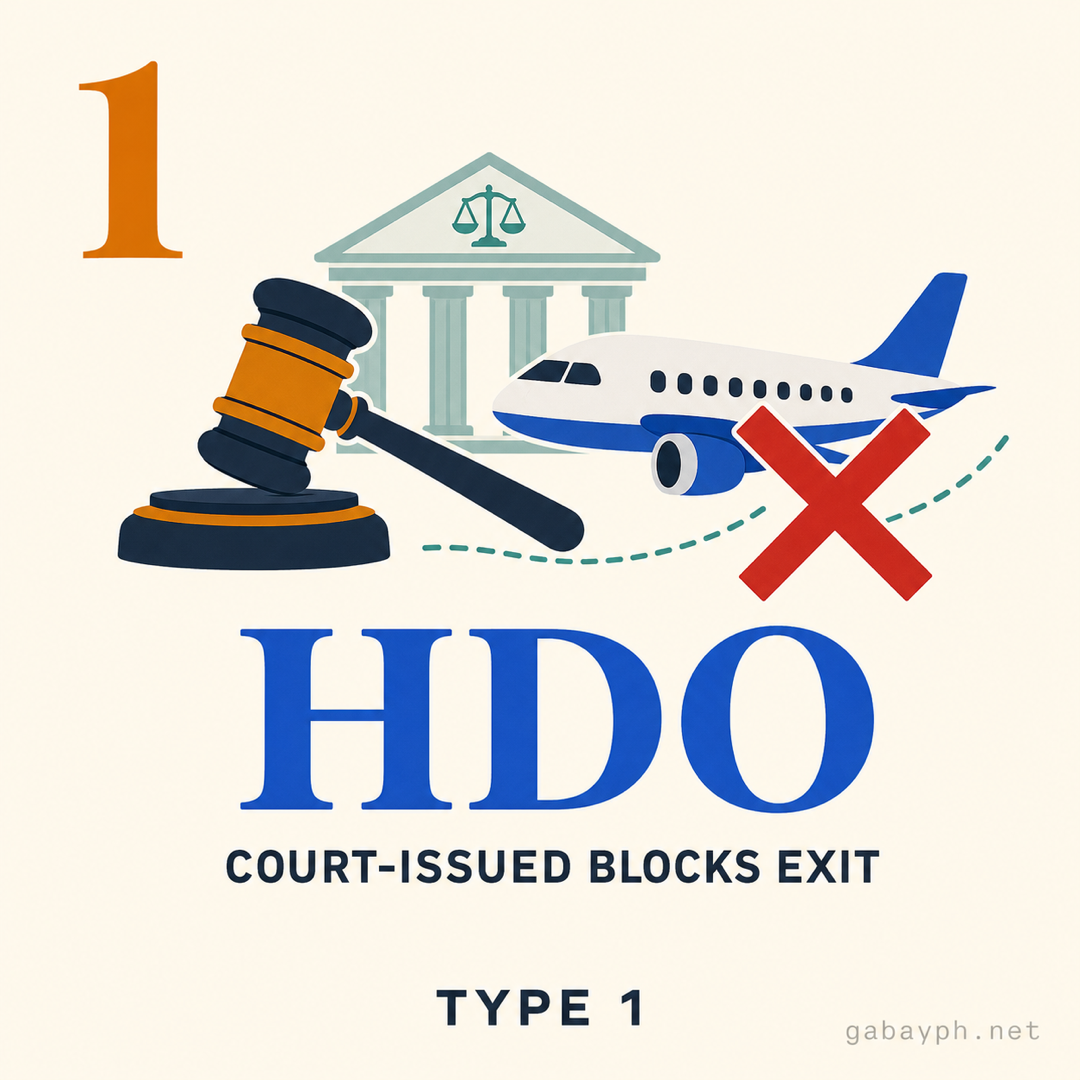
1. HDO (Hold Departure Order) — Court-issued, blocks departure
1. HDO (Hold Departure Order) — Mula sa korte, pumipigil sa pag-alis
An HDO is a court order issued after a criminal case has been formally filed. Under Supreme Court Circular No. 39-97, an HDO can be issued by a Regional Trial Court in criminal cases where the penalty is at least six (6) years and one (1) day, or by the Sandiganbayan in cases within its jurisdiction (typically corruption cases involving public officials). When you are on an HDO, the Bureau of Immigration will physically stop you from departing. Pwedeng mag-issue din ang family courts ng restraining orders sa international travel sa mga child custody at support cases, na pareho ang epekto sa pag-alis.
Ang HDO ay court order na nilalabas matapos pormal na mai-file ang criminal case. Sa ilalim ng Supreme Court Circular No. 39-97, ang HDO ay pwedeng i-issue ng Regional Trial Court sa criminal cases kung saan ang parusa ay hindi bababa sa anim (6) na taon at isang (1) araw, o ng Sandiganbayan sa mga kasong nasasakupan nito (karaniwan ay corruption cases na may kinalaman sa public officials). Kapag may HDO ka, ang Bureau of Immigration ay pisikal na pipigilan ka sa pag-alis. Pwede ring mag-issue ang family courts ng restraining orders sa international travel sa child custody at support cases — pareho ang epekto sa pag-alis.
2. PHDO (Precautionary Hold Departure Order) — Court-issued, before charges filed
2. PHDO (Precautionary Hold Departure Order) — Mula sa korte, bago mai-file ang kaso
A PHDO is a court-issued order requested by the prosecution before a criminal information is filed in court — typically during the preliminary investigation phase. It was created under A.M. No. 18-07-05-SC (Rule on Precautionary Hold Departure Order, issued by the Supreme Court in 2018) to fill the gap that the Genuino v. De Lima ruling exposed. The court can issue a PHDO when the prosecutor shows that there is probable cause that a person committed an offense and there is a high probability of flight. PHDOs are time-bound — you should check with your lawyer or the issuing court for the current validity period and renewal rules.
Ang PHDO ay court-issued order na hinihiling ng prosecution bago mai-file ang criminal information sa korte — karaniwan ay sa panahon ng preliminary investigation. Ginawa ito sa ilalim ng A.M. No. 18-07-05-SC (Rule on Precautionary Hold Departure Order, na nilabas ng Supreme Court noong 2018) para sagutin ang gap na ipinakita ng Genuino v. De Lima ruling. Pwedeng mag-issue ang korte ng PHDO kapag napatunayan ng prosecutor na may probable cause na nakagawa ng paglabag ang tao at may mataas na posibilidad ng pag-takas. Time-bound ang PHDO — i-check sa abogado mo o sa issuing court ang kasalukuyang validity period at renewal rules.
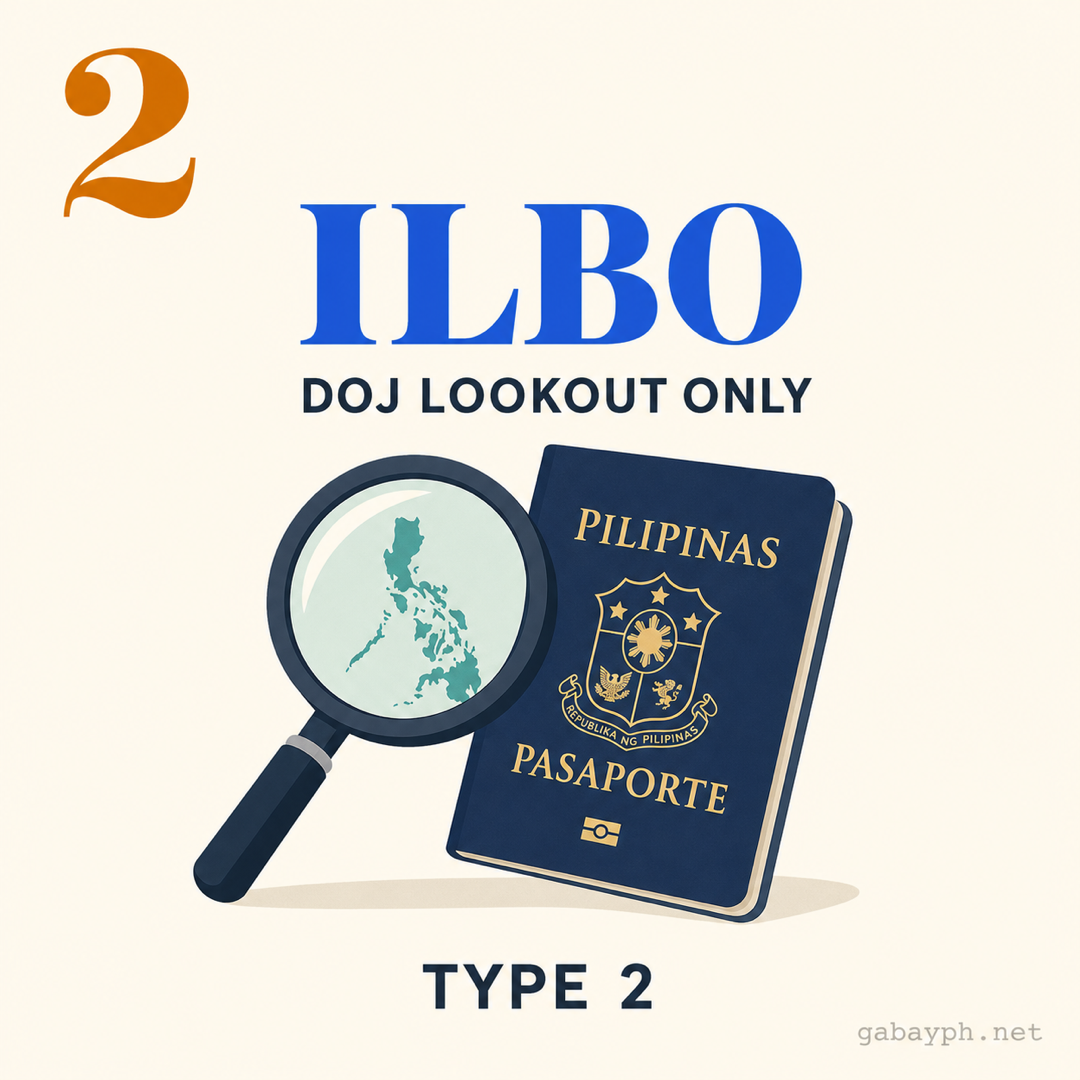
3. ILBO (Immigration Lookout Bulletin Order) — DOJ-issued, lookout only
3. ILBO (Immigration Lookout Bulletin Order) — Mula sa DOJ, lookout lang
An ILBO is issued by the Secretary of Justice (DOJ), not by a court. It is technically just a "lookout" instruction to the Bureau of Immigration to monitor and report on a named person's travel — not a binding order to prevent departure. After the 2018 Genuino ruling, the DOJ's authority to outright stop departure through its own circulars (the old DOJ Circular 41 series of 2010) was declared unconstitutional. An ILBO is now mostly used to alert the BI so that, when the person presents themselves at an immigration counter, BI officers can question them, refer them to the prosecutor handling the case, and document their attempt to leave — but they generally cannot stop them on the ILBO alone.
Ang ILBO ay nilalabas ng Secretary of Justice (DOJ), hindi ng korte. Technically, "lookout" instruction lang ito sa Bureau of Immigration para i-monitor at i-report ang biyahe ng pinangalanang tao — hindi ito binding na utos na pigilan ang pag-alis. Matapos ang 2018 Genuino ruling, ang awtoridad ng DOJ na pigilan agad ang pag-alis sa pamamagitan ng sarili nilang circulars (ang lumang DOJ Circular 41 series of 2010) ay idineklarang unconstitutional. Karaniwan ngayong ginagamit ang ILBO para i-alert ang BI — kapag pumunta sa immigration counter ang tao, pwedeng tanungin siya ng BI officers, i-refer sa prosecutor na humahawak ng kaso, at i-dokumento ang attempt niyang umalis — pero karaniwan ay hindi siya pwedeng pigilan base lang sa ILBO.
4. WLO (Watchlist Order) — Old DOJ mechanism, now defunct
4. WLO (Watchlist Order) — Lumang DOJ mechanism, wala na ngayon
The Watchlist Order (WLO) was the older DOJ mechanism under DOJ Circular No. 41, series of 2010, which empowered the Secretary of Justice to issue HDOs, WLOs, and Allow Departure Orders independently of any court. In Genuino v. De Lima, G.R. No. 197930 (April 17, 2018), the Supreme Court declared DOJ Circular 41 unconstitutional, ruling that the right to travel can only be impaired in the interest of national security, public safety, or public health, and only as provided by law — not by a department circular. WLOs in their original form no longer exist; what people still loosely call a "watchlist" today is now usually an ILBO. If anyone tells you they have or you have a "WLO," that label is outdated — confirm with the issuing agency or your lawyer whether it is actually an ILBO, a PHDO, or something else.
Ang Watchlist Order (WLO) ay ang lumang DOJ mechanism sa ilalim ng DOJ Circular No. 41, series of 2010, na nagbigay sa Secretary of Justice ng kapangyarihang mag-isyu ng HDOs, WLOs, at Allow Departure Orders nang walang court approval. Sa Genuino v. De Lima, G.R. No. 197930 (April 17, 2018), idineklara ng Supreme Court na unconstitutional ang DOJ Circular 41, na nagsasabing ang karapatang maglakbay ay pwede lang limitahan sa interes ng national security, public safety, o public health, at sa paraang itinakda ng batas — hindi sa pamamagitan ng department circular. Wala na sa kasalukuyan ang WLO sa orihinal nitong porma; ang tinatawag pa rin ng iba ngayong "watchlist" ay karaniwang ILBO na. Kung may magsabi sa iyong may "WLO" siya o ikaw, luma na ang label na iyon — i-verify sa issuing agency o sa abogado mo kung ILBO ba talaga, PHDO, o iba pa.
What Triggers Each One
Ano ang Nagti-trigger sa Bawat Isa
The trigger depends mostly on the type of case and what stage it is in. Here are the most common Filipino scenarios that lead to one of these orders:
Nakadepende ang trigger sa uri ng kaso at sa stage nito. Narito ang mga pinakakaraniwang Pilipino scenarios na humahantong sa isa sa mga utos na ito:
- Pending criminal case in the RTC. Estafa or other fraud cases with damages exceeding the threshold, B.P. 22 (bouncing checks) cases when consolidated to a high amount, drug cases under R.A. 9165, qualified theft, and similar offenses where the penalty meets the 6-year-and-1-day floor. The court that hears the case can issue an HDO directly.
- Sandiganbayan case. Government employees and elected officials charged with graft, plunder, malversation, or other offenses under R.A. 3019 (Anti-Graft and Corrupt Practices Act) or related laws typically have an HDO issued by the Sandiganbayan as part of standard procedure.
- BIR tax evasion case. When the Bureau of Internal Revenue files a criminal case for tax evasion and the penalty meets the threshold, the trial court can issue an HDO. The DOJ may also issue an ILBO during preliminary investigation.
- AMLA (Anti-Money Laundering Act) case. Money-laundering and terrorism-financing cases under R.A. 9160 (as amended) routinely result in HDOs or PHDOs because of the high flight risk involved.
- Family court order. A parent who is not paying court-ordered child support, or a party in a custody dispute, may have travel restricted by a family court even without a criminal case. These are typically narrower (limiting travel with the child, not the parent's own travel) but still enforced at the BI counter.
- Preliminary investigation at the DOJ. Even before a case is formally filed in court, if a complaint is undergoing preliminary investigation and the prosecutor wants to prevent flight, the DOJ may issue an ILBO and/or the prosecutor may apply for a PHDO from the appropriate court.
- Pending criminal case sa RTC. Estafa o iba pang fraud cases na lumalampas sa damages threshold, B.P. 22 (bouncing checks) cases kapag malaki ang consolidated amount, drug cases sa ilalim ng R.A. 9165, qualified theft, at mga katulad na offenses kung saan umaabot ang parusa sa 6-taon-at-1-araw na floor. Pwedeng direktang mag-isyu ng HDO ang korteng humahawak ng kaso.
- Sandiganbayan case. Mga government employees at elected officials na sinampahan ng graft, plunder, malversation, o iba pang offenses sa ilalim ng R.A. 3019 (Anti-Graft and Corrupt Practices Act) o related laws ay karaniwang nilalabasan ng HDO ng Sandiganbayan bilang standard procedure.
- BIR tax evasion case. Kapag nag-file ang Bureau of Internal Revenue ng criminal case para sa tax evasion at umabot sa threshold ang parusa, pwedeng mag-isyu ang trial court ng HDO. Pwede rin mag-isyu ang DOJ ng ILBO habang preliminary investigation.
- AMLA (Anti-Money Laundering Act) case. Money-laundering at terrorism-financing cases sa ilalim ng R.A. 9160 (as amended) ay madalas humantong sa HDO o PHDO dahil mataas ang flight risk.
- Family court order. Magulang na hindi nagbabayad ng court-ordered child support, o party sa custody dispute, ay maaaring limitahan ang international travel ng family court kahit walang criminal case. Karaniwan ay mas limitado ito (limiting travel with the child, hindi ang sariling biyahe ng magulang) pero ipinatutupad pa rin sa BI counter.
- Preliminary investigation sa DOJ. Kahit bago pa mai-file ang kaso sa korte, kung may complaint na nasa preliminary investigation at gusto ng prosecutor na pigilan ang pag-takas, pwedeng mag-isyu ang DOJ ng ILBO at/o pwedeng mag-apply ang prosecutor ng PHDO sa naaangkop na korte.
How to Check If You're on an HDO or ILBO
Paano I-check Kung May HDO/ILBO Ka
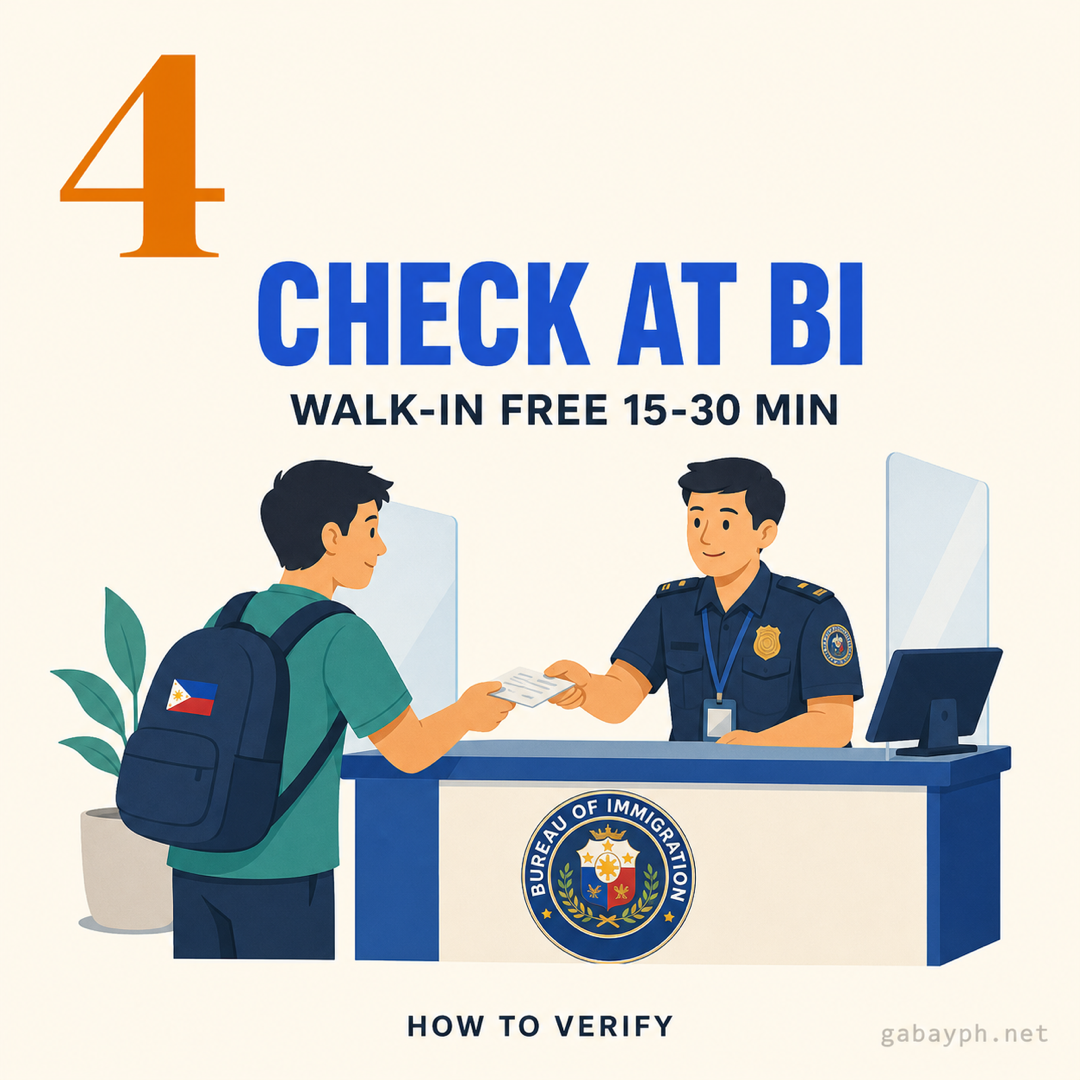
The cleanest and most reliable way is a walk-in inquiry at the Bureau of Immigration Public Information Office (BI PIO). It is free and typically takes 15–30 minutes. Here is the process:
Ang pinaka-malinis at maaasahang paraan ay walk-in inquiry sa Bureau of Immigration Public Information Office (BI PIO). Libre ito at karaniwang 15–30 minuto lang. Narito ang proseso:
-
Go to the BI Public Information Office
Pumunta sa BI Public Information Office
The BI main office is at Magsaysay Drive, Intramuros, Manila. The Public Information Office (PIO) handles status inquiries. Most BI satellite or one-stop-shop offices in major cities (Alabang, Quezon City, Cebu, Davao) can also process status checks — call ahead to confirm. Office hours are typically Monday to Friday, 8:00 AM to 5:00 PM, no lunch break for the receiving counters but verify on the day.
Ang BI main office ay nasa Magsaysay Drive, Intramuros, Manila. Ang Public Information Office (PIO) ang humahawak ng status inquiries. Karamihan ng BI satellite o one-stop-shop offices sa mga malalaking lungsod (Alabang, Quezon City, Cebu, Davao) ay pwede ring mag-process ng status checks — tumawag muna para ma-confirm. Karaniwang Lunes hanggang Biyernes ang office hours, 8:00 AM hanggang 5:00 PM, walang lunch break ang receiving counters pero i-verify mo sa araw mismo.
-
Bring Two Valid Government-Issued IDs
Magdala ng Dalawang Valid Government-Issued IDs
Bring two original, unexpired government IDs. Best combinations: passport + PhilSys National ID, passport + driver's license, or PhilSys + UMID. The name on your IDs must match exactly — kahit isang letrang mali sa middle name pwedeng magdulot ng delay. If you have a married name and a maiden name, bring documents showing both. The BI staff will photocopy your IDs and use them to search the database.
Magdala ng dalawang original, hindi expired na government IDs. Mga pinakamagandang kumbinasyon: passport + PhilSys National ID, passport + driver's license, o PhilSys + UMID. Ang pangalan sa IDs mo ay dapat magmatch nang eksakto — kahit isang letrang mali sa middle name pwedeng magdulot ng delay. Kung may married name at maiden name ka, magdala ng dokumento na nagpapakita ng dalawa. Iko-kopya ng BI staff ang IDs mo at gagamitin para i-search ang database.
-
Request a Status Check / Certification
Humingi ng Status Check / Certification
At the PIO counter, tell them you are requesting a derogatory record check or status check for HDO/ILBO. You may also formally request a Certificate of Not the Same Person if your name is common and you want documentation that any hit in the system is not you. The basic database search is free. A formal certification, if you need one as a document, may carry a small fee. Confirm current fees at the counter.
Sa PIO counter, sabihin mong nag-re-request ka ng derogatory record check o status check para sa HDO/ILBO. Pwede mo ring formally i-request ang Certificate of Not the Same Person kung common ang pangalan mo at gusto mong may dokumento na anumang hit sa system ay hindi ikaw. Libre ang basic database search. Ang formal certification, kung kailangan mo bilang dokumento, ay maaaring may maliit na bayad. I-confirm ang kasalukuyang fees sa counter.
The officer searches the BI database against your name + date of birth. Results come back as: (a) no hits — you are clear; (b) hit — they will tell you what kind of order (HDO, ILBO, PHDO) and which issuing agency or court is named on the record. They will not hand you the underlying court order — for that you go to the issuing court and request a copy of the case file as a party of record (your lawyer can do this).
I-sa-search ng officer ang BI database gamit ang pangalan mo + petsa ng kapanganakan. Ang resulta ay: (a) walang hit — clear ka; (b) may hit — sasabihin nila kung anong klaseng utos (HDO, ILBO, PHDO) at sinong issuing agency o korte ang nakapangalan sa record. Hindi nila ibibigay sa iyo ang underlying court order — para diyan, pupunta ka sa issuing court at humingi ng kopya ng case file bilang party of record (gagawin ito ng abogado mo).
Online and Other Options
Online at Iba Pang Options
The BI maintains an online portal at immigration.gov.ph. Self-service derogatory checks are limited and the available services change over time — verify the current capabilities on the portal before relying on it. Some private services and travel agencies claim to do "HDO checks" for a fee. Be careful — the only official source is the Bureau of Immigration itself. If in doubt, walk in to the BI PIO and pay nothing.
May online portal ang BI sa immigration.gov.ph. Limitado ang self-service derogatory checks at nagbabago ang available services paminsan-minsan — i-verify ang kasalukuyang capabilities sa portal bago mo asahan ito. May ilang private services at travel agencies na nag-claim na nakakagawa ng "HDO checks" sa bayad. Mag-ingat — ang opisyal na source lang ay ang Bureau of Immigration mismo. Kung may pagdududa, mag-walk-in sa BI PIO at walang babayaran.
What it does NOT cover: domestic flights. HDOs and ILBOs only affect international departure from a Philippine port. You can travel within the Philippines (Manila to Cebu, Davao to Iloilo) even if you have an active HDO.
Ano ang hindi sakop nito: domestic flights. Ang HDO at ILBO ay nakakaapekto lang sa international departure mula sa Philippine port. Pwede ka pa ring maglakbay sa loob ng Pilipinas (Manila papuntang Cebu, Davao papuntang Iloilo) kahit may active HDO ka.
What Happens at the Airport
Ano ang Mangyayari sa Airport
Hindi mo ito gusto malaman sa airport. Pero kung mangyari, here is roughly what happens depending on what you are on:
Hindi mo ito gusto malaman sa airport. Pero kung mangyari, narito ang humigit-kumulang sa magaganap depende sa kung ano ang naka-flag sa iyo:
- If on an active HDO or PHDO: the immigration officer's screen flags your name at the exit counter. You will be pulled aside, escorted to a secondary inspection area, and informed that there is an active court order preventing your departure. You will not be allowed to board. The BI typically issues a written record of the offload, and the airline will refund or rebook your ticket subject to its own policy. There is no negotiating at the counter — the BI officer is enforcing a court order and has no authority to ignore it.
- If on an ILBO only (no HDO/PHDO): post-Genuino, the BI generally cannot stop you from departing based on the ILBO alone. In practice, however, BI officers may delay you for secondary questioning, contact the DOJ prosecutor handling the underlying case, and document your attempt to depart. If they have no court order in hand, they should ultimately allow you to board — but the delay can easily cause you to miss your flight. This area is sensitive and depends on the case; do not assume an ILBO is "safe."
- If both on an ILBO and a separate HDO/PHDO: the HDO/PHDO controls. You will not be allowed to board.
- Airline cooperation: once BI flags you, the airline will not push back — they are bound by Philippine immigration enforcement. Refunds and rebookings depend on each airline's policy, not on whose fault the offload was.
- Kung may active HDO o PHDO ka: nag-fla-flag ang screen ng immigration officer sa exit counter. Ihihiwalay ka, isasama sa secondary inspection area, at sasabihing may active court order na pumipigil sa pag-alis mo. Hindi ka pasakayin. Karaniwang nag-i-issue ang BI ng nakasulat na record ng offload, at ang airline ang nagre-refund o nag-rerebook ng ticket sa ilalim ng sarili nilang patakaran. Walang nego sa counter — ang BI officer ay nagpapatupad lang ng court order at walang awtoridad na huwag itong sundin.
- Kung ILBO lang (walang HDO/PHDO): matapos ang Genuino, karaniwan ay hindi pwedeng pigilan ng BI ang pag-alis mo base lang sa ILBO. Pero sa practice, pwede kang ma-delay ng BI officers para sa secondary questioning, makipag-ugnayan sila sa DOJ prosecutor na humahawak ng underlying case, at i-dokumento ang attempt mong umalis. Kung wala silang hawak na court order, sa huli ay dapat ka nilang papayagang sumakay — pero pwedeng dahil sa delay ay ma-miss mo ang flight mo. Sensitive ang area na ito at depende sa kaso; huwag mong ipagpalagay na "safe" ang ILBO.
- Kung pareho — ILBO at hiwalay na HDO/PHDO: ang HDO/PHDO ang pinaka-mabigat. Hindi ka pasakayin.
- Airline cooperation: kapag na-flag ka ng BI, hindi makikipagtalo ang airline — naka-bind sila sa Philippine immigration enforcement. Ang refunds at rebookings ay nakadepende sa policy ng bawat airline, hindi sa kung kanino kasalanan ang offload.
How to Lift an HDO or PHDO
Paano Mag-lift ng HDO o PHDO
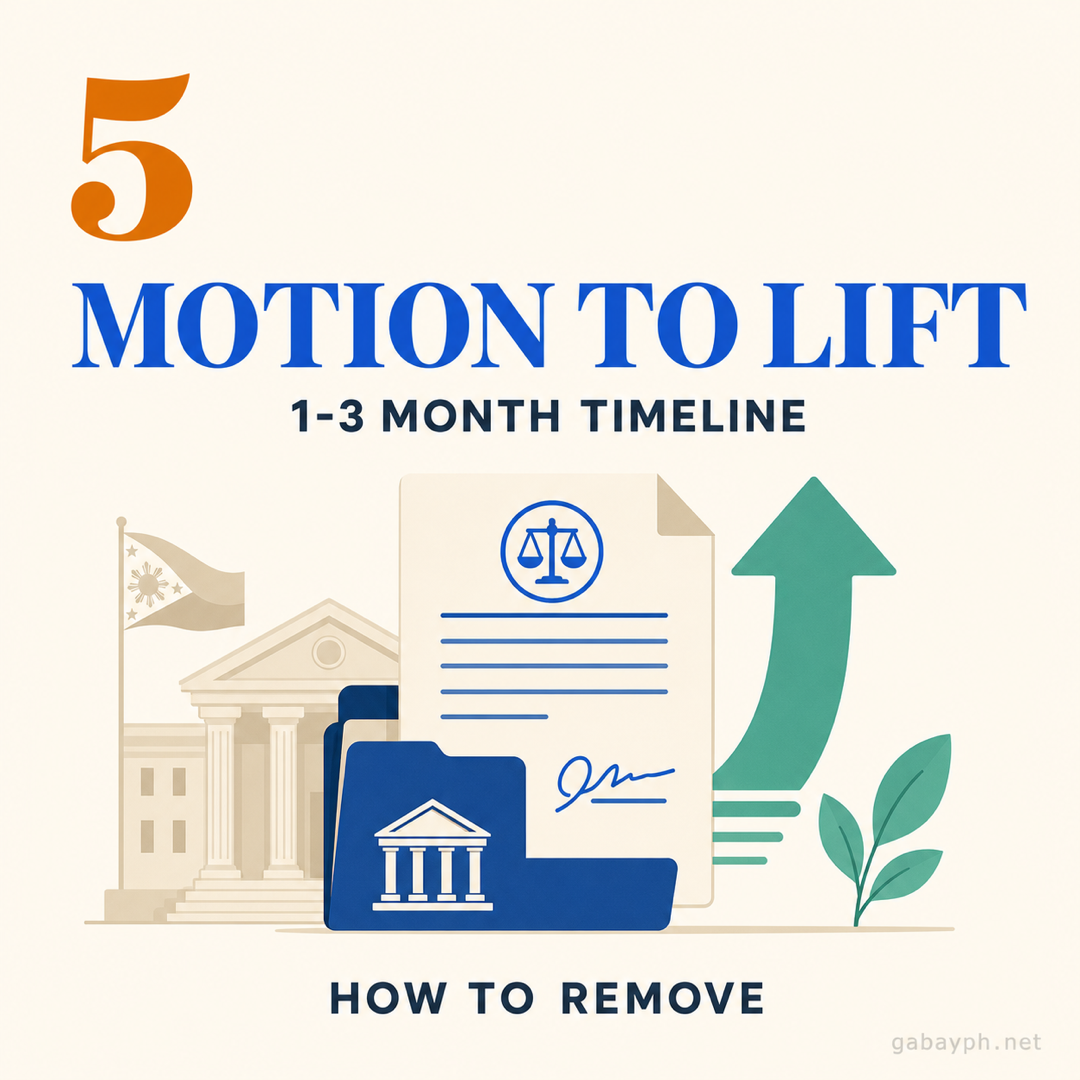
Because an HDO or PHDO is a court order, lifting it requires going back to the issuing court via a Motion to Lift Hold Departure Order (or Motion to Lift PHDO). You will need a lawyer — or, if you qualify as indigent, the Public Attorney's Office (PAO). The court process roughly goes:
Dahil court order ang HDO o PHDO, ang pag-lift nito ay nangangailangan ng pagbabalik sa issuing court sa pamamagitan ng Motion to Lift Hold Departure Order (o Motion to Lift PHDO). Kailangan mo ng abogado — o, kung kwalipikado bilang indigent, ang Public Attorney's Office (PAO). Ang court process ay humigit-kumulang ganito:
-
Identify the Grounds for Lifting
Tukuyin ang Dahilan ng Pag-lift
A court will only grant a motion to lift if there is a legitimate ground. The most common grounds are: the criminal case was dismissed; the accused was acquitted on the merits; the accused has been granted bail and the case is at a stage where the HDO is no longer necessary; the case was settled (in B.P. 22 or estafa cases where payment was made and complaint withdrawn); there was an error in identity (the HDO was issued against someone with the same or similar name); the accused needs to travel for urgent medical or family emergency (this is handled as a "Permission to Travel" — see Emergency Travel below); or the case has been provisionally dismissed and the conditions to revive have lapsed.
Bibigyang-pansin lang ng korte ang motion to lift kung may legitimate na dahilan. Mga pinakakaraniwang dahilan: na-dismiss ang criminal case; na-acquit ang accused on the merits; na-bigyan ng bail ang accused at ang kaso ay nasa stage kung saan hindi na kailangan ang HDO; nai-settle ang kaso (sa B.P. 22 o estafa cases kung saan nakabayad at na-withdraw ang reklamo); may error in identity (na-isyu ang HDO laban sa taong may parehong o katulad na pangalan); kailangan maglakbay ang accused dahil sa medical o family emergency (ito ay hinahawakan bilang "Permission to Travel" — tingnan ang Emergency Travel sa baba); o ang kaso ay provisionally na-dismiss at lumipas na ang conditions to revive.
-
Your Lawyer Prepares and Files the Motion
Ihahanda at I-fa-file ng Abogado Mo ang Motion
The Motion to Lift must be filed in the same court that issued the HDO/PHDO — same case docket number, same branch. It is a written pleading stating the facts of the case, the current procedural status, the specific ground for lifting, and the legal basis. Attached as annexes are the relevant supporting documents: order of dismissal, judgment of acquittal, settlement agreement, bail bond, ID-mismatch proof, medical records, etc.
Ang Motion to Lift ay kailangang i-file sa parehong korteng nag-isyu ng HDO/PHDO — parehong case docket number, parehong branch. Ito ay nakasulat na pleading na nagsasaad ng facts ng kaso, kasalukuyang procedural status, ang specific na dahilan ng pag-lift, at ang legal basis. Naka-attach bilang annexes ang relevant na supporting documents: order of dismissal, judgment of acquittal, settlement agreement, bail bond, ID-mismatch proof, medical records, atbp.
A copy of the motion is also furnished to the prosecution (Office of the City/Provincial Prosecutor or the Office of the Solicitor General, depending on the case) so they can file a comment or opposition.
Ang kopya ng motion ay ibinibigay din sa prosecution (Office of the City/Provincial Prosecutor o Office of the Solicitor General, depende sa kaso) para makapag-file sila ng comment o opposition.
-
Hearing and Ruling
Hearing at Ruling
The court typically sets the motion for hearing. The prosecution may oppose; you and your lawyer will respond. If the grounds are clear (case already dismissed, accused already acquitted), the judge often resolves it on the papers without lengthy arguments. If the case is still ongoing and you are asking to travel temporarily, the judge will scrutinize the reason and may impose conditions (cash bond, surrender of passport on return, sworn undertaking, fixed travel dates).
Karaniwang itatakda ng korte ang motion para sa hearing. Pwedeng tumutol ang prosecution; sasagot kayo ng abogado mo. Kung malinaw ang dahilan (na-dismiss na ang kaso, na-acquit na ang accused), kadalasan ay nire-resolba ito ng hukom base sa papeles nang walang mahabang arguments. Kung ongoing pa ang kaso at humihingi ka lang na maglakbay nang pansamantala, su-scrutinize ng hukom ang dahilan at maaaring magpataw ng conditions (cash bond, isuko ang passport pagbalik, sworn undertaking, fixed travel dates).
Typical timeline: 1–3 months from filing to ruling, depending on court calendar and whether the prosecution opposes. Once the court grants the motion, the order is transmitted to the BI, which updates its database. Allow a few business days for the lift to actually reflect on the BI side before you book travel — do another BI status check to confirm.
Karaniwang timeline: 1–3 buwan mula filing hanggang ruling, depende sa court calendar at kung tutulan ng prosecution. Kapag napayagan ng korte ang motion, ipapadala ang order sa BI, na nag-a-update sa database nila. Hayaan ang ilang business day para tunay na ma-reflect sa BI side ang lift bago mag-book ng biyahe — gumawa ulit ng BI status check para ma-confirm.
Realistic Cost
Realistic na Gastos
Attorney's fees for a Motion to Lift HDO/PHDO vary widely — from around ₱15,000–₱50,000+ depending on the lawyer, the complexity of the case, and whether there will be opposed hearings. Court filing fees are minimal (a few hundred pesos for the motion itself). PAO assistance is free for indigents who qualify. Always ask for a fixed-fee or capped engagement letter; do not commit to open-ended hourly billing for a single motion.
Iba-iba ang attorney's fees para sa Motion to Lift HDO/PHDO — mula ₱15,000–₱50,000+ depende sa abogado, sa kumplikasyon ng kaso, at kung magkakaroon ba ng opposed hearings. Minimal lang ang court filing fees (ilang daang piso lang para sa motion mismo). Libre ang PAO assistance para sa mga indigents na kwalipikado. Laging humingi ng fixed-fee o capped engagement letter; huwag mag-commit sa open-ended hourly billing para sa isang motion lang.
How to Lift an ILBO
Paano Mag-lift ng ILBO
An ILBO is administrative, not judicial, so the path is different. You (through counsel) file a Motion for Reconsideration or a Petition to Lift the ILBO with the Department of Justice (DOJ) — specifically, with the office and prosecutor that requested the ILBO, addressed to the Secretary of Justice or the appropriate DOJ official. Grounds include: the underlying preliminary investigation has been resolved (case dismissed or no probable cause found); the criminal information has now been filed in court and the matter has moved out of DOJ jurisdiction (at which point the DOJ basis for the ILBO arguably ends); the order is being used to restrict the right to travel without lawful basis (citing Genuino); or there has been an error of identity.
Administrative ang ILBO, hindi judicial, kaya iba ang ruta. Ikaw (sa pamamagitan ng abogado) ay magfa-file ng Motion for Reconsideration o Petition to Lift the ILBO sa Department of Justice (DOJ) — partikular sa opisina at prosecutor na nag-request ng ILBO, naka-address sa Secretary of Justice o naaangkop na DOJ official. Mga dahilan: na-resolba na ang underlying preliminary investigation (na-dismiss ang kaso o walang probable cause); na-file na ang criminal information sa korte at lumipat na ang usapin sa hurisdiksyon ng korte (kung saan, argumento, natapos na ang DOJ basis para sa ILBO); ginagamit ang utos para limitahan ang karapatang maglakbay nang walang lawful basis (banggitin ang Genuino); o may error of identity.
If the DOJ denies the motion or does not act, you can elevate the issue to court through a Petition for Certiorari, Prohibition, or Mandamus with the Court of Appeals — but this is more aggressive, more expensive, and usually only worth it if you can show a clear constitutional violation. For most people, the cleaner play is to wait out the underlying case or push the prosecutor to resolve it, after which the ILBO often gets lifted as a matter of course.
Kung tutulan ng DOJ ang motion o hindi kumilos, pwede mong dalhin ang isyu sa korte sa pamamagitan ng Petition for Certiorari, Prohibition, o Mandamus sa Court of Appeals — pero mas agresibo ito, mas mahal, at karaniwang sulit lang kung may malinaw kang constitutional violation na maipapakita. Para sa karamihan, mas malinis na paraan ay hintayin matapos ang underlying case o himukin ang prosecutor na lutasin ito, pagkatapos ay madalas mag-le-lift din ang ILBO bilang routine.
Emergency Travel Exception (Permission to Travel)
Emergency Travel Exception (Permission to Travel)
If you have an active HDO/PHDO but need to travel for a genuine emergency (a parent or child abroad needing medical care, your own medical treatment that cannot be done in the Philippines, a death in the immediate family abroad), the court can grant a Permission to Travel (sometimes called a Motion for Leave to Travel) — a temporary, conditional lift for a specified period and destination.
Kung may active HDO/PHDO ka pero kailangan mong maglakbay dahil sa totoong emergency (magulang o anak sa abroad na nangangailangan ng medical care, sariling medical treatment na hindi magagawa sa Pilipinas, pagkamatay sa immediate family abroad), pwede mag-grant ang korte ng Permission to Travel (tinatawag minsang Motion for Leave to Travel) — temporary at conditional lift para sa specified period at destination.
- Filed in the same court that issued the HDO/PHDO.
- Requires a sworn motion stating the specific reason, the exact travel dates, the destination, and the address where you will be staying.
- Supporting documents: medical certificates (if medical), death certificate (if bereavement), invitation/visa documents, return ticket (often a court will not allow one-way bookings).
- Conditions typically imposed: a cash bond or property bond as security; a sworn undertaking to return on a specific date; surrender of the passport to the court clerk upon return; periodic reporting; sometimes a sworn statement from a third-party guarantor.
- Standard procedure: the prosecution is given a chance to oppose; the court holds a brief hearing; if granted, the order is sent to the BI specifying the dates and destination during which you may depart and re-enter.
- I-file sa parehong korte na nag-isyu ng HDO/PHDO.
- Kailangan ng sworn motion na nagsasaad ng specific na dahilan, eksaktong travel dates, destination, at address kung saan ka mananatili.
- Mga supporting documents: medical certificates (kung medical), death certificate (kung bereavement), invitation/visa documents, return ticket (madalas ay hindi papayagan ng korte ang one-way booking).
- Karaniwang ipinapataw na conditions: cash bond o property bond bilang security; sworn undertaking na babalik sa specific na petsa; isuko ang passport sa court clerk pagbalik; periodic reporting; minsan ay sworn statement mula sa third-party guarantor.
- Standard procedure: bibigyan ng pagkakataon ang prosecution na tumutol; magkakaroon ng maikling hearing ang korte; kung ipagkaloob, ipapadala ang utos sa BI na nagsasaad ng dates at destination kung kailan ka pwedeng umalis at bumalik.
This is not a backdoor for lifting an HDO entirely — it is a one-time, time-limited carve-out. If your case is still ongoing, you will return and the HDO snaps back into effect. For a permanent lift, see the previous section.
Hindi ito backdoor para tuluyang lift-in ang HDO — isang beses lang ito at limitado sa panahon. Kung ongoing pa ang kaso mo, babalik ka at babalik din ang bisa ng HDO. Para sa permanenteng lift, tingnan ang naunang section.
The Genuino Case and the Current State of the Law
Ang Genuino Case at ang Kasalukuyang Estado ng Batas
In Genuino v. De Lima, G.R. No. 197930, promulgated April 17, 2018, the Supreme Court of the Philippines struck down DOJ Circular No. 41, series of 2010 as unconstitutional. That circular was the legal basis the DOJ had been using to issue HDOs, Watchlist Orders, and Allow Departure Orders on its own authority, independent of any court.
Sa Genuino v. De Lima, G.R. No. 197930, na nilabas noong April 17, 2018, idineklara ng Supreme Court ng Pilipinas na unconstitutional ang DOJ Circular No. 41, series of 2010. Ang circular na iyon ang legal basis na ginamit ng DOJ para mag-isyu ng HDO, Watchlist Orders, at Allow Departure Orders sa sarili nilang awtoridad, nang walang court.
The Court's reasoning was anchored on the constitutional right to travel under Section 6, Article III of the 1987 Constitution, which provides that the right to travel may only be impaired "in the interest of national security, public safety, or public health, as may be provided by law." A department circular, the Court ruled, is not "law" within the meaning of that clause — only Congress can pass a statute that legitimately impairs the right to travel.
Ang pangangatwiran ng Korte ay nakabatay sa constitutional right to travel sa ilalim ng Section 6, Article III ng 1987 Constitution, na nagsasaad na ang karapatang maglakbay ay pwedeng limitahan lang "sa interes ng national security, public safety, o public health, ayon sa itatakda ng batas." Ang department circular, ayon sa Korte, ay hindi "batas" sa kahulugan ng probisyong iyon — ang Kongreso lang ang pwedeng magpasa ng statute na lehitimong nagli-limit sa karapatang maglakbay.
What changed after Genuino:
Ano ang nagbago matapos ang Genuino:
- The DOJ can no longer issue an HDO or WLO on its own to physically prevent departure.
- The DOJ may still issue an ILBO — but as a "lookout" / advisory mechanism only, not a binding prohibition on travel.
- Courts remain the only authority that can issue an order physically blocking departure. After Genuino, the Supreme Court promulgated A.M. No. 18-07-05-SC, the Rule on Precautionary Hold Departure Order, to give courts a clear procedure for issuing PHDOs before formal charges are filed.
- For cases already filed in court, the existing rule under Supreme Court Circular No. 39-97 continues to apply: the trial court can issue an HDO in criminal cases punishable by at least six (6) years and one (1) day of imprisonment.
- Hindi na pwede mag-isyu ang DOJ ng HDO o WLO sa sarili nilang awtoridad para pisikal na pigilan ang pag-alis.
- Pwede pa ring mag-isyu ang DOJ ng ILBO — pero "lookout" / advisory mechanism lang, hindi binding prohibition sa pag-alis.
- Korte lang ang awtoridad na pwedeng mag-isyu ng utos na pisikal na pumipigil sa pag-alis. Matapos ang Genuino, pinalabas ng Supreme Court ang A.M. No. 18-07-05-SC, ang Rule on Precautionary Hold Departure Order, para bigyan ang mga korte ng malinaw na pamamaraan ng pag-isyu ng PHDO bago mai-file ang pormal na kaso.
- Sa mga kasong nai-file na sa korte, patuloy na nasusunod ang existing rule sa ilalim ng Supreme Court Circular No. 39-97: pwedeng mag-isyu ang trial court ng HDO sa criminal cases na pwedeng parusahan ng hindi bababa sa anim (6) na taon at isang (1) araw na pagkakulong.
The takeaway: if anyone tells you that "the DOJ put a hold on you" in 2026 and you should just accept that you cannot leave, that statement is incomplete. Verify whether what is in BI's system is an actual court-issued HDO/PHDO (which binds) or only a DOJ-issued ILBO (which generally does not, post-Genuino). The distinction matters enormously to your travel rights.
Ang aral: kung may magsabi sa iyong "may hold ang DOJ sa iyo" ngayong 2026 at dapat mong tanggapin na hindi ka makakaalis, hindi kumpleto ang statement na iyon. I-verify kung ano talaga ang nasa BI system — actual court-issued HDO/PHDO ba (na binding) o DOJ-issued ILBO lang (na karaniwang hindi, post-Genuino). Mahalaga ang pagkakaiba para sa karapatan mong maglakbay.
Pro Tips
Mga Payo
- Check your BI status at least 2 weeks before any international flight. Hindi mo gusto malaman sa NAIA Terminal 3 na may HDO ka. A free walk-in to the BI PIO catches it early and gives your lawyer time to act.
- If you have a pending criminal case, ask your lawyer point-blank whether a PHDO has been requested or issued. Courts do not always notify the accused personally that a PHDO has been issued, so do not assume "no notice = no order."
- Bring 2 valid IDs and any document showing prior names to your BI inquiry. Mismatched first names, maiden vs married names, or even a missing middle initial can produce false hits or false clears.
- Get a Certificate of Not the Same Person if your name is common. If "Maria Santos Reyes" or "Juan dela Cruz" exists in the BI database against someone with your exact name and similar DOB, walk in well before any planned departure and request formal documentation that the hit is not you. Bring it with your passport to the airport.
- Do not ignore an ILBO just because Genuino weakened it. Even if BI cannot legally stop you, they can delay you for hours, refer you to the prosecutor, and document the attempt — all of which can torpedo a tight connection or look bad in your underlying case. Address the ILBO through proper channels instead.
- For emergency travel, file the Permission to Travel motion as early as possible. Courts move slowly. A medical emergency motion filed two days before the flight is unlikely to be heard in time. If you anticipate any need to travel, file proactively.
- I-check ang BI status mo ng hindi bababa sa 2 linggo bago ang anumang international flight. Hindi mo gusto malaman sa NAIA Terminal 3 na may HDO ka. Libreng walk-in sa BI PIO ang nakakahuli nito nang maaga at nagbibigay ng oras sa abogado mo para kumilos.
- Kung may pending criminal case ka, tanungin nang diretso ang abogado mo kung may PHDO na hiniling o nai-isyu. Hindi laging personal na ipinapaalam ng korte sa accused na may na-issue na PHDO, kaya huwag ipagpalagay na "walang notice = walang utos."
- Magdala ng 2 valid IDs at anumang dokumentong nagpapakita ng nakaraang pangalan sa BI inquiry mo. Mismatched first names, maiden vs married names, o kahit kulang na middle initial ay pwedeng magbigay ng false hits o false clears.
- Kumuha ng Certificate of Not the Same Person kung common ang pangalan mo. Kung may "Maria Santos Reyes" o "Juan dela Cruz" sa BI database laban sa taong eksaktong kapareho ng pangalan mo at malapit ang DOB, mag-walk-in nang maaga bago ang planong biyahe at humingi ng formal documentation na hindi ikaw ang hit. Dalhin ito kasama ng passport mo sa airport.
- Huwag balewalain ang ILBO dahil lang sa pinahina ito ng Genuino. Kahit hindi ka legal na mapipigilan ng BI, pwede ka nilang i-delay ng ilang oras, i-refer sa prosecutor, at i-dokumento ang attempt — lahat ito ay pwedeng sumira sa masikip na connection o magmukhang masama sa underlying case mo. Ayusin ang ILBO sa tamang channel.
- Para sa emergency travel, i-file ang Permission to Travel motion sa lalong madaling panahon. Mabagal mag-galaw ang korte. Ang medical emergency motion na ini-file dalawang araw bago ang flight ay malabong marinig sa tamang oras. Kung may inaasahan kang pangangailangan na maglakbay, mag-file nang maaga.
Frequently Asked Questions
Mga Madalas Itanong
Pwede ba akong mag-domestic flight kung may HDO ako?
Yes. An HDO restricts international departure from the Philippines only. Domestic flights (Manila to Cebu, Davao to Iloilo, etc.) are not affected because you are not leaving Philippine territory. There may be separate restrictions in your specific case (for example, a court order requiring you to stay within a specific province while on bail), so check the conditions of your bail or the specific terms of your case with your lawyer — but the HDO itself does not block domestic travel.
Pwede ba akong mag-domestic flight kung may HDO ako?
Oo. Ang HDO ay nagli-limit lang ng international departure mula sa Pilipinas. Hindi naaapektuhan ang domestic flights (Manila papuntang Cebu, Davao papuntang Iloilo, atbp.) dahil hindi ka umaalis ng Philippine territory. Maaaring may hiwalay na restrictions sa specific case mo (halimbawa, court order na obligadong manatili sa isang probinsya habang naka-bail), kaya i-check ang conditions ng bail mo o ang specific terms ng kaso mo sa abogado — pero ang HDO mismo ay hindi pumipigil sa domestic travel.
Magkano ang Motion to Lift HDO?
Attorney's fees range roughly ₱15,000–₱50,000+ depending on the lawyer's rates, the complexity of the case, and whether the prosecution actively opposes. Court filing fees for the motion itself are minimal — usually a few hundred pesos. If you qualify as indigent (your income falls below the threshold set by the PAO), the Public Attorney's Office (PAO) can represent you for free. Always insist on a written engagement letter with a clear fee structure (preferably fixed or capped) before paying anything.
Magkano ang Motion to Lift HDO?
Ang attorney's fees ay humigit-kumulang ₱15,000–₱50,000+ depende sa rates ng abogado, sa kumplikasyon ng kaso, at kung aktibong tutulan ng prosecution. Minimal lang ang court filing fees para sa motion mismo — karaniwang ilang daang piso. Kung kwalipikado kang indigent (ang kita mo ay bumababa sa threshold na itinakda ng PAO), pwede kang i-represent ng Public Attorney's Office (PAO) nang libre. Laging humingi ng nakasulat na engagement letter na may malinaw na fee structure (mas mainam kung fixed o capped) bago magbayad ng kahit ano.
Will the airline tell me before BI does?
Usually no. Airlines do not have access to BI's HDO/ILBO database when issuing tickets or processing check-in. You will check in, drop your bag, get your boarding pass, and walk to immigration normally. Only at the BI exit counter — when the officer scans your passport against the BI watchlist database — will the issue surface. By that point, you are already past check-in and your bag may already be on the plane (it gets pulled back). This is exactly why a BI status check before booking is so important. Do not rely on the airline to warn you.
Sasabihin ba ng airline bago ko malaman sa BI?
Karaniwan ay hindi. Walang access ang mga airline sa BI's HDO/ILBO database kapag nagbibigay ng ticket o nag-ko-check in. Magche-check in ka, ibibigay ang bagahe, makakakuha ng boarding pass, at lalakad ka papuntang immigration nang normal. Sa BI exit counter lang — kapag ina-scan ng officer ang passport mo laban sa BI watchlist database — lalabas ang isyu. Sa puntong iyon, past check-in ka na at maaaring nasa eroplano na ang bag mo (ibabalik ito). Ito ang dahilan kung bakit mahalaga ang BI status check bago mag-book. Huwag umasa na bababalitaan ka ng airline.
Anong cases ang madalas mag-issue ng HDO?
In practice, the most common Filipino scenarios that result in an HDO are: estafa (swindling) cases above the threshold for the higher penalty bracket, large or consolidated B.P. 22 (bouncing checks) cases, drug cases under R.A. 9165, tax evasion cases filed by the BIR, graft and corruption cases at the Sandiganbayan involving public officials, and AMLA (money laundering) cases. Family court orders limiting international travel for child custody or support disputes are also common, though those are technically not "HDOs" in the criminal-law sense — they are restraining orders on travel that BI enforces similarly at the counter.
Anong cases ang madalas mag-issue ng HDO?
Sa practice, ang mga pinakakaraniwang Filipino scenarios na humahantong sa HDO ay: estafa (panloloko) na lampas sa threshold para sa mas mataas na parusa, malaki o consolidated B.P. 22 (bouncing checks) cases, drug cases sa ilalim ng R.A. 9165, tax evasion cases na ini-file ng BIR, graft at corruption cases sa Sandiganbayan na may kinalaman sa public officials, at AMLA (money laundering) cases. Karaniwan din ang family court orders na nagli-limit ng international travel para sa child custody o support disputes, pero technically hindi ito "HDO" sa criminal-law sense — restraining orders sila sa travel na ipinatutupad pa rin ng BI sa counter.
Pwede ba akong umalis kung ILBO lang ang hawak sa akin?
Post-Genuino, an ILBO alone is technically just a lookout and generally should not legally prevent your departure. In practice, however, the BI may still delay you significantly at the counter, refer the matter to the DOJ prosecutor, and document your attempt. This can easily cost you a flight even if you are ultimately allowed to board. Before any planned international trip, address the ILBO with your lawyer — either by getting it lifted, by getting a written clarification from the DOJ, or by being prepared with documentation showing the underlying case status. Do not treat an ILBO as nothing.
Pwede ba akong umalis kung ILBO lang ang hawak sa akin?
Matapos ang Genuino, ang ILBO lang ay technically lookout at karaniwang hindi dapat legal na pumipigil sa pag-alis mo. Pero sa practice, pwede ka pa ring i-delay ng BI sa counter, i-refer sa DOJ prosecutor, at i-dokumento ang attempt mo. Pwede itong magdulot ng pagka-miss sa flight kahit sa huli ay pinasakay ka. Bago ang anumang planned international trip, ayusin ang ILBO kasama ng abogado mo — mag-lift, kumuha ng nakasulat na clarification mula sa DOJ, o maging handa na may documentation tungkol sa status ng underlying case. Huwag ipagwalang-bahala ang ILBO.
Gaano katagal bago ma-update ng BI ang database kapag na-lift na ang HDO?
After the court grants the Motion to Lift, the order is transmitted to the BI for system update. Reported timelines vary — anywhere from a few business days to a couple of weeks, depending on how quickly the court clerk transmits the order and BI processes the update. Do another BI status check before booking your travel to confirm the lift has actually taken effect on the BI side. Do not rely on the court order alone — what matters at the airport counter is what BI's system shows.
Gaano katagal bago ma-update ng BI ang database kapag na-lift na ang HDO?
Matapos i-grant ng korte ang Motion to Lift, ipapadala ang utos sa BI para sa system update. Iba-iba ang reported timelines — mula ilang business day hanggang ilang linggo, depende sa kung gaano kabilis ipapadala ng court clerk ang utos at i-process ito ng BI. Magkaroon ng panibagong BI status check bago mag-book ng biyahe para ma-confirm na talagang naipasok na ang lift sa BI side. Huwag umasa sa court order lang — ang mahalaga sa airport counter ay kung ano ang ipinapakita ng BI system.
May HDO ba ako kung may pending kasong civil lang at hindi criminal?
Generally no. HDOs under SC Circular 39-97 apply to criminal cases punishable by at least six (6) years and one (1) day. Purely civil cases (collection of sum of money, breach of contract, ordinary damages) by themselves typically do not produce an HDO. The exceptions are family court orders involving child custody or support, where a court may restrict international travel of a parent and/or child as part of its protective orders. If you have a civil case and someone is telling you that you cannot leave the country, ask for the specific court order — chances are it is either misinformation or there is a separate criminal angle (e.g., the civil case has a parallel B.P. 22 criminal case).
May HDO ba ako kung may pending kasong civil lang at hindi criminal?
Sa pangkalahatan, hindi. Ang HDO sa ilalim ng SC Circular 39-97 ay sa criminal cases na may parusang hindi bababa sa anim (6) na taon at isang (1) araw. Ang puro civil cases (collection of sum of money, breach of contract, ordinary damages) lang ay karaniwang hindi nagdudulot ng HDO. Ang exceptions ay family court orders na may kinalaman sa child custody o support, kung saan pwedeng limitahan ng korte ang international travel ng magulang at/o anak bilang bahagi ng protective orders nito. Kung may civil case ka at may nagsasabing hindi ka makakalabas ng bansa, humingi ng specific court order — malamang ay misinformation o may hiwalay na criminal angle (hal., ang civil case ay may katumbas na B.P. 22 criminal case).
Pwede ba akong magpa-renew ng passport kung may HDO ako?
Passport issuance and renewal are handled by the DFA, not the BI. An HDO at BI does not automatically block a DFA passport renewal — they are separate systems. That said, the DFA may have its own internal coordination on high-profile or specific cases, and a court can issue a separate order directing the DFA to withhold or cancel a passport in extreme cases (typically tied to bail conditions). For most pending criminal cases, you can still renew your passport at the DFA; what you cannot do is use it to depart while the HDO is active. Confirm specifics with your lawyer.
Pwede ba akong magpa-renew ng passport kung may HDO ako?
Ang pag-isyu at renewal ng passport ay hinahawakan ng DFA, hindi ng BI. Ang HDO sa BI ay hindi awtomatikong nakaka-block ng DFA passport renewal — magkahiwalay sila. Pero, maaaring may sariling internal coordination ang DFA sa mga high-profile o specific cases, at pwede mag-isyu ang korte ng hiwalay na utos na nag-o-order sa DFA na pigilan o kanselahin ang passport sa extreme cases (karaniwang nakatali sa bail conditions). Sa karamihan ng pending criminal cases, pwede ka pa ring mag-renew sa DFA; ang hindi mo magagawa ay gamitin ito para umalis habang active ang HDO. I-confirm ang specifics sa abogado mo.