

Kare-Kare Without Bagoong: 4 Substitutes That Work (2026)
Kare-Kare na Walang Bagoong: 4 Pamalit na Talagang Bumabagay (2026)

The 5-Step Recipe
Kare-kare without bagoong in five steps.
Quick Summary
Mabilis na Buod
Table of Contents
Talaan ng Nilalaman
Why Skip the Bagoong
Bakit Hindi Maglagay ng Bagoong
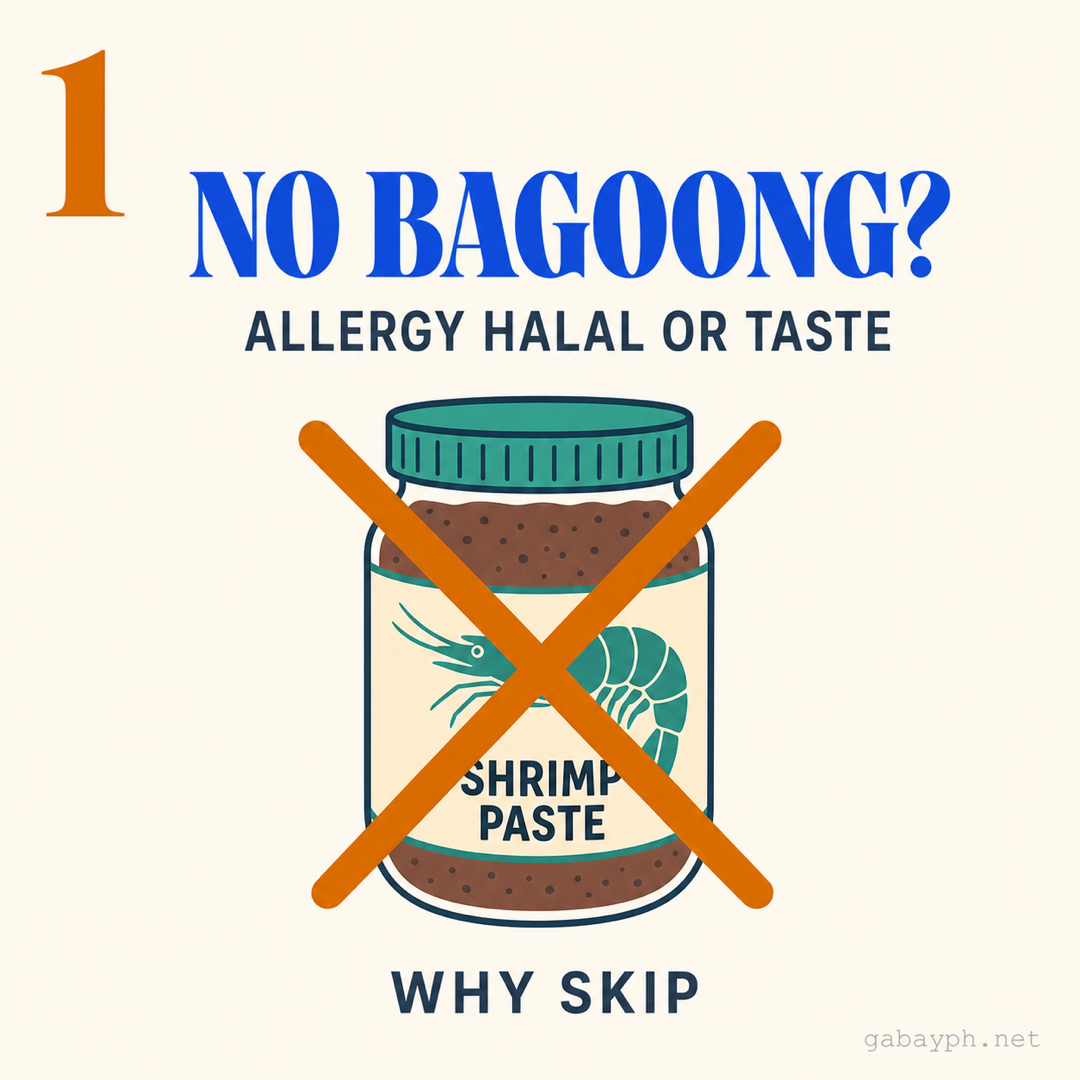
Bagoong alamang — the salty, funky shrimp paste sautéed with garlic and a bit of sugar — is the traditional partner of kare-kare. It is not in the sauce; it sits on the side, and you scoop a little onto each spoonful of stew and rice. The bagoong adds salt, fermented funk, and a seafood umami that the peanut sauce, on its own, lacks.
But a lot of people genuinely cannot eat it: shellfish allergies (kare-kare without bagoong is one of the safest Filipino dishes for shrimp-allergic guests), halal observance (most commercial bagoong contains additives or processing that practising Muslims avoid), or just taste preference — the smell of bagoong is divisive even among Filipinos. This guide is for all three. We are not watering down kare-kare. We are swapping one ingredient and adjusting the salt-umami balance with a substitute that does the same job.
Ang bagoong alamang — ang maalat at malasang sahog na ginisa sa bawang at kaunting asukal — ang tradisyonal na kapares ng kare-kare. Hindi siya nasa loob ng sarsa; nasa gilid lang, at sumasandok ka ng kaunti sa bawat kutsara ng stew at kanin. Nagdadagdag ang bagoong ng asin, fermented funk, at seafood umami na hindi naibibigay ng peanut sauce mag-isa.
Pero maraming tao ang talagang hindi makakain nito: may shellfish allergy (ang kare-kare na walang bagoong ay isa sa pinaka-safe na Filipino dish para sa bisitang allergic sa hipon), halal observance (karamihan ng commercial bagoong ay may additive o processing na iniiwasan ng practising Muslim), o panlasa lang talaga — divisive ang amoy ng bagoong kahit sa mga Pilipino. Para sa tatlo ang gabay na ito. Hindi natin pinapagaan ang kare-kare. Pinapalitan lang natin ang isang sangkap at i-aadjust ang asin-umami balanse gamit ang pamalit na may parehong trabaho.
The 4 Substitutes Compared
Ang 4 na Pamalit, Pinagkumpara
Bagoong does four things at once: salt, funk, fermented umami, and a touch of seafood "depth." A good substitute hits at least three of these. We tested four. Here is how they compare:
Apat ang ginagawa ng bagoong nang sabay-sabay: asin, funk, fermented umami, at konting seafood "depth." Ang magandang pamalit ay tatama sa hindi bababa sa tatlo nito. Sinubukan namin ang apat. Ito ang paghahambing:
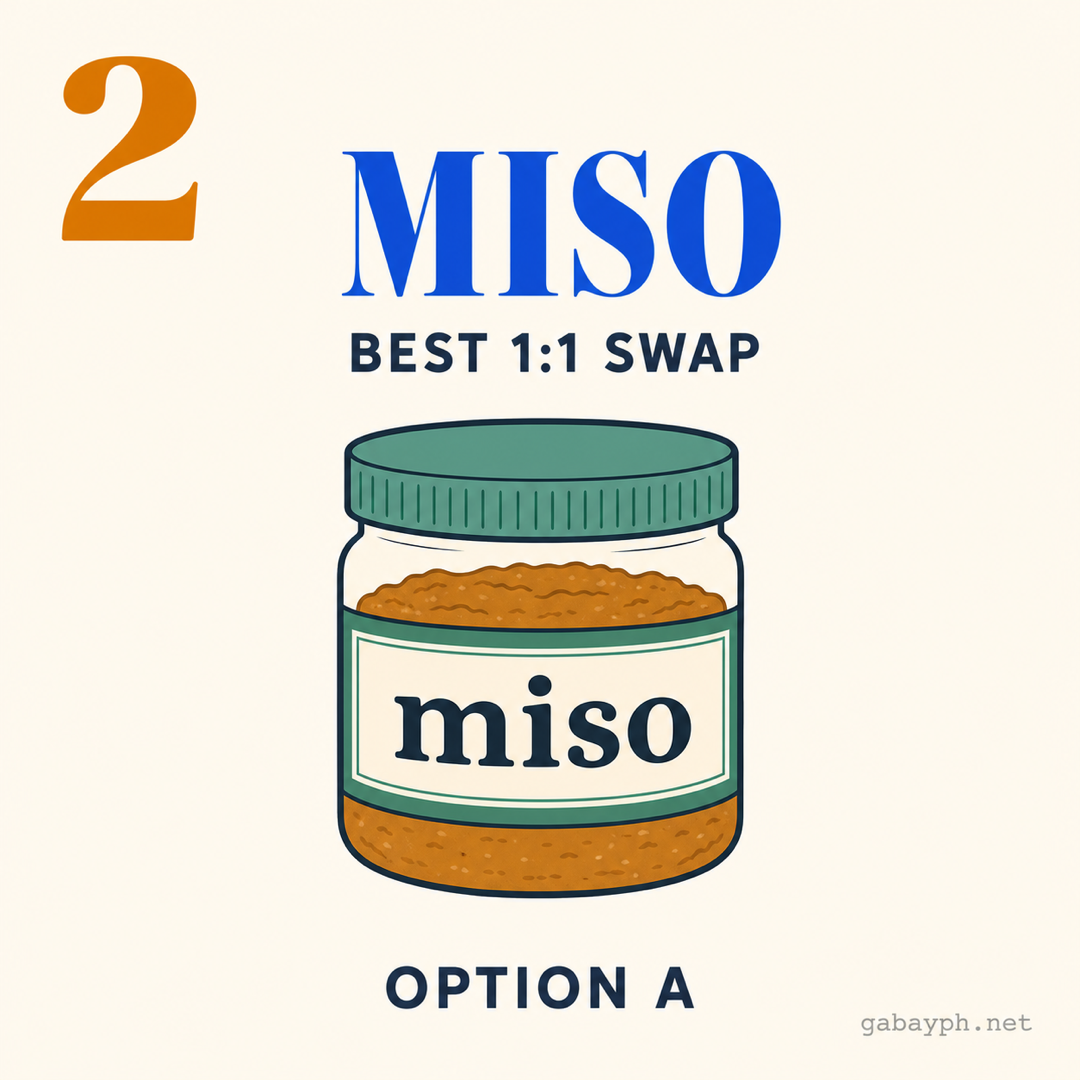
- Option A — White miso (3-4 tbsp): The closest umami match for shellfish allergies. Fermented soybean paste; salty, savory, gently sweet. Available at SM/Robinsons Asian aisle and S&R, ₱200-300 per small jar (300-500g). One jar lasts months in the fridge. Best for: shellfish-allergic guests.
- Option B — Soy sauce + a dash of patis (2 tbsp soy + 1 tsp fish sauce): Closest "Filipino-tasting" substitute. Patis is fermented fish sauce — closer to the seafood note of bagoong than miso is. NOT halal-friendly (patis is also pescatarian-incompatible). Best for: taste preference (you just dislike the smell of bagoong) but still want a Filipino-leaning flavor.
- Option C — Tahini (sesame paste) + salt (1-2 tbsp tahini + salt to taste): Halal-friendly and shellfish-free. Adds a different kind of nutty depth — works because it complements peanut rather than competing. Not as umami-forward as miso, so you compensate with a little extra salt. Best for: halal observance when you cannot source halal-certified miso.
- Option D — Doenjang (Korean fermented bean paste, 2-3 tbsp): Deeper and funkier than miso — almost too funky for kare-kare, but a small amount adds the fermented depth bagoong gives. Sold at Korean groceries (Assi Plaza, Korean Mart) and some S&R branches, ₱250-400 per tub. Best for: when you want maximum umami and don't mind a slightly Korean-inflected stew.
- Option A — White miso (3-4 kutsara): Pinakamalapit na umami match para sa shellfish allergy. Fermented soybean paste; maalat, malasa, banayad na matamis. Mabibili sa SM/Robinsons Asian aisle at S&R, ₱200-300 bawat small jar (300-500g). Isang jar tumatagal ng buwan sa ref. Pinakamaganda para sa: bisitang allergic sa hipon.
- Option B — Toyo + konting patis (2 kutsarang toyo + 1 kutsaritang patis): Pinakamalapit sa "Filipino-tasting" na pamalit. Ang patis ay fermented fish sauce — mas malapit sa seafood note ng bagoong kaysa miso. Hindi halal-friendly (hindi rin pescatarian-friendly ang patis). Pinakamaganda para sa: kapag hindi mo lang gusto ang amoy ng bagoong pero gusto mo pa ring Filipino ang lasa.
- Option C — Tahini (sesame paste) + asin (1-2 kutsarang tahini + asin sa panlasa): Halal-friendly at walang shellfish. Nagdadagdag ng ibang klaseng nutty depth — gumagana dahil kapares ng peanut, hindi kalaban. Hindi gaanong umami-forward na parang miso, kaya kompensahan mo ng kaunting dagdag na asin. Pinakamaganda para sa: halal observance kapag walang mahanap na halal-certified na miso.
- Option D — Doenjang (Korean fermented bean paste, 2-3 kutsara): Mas malalim at mas funky kaysa miso — halos sobra na nga ang funk para sa kare-kare, pero ang kaunting halo ay nagdadagdag ng fermented depth na binibigay ng bagoong. Bibili sa Korean grocery (Assi Plaza, Korean Mart) at iilang S&R, ₱250-400 bawat tub. Pinakamaganda para sa: kapag gusto mo ng maximum umami at OK lang sa iyo ang medyo Korean-leaning na lasa.
Recommendation: If you are cooking this for a guest with a shellfish allergy and don't know which to use — go with Option A (white miso). It is the cleanest 1:1 swap, widely available, and the flavor lands closest to the original.
Rekomendasyon: Kung niluto mo ito para sa bisitang may shellfish allergy at hindi mo alam kung alin — piliin ang Option A (white miso). Ito ang pinakamalinis na 1:1 swap, madaling mahanap, at pinakamalapit ang lasa sa orihinal.
Ingredients (6 Servings)
Mga Sangkap (6 na Serbida)
For the stew
Para sa stew
- 1.5 kg oxtail (buntot ng baka) — cut into chunks; ask your butcher for the standard kare-kare cut
- 2 liters water (or beef stock for deeper flavor)
- 1 large onion, quartered
- 4 cloves garlic, crushed
- 1 tbsp salt
- 1 tbsp whole black peppercorns
- 2 bay leaves
- 1.5 kg buntot ng baka (oxtail) — hiwain sa chunks; humingi ng standard na kare-kare cut sa magkakarne
- 2 litro tubig (o beef stock para mas malalim na lasa)
- 1 malaking sibuyas, hinati sa apat
- 4 na butil bawang, dinikdik
- 1 kutsarang asin
- 1 kutsarang buong pamintang itim
- 2 dahon ng laurel
For the peanut sauce
Para sa peanut sauce
- 3/4 cup natural peanut butter — Lily's or US import; smooth, unsweetened, no added sugar
- 1/2 cup ground toasted peanuts — for extra texture
- 3 tbsp annatto oil — or 1 tbsp annatto seeds steeped in 3 tbsp oil
- 1/4 cup glutinous rice flour (galapong) — the traditional thickener; do not skip
- 1/4 cup reserved oxtail braising liquid
- 3/4 cup natural peanut butter — Lily's o US import; smooth, walang asukal
- 1/2 cup ground toasted peanuts — para sa dagdag na texture
- 3 kutsarang annatto oil — o 1 kutsarang atsuete na binabad sa 3 kutsarang mantika
- 1/4 cup glutinous rice flour (galapong) — ang tradisyonal na pampalapot; huwag laktawan
- 1/4 cup itinabiling braising liquid ng buntot
Vegetables
Mga Gulay
- 1 medium eggplant (talong), sliced
- 1 bunch sitaw (string beans), cut into 2-inch lengths
- 1 small bunch petsay or kangkong
- 1 bundle puso ng saging (banana heart), sliced thin — optional but adds authenticity
- 1 medium talong, hiniwa
- 1 tali sitaw, hiniwa sa 2-inch na haba
- 1 maliit na bigkis petsay o kangkong
- 1 bundle puso ng saging, hiniwa nang manipis — opsyonal pero nagdadagdag ng authenticity
The bagoong replacement — PICK ONE
Ang pamalit sa bagoong — PUMILI NG ISA
- Option A: 3-4 tbsp white miso
- Option B: 2 tbsp soy sauce + 1 tsp patis (NOT halal)
- Option C: 1-2 tbsp tahini + salt to taste (halal-friendly)
- Option D: 2-3 tbsp doenjang (Korean fermented bean paste)
- Option A: 3-4 kutsarang white miso
- Option B: 2 kutsarang toyo + 1 kutsaritang patis (HINDI halal)
- Option C: 1-2 kutsarang tahini + asin sa panlasa (halal-friendly)
- Option D: 2-3 kutsarang doenjang (Korean fermented bean paste)
Step-by-Step Instructions
Hakbang-hakbang na Tagubilin
-
Braise the Oxtail (2.5-3 hours)
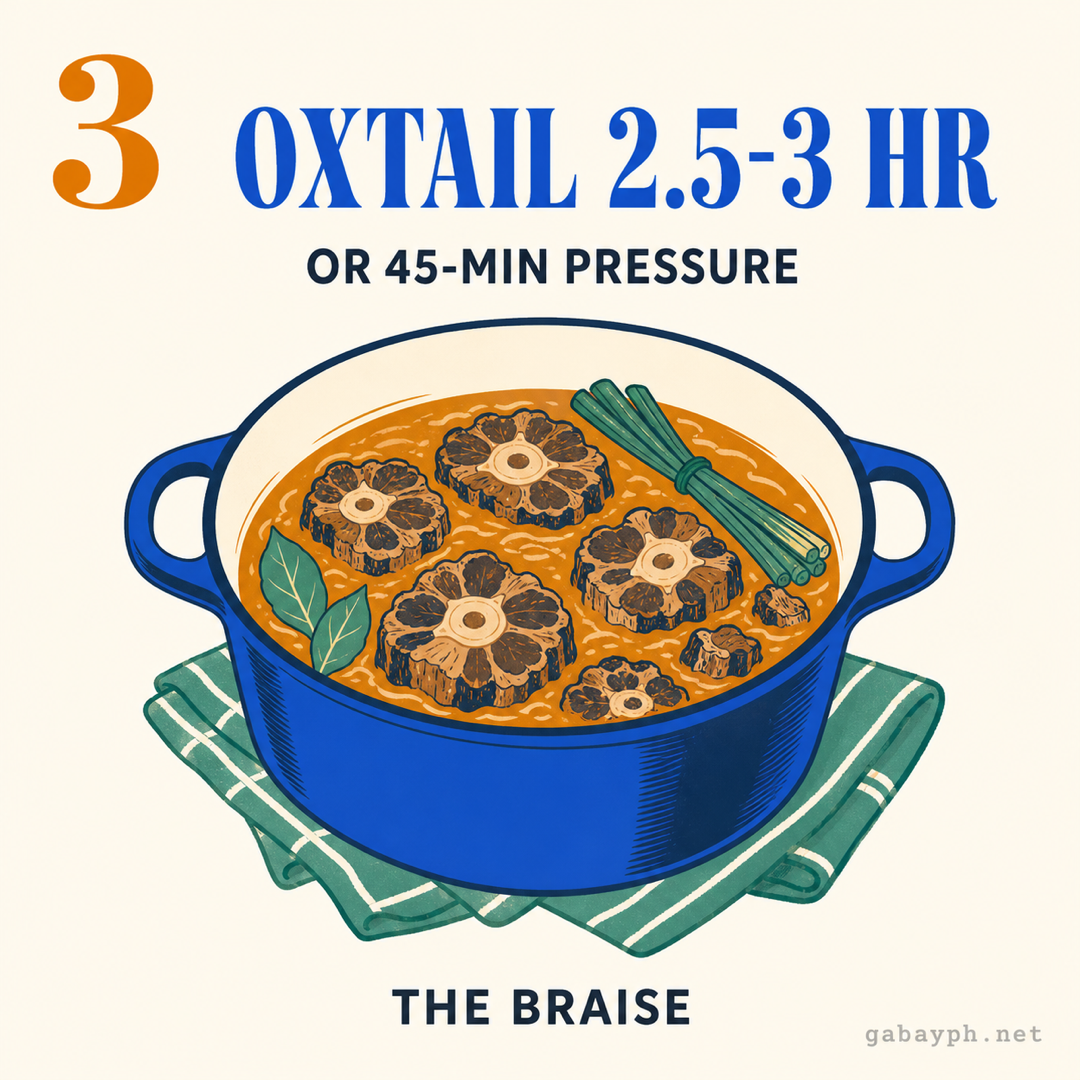
Combine the oxtail, 2 liters water, onion, garlic, salt, peppercorns, and bay leaves in a large heavy pot. Bring to a boil over high heat, then skim off the foam that rises to the top — this keeps the broth clean.
Reduce to a low simmer, cover, and cook for 2.5 to 3 hours until the oxtail is fork-tender and the meat pulls easily off the bone. The collagen breaks down here — this is what gives kare-kare its body. Do not rush this step.
Pressure cooker shortcut: 45-60 minutes at high pressure, natural release. This is the difference between a weekend project and a weeknight dinner.
When done, reserve 1/4 cup of the braising liquid for the peanut sauce. Keep the oxtail in the pot.
-
Make the Annatto Oil
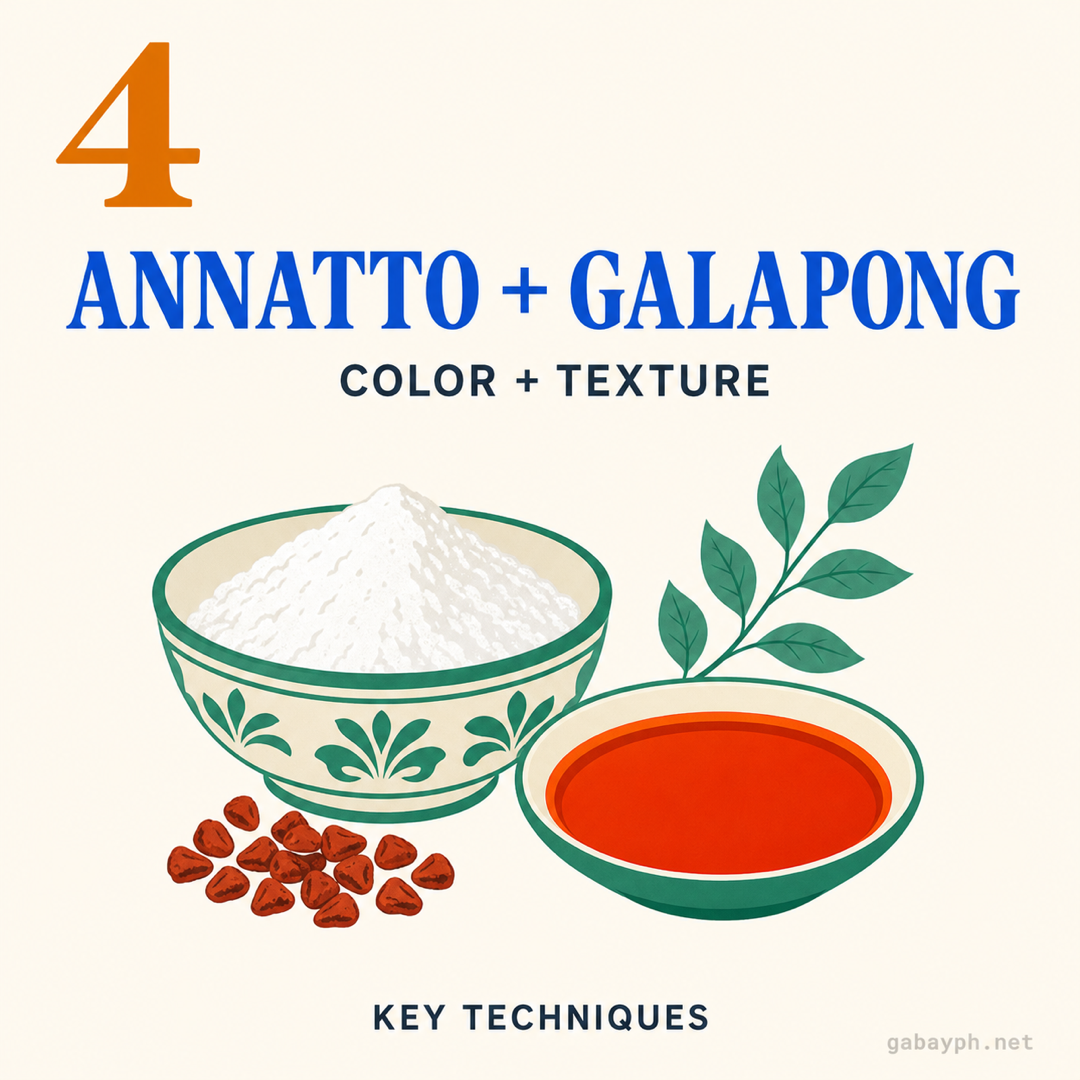
Heat 3 tbsp cooking oil in a small pan over low heat. Add 1 tbsp annatto seeds (atsuete) and steep for 3-4 minutes, swirling occasionally, until the oil turns a deep orange-red. Strain out the seeds and discard.
This is what gives kare-kare its signature color. Skip it and the sauce comes out grey-brown — edible but visually wrong. If you have pre-made annatto oil, skip ahead.
-
Make the Peanut Sauce
In a separate pan over medium heat, pour in the annatto oil. Add the reserved 1/4 cup oxtail braising liquid, the 3/4 cup peanut butter, and the 1/2 cup ground toasted peanuts. Whisk until smooth.
In a small bowl, make a galapong slurry: mix the 1/4 cup glutinous rice flour with 1/2 cup of cool braising liquid (do this with cool liquid, not hot, or you will get lumps). Pour the slurry into the peanut sauce while whisking constantly. Cook for 5-7 minutes until thickened to a gravy consistency.
Galapong is critical here. Peanut butter alone makes the sauce sticky and pasty; galapong gives it that smooth, velvety body kare-kare is known for.
-
Combine and Add Vegetables
Pour the peanut sauce into the pot with the braised oxtail. Stir gently to combine. Bring to a low simmer.
Add the vegetables in stages so each one cooks just right:
- Eggplant first — simmer 5 minutes (it takes the longest)
- Sitaw next — simmer 3 minutes
- Petsay or kangkong last — simmer 1-2 minutes until just wilted
- Banana heart (if using) — add with the eggplant
You want the vegetables tender-crisp, not mushy. If they go limp, you over-simmered them.
-
Add the Bagoong Substitute and Serve
Stir in your chosen substitute:
- Miso (Option A): 3-4 tbsp, dissolved first in a ladle of hot broth to avoid clumping, then stirred into the pot
- Soy + patis (Option B): 2 tbsp soy + 1 tsp patis, stirred straight in
- Tahini (Option C): 1-2 tbsp tahini whisked with a splash of broth first, plus salt to taste
- Doenjang (Option D): 2-3 tbsp, dissolved in broth same as miso
Taste, adjust the salt. The sauce should be thick, glossy, and orange-red.
Serve hot with steamed rice. Put a small bowl of the substitute on the side too (a teaspoon of miso paste with a wedge of calamansi, or soy with chopped chili) so guests can dial up the umami if they want. Garnish with extra toasted peanuts.
-
Pakuluan ang Buntot (2.5-3 oras)
Pagsamahin ang buntot, 2 litrong tubig, sibuyas, bawang, asin, paminta, at dahon ng laurel sa malaking mabigat na kaldero. Pakuluin sa malakas na apoy, pagkatapos ay alisin ang bula na lumulutang sa ibabaw — para malinis ang sabaw.
Hinaan ang apoy, takpan, at lutuin nang 2.5 hanggang 3 oras hanggang sa fork-tender ang buntot at madaling matanggal ang karne sa buto. Dito nasisira ang collagen — ito ang nagbibigay ng body sa kare-kare. Huwag madaliin ang hakbang na ito.
Pressure cooker shortcut: 45-60 minuto sa high pressure, natural release. Ito ang pagkakaiba ng weekend project at weeknight dinner.
Kapag tapos na, itabi ang 1/4 cup ng braising liquid para sa peanut sauce. Iwan ang buntot sa kaldero.
-
Gawin ang Annatto Oil
Painitin ang 3 kutsarang mantika sa maliit na kawali sa mahinang apoy. Idagdag ang 1 kutsarang atsuete at i-steep nang 3-4 minuto, paminsan-minsang ikutin, hanggang sa maging malalim na orange-red ang mantika. Salain at itapon ang buto.
Ito ang nagbibigay sa kare-kare ng signature na kulay. Kung lalaktawan mo, magiging grey-brown ang sarsa — kakainin pa rin, pero mali ang itsura. Kung may pre-made na annatto oil, laktawan ang step na ito.
-
Gawin ang Peanut Sauce
Sa hiwalay na kawali sa medium heat, ibuhos ang annatto oil. Idagdag ang 1/4 cup ng itinabiling braising liquid, ang 3/4 cup peanut butter, at ang 1/2 cup ground toasted peanuts. Haluin hanggang smooth.
Sa maliit na mangkok, gumawa ng galapong slurry: paghaluin ang 1/4 cup glutinous rice flour at 1/2 cup ng malamig na braising liquid (gawin ito sa malamig, hindi mainit, kung hindi magbubuo). Ibuhos ang slurry sa peanut sauce habang patuloy na hinahalo. Lutuin nang 5-7 minuto hanggang lumapot sa gravy consistency.
Kritikal dito ang galapong. Ang peanut butter mag-isa ay gumagawa ng sticky at pasty na sarsa; ang galapong ay nagbibigay ng smooth at velvety body na kilala sa kare-kare.
-
Pagsamahin at Idagdag ang Gulay
Ibuhos ang peanut sauce sa kaldero ng buntot. Haluin nang dahan-dahan. Pakuluin sa mahinang apoy.
Idagdag ang mga gulay nang paisa-isa para tama ang luto ng bawat isa:
- Talong muna — pakuluan 5 minuto (siya ang pinakamatagal maluto)
- Sitaw sunod — pakuluan 3 minuto
- Petsay o kangkong huli — pakuluan 1-2 minuto hanggang sa just-wilted lang
- Puso ng saging (kung gagamit) — idagdag kasabay ng talong
Gusto mo silang tender-crisp, hindi lata. Kapag lumambot na masyado, sobra ang luto.
-
Idagdag ang Pamalit sa Bagoong at Ihain
Haluin ang piniling pamalit:
- Miso (Option A): 3-4 kutsara, tunawin muna sa sandok ng mainit na sabaw para hindi magbuo, saka ihalo sa kaldero
- Toyo + patis (Option B): 2 kutsarang toyo + 1 kutsaritang patis, ihalo deretso
- Tahini (Option C): 1-2 kutsarang tahini na hinaluan ng kaunting sabaw muna, dagdagan ng asin sa panlasa
- Doenjang (Option D): 2-3 kutsara, tunawin sa sabaw katulad ng miso
Tikman, i-adjust ang asin. Ang sarsa ay dapat malapot, makintab, at orange-red.
Ihain nang mainit kasama ang kanin. Lagyan din ng maliit na mangkok ng pamalit sa gilid (isang kutsaritang miso paste na may calamansi, o toyo na may chili) para makapagdagdag ang bisita ng umami kung gusto nila. Dagdagan ng toasted peanuts bilang garnish.
Pro Tips
Mga Payo
- Miso is the closest 1:1 swap for shellfish allergy. Buy a small jar (300-500g) for ₱200-300 — it lasts months in the fridge and unlocks 20+ Filipino-Japanese dishes you can't normally make halal or shellfish-free.
- If you are cooking for mixed guests, serve bagoong on the side anyway. Put your substitute in the dish itself and a small bowl of regular bagoong on the table for whoever wants it. You stay allergy-friendly without forcing the change on everyone — the best of both.
- Galapong is critical for the right texture. Found at Filipino sari-sari and Asian groceries for ₱30-50/pack. If you genuinely cannot get it, substitute 2 tbsp cornstarch slurry — the texture won't be quite right but workable. Do not skip the thickener entirely.
- Annatto oil = the color. Do not skip. 1 tbsp annatto seeds steeped in 3 tbsp oil for 3-4 minutes. Without it, the sauce comes out grey-brown (peanut butter alone is yellow-tan). Sold at any Filipino grocery for ₱30-40/pack.
- Pressure cooker cuts braising time from 3 hours to 45-60 minutes. Game-changer for weeknight kare-kare. Otherwise this is a weekend-meal commitment — start at 2pm if you want to serve at 6pm.
- Ang miso ang pinakamalapit na 1:1 swap para sa shellfish allergy. Bumili ng maliit na jar (300-500g) sa ₱200-300 — tumatagal nang buwan sa ref at nag-uunlock ng 20+ Filipino-Japanese dishes na hindi mo normal nagagawang halal o shellfish-free.
- Kung mixed ang bisita, ihain pa rin ang bagoong sa gilid. Ilagay ang pamalit sa loob ng ulam at maliit na mangkok ng bagoong sa mesa para sa gustong magdagdag. Manatili kang allergy-friendly nang hindi pinipilit ang lahat — best of both.
- Kritikal ang galapong para sa tamang texture. Mabibili sa sari-sari at Asian grocery sa ₱30-50/pack. Kung talagang wala, palitan ng 2 kutsarang cornstarch slurry — hindi gaanong tama ang texture pero pwede. Huwag tanggalin nang lubusan ang pampalapot.
- Annatto oil = ang kulay. Huwag laktawan. 1 kutsarang atsuete sa 3 kutsarang mantika, 3-4 minuto. Kung wala, magiging grey-brown ang sarsa (yellow-tan lang ang peanut butter). Mabibili sa anumang Filipino grocery sa ₱30-40/pack.
- Bawas ng pressure cooker ang braising time mula 3 oras hanggang 45-60 minuto. Game-changer para sa weeknight kare-kare. Kundi, weekend-meal commitment ito — magsimula nang 2pm kung 6pm ang serbi.
Frequently Asked Questions
Mga Madalas Itanong
Can I use beef stew meat instead of oxtail?
Yes, but use bone-in cuts like osso buco or beef shank for the collagen. Pure stew meat (cubed chuck or round) lacks the body the bones give. Reduce cook time to 1.5-2 hours since these cuts tenderize faster than oxtail. The dish will still be excellent — just slightly less rich.
Pwede ba beef stew meat instead of oxtail?
Oo, pero gumamit ng bone-in cuts tulad ng osso buco o beef shank para sa collagen. Ang pure stew meat (cubed chuck o round) ay walang body na binibigay ng buto. Bawasan ang cook time sa 1.5-2 oras dahil mas mabilis lumambot ang mga cuts na ito kaysa buntot. Maganda pa rin ang luto — medyo mas hindi lang mayaman.
Saan makakabili ng miso?
SM Supermarket Asian aisle, Robinsons Asian section, Healthy Options, and S&R all carry it. Brands to look for: Hikari, Marukome, Shinjyo. Smallest jar (300-500g) runs ₱200-300 and lasts months refrigerated. White miso (shiro miso) is the mildest and closest to bagoong's role — that's what you want here.
Saan makakabili ng miso?
SM Supermarket Asian aisle, Robinsons Asian section, Healthy Options, at S&R lahat may benta. Mga brand na hanapin: Hikari, Marukome, Shinjyo. Pinakamaliit na jar (300-500g) ay ₱200-300 at tumatagal ng buwan sa ref. White miso (shiro miso) ang pinakabanayad at pinakamalapit sa role ng bagoong — yan ang kailangan dito.
Halal certified ba ang miso?
Most Japanese miso is technically halal-compliant — the ingredients are soybeans, salt, koji culture, and water, with no alcohol added during fermentation. However, for strict halal observance, look for a "halal-certified" label specifically. Hikari carries halal-certified variants sold at Healthy Options and select S&R branches. When in doubt, ask the staff or look for the halal mark on the label.
Halal certified ba ang miso?
Karamihan ng Japanese miso ay technically halal-compliant — ang sangkap ay soybeans, asin, koji culture, at tubig, walang alak na idinagdag sa fermentation. Pero para sa strict halal observance, hanapin ang "halal-certified" na label. May halal-certified na variants ang Hikari na binebenta sa Healthy Options at piling S&R branches. Kung may duda, magtanong sa staff o hanapin ang halal mark sa label.
Magkano gastos total?
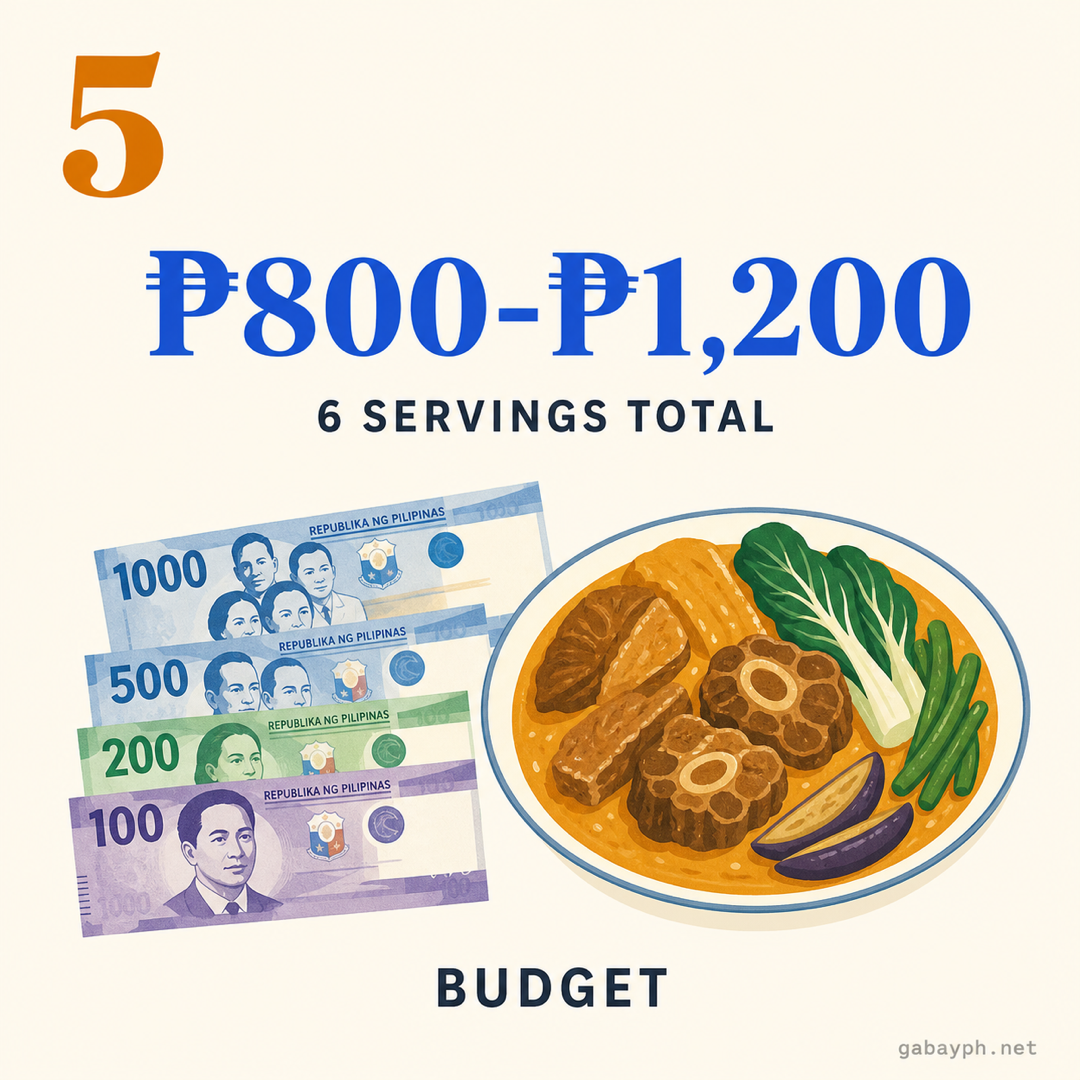
Roughly ₱800 to ₱1,200 for 6 servings. Oxtail is the biggest line item at ₱400-600/kg. Miso is ₱200-300 per jar (lasts multiple meals — only ₱30-40 worth used here). Vegetables run ₱150-250 depending on season. Galapong + annatto + peanut butter altogether ~₱100. That works out to ~₱150-200 per serving — a special-occasion price, not weeknight.
Magkano gastos total?
Mga ₱800 hanggang ₱1,200 para sa 6 na serbida. Ang buntot ang pinakamahal na line item sa ₱400-600/kg. Ang miso ay ₱200-300 bawat jar (tumatagal ng ilang ulam — ₱30-40 lang ang nagagamit dito). Ang gulay ay ₱150-250 depende sa season. Galapong + atsuete + peanut butter sabay-sabay ~₱100. ~₱150-200 kada serbida — special-occasion na presyo, hindi weeknight.
Can I use chunky peanut butter?
Smooth is traditional, but chunky works — the texture will be more rustic, with bigger peanut bits in the sauce. If you go chunky, you can skip the separate ground toasted peanuts. The flavor will be slightly nuttier and the mouthfeel a bit more like a peanut soup than a velvety sauce.
Pwede ba chunky peanut butter?
Smooth ang tradisyonal, pero pwede ang chunky — mas rustic ang texture, na may malalaking piraso ng mani sa sarsa. Kung chunky ang gagamitin, pwede mong laktawan ang separate na ground toasted peanuts. Medyo mas mani-nan ang lasa at medyo mas peanut soup ang mouthfeel kaysa velvety sauce.
Bakit kailangan pa atsuete kahit may peanut butter?
Peanut butter alone makes a yellow-brown sauce — it does not carry the orange-red color that defines kare-kare on sight. Annatto (atsuete) is what turns the sauce that distinctive orange. Visual matters in this dish — half of what people love about kare-kare is the color hitting the table. Skip annatto and people will eat it and say "ang sarap, pero mukhang ibang ulam."
Bakit kailangan pa atsuete kahit may peanut butter?
Ang peanut butter mag-isa ay gumagawa ng yellow-brown na sarsa — hindi nito dala ang orange-red na kulay na sumasagi sa kare-kare sa tingin pa lang. Ang atsuete ang nagpapaging orange ng sarsa. Mahalaga ang itsura sa ulam na ito — kalahati ng dahilan kung bakit gusto ng mga tao ang kare-kare ay ang kulay pagdating sa mesa. Laktawan mo ang atsuete at kakainin pa rin pero sasabihin "ang sarap, pero mukhang ibang ulam."
What if I'm allergic to peanuts AND shellfish?
Then kare-kare is not possible as kare-kare — peanut is the dish's defining ingredient. You could make a similar oxtail-vegetable stew with sesame paste (tahini) replacing the peanut, but it would be a different dish entirely — closer to a Filipino-style sesame stew. Honest answer: if you have both allergies, pick a different ulam (sinigang or nilaga are great oxtail-friendly options).
Paano kung allergic ako sa mani AT hipon?
Kung gayon, hindi pwede ang kare-kare bilang kare-kare — ang mani ang defining ingredient ng ulam. Pwede kang gumawa ng katulad na oxtail-vegetable stew gamit ang sesame paste (tahini) bilang pamalit sa mani, pero ibang ulam na talaga ito — mas malapit sa Filipino-style sesame stew. Honest na sagot: kung may dalawang allergy ka, pumili na lang ng ibang ulam (sinigang o nilaga ay magagandang oxtail-friendly options).
Can the sauce be made ahead?
Yes — peanut sauce keeps 3 days in the fridge. Reheat with a splash of broth (it thickens further when cold) before adding the vegetables. The oxtail also benefits from sitting overnight — the flavor deepens. Many cooks intentionally make kare-kare a day ahead. Just add the bagoong substitute on the day of serving, not when you store, since miso can lose nuance after long refrigeration.
Pwede ba gawin ng maaga ang sarsa?
Oo — tumatagal ng 3 araw ang peanut sauce sa ref. Initin ulit na may dagdag na sabaw (lumalapot pa kapag malamig) bago idagdag ang gulay. Mas masarap din ang buntot kapag overnight — mas lumalalim ang lasa. Maraming nagluluto ang sinasadyang gawin ang kare-kare isang araw bago. Idagdag lang ang pamalit sa bagoong sa araw ng serbi, hindi sa pag-imbak, dahil maaaring mawalan ng nuance ang miso pagkatapos ng matagal na refrigeration.