

Filipino Farmer's Guide: Subsidies, Crop Insurance & Cooperatives (2026 Guide)
Gabay para sa Magsasaka: Subsidies, Insurance, at Kooperatiba (2026 Gabay)

5 Things to Know
Farmer support in five facts.
Quick Summary
Mabilis na Buod
Table of Contents
Talaan ng Nilalaman

This guide covers all the government programs, insurance, loans, and support available to Filipino farmers in 2026. Whether you grow rice, corn, vegetables, or raise livestock, there are programs that can help you — and most of them are free. You just need to know where to go and what to bring.
Sakop ng gabay na ito ang lahat ng programa ng gobyerno, insurance, utang, at tulong na available para sa mga magsasaka sa Pilipinas ngayong 2026. Kahit palay, mais, gulay, o hayop ang pinapangalagaan mo, may mga programa na makakatulong sa iyo — at halos lahat ay libre. Kailangan mo lang malaman kung saan pupunta at ano ang dadalhin.
Requirements Checklist
Listahan ng mga Kailangan
- Valid government-issued ID (PhilSys national ID, UMID, voter's ID, or driver's license)
- Proof of farm land — land title, CLOA (Certificate of Land Ownership Award from DAR), lease contract, or certification from landowner
- RSBSA registration (Registry System for Basic Sectors in Agriculture) — this is your gateway to all DA programs
- Barangay certification as a farmer or fisherfolk — ask your barangay captain for this
- Recent harvest records, if available (receipts from traders, cooperative records, or a simple logbook)
- Valid na government ID (PhilSys national ID, UMID, voter's ID, o driver's license)
- Patunay ng lupa — titulo ng lupa, CLOA (Certificate of Land Ownership Award mula sa DAR), kontrata ng upa, o sertipikasyon mula sa may-ari ng lupa
- RSBSA registration (Registry System for Basic Sectors in Agriculture) — ito ang susi sa lahat ng programa ng DA
- Barangay certification bilang magsasaka o mangingisda — humingi sa inyong barangay captain
- Mga record ng ani, kung meron (resibo mula sa traders, record ng kooperatiba, o simpleng listahan)
Government Programs for Farmers
Mga Programa ng Gobyerno para sa Magsasaka
RSBSA — Your First Step
RSBSA — Ang Unang Hakbang Mo
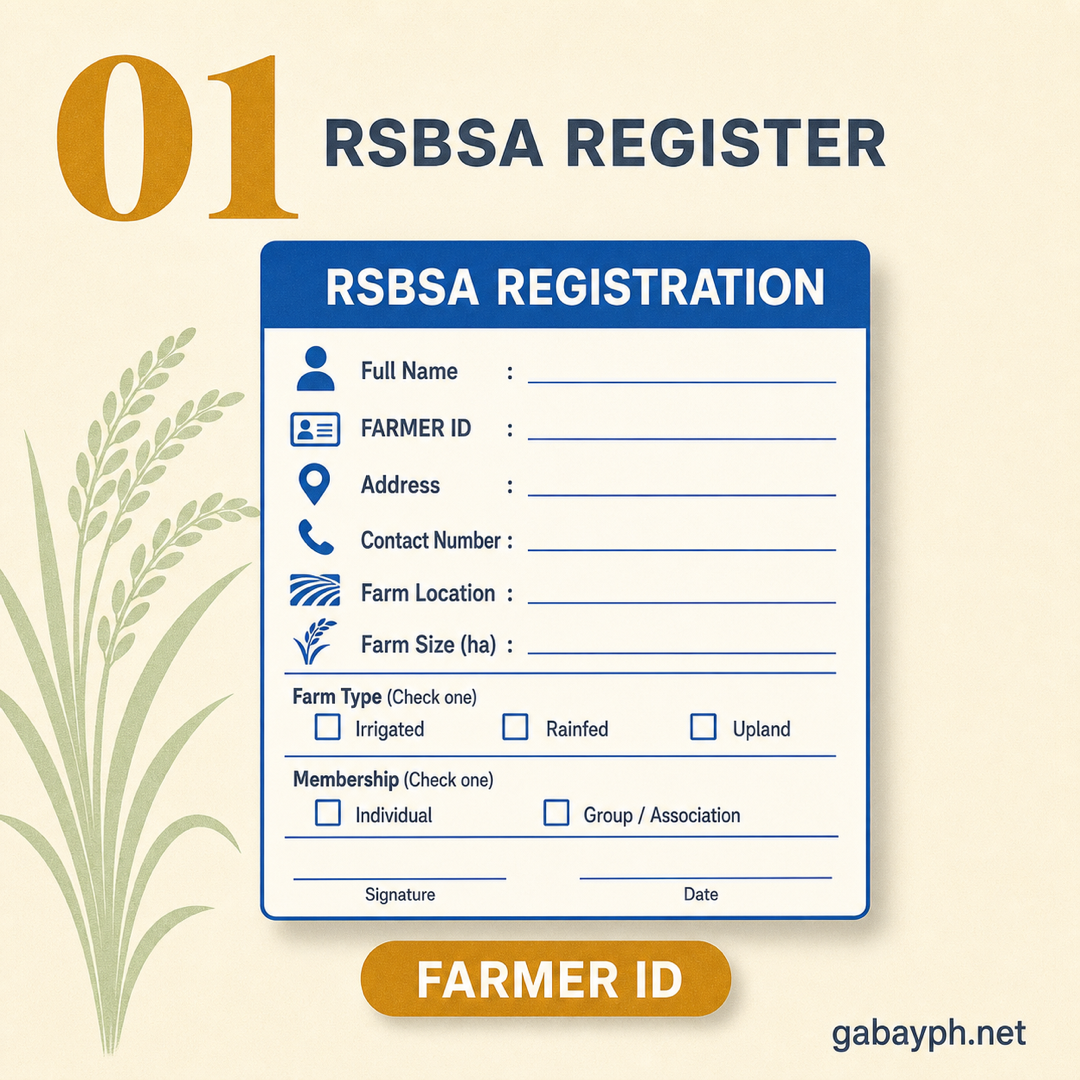
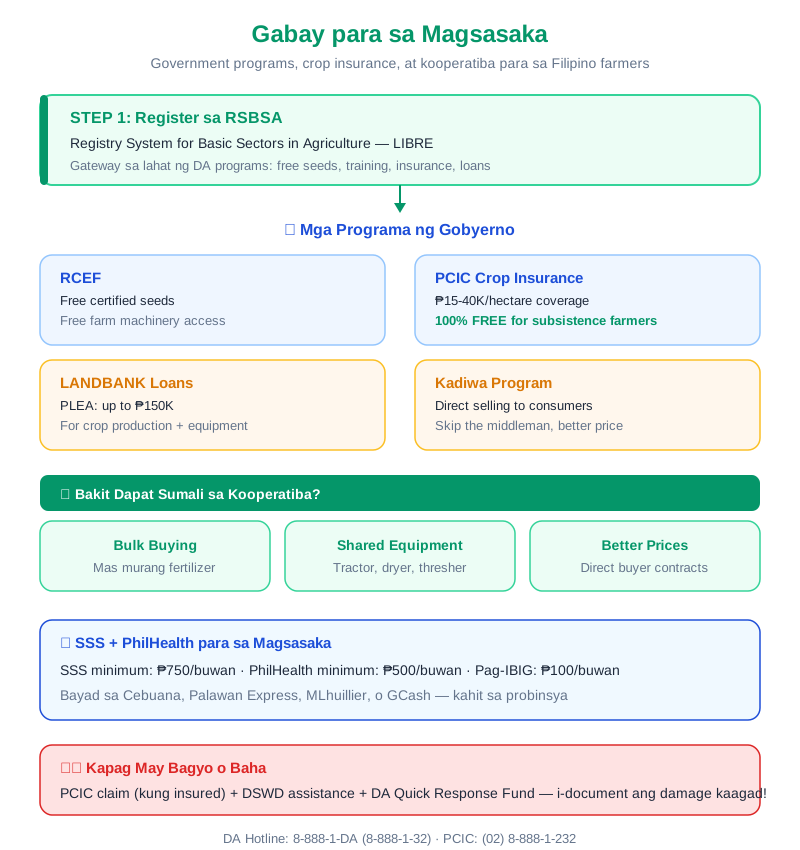
The RSBSA (Registry System for Basic Sectors in Agriculture) is a list of all farmers, farmworkers, and fisherfolk in the Philippines maintained by the DA (Department of Agriculture). If you are not in this list, you cannot access most government programs for farmers. Think of it as your "farmer ID."
Ang RSBSA (Registry System for Basic Sectors in Agriculture) ay listahan ng lahat ng magsasaka, manggagawa sa bukid, at mangingisda sa Pilipinas na hawak ng DA (Department of Agriculture). Kung wala ka sa listahang ito, hindi mo maa-access ang karamihan ng mga programa ng gobyerno para sa magsasaka. Isipin mo itong "farmer ID" mo.
How to register: Go to your Municipal/City Agriculture Office (MAO/CAO) or the barangay hall. Bring a valid ID, proof of farm land, and barangay certification. Registration is free. Once registered, you get an RSBSA number that you can use for all DA programs.
Paano magpa-register: Pumunta sa Municipal/City Agriculture Office (MAO/CAO) o sa barangay hall. Magdala ng valid na ID, patunay ng lupa, at barangay certification. Ang registration ay libre. Kapag nakarehistro ka na, makakakuha ka ng RSBSA number na magagamit mo sa lahat ng programa ng DA.
RCEF — Rice Competitiveness Enhancement Fund
RCEF — Pondo para sa Pagtatanim ng Palay
If you are a rice farmer, the RCEF gives you access to:
Kung magsasaka ng palay ka, ang RCEF ay nagbibigay sa iyo ng:
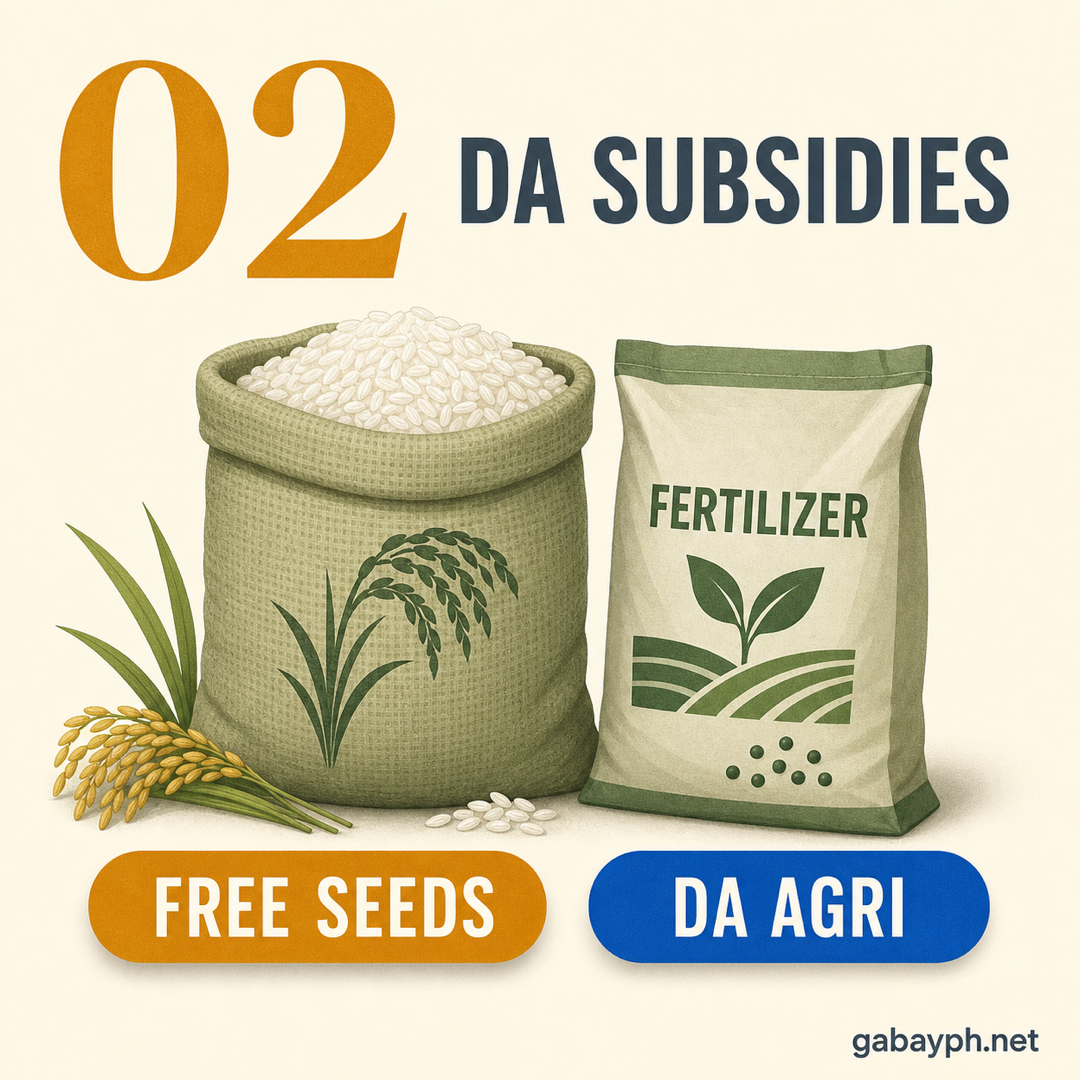
- Free certified seeds — distributed through your MAO. You can get enough seeds for up to 1 hectare per season.
- Free farm machinery — rice transplanters, combine harvesters, flatbed dryers, and rice mills are given to farmer cooperatives and associations (not to individuals, so joining a cooperative is key)
- Free training — the Philippine Rice Research Institute (PhilRice) and ATI (Agricultural Training Institute) conduct trainings on modern farming methods, seed selection, and pest management
- Credit assistance — low-interest or zero-interest loans through LANDBANK and other partner institutions
- Libreng certified seeds — ipinamamahagi sa pamamagitan ng inyong MAO. Maaari kang makakuha ng sapat na binhi para sa hanggang 1 ektarya bawat taniman.
- Libreng farm machinery — rice transplanters, combine harvesters, flatbed dryers, at rice mills ang ibinibigay sa kooperatiba at asosasyon ng magsasaka (hindi sa indibidwal, kaya mahalaga ang pagsali sa kooperatiba)
- Libreng training — ang PhilRice at ATI (Agricultural Training Institute) ay nagsasagawa ng mga pagsasanay tungkol sa makabagong paraan ng pagtatanim, pagpili ng binhi, at pamamahala sa peste
- Tulong sa pautang — mababang interes o walang interes na utang sa pamamagitan ng LANDBANK at iba pang kasosyo
Philippine Crop Insurance (PCIC)
Insurance ng Pananim sa Pilipinas (PCIC)
The PCIC (Philippine Crop Insurance Corporation) protects farmers when crops are damaged by typhoons, floods, drought, pests, or disease. If you lose your harvest, PCIC pays you money so you can plant again next season.
Ang PCIC (Philippine Crop Insurance Corporation) ang nagpoprotekta sa mga magsasaka kapag nasira ang pananim dahil sa bagyo, baha, tagtuyot, peste, o sakit. Kung mawala ang ani mo, magbabayad ang PCIC sa iyo para makapagtanim ka ulit sa susunod na taniman.
What PCIC Covers
Ano ang Sinasaklaw ng PCIC
- Rice — coverage of ₱15,000 to ₱40,000 per hectare
- Corn — coverage of ₱10,000 to ₱30,000 per hectare
- High-value crops (vegetables, fruit trees, etc.) — coverage varies by crop type
- Livestock — covers carabao, cattle, goats, hogs, and poultry
- Fisheries — covers fishponds, fish cages, and seaweed farms
- Palay — saklaw na ₱15,000 hanggang ₱40,000 bawat ektarya
- Mais — saklaw na ₱10,000 hanggang ₱30,000 bawat ektarya
- High-value crops (gulay, punong-prutas, atbp.) — ang saklaw ay depende sa uri ng pananim
- Livestock — kasama ang kalabaw, baka, kambing, baboy, at manok
- Pangisdaan — kasama ang fishponds, fish cages, at seaweed farms
How Much Does It Cost?
Magkano ang Bayad?
Good news: if you are a subsistence farmer (small-scale, registered in RSBSA), your premium is 100% subsidized by the government. That means you pay nothing — the government pays your insurance for you. For commercial farmers, premiums are partially subsidized.
Magandang balita: kung subsistence farmer ka (maliit na sakahan, nakarehistro sa RSBSA), ang bayad mo sa insurance ay 100% sinasagot ng gobyerno. Ibig sabihin, wala kang babayaran — ang gobyerno ang magbabayad ng insurance mo. Para sa commercial farmers, bahagyang sinusubsidize ang premium.
How to Apply for PCIC
Paano Mag-apply sa PCIC
- Go to your LGU Municipal/City Agriculture Office or the nearest PCIC Provincial Office
- Bring your valid ID, RSBSA registration, and proof of farm land
- Fill out the PCIC application form — the agriculture technician will help you
- Your application will be processed, and your coverage starts when the planting season begins
- Pumunta sa inyong LGU Municipal/City Agriculture Office o sa pinakamalapit na PCIC Provincial Office
- Magdala ng valid na ID, RSBSA registration, at patunay ng lupa
- Sagutan ang PCIC application form — tutulungan ka ng agriculture technician
- Ipoproseso ang application mo, at magsisimula ang coverage mo kapag nagsimula na ang taniman
Joining a Cooperative
Pagsali sa Kooperatiba
A farming cooperative is a group of farmers who work together to save money, share resources, and get better deals. It is one of the best moves you can make as a farmer.
Ang kooperatiba ng magsasaka ay grupo ng mga magsasaka na nagtutulungan para makatipid, maghati sa gamit, at makakuha ng mas magandang presyo. Isa ito sa pinaka-magandang hakbang na magagawa mo bilang magsasaka.
Benefits of Joining a Cooperative
Mga Benepisyo ng Pagsali sa Kooperatiba
- Bulk buying — buy fertilizer, seeds, and supplies together at lower prices
- Shared equipment — access tractors, threshers, and dryers that are too expensive to buy alone (RCEF gives farm machinery to cooperatives, not individuals)
- Better farmgate prices — sell your harvest together and negotiate a higher price from traders
- Access to loans — cooperatives can borrow from LANDBANK and other banks more easily than individual farmers
- Training and support — DA and NGOs often provide training to cooperatives
- Savings and lending — many cooperatives have their own savings and credit programs for members
- Bulk buying — sabay-sabay bumili ng pataba, binhi, at mga gamit para mas mura
- Shared equipment — makagagamit ng traktora, thresher, at dryer na masyadong mahal kung mag-isa kang bibili (ang RCEF ay nagbibigay ng farm machinery sa kooperatiba, hindi sa indibidwal)
- Mas mataas na presyo ng ani — sabay-sabay ibenta ang ani at makipag-negotiate ng mas mataas na presyo sa mga trader
- Access sa utang — mas madaling umutang ng kooperatiba sa LANDBANK at iba pang bangko kumpara sa indibidwal na magsasaka
- Training at suporta — madalas magbigay ng pagsasanay ang DA at mga NGO sa kooperatiba
- Savings at lending — maraming kooperatiba ang may sariling programa ng ipon at pautang para sa miyembro
How to Find and Join a Cooperative
Paano Humanap at Sumali sa Kooperatiba
- Ask at your LGU Agriculture Office — they know which cooperatives operate in your area
- Check the CDA (Cooperative Development Authority) registry at cda.gov.ph
- Visit the DA Regional Field Office for a list of accredited farmer organizations
- Talk to other farmers in your barangay — word of mouth is still the best way to find a good cooperative
- Magtanong sa inyong LGU Agriculture Office — alam nila kung aling kooperatiba ang nag-ooperate sa inyong lugar
- Tingnan ang listahan ng CDA (Cooperative Development Authority) sa cda.gov.ph
- Pumunta sa DA Regional Field Office para sa listahan ng accredited na samahan ng magsasaka
- Makipag-usap sa ibang magsasaka sa inyong barangay — ang payo ng kakilala mo pa rin ang pinakamadaling paraan para makahanap ng magandang kooperatiba
Minimum members to form a cooperative: 15 members. If there is no cooperative in your area, you can start one by registering with the CDA. You need 15 people, a set of bylaws, and a pre-registration education seminar (PRES) — the CDA or your LGU can help with this.
Minimum na miyembro para bumuo ng kooperatiba: 15 miyembro. Kung walang kooperatiba sa inyong lugar, maaari kang magsimula ng isa sa pamamagitan ng pagpapa-rehistro sa CDA. Kailangan ninyo ng 15 tao, isang set ng bylaws, at pre-registration education seminar (PRES) — makakatulong ang CDA o inyong LGU dito.
SSS and PhilHealth for Farmers
SSS at PhilHealth para sa Magsasaka
Yes, farmers can and should get SSS and PhilHealth. You do not need a regular job or an employer. Here is how it works.
Oo, pwede at dapat magkaroon ng SSS at PhilHealth ang mga magsasaka. Hindi mo kailangan ng regular na trabaho o employer. Ganito ang proseso.
SSS for Farmers
SSS para sa Magsasaka
Register as a self-employed or voluntary member at your nearest SSS branch or online at sss.gov.ph. The minimum monthly contribution is ₱960 (based on minimum monthly salary credit of ₱4,000). You can pay higher if you want bigger benefits later.
Magparehistro bilang self-employed o voluntary member sa pinakamalapit na SSS branch o online sa sss.gov.ph. Ang pinakamababang buwanang kontribusyon ay ₱960 (base sa minimum monthly salary credit na ₱4,000). Maaari kang magbayad ng mas mataas kung gusto mo ng mas malaking benepisyo sa hinaharap.
Where to pay even in rural areas: Cebuana Lhuillier, Palawan Express, Bayad Center, GCash, Maya, and 7-Eleven all accept SSS payments. No need to go to the SSS branch every month.
Saan pwedeng magbayad kahit nasa probinsya: Cebuana Lhuillier, Palawan Express, Bayad Center, GCash, Maya, at 7-Eleven — lahat sila tumatanggap ng bayad sa SSS. Hindi mo kailangang pumunta sa SSS branch buwan-buwan.
PhilHealth for Farmers
PhilHealth para sa Magsasaka
PhilHealth has a special membership category for farmers and fisherfolk. If you are registered in the RSBSA, you may be enrolled as a sponsored member — this means the national government or your LGU pays your PhilHealth premium for you. Check with your Municipal Health Office or PhilHealth office if you are already covered.
May espesyal na membership category ang PhilHealth para sa magsasaka at mangingisda. Kung nakarehistro ka sa RSBSA, maaaring enrolled ka bilang sponsored member — ibig sabihin, ang gobyerno o LGU ang nagbabayad ng PhilHealth premium mo. Itanong sa inyong Municipal Health Office o PhilHealth office kung covered ka na.
If you are not sponsored, you can register as a voluntary/informal economy member. The monthly premium is ₱500 (covers you and your dependents). Pay through Cebuana, Palawan Express, GCash, or any PhilHealth-accredited collection agent.
Kung hindi ka sponsored, maaari kang magparehistro bilang voluntary/informal economy member. Ang buwanang premium ay ₱500 (kasama ka at ang mga dependent mo). Magbayad sa pamamagitan ng Cebuana, Palawan Express, GCash, o kahit anong PhilHealth-accredited collection agent.
Farm Financing
Pagpapautang para sa Bukid
LANDBANK Loans
Utang sa LANDBANK
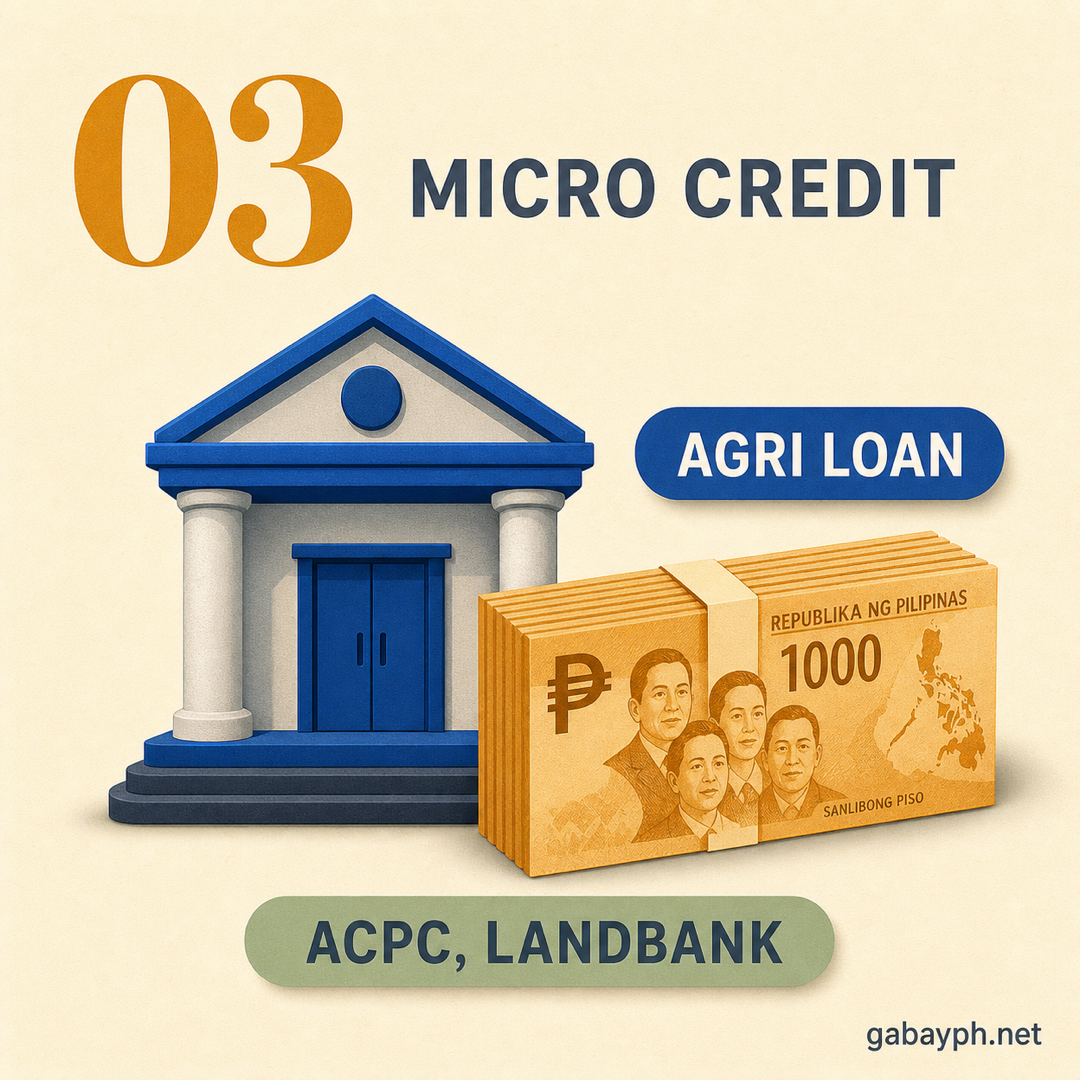
LANDBANK is the primary government bank for farmers. Their PLEA (Program Lending for Expanded Agriculture) offers loans of up to ₱150,000 for crop production. Interest rates are lower than private lenders — usually around 6% to 8% per year.
Ang LANDBANK ang pangunahing bangko ng gobyerno para sa magsasaka. Ang kanilang PLEA (Program Lending for Expanded Agriculture) ay nag-aalok ng utang hanggang ₱150,000 para sa crop production. Ang interes ay mas mababa kumpara sa private lenders — karaniwang 6% hanggang 8% bawat taon.
Requirements: RSBSA registration, valid ID, proof of farm land (title, CLOA, or lease), and a simple farm plan. Apply at the nearest LANDBANK branch. If you are part of a cooperative, the cooperative can apply for a bigger loan on behalf of its members.
Mga kailangan: RSBSA registration, valid na ID, patunay ng lupa (titulo, CLOA, o upa), at simpleng plano ng sakahan. Mag-apply sa pinakamalapit na LANDBANK branch. Kung miyembro ka ng kooperatiba, ang kooperatiba ang maaaring mag-apply ng mas malaking utang para sa mga miyembro nito.
ACPC Programs
Mga Programa ng ACPC
The ACPC (Agricultural Credit Policy Council) under the DA provides various lending programs with 0% interest for smallholder farmers. These loans are coursed through cooperatives, rural banks, and microfinance institutions. Ask your MAO or cooperative about available ACPC programs in your area.
Ang ACPC (Agricultural Credit Policy Council) sa ilalim ng DA ay may iba't ibang programa ng pautang na 0% interes para sa maliliit na magsasaka. Ang mga utang na ito ay dinadaan sa mga kooperatiba, rural banks, at microfinance institutions. Magtanong sa inyong MAO o kooperatiba kung may available na ACPC programs sa inyong lugar.
Pag-IBIG Multi-Purpose Loan
Pag-IBIG Multi-Purpose Loan
If you are a Pag-IBIG member with at least 24 monthly contributions, you can take out a multi-purpose loan (MPL) of up to ₱100,000. The interest rate is low (5.5% per year) and you can use it for anything — including farm inputs. Register at any Pag-IBIG branch or online at pagibigfund.gov.ph.
Kung Pag-IBIG member ka na may hindi bababa sa 24 na buwanang kontribusyon, maaari kang umutang ng multi-purpose loan (MPL) hanggang ₱100,000. Mababa ang interes (5.5% bawat taon) at maaari mo itong gamitin sa kahit ano — kasama ang mga gamit sa bukid. Magparehistro sa kahit anong Pag-IBIG branch o online sa pagibigfund.gov.ph.
Selling Your Harvest
Pagbebenta ng Ani
Knowing where and how to sell your harvest can make the difference between barely surviving and actually earning well. Here are your options.
Ang pag-alam kung saan at paano ibenta ang ani mo ay malaking bagay — maaari itong pagkakaiba ng halos hindi kumikita at talagang kumikita nang maayos. Narito ang mga pagpipilian mo.
Farmgate vs. Trader Prices
Farmgate vs. Presyo ng Trader
Farmgate price is what a trader pays you right at your farm. It is convenient but usually the lowest price you will get. Traders then sell to wholesalers at a much higher price. If possible, try to sell closer to the consumer — at the market, through a cooperative, or directly to buyers.
Ang farmgate price ay ang binabayaran sa iyo ng trader doon mismo sa bukid mo. Maginhawa ito pero karaniwang ito ang pinakamababang presyo na makukuha mo. Ibebenta naman ng traders ito sa wholesalers sa mas mataas na presyo. Kung maaari, subukang magbenta nang mas malapit sa mamimili — sa palengke, sa pamamagitan ng kooperatiba, o direkta sa mga buyer.
Kadiwa ni Ani at Kita
Kadiwa ni Ani at Kita
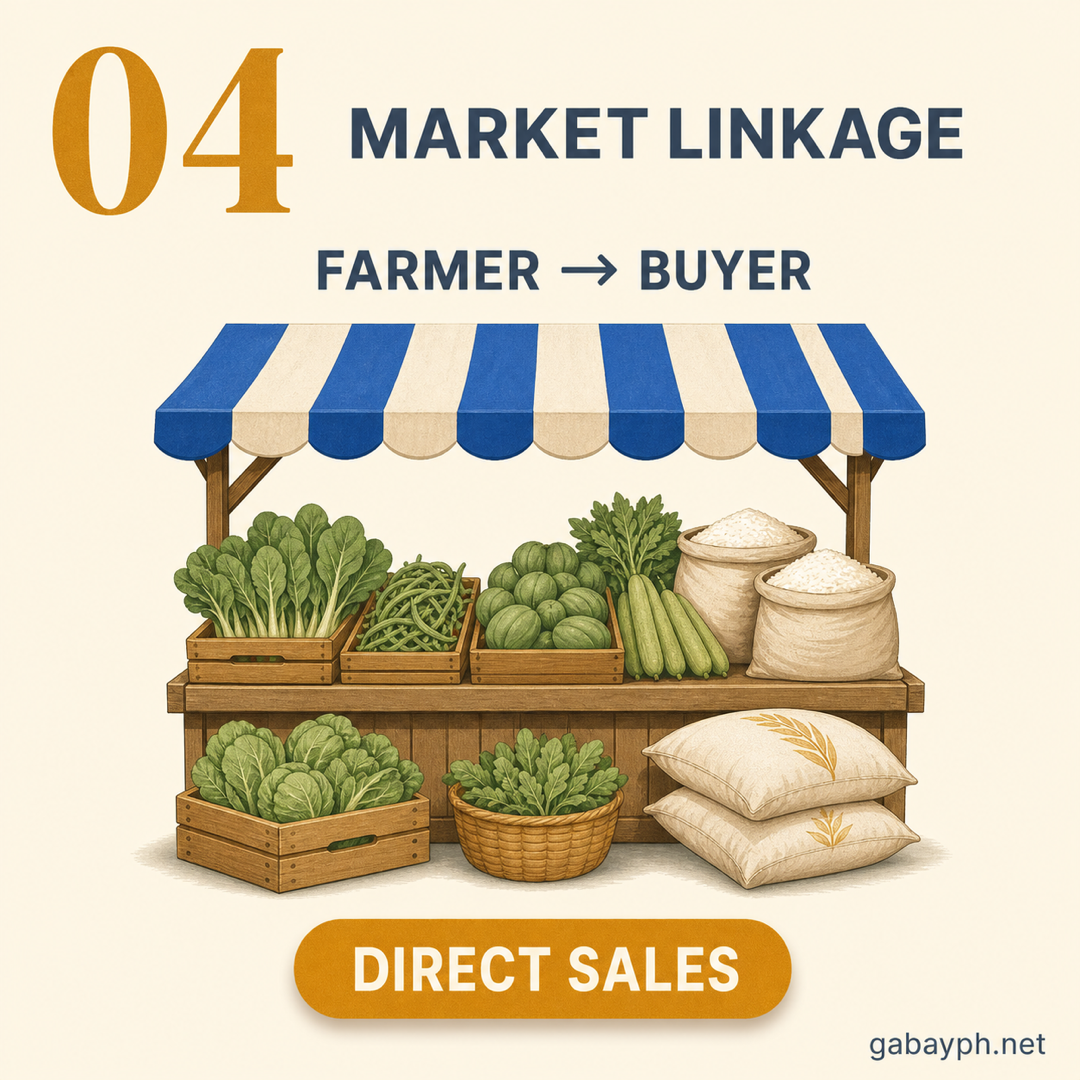
The DA runs the Kadiwa ni Ani at Kita program — these are direct-selling events where farmers sell produce directly to consumers at fair prices. No middleman. Ask your MAO or DA regional office about Kadiwa schedules in your area.
Pinapatakbo ng DA ang Kadiwa ni Ani at Kita — mga direct-selling events kung saan ibinebenta ng magsasaka ang produkto nila nang direkta sa mga mamimili sa tamang presyo. Walang middleman. Magtanong sa inyong MAO o DA regional office tungkol sa schedule ng Kadiwa sa inyong lugar.
Other Options
Iba Pang Pagpipilian
- NFA palay buying stations — NFA buys palay at a support price. Check with your local NFA office for buying schedules and current prices.
- Local palengke — rent a stall or sell on market days. Works well for vegetables, fruits, and other perishable goods.
- Cooperative marketing — your cooperative can pool the harvest and negotiate bulk prices with big buyers like restaurants, hotels, and supermarkets.
- NFA palay buying stations — bumibili ang NFA ng palay sa support price. Tanungin sa inyong lokal na NFA office ang schedule ng pagbili at kasalukuyang presyo.
- Lokal na palengke — mag-upa ng stall o magbenta sa market days. Maganda ito para sa gulay, prutas, at iba pang madaling mapanis.
- Cooperative marketing — maaaring pagsama-samahin ng kooperatiba ang ani at makipag-negotiate ng bulk prices sa malalaking buyer tulad ng mga restaurant, hotel, at supermarket.
Disaster Recovery
Pagbangon Mula sa Kalamidad
The Philippines gets hit by an average of 20 typhoons a year, plus floods and droughts. When disaster strikes your farm, here is what to do.
Tinatamaan ang Pilipinas ng average na 20 bagyo bawat taon, dagdag pa ang baha at tagtuyot. Kapag tinamaan ng kalamidad ang bukid mo, ito ang gagawin mo.
If You Have PCIC Insurance
Kung May PCIC Insurance Ka
- Document the damage immediately — take photos and videos of your damaged crops or livestock. Include the date, your name, and the location. A phone camera is fine.
- Report to your MAO or PCIC within 30 days — go to your Municipal Agriculture Office or PCIC provincial office to file a claim
- An adjuster will visit your farm — they will assess the damage and verify your claim
- Receive your payment — PCIC pays through LANDBANK checks or direct deposit. Processing usually takes 30 to 60 days after filing.
- I-dokumento ang pinsala agad — kunan ng litrato at video ang sirang pananim o hayop. Isama ang petsa, pangalan mo, at lokasyon. Ang phone camera ay sapat na.
- I-report sa MAO o PCIC sa loob ng 30 araw — pumunta sa Municipal Agriculture Office o PCIC provincial office para mag-file ng claim
- May adjuster na bibisita sa bukid mo — titingnan nila ang pinsala at ve-verify ang claim mo
- Tanggapin ang bayad — nagbabayad ang PCIC sa pamamagitan ng LANDBANK checks o direct deposit. Ang proseso ay karaniwang tumatagal ng 30 hanggang 60 araw pagkatapos mag-file.
Other Disaster Assistance
Iba Pang Tulong sa Kalamidad
- DA Quick Response Fund — the DA releases emergency assistance after major disasters, including seeds, fertilizer, and tools to help you replant. Go to your MAO to register as an affected farmer.
- DSWD assistance — for immediate needs (food, shelter, clothing), the DSWD provides emergency relief through your LGU. Go to your barangay hall to register as a disaster-affected family.
- DAR assistance — if you are an agrarian reform beneficiary (CLOA holder), the DAR may provide additional support. Contact your nearest DAR provincial office.
- DA Quick Response Fund — naglalabas ang DA ng emergency assistance pagkatapos ng malalaking kalamidad, kasama ang binhi, pataba, at mga kagamitan para makapagtanim ulit. Pumunta sa inyong MAO para magparehistro bilang apektadong magsasaka.
- Tulong ng DSWD — para sa agarang pangangailangan (pagkain, tirahan, damit), nagbibigay ang DSWD ng emergency relief sa pamamagitan ng inyong LGU. Pumunta sa barangay hall para magparehistro bilang pamilyang apektado ng kalamidad.
- Tulong ng DAR — kung ikaw ay agrarian reform beneficiary (may hawak na CLOA), maaaring magbigay ng karagdagang suporta ang DAR. Makipag-ugnayan sa pinakamalapit na DAR provincial office.
Pro Tips
Mga Payo
- Register with RSBSA first — this is the gateway to all government programs for farmers. Without it, you cannot access free seeds, free crop insurance, RCEF machinery, or most DA assistance. Go to your MAO as soon as possible.
- Join a cooperative as early as you can — individual farmers have very little bargaining power. As a group, you can negotiate better prices, borrow larger amounts, and access shared equipment. Most government support (like RCEF machinery) goes to cooperatives, not to individual farmers.
- Keep records of every harvest — write down what you planted, how much you harvested, and how much you sold it for. Even a simple notebook will do. These records make it much easier to apply for loans because the bank can see your income history.
- Apply for PCIC every planting season — do not wait for a disaster to happen. Apply before every planting season. If you are in the RSBSA, the insurance is free. You have nothing to lose and everything to gain.
- Use technology — download the DA's apps, join Facebook groups for farmers in your province, and use GCash/Maya for payments. You do not need a computer — a smartphone is enough. Many cooperatives now use Viber or Messenger groups to share price updates and weather alerts.
- Attend DA and ATI trainings — these free trainings teach modern farming techniques that can dramatically increase your yield. Topics include organic farming, crop diversification, integrated pest management, and post-harvest handling. Ask your MAO for the training schedule.
- Magparehistro sa RSBSA muna — ito ang susi sa lahat ng programa ng gobyerno para sa magsasaka. Kung wala ito, hindi mo maa-access ang libreng binhi, libreng crop insurance, RCEF machinery, o karamihan ng tulong ng DA. Pumunta sa inyong MAO sa lalong madaling panahon.
- Sumali sa kooperatiba sa lalong madaling panahon — napakaliit ng bargaining power ng indibidwal na magsasaka. Bilang grupo, mas maganda ang presyo na makukuha ninyo, mas malaking halaga ang mauutang, at makakagamit kayo ng shared equipment. Karamihan ng suporta ng gobyerno (tulad ng RCEF machinery) ay napupunta sa kooperatiba, hindi sa indibidwal na magsasaka.
- Itala ang bawat ani — isulat mo kung ano ang itinanim mo, gaano karami ang naani, at magkano ang nabenta. Kahit simpleng notebook lang ay pwede na. Ang mga record na ito ang magpapadali ng pag-apply ng utang dahil makikita ng bangko ang history ng kita mo.
- Mag-apply ng PCIC bawat taniman — huwag mong hintaying dumating ang kalamidad. Mag-apply bago magsimula ang bawat taniman. Kung nasa RSBSA ka, libre ang insurance. Wala kang mawawala at marami kang mapapala.
- Gamitin ang technology — i-download ang apps ng DA, sumali sa Facebook groups ng mga magsasaka sa inyong probinsya, at gamitin ang GCash/Maya para sa pagbayad. Hindi mo kailangan ng computer — sapat na ang smartphone. Maraming kooperatiba na ang gumagamit ng Viber o Messenger groups para mag-share ng price updates at weather alerts.
- Dumalo sa mga training ng DA at ATI — ang mga libreng training na ito ay nagtuturo ng makabagong paraan ng pagtatanim na maaaring lubos na dagdagan ang ani mo. Kasama sa mga paksa ang organic farming, crop diversification, integrated pest management, at post-harvest handling. Magtanong sa inyong MAO para sa schedule ng training.
Frequently Asked Questions
Mga Madalas Itanong
Are free seeds really available from the government?
Yes. Through the RCEF program, the DA distributes free certified rice seeds to registered rice farmers (those in the RSBSA). You can get seeds for up to 1 hectare per planting season. Visit your Municipal Agriculture Office to apply. For other crops, the DA also has seed distribution programs — ask your MAO about what is available.
Totoo bang may libreng binhi mula sa gobyerno?
Oo. Sa pamamagitan ng programang RCEF, namamahagi ang DA ng libreng certified na binhi ng palay sa mga rehistradong magsasaka ng palay (mga nasa RSBSA). Maaari kang makakuha ng binhi para sa hanggang 1 ektarya bawat taniman. Bisitahin ang inyong Municipal Agriculture Office para mag-apply. Para sa ibang pananim, may seed distribution programs din ang DA — magtanong sa inyong MAO kung ano ang available.
Is PCIC crop insurance really free for small farmers?
Yes. If you are a subsistence farmer registered in the RSBSA, the government pays 100% of your PCIC premium. You pay nothing. This covers rice, corn, high-value crops, livestock, and fisheries. Apply through your MAO or PCIC provincial office before each planting season.
Totoo bang libre ang PCIC crop insurance para sa maliliit na magsasaka?
Oo. Kung subsistence farmer ka na nakarehistro sa RSBSA, ang gobyerno ang nagbabayad ng 100% ng PCIC premium mo. Wala kang babayaran. Kasama dito ang palay, mais, high-value crops, livestock, at pangisdaan. Mag-apply sa pamamagitan ng inyong MAO o PCIC provincial office bago magsimula ang bawat taniman.
How many members are needed to form a cooperative?
You need a minimum of 15 members to register an agricultural cooperative with the CDA. All members must attend a Pre-Registration Education Seminar (PRES). Your LGU or CDA office can help you organize this.
Ilang miyembro ang kailangan para bumuo ng kooperatiba?
Kailangan ng minimum na 15 miyembro para magparehistro ng agricultural cooperative sa CDA. Lahat ng miyembro ay kailangang dumalo sa Pre-Registration Education Seminar (PRES). Makakatulong ang inyong LGU o CDA office na i-organize ito.
Can I pay SSS even if my income is seasonal?
Yes. As a voluntary or self-employed SSS member, you can pay monthly, quarterly, or semi-annually. If you earn most of your income during harvest season, you can pay several months at once during that time. Just make sure you pay consistently to maintain your membership and qualify for benefits like loans, disability, and pension.
Pwede ba akong magbayad ng SSS kahit seasonal ang kita ko?
Oo. Bilang voluntary o self-employed SSS member, maaari kang magbayad buwan-buwan, quarterly, o semi-annually. Kung karamihan ng kita mo ay tuwing anihan, maaari kang magbayad ng ilang buwan nang sabay-sabay sa panahong iyon. Siguraduhin lang na tuloy-tuloy ang bayad mo para mapanatili ang membership mo at maging eligible sa mga benepisyo tulad ng utang, disability, at pension.
What do I need for a LANDBANK farm loan?
Basic requirements include: valid ID, RSBSA registration, proof of farm land (title, CLOA, or lease contract), a simple farm plan (your MAO can help you prepare this), and harvest records if available. If you are applying through a cooperative, the cooperative handles most of the paperwork. Visit the nearest LANDBANK branch to get the full list of requirements for your specific loan type.
Ano ang kailangan ko para sa LANDBANK farm loan?
Ang basic na kailangan ay: valid na ID, RSBSA registration, patunay ng lupa (titulo, CLOA, o kontrata ng upa), simpleng plano ng sakahan (makakatulong ang inyong MAO na gawin ito), at record ng ani kung meron. Kung nag-a-apply ka sa pamamagitan ng kooperatiba, ang kooperatiba ang mag-aasikaso ng karamihan sa papeles. Bisitahin ang pinakamalapit na LANDBANK branch para makuha ang buong listahan ng requirements para sa uri ng utang na kailangan mo.
What is the DA hotline number?
Call 8-888-1-DA (8-888-1-32), available Monday to Friday, 8 AM to 5 PM. You can ask about any DA program, report agricultural problems, or get referrals to your nearest DA regional office.
Ano ang hotline number ng DA?
Tumawag sa 8-888-1-DA (8-888-1-32), available Lunes hanggang Biyernes, 8 AM hanggang 5 PM. Maaari kang magtanong tungkol sa kahit anong programa ng DA, mag-report ng mga problema sa agrikultura, o humingi ng referral sa pinakamalapit na DA regional office.