

NCIP Scholarships and Indigenous Peoples' Rights in the Philippines (2026 Guide)
NCIP Scholarships at Karapatan ng mga Katutubo sa Pilipinas (2026 Gabay)

5 Things to Know
NCIP & IPRA in five facts.
Quick Summary
Mabilis na Buod
Table of Contents
Talaan ng Nilalaman
What Is the NCIP?
Ano ang NCIP?
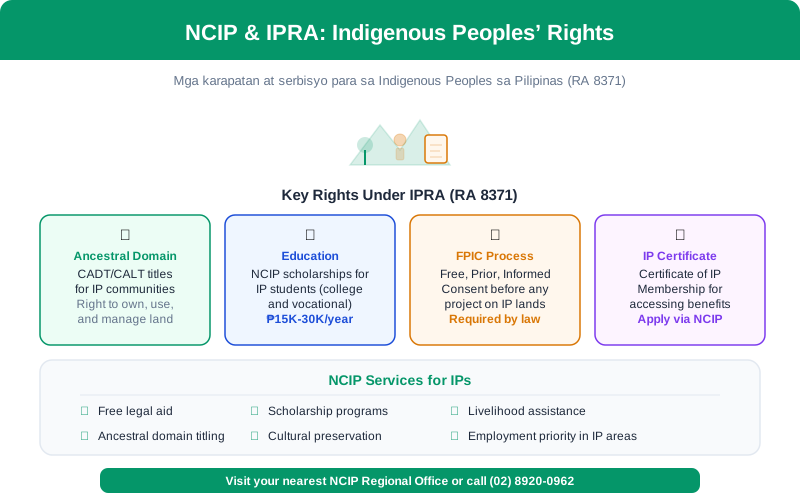
The National Commission on Indigenous Peoples (NCIP) is the primary government agency responsible for protecting IP rights under Republic Act No. 8371 (IPRA). With regional and provincial offices nationwide, it handles ancestral domain titles (CADT), educational assistance for IP students, and FPIC compliance for projects on ancestral lands.
Ang National Commission on Indigenous Peoples (NCIP) ang pangunahing ahensya ng gobyerno na responsable sa pagprotekta ng karapatan ng mga IP sa ilalim ng Republic Act No. 8371 (IPRA). May mga regional at provincial offices sa buong bansa, hinahawakan nito ang ancestral domain titles (CADT), educational assistance para sa mga IP students, at FPIC compliance para sa mga proyekto sa ancestral lands.
Who Are Indigenous Peoples in the Philippines?
Sino ang mga Katutubo sa Pilipinas?
The Philippines is home to over 110 ethnolinguistic groups classified as Indigenous Peoples, comprising roughly 14–17 million people (14–17% of the population). Major groups include the Igorot peoples of the Cordillera, Aeta of Sierra Madre, Mangyan of Mindoro, Ati of the Visayas, Lumad peoples of Mindanao (B'laan, T'boli, Manobo, and others), Moro peoples of Bangsamoro, and Tagbanwa of Palawan. For a complete listing, visit the NCIP website at ncip.gov.ph.
Ang Pilipinas ay tahanan ng mahigit 110 ethnolinguistic groups na kinikilala bilang mga Katutubo, na bumubuo ng humigit-kumulang 14–17 milyong tao (14–17% ng populasyon). Kabilang sa mga pangunahing grupo ang mga Igorot ng Cordillera, Aeta ng Sierra Madre, Mangyan ng Mindoro, Ati ng Visayas, mga Lumad ng Mindanao (B'laan, T'boli, Manobo, at iba pa), mga Moro ng Bangsamoro, at Tagbanwa ng Palawan. Para sa kumpletong listahan, bisitahin ang NCIP website sa ncip.gov.ph.
Whether you live in a tribal community or an urban area, if you belong to a recognized IP group, you are entitled to the rights and programs under IPRA.
Kahit nakatira ka sa tribal community o urban area, kung ikaw ay kabilang sa isang kinikilalang IP group, may karapatan ka sa mga rights at programa sa ilalim ng IPRA.
IPRA Overview: The Indigenous Peoples Rights Act (RA 8371)
Pangkalahatang-tanaw sa IPRA: Indigenous Peoples Rights Act (RA 8371)
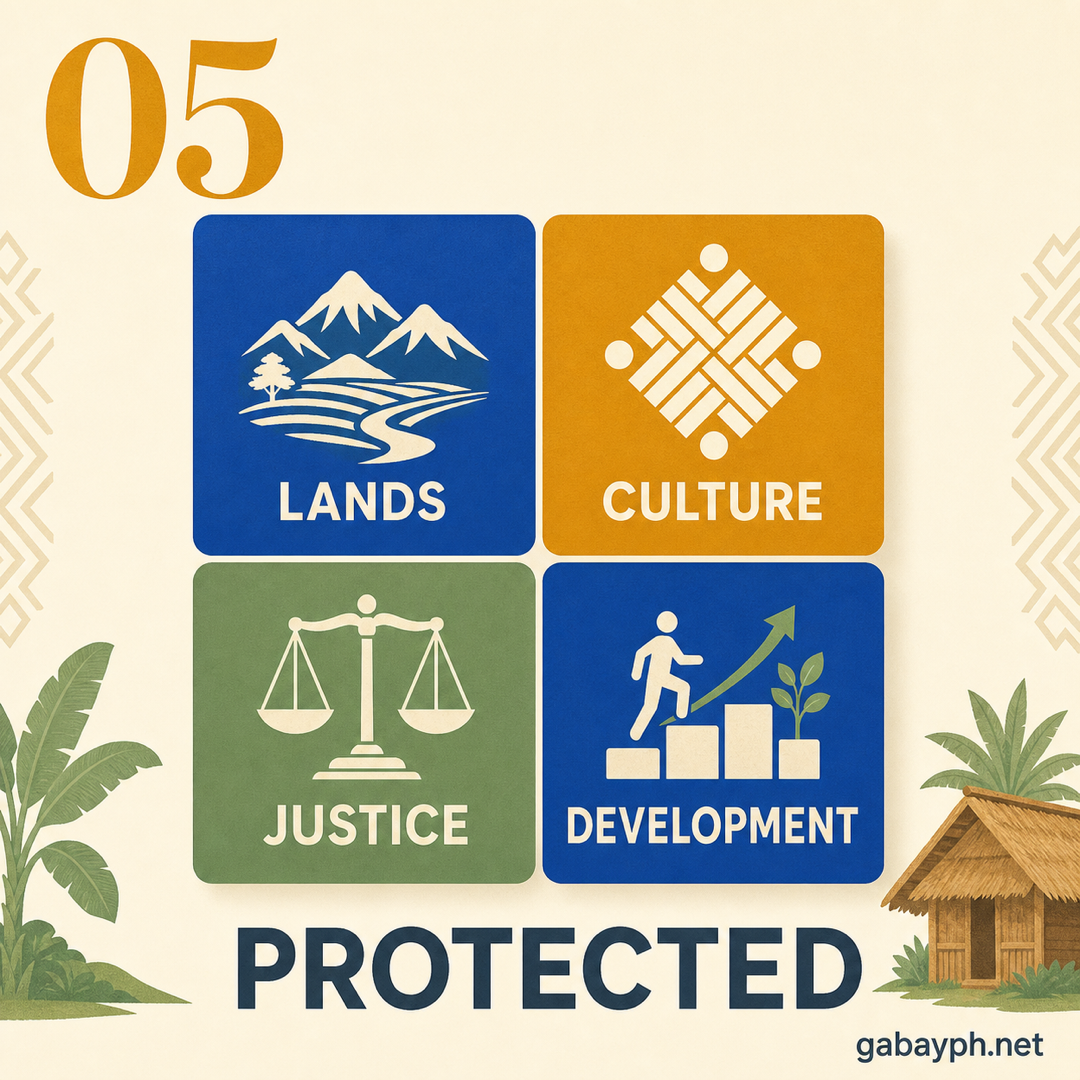
Republic Act No. 8371, the Indigenous Peoples Rights Act (IPRA), was signed into law on October 29, 1997. It is considered one of the most progressive indigenous rights laws in Asia and the Pacific. The law recognizes and protects four bundles of rights for Indigenous Peoples:
Ang Republic Act No. 8371, ang Indigenous Peoples Rights Act (IPRA), ay nilagdaan bilang batas noong Oktubre 29, 1997. Ito ay itinuturing na isa sa pinakaprogresibong batas sa karapatan ng mga katutubo sa Asya at Pasipiko. Kinikilala at pinoprotektahan ng batas ang apat na hanay ng karapatan para sa mga Katutubo:
1. Right to Ancestral Domains and Lands
1. Karapatan sa mga Ancestral Domain at Lupa
IPs can own and develop their ancestral domains (lands, waters, and natural resources). The NCIP issues communal Certificates of Ancestral Domain Title (CADT) as proof of ownership.
Maaaring mag-ari at magpaunlad ng mga IP ang kanilang mga ancestral domain (lupa, tubig, at natural resources). Nag-i-isyu ang NCIP ng communal na Certificates of Ancestral Domain Title (CADT) bilang patunay ng pagmamay-ari.
2. Right to Self-Governance and Empowerment
2. Karapatan sa Sariling Pamamahala at Pagpapalakas
IPs can maintain their own political structures and use customary laws for resolving disputes, as long as these do not violate the Constitution.
Maaaring panatilihin ng mga IP ang kanilang sariling political structures at gamitin ang customary laws sa pag-resolba ng mga alitan, basta hindi lumalabag sa Konstitusyon.
3. Right to Cultural Integrity
3. Karapatan sa Integridad ng Kultura
IPs can practice their cultural traditions, maintain their own schools, and teach in their own languages. The law protects sacred sites and cultural heritage from desecration.
Maaaring isagawa ng mga IP ang kanilang mga tradisyong pangkultura, magpanatili ng sariling paaralan, at magturo sa kanilang sariling wika. Pinoprotektahan ng batas ang mga sagradong lugar at cultural heritage.
4. Right to Social Justice and Human Rights
4. Karapatan sa Social Justice at Karapatang Pantao
IPRA guarantees equal protection and mandates affirmative action — including access to basic services, scholarships, employment, and government representation.
Ginagarantiya ng IPRA ang pantay na proteksyon at inaatasan ang affirmative action — kasama ang access sa basic services, scholarships, trabaho, at representasyon sa gobyerno.
NCIP Educational Assistance Program (Scholarship for IP Students)
NCIP Educational Assistance Program (Scholarship para sa mga IP Students)
One of the most important programs offered by the NCIP is its Educational Assistance Program (EAP), which provides financial support to qualified Indigenous Peoples students pursuing college degrees and technical-vocational courses. Ito ang pinakasikat na programa ng NCIP para sa mga kabataang katutubo na gustong mag-aral.
Isa sa pinakamahalaga na mga programa ng NCIP ang Educational Assistance Program (EAP), na nagbibigay ng financial support sa mga kwalipikadong estudyanteng katutubo na nag-aaral ng college degrees at technical-vocational courses. Ito ang pinakasikat na programa ng NCIP para sa mga kabataang katutubo na gustong mag-aral.
Who Can Apply?
Sino ang Pwedeng Mag-apply?
- Must be a bonafide member of a recognized Indigenous Peoples group in the Philippines
- Must be enrolled or accepted in a college or university (for degree programs) or a TESDA-accredited institution (for technical-vocational courses)
- Must belong to a low-income family (the NCIP uses income thresholds that vary by region — generally, family annual income should not exceed ₱300,000, though this can change)
- Must maintain satisfactory academic standing (no failing grades in the previous semester)
- Must not be a recipient of another full scholarship that already covers tuition and allowances (pero pwede kung partial lang ang ibang scholarship)
- Dapat bonafide member ng isang kinikilalang Indigenous Peoples group sa Pilipinas
- Dapat naka-enroll o tinanggap sa isang kolehiyo o unibersidad (para sa degree programs) o TESDA-accredited na institusyon (para sa technical-vocational courses)
- Dapat kabilang sa low-income na pamilya (gumagamit ang NCIP ng income thresholds na nag-iiba-iba ayon sa rehiyon — sa pangkalahatan, hindi dapat lumampas sa ₱300,000 ang taunang kita ng pamilya, bagama't maaaring magbago ito)
- Dapat maintain ang satisfactory academic standing (walang bagsak na grado sa nakaraang semester)
- Hindi dapat recipient ng ibang full scholarship na sumasaklaw na sa tuition at allowances (pero pwede kung partial lang ang ibang scholarship)
What Does the Scholarship Cover?
Ano ang Sakop ng Scholarship?
The EAP typically provides assistance for tuition and other school fees, book and supply allowance, and a living stipend. The exact amounts depend on the annual NCIP budget allocation and may vary by region. As of recent cycles, the assistance ranges from ₱10,000 to ₱30,000 per semester, depending on the type of institution (state university vs. private school) and the program level.
Ang EAP ay karaniwang nagbibigay ng tulong para sa tuition at iba pang school fees, allowance para sa libro at gamit-pang-aral, at living stipend. Ang eksaktong halaga ay depende sa taunang budget allocation ng NCIP at maaaring mag-iba ayon sa rehiyon. Ayon sa mga kamakailan na cycle, ang tulong ay umaabot mula ₱10,000 hanggang ₱30,000 bawat semester, depende sa uri ng institusyon (state university vs. private school) at sa program level.
How to Apply for the NCIP Educational Assistance
Paano Mag-apply para sa NCIP Educational Assistance
-
Get Your Certificate of IP Membership (Certification from Tribal Council/Community)
Kumuha ng Certificate of IP Membership (Sertipikasyon mula sa Tribal Council/Community)
The first and most important requirement is proof that you are a member of a recognized IP community. You need a Certificate of Confirmation/Identification as an IP member. This can be obtained from your tribal council, community elder, or the NCIP regional/provincial office. More details on this process are in the section below.
Ang una at pinakamahalagang requirement ay patunay na ikaw ay miyembro ng isang kinikilalang IP community. Kailangan mo ng Certificate of Confirmation/Identification bilang IP member. Ito ay makukuha mula sa iyong tribal council, community elder, o sa NCIP regional/provincial office. Mas maraming detalye tungkol sa prosesong ito sa seksyon sa ibaba.
-
Prepare the Required Documents
Ihanda ang mga Kinakailangang Dokumento
Gather the following documents to complete your application:
Kolektahin ang mga sumusunod na dokumento para makumpleto ang iyong aplikasyon:
- Certificate of IP Membership/Identification (original)Certificate of IP Membership/Identification (original)
- Certificate of enrollment or acceptance letter from the schoolCertificate of enrollment o acceptance letter mula sa paaralan
- Copy of grades from the previous semester (for continuing students)Kopya ng mga grado mula sa nakaraang semester (para sa mga continuing students)
- Barangay certificate of residencyBarangay certificate of residency
- Certificate of Indigency or proof of family income (from barangay or DSWD)Certificate of Indigency o patunay ng kita ng pamilya (mula sa barangay o DSWD)
- Photocopy of valid ID (or birth certificate if no ID yet)Photocopy ng valid ID (o birth certificate kung wala pang ID)
- 2x2 ID photos (usually 2-4 copies)2x2 ID photos (karaniwang 2-4 kopya)
-
Submit Your Application at the Nearest NCIP Office
I-submit ang Iyong Aplikasyon sa Pinakamalapit na NCIP Office
Bring all your documents to the NCIP Regional Office or Provincial Office nearest to you. The staff will review your application, verify your documents, and add you to the list of applicants for the current year's EAP cycle. In some regions, the NCIP also accepts applications through their community service centers or during outreach events in IP areas.
Dalhin lahat ng iyong mga dokumento sa NCIP Regional Office o Provincial Office na pinakamalapit sa iyo. Ire-review ng staff ang iyong aplikasyon, ive-verify ang mga dokumento, at idadagdag ka sa listahan ng mga aplikante para sa EAP cycle ngayong taon. Sa ilang rehiyon, tumatanggap din ang NCIP ng mga aplikasyon sa kanilang community service centers o sa mga outreach events sa mga IP areas.
Deadlines vary by region and are usually announced through NCIP social media pages, community bulletin boards, or through tribal leaders. Apply as early as possible — slots can fill up fast, lalo na sa mga rehiyon na maraming IP students.
Nag-iiba-iba ang mga deadline ayon sa rehiyon at karaniwang iniaanunsyo sa pamamagitan ng NCIP social media pages, community bulletin boards, o sa pamamagitan ng mga tribal leaders. Mag-apply nang maaga hangga't maaari — maaaring mapuno agad ang mga slots, lalo na sa mga rehiyon na maraming IP students.
-
Wait for Evaluation and Release of Funds
Hintayin ang Evaluation at Paglabas ng Pondo
Once submitted, the NCIP evaluates all applications based on eligibility, available budget, and the number of applicants. Approved scholars will be notified through the NCIP office or their tribal leaders. Funds are typically released directly to the scholar through bank deposit, check, or cash card. Processing may take 2–4 weeks after the deadline closes, but in some regions it can take longer due to budget cycles.
Kapag naisumite na, ie-evaluate ng NCIP ang lahat ng mga aplikasyon batay sa eligibility, available na budget, at bilang ng mga aplikante. Aabisuhan ang mga aprubadong scholars sa pamamagitan ng NCIP office o ng kanilang mga tribal leaders. Ang mga pondo ay karaniwang inilalagay direkta sa scholar sa pamamagitan ng bank deposit, check, o cash card. Maaaring tumagal ng 2–4 na linggo ang processing pagkatapos magsara ng deadline, pero sa ilang rehiyon ay mas matagal dahil sa budget cycles.
Ancestral Domain: What It Is and How to Secure a CADT
Ancestral Domain: Ano Ito at Paano Kumuha ng CADT
An ancestral domain encompasses all lands, waters, mineral resources, and natural resources that IPs have traditionally occupied since time immemorial. Under IPRA, the NCIP can issue a communal title (CADT) as formal recognition of ownership.
Ang ancestral domain ay sumasaklaw sa lahat ng lupa, tubig, mineral resources, at natural resources na tradisyunal na inokupa ng mga IP mula pa noong unang panahon. Sa ilalim ng IPRA, maaaring mag-isyu ang NCIP ng communal title (CADT) bilang pormal na pagkilala ng pagmamay-ari.
What Is a CADT?
Ano ang CADT?
A Certificate of Ancestral Domain Title (CADT) is the official document that formally recognizes the rights of an IP community to their ancestral domain. It is issued by the NCIP and serves as proof of communal ownership. Unlike individual land titles under the Torrens system, a CADT is a communal title — it belongs to the entire community and cannot be sold or transferred to non-IP individuals or entities.
Ang Certificate of Ancestral Domain Title (CADT) ang opisyal na dokumento na pormal na kinikilala ang mga karapatan ng isang IP community sa kanilang ancestral domain. Ito ay inilalabas ng NCIP at nagsisilbing patunay ng communal ownership. Hindi tulad ng individual land titles sa ilalim ng Torrens system, ang CADT ay isang communal title — pag-aari ito ng buong komunidad at hindi maaaring ibenta o ilipat sa mga hindi IP na indibidwal o entidad.
How to Apply for a CADT
Paano Mag-apply ng CADT
The CADT application is community-driven and involves filing a petition with the NCIP, boundary surveys, gathering historical evidence, public validation hearings, and NCIP evaluation. The process typically takes 3–10 years. Contact your nearest NCIP Regional Office or a legal aid organization specializing in IP rights (such as LRC-KSK) to start the process.
Ang aplikasyon ng CADT ay pinamumunuan ng komunidad at kasama ang paghahain ng petisyon sa NCIP, boundary surveys, pagtitipon ng historikal na ebidensya, public validation hearings, at pagsusuri ng NCIP. Karaniwang tumatagal ito ng 3–10 taon. Makipag-ugnayan sa pinakamalapit na NCIP Regional Office o legal aid organization na espesyalista sa IP rights (tulad ng LRC-KSK) para simulan ang proseso.
FPIC Process Explained: Free, Prior, and Informed Consent
Proseso ng FPIC: Free, Prior, and Informed Consent
Free, Prior, and Informed Consent (FPIC) means any project affecting ancestral domains — mining, logging, dams, infrastructure, agribusiness, tourism, or military installations — must get consent from the affected IP community first. The NCIP facilitates the process through field investigations, community conferences, consensus-building assemblies, and formal documentation via a Memorandum of Agreement (MOA).
Ang Free, Prior, and Informed Consent (FPIC) ay nangangahulugan na ang anumang proyektong nakakaapekto sa ancestral domains — pagmimina, pagtotroso, dam, infrastructure, agribusiness, turismo, o military installations — ay kailangang kumuha muna ng consent mula sa apektadong IP community. Pinapadali ng NCIP ang proseso sa pamamagitan ng field investigations, community conferences, consensus-building assemblies, at pormal na documentation sa pamamagitan ng Memorandum of Agreement (MOA).
Your community has every right to say no. If a project will harm your land, culture, or way of life, you can withhold consent and it cannot legally proceed. If FPIC was not properly conducted, file a complaint with the NCIP or contact a legal aid organization like LRC-KSK or the Commission on Human Rights (CHR).
May buong karapatan ang iyong komunidad na tumanggi. Kung ang isang proyekto ay makakasama sa inyong lupa, kultura, o paraan ng pamumuhay, maaari ninyong ipagkait ang consent at hindi ito maaaring legal na magpatuloy. Kung hindi maayos na naisagawa ang FPIC, maghain ng reklamo sa NCIP o makipag-ugnayan sa legal aid organization tulad ng LRC-KSK o Commission on Human Rights (CHR).
IP Rights in Employment and Education
Karapatan ng IP sa Trabaho at Edukasyon
Beyond ancestral domain and FPIC, IPRA also guarantees important rights for Indigenous Peoples in employment, education, and government representation. These are often overlooked, but they are real, enforceable rights na dapat alam ng bawat katutubo.
Bukod sa ancestral domain at FPIC, ginagarantiya rin ng IPRA ang mahahalagang karapatan para sa mga Katutubo sa trabaho, edukasyon, at representasyon sa gobyerno. Kadalasan itong hindi napapansin, pero tunay itong mga karapatan na maipapatupad na dapat alam ng bawat katutubo.
Affirmative Action in Employment
Affirmative Action sa Trabaho
IPRA mandates that government agencies and government-owned corporations give preference to qualified IP applicants in hiring, particularly in positions that serve IP communities. This means that if you are a qualified IP applicant and a government agency is hiring, you should have an equal or preferential opportunity. Hindi ito "special treatment" — ito ay recognition na ang mga katutubo ay historically underrepresented sa government workforce.
Inaatasan ng IPRA na bigyan ng preference ng mga ahensya ng gobyerno at government-owned corporations ang mga kwalipikadong IP applicants sa pagtanggap ng empleyado, lalo na sa mga posisyon na nagsisilbi sa mga IP community. Nangangahulugan ito na kung ikaw ay isang kwalipikadong IP applicant at may hiring ang isang ahensya ng gobyerno, dapat ay may pantay o mas mataas na pagkakataon ka. Hindi ito "special treatment" — ito ay pagkilala na ang mga katutubo ay historically underrepresented sa government workforce.
IP Education Rights
Karapatan sa Edukasyon ng IP
- Indigenous Peoples Education (IPEd) Program: DepEd's program that integrates indigenous knowledge, culture, and language into the basic education curriculum for IP learners. This means IP children can learn using their mother tongue and see their culture reflected in their textbooks and lessons.
- Scholarship programs: Multiple government agencies offer IP-specific scholarships — NCIP's EAP (covered above), CHED scholarships for IP students, DOST-SEI for science and technology, and TESDA skills training with IP priority slots.
- School of Living Traditions (SLT): Community-based learning centers where IP elders pass on traditional knowledge, crafts, music, dance, and other cultural practices to younger generations. These are supported by the NCCA and NCIP.
- Free higher education: Under RA 10931 (Universal Access to Quality Tertiary Education Act), IP students enrolled in State Universities and Colleges (SUCs) and Local Universities and Colleges (LUCs) are entitled to free tuition and miscellaneous fees, on top of any NCIP scholarship they may receive.
- Indigenous Peoples Education (IPEd) Program: Programa ng DepEd na nag-i-integrate ng indigenous knowledge, kultura, at wika sa basic education curriculum para sa mga IP learners. Nangangahulugan ito na ang mga batang katutubo ay maaaring matuto gamit ang kanilang mother tongue at makita ang kanilang kultura sa kanilang mga aklat-aralin at mga aralin.
- Mga programa ng scholarship: Maraming ahensya ng gobyerno ang nag-aalok ng IP-specific na scholarships — NCIP's EAP (nabanggit sa itaas), CHED scholarships para sa mga IP students, DOST-SEI para sa agham at teknolohiya, at TESDA skills training na may IP priority slots.
- School of Living Traditions (SLT): Community-based learning centers kung saan ipinamamana ng mga IP elder ang tradisyunal na kaalaman, crafts, musika, sayaw, at iba pang mga gawaing pangkultura sa mga susunod na henerasyon. Sinusuportahan ito ng NCCA at NCIP.
- Libreng higher education: Sa ilalim ng RA 10931 (Universal Access to Quality Tertiary Education Act), ang mga IP students na naka-enroll sa State Universities and Colleges (SUCs) at Local Universities and Colleges (LUCs) ay may karapatan sa libreng tuition at miscellaneous fees, bukod pa sa anumang NCIP scholarship na maaaring natanggap nila.
IP Representation in Government
Representasyon ng IP sa Gobyerno
IPRA requires mandatory representation of IPs in policy-making bodies and legislative councils that directly affect their communities. At the national level, there is an IP Mandatory Representative (IPMR) system in local government units where IP communities are present. These representatives sit in the Sangguniang Barangay, Sangguniang Bayan/Panlungsod, and Sangguniang Panlalawigan to ensure that IP concerns are heard and addressed in local governance.
Inaatasan ng IPRA ang mandatory representation ng mga IP sa mga policy-making bodies at legislative councils na direktang nakakaapekto sa kanilang mga komunidad. Sa pambansang antas, may IP Mandatory Representative (IPMR) system sa mga local government units kung saan may mga IP community. Ang mga kinatawan na ito ay nakaupo sa Sangguniang Barangay, Sangguniang Bayan/Panlungsod, at Sangguniang Panlalawigan para matiyak na ang mga concern ng IP ay naririnig at naaaksyunan sa lokal na pamamahala.
How to Get a Certificate of IP Membership
Paano Kumuha ng Certificate of IP Membership
A Certificate of IP Membership (also called Certificate of Confirmation/Identification as an IP) is the key document that proves you belong to a recognized Indigenous Peoples community. You will need this for scholarship applications, NCIP programs, and any transaction that requires proof of IP status. Ito ang "golden ticket" mo para ma-access ang mga benepisyo at serbisyo na nakalaan para sa mga katutubo.
Ang Certificate of IP Membership (tinatawag din na Certificate of Confirmation/Identification as an IP) ang pangunahing dokumento na nagpapatunay na ikaw ay kabilang sa isang kinikilalang Indigenous Peoples community. Kakailanganin mo ito para sa mga scholarship applications, NCIP programs, at anumang transaksyon na nangangailangan ng patunay ng IP status. Ito ang "golden ticket" mo para ma-access ang mga benepisyo at serbisyo na nakalaan para sa mga katutubo.
Requirements
Mga Kailangan
Requirements Checklist
Checklist ng mga Kailangan
- Certification from a Tribal Council, Tribal Chieftain, or Community Elder — this is a signed statement from your community's recognized leader(s) confirming that you are a bonafide member of the IP community. This is the most critical document.
- Barangay Certificate or Certification of Residency — from the barangay where you or your family's IP community is located.
- Birth Certificate (PSA-issued) — to establish your identity and lineage. If your parents are IP, their names on the birth certificate help establish generational membership.
- Valid ID or School ID — any government-issued ID. For students, a school ID with current registration form is acceptable.
- 2x2 ID photos — typically 2 copies needed.
- Affidavit of IP Membership — some NCIP offices require a notarized affidavit. Check with your regional office if this is needed.
- Sertipikasyon mula sa Tribal Council, Tribal Chieftain, o Community Elder — ito ay isang nilagdaang pahayag mula sa kinikilalang lider/mga lider ng iyong komunidad na nagkukumpirma na ikaw ay bonafide member ng IP community. Ito ang pinakamahalagang dokumento.
- Barangay Certificate o Certification of Residency — mula sa barangay kung saan matatagpuan ang iyong IP community o pamilya.
- Birth Certificate (PSA-issued) — para patunayan ang iyong pagkakakilanlan at lahi. Kung ang mga magulang mo ay IP, nakakatulong ang kanilang mga pangalan sa birth certificate para itatag ang generational membership.
- Valid ID o School ID — anumang government-issued ID. Para sa mga estudyante, tinatanggap ang school ID na may kasalukuyang registration form.
- 2x2 ID photos — karaniwang 2 kopya ang kailangan.
- Affidavit of IP Membership — ang ilang NCIP offices ay nangangailangan ng notarized affidavit. Tanungin ang iyong regional office kung kailangan ito.
Step-by-Step Process
Hakbang-Hakbang na Proseso
-
Get Certification from Your Tribal Council or Community Elder
Kumuha ng Sertipikasyon mula sa Iyong Tribal Council o Community Elder
Visit your tribal council or community elders and request a written certification that you are a recognized member of the IP community. The certification should include your full name, the name of the IP community/tribe, and the signature and position of the certifying leader. Some communities have a standard format for this; others write it as a letter. Ang mahalaga ay malinaw na nakalagay na ikaw ay bonafide member at may pirma ng kinikilalang lider.
Bisitahin ang iyong tribal council o community elders at humiling ng nakasulat na sertipikasyon na ikaw ay kinikilalang miyembro ng IP community. Dapat kasama sa sertipikasyon ang iyong buong pangalan, pangalan ng IP community/tribu, at pirma at posisyon ng nagsesertipikang lider. Ang ibang mga komunidad ay may standard format para dito; ang iba naman ay sinusulat ito bilang isang liham. Ang mahalaga ay malinaw na nakalagay na ikaw ay bonafide member at may pirma ng kinikilalang lider.
-
Visit the Nearest NCIP Regional or Provincial Office
Bumisita sa Pinakamalapit na NCIP Regional o Provincial Office
Bring all your documents to the NCIP office. The staff will verify your tribal certification, check your supporting documents, and process your Certificate of IP Membership. In some areas, especially remote IP communities, the NCIP conducts mobile registration drives — ask your tribal leader if there are any upcoming schedules in your area.
Dalhin lahat ng iyong mga dokumento sa NCIP office. Ive-verify ng staff ang iyong tribal certification, sususriin ang iyong mga supporting documents, at ipro-process ang iyong Certificate of IP Membership. Sa ilang lugar, lalo na sa mga malalayong IP community, nagsasagawa ang NCIP ng mobile registration drives — tanungin ang iyong tribal leader kung may mga paparating na schedule sa inyong lugar.
-
Wait for Processing and Claim Your Certificate
Hintayin ang Processing at Kunin ang Iyong Certificate
Processing time varies by office, but it usually takes 1–2 weeks. Some provincial offices can issue it on the same day if all documents are complete and there is no backlog. The certificate is free of charge — the NCIP does not charge any fee for issuing Certificates of IP Membership. If anyone asks you to pay, that is not official NCIP practice. Huwag kang magbayad kahit kanino para sa certificate na ito — libre ito.
Nag-iiba-iba ang processing time ayon sa opisina, pero karaniwang tumatagal ito ng 1–2 linggo. Ang ilang provincial offices ay kaya itong ilabas sa parehong araw kung kumpleto ang lahat ng dokumento at walang backlog. Ang certificate ay libre — hindi naniningil ang NCIP ng anumang bayad para sa pag-isyu ng Certificates of IP Membership. Kung may humingi sa iyo ng bayad, hindi iyon opisyal na gawi ng NCIP. Huwag kang magbayad kahit kanino para sa certificate na ito — libre ito.
Pro Tips
Mga Payo
- Start your IP membership certificate early. Whether you need it for a scholarship or another program, getting it takes time — especially the tribal certification part, which depends on your elder or council's availability. Don't wait until the last minute, lalo na kung malayo ang iyong komunidad sa NCIP office.
- Follow the NCIP's official Facebook page and your regional NCIP office's page for announcements about scholarship deadlines, EAP applications, community programs, and other opportunities. Doon karaniwang nago-post ng updates.
- Connect with IP organizations at your school or in your area. Many universities have IP student organizations that can help you navigate the scholarship process, share tips, and provide peer support. May mga grupo rin na nagbibigay ng mentorship at tutoring para sa IP students.
- Know your FPIC rights. If a mining company, logging operation, or infrastructure project is being planned on your community's ancestral land, your community has the right to be consulted and to give or withhold consent. Never let anyone tell you otherwise. Kung may nagsabi na wala kayong karapatan tumanggi, hindi iyon totoo.
- Document everything about your ancestral domain. If your community has not yet applied for a CADT, start collecting evidence now — old photos, oral histories recorded on video, maps drawn by elders, land tax declarations, and any government documents. The earlier you start, the stronger your eventual application.
- Reach out to legal aid organizations if you face issues. Groups like the Legal Rights and Natural Resources Center (LRC-KSK), Tanggapan ng Katutubong Mamamayan (TKMM), and the Philippine Task Force for Indigenous Peoples' Rights (TFIP) offer free legal assistance to IP communities.
- Simulan agad ang iyong IP membership certificate. Kahit kailangan mo ito para sa scholarship o ibang programa, ang pagkuha nito ay nangangailangan ng oras — lalo na ang tribal certification part, na depende sa availability ng iyong elder o council. Huwag maghintay sa huling minuto, lalo na kung malayo ang iyong komunidad sa NCIP office.
- I-follow ang opisyal na Facebook page ng NCIP at ang page ng iyong regional NCIP office para sa mga anunsyo tungkol sa scholarship deadlines, EAP applications, community programs, at iba pang mga oportunidad. Doon karaniwang nago-post ng updates.
- Kumonekta sa mga IP organizations sa iyong paaralan o lugar. Maraming unibersidad ang may IP student organizations na makakatulong sa iyo sa scholarship process, magbahagi ng mga tip, at magbigay ng peer support. May mga grupo rin na nagbibigay ng mentorship at tutoring para sa mga IP students.
- Alamin ang iyong mga karapatan sa FPIC. Kung may mining company, logging operation, o infrastructure project na pinaplano sa ancestral land ng iyong komunidad, may karapatan ang iyong komunidad na konsultahin at payagan o tanggihan ang consent. Huwag hayaang may magsabi sa iyo na iba. Kung may nagsabi na wala kayong karapatan tumanggi, hindi iyon totoo.
- I-dokumento ang lahat tungkol sa iyong ancestral domain. Kung hindi pa nag-apply ang iyong komunidad para sa CADT, simulan na ngayon ang pagkolekta ng ebidensya — lumang mga litrato, oral histories na naka-record sa video, mga mapa na iginuhit ng mga elder, land tax declarations, at anumang mga dokumento ng gobyerno. Kung mas maaga ka magsimula, mas matibay ang iyong aplikasyon balang-araw.
- Humingi ng tulong sa mga legal aid organizations kung may problema ka. Ang mga grupong tulad ng Legal Rights and Natural Resources Center (LRC-KSK), Tanggapan ng Katutubong Mamamayan (TKMM), at Philippine Task Force for Indigenous Peoples' Rights (TFIP) ay nag-aalok ng libreng legal assistance sa mga IP community.
Frequently Asked Questions
Mga Madalas Itanong
How do I know if I qualify as an Indigenous Person under IPRA?
If your parents or grandparents belong to a recognized IP community (Igorot, Mangyan, Lumad, T'boli, Aeta, etc.) and your community leaders can certify your membership, you qualify. See the Certificate of IP Membership section above for how to get certified.
Paano ko malalaman kung kwalipikado ako bilang Katutubo sa ilalim ng IPRA?
Kung ang iyong mga magulang o lolo't lola ay kabilang sa isang kinikilalang IP community (Igorot, Mangyan, Lumad, T'boli, Aeta, atbp.) at maaring sertipikahan ng mga lider ng iyong komunidad ang iyong pagiging miyembro, kwalipikado ka. Tingnan ang seksyon ng Certificate of IP Membership sa itaas para sa proseso.
Is the NCIP Educational Assistance Program available for graduate school?
The NCIP EAP primarily targets undergraduate students (college level) and technical-vocational learners. As of 2026, there is limited availability for graduate-level assistance, and it depends heavily on the regional NCIP office's budget and priorities. However, other scholarship programs — such as CHED's scholarship programs and DOST-SEI's Science Education Institute grants — may cover graduate studies for qualified IP applicants. It is best to inquire directly at your nearest NCIP regional office for the latest offerings.
Available ba ang NCIP Educational Assistance Program para sa graduate school?
Ang NCIP EAP ay pangunahing nakatutok sa undergraduate students (college level) at technical-vocational learners. Simula 2026, limitado ang availability para sa graduate-level na tulong, at masyado itong depende sa budget at priorities ng regional NCIP office. Gayunpaman, ang ibang mga scholarship programs — tulad ng scholarship programs ng CHED at ang Science Education Institute grants ng DOST-SEI — ay maaaring sumasaklaw sa graduate studies para sa mga kwalipikadong IP applicants. Pinakamabuting magtanong nang direkta sa pinakamalapit na NCIP regional office para sa mga pinakabagong alok.
Can IP communities sell their ancestral domain?
No. Ancestral domains under a CADT are inalienable — they cannot be sold or transferred to non-IP individuals or entities. The land belongs to the entire community as communal property.
Maaari bang ibenta ng mga IP community ang kanilang ancestral domain?
Hindi. Ang mga ancestral domain na sakop ng CADT ay inalienable — hindi maaaring ibenta o ilipat sa mga hindi IP na indibidwal o entidad. Ang lupa ay pagmamay-ari ng buong komunidad bilang communal property.
What should I do if a company is operating on our ancestral land without FPIC?
Document everything (photos, videos, notes), then file a formal complaint with the NCIP regional office. The NCIP can investigate and issue cease-and-desist orders. You can also seek free legal help from LRC-KSK, TKMM, or the Commission on Human Rights (CHR).
Ano ang dapat kong gawin kung may kumpanyang nag-o-operate sa aming ancestral land nang walang FPIC?
I-dokumento ang lahat (litrato, video, tala), pagkatapos maghain ng pormal na reklamo sa NCIP regional office. Maaaring mag-imbestiga ang NCIP at mag-isyu ng cease-and-desist orders. Maaari ka ring humingi ng libreng legal na tulong sa LRC-KSK, TKMM, o Commission on Human Rights (CHR).
Where can I find the nearest NCIP office?
Visit ncip.gov.ph or call the central office at (02) 8373-9269. The NCIP has regional offices in all 17 regions, plus provincial offices. You can also check their official Facebook page or ask your tribal leader for the nearest representative.
Saan ko mahahanap ang pinakamalapit na NCIP office?
Bisitahin ang ncip.gov.ph o tumawag sa central office sa (02) 8373-9269. May regional offices ang NCIP sa lahat ng 17 rehiyon, at provincial offices din. Maaari mo ring tingnan ang kanilang opisyal na Facebook page o tanungin ang iyong tribal leader para sa pinakamalapit na representative.
Can I apply for NCIP scholarship if I live in the city, not in my ancestral community?
Yes. You do not need to live in your ancestral domain. As long as you have a valid tribal certification and NCIP Certificate of IP Membership, you can apply from anywhere.
Maaari ba akong mag-apply ng NCIP scholarship kung nakatira ako sa lungsod, hindi sa aking ancestral community?
Oo. Hindi mo kailangang nakatira sa iyong ancestral domain. Basta may valid na tribal certification at NCIP Certificate of IP Membership ka, maaari kang mag-apply kahit saan.