

How to File for Child Support in the Philippines (2026 Guide)
Paano Mag-file ng Child Support sa Pilipinas (2026 Gabay)

The 5-Step Walkthrough
Child support in five steps.

Quick Summary
Mabilis na Buod
Legal Disclaimer: This guide provides general information about child support laws in the Philippines. It is not legal advice. Every family situation is different. For advice specific to your case, consult a lawyer or visit the Public Attorney’s Office (PAO) for free legal assistance.
Paalala sa Batas: Ang gabay na ito ay nagbibigay ng pangkalahatang impormasyon tungkol sa batas ng sustento ng anak sa Pilipinas. Hindi ito legal advice. Iba-iba ang bawat sitwasyon ng pamilya. Para sa payo na angkop sa iyong kaso, kumonsulta sa abogado o bumisita sa Public Attorney’s Office (PAO) para sa libreng tulong legal.
Table of Contents
Talaan ng Nilalaman
- Hakbang 1: Alamin ang Iyong Karapatan
- Hakbang 2: Kalkulahin ang Pangangailangan
- Hakbang 3: Subukan ang Barangay Mediation
- Hakbang 4: Mag-file ng Petisyon sa Korte
- Hakbang 5: Kumuha ng Libreng Tulong Legal
- Hakbang 6: Ipatupad ang Utos ng Korte
- Hakbang 7: Alamin ang Kaugnay na Benepisyo
- Listahan ng Requirements
- Mga Payo
- Mga Madalas Itanong
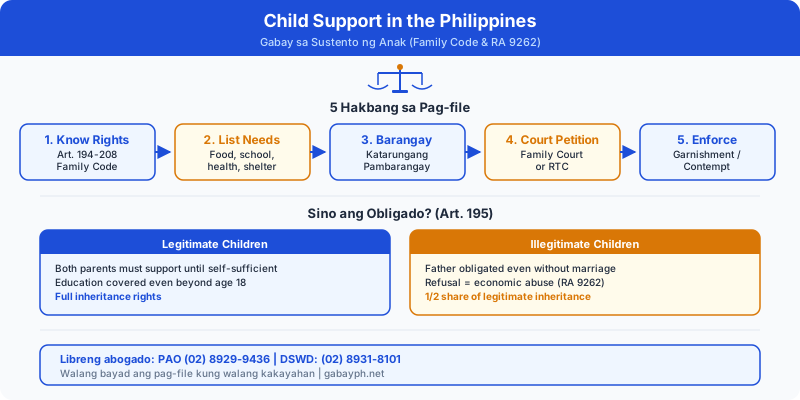
Every child in the Philippines — whether born within or outside marriage — has a legal right to financial support from both parents. If a parent refuses to provide for their child, the law gives you clear steps to demand it, from barangay mediation to a court order with real enforcement power.
Bawat bata sa Pilipinas — ipinanganak man sa loob o labas ng kasal — ay may legal na karapatan sa sustento mula sa magulang. Kung tumatanggi ang isang magulang na suportahan ang kanyang anak, may malinaw na hakbang ang batas para humingi nito, mula sa barangay mediation hanggang sa utos ng korte na may tunay na kapangyarihang ipatupad.
Step 1: Understand Your Rights
Hakbang 1: Alamin ang Iyong Karapatan
Who is obligated to give support?
Sino ang obligadong magbigay ng sustento?
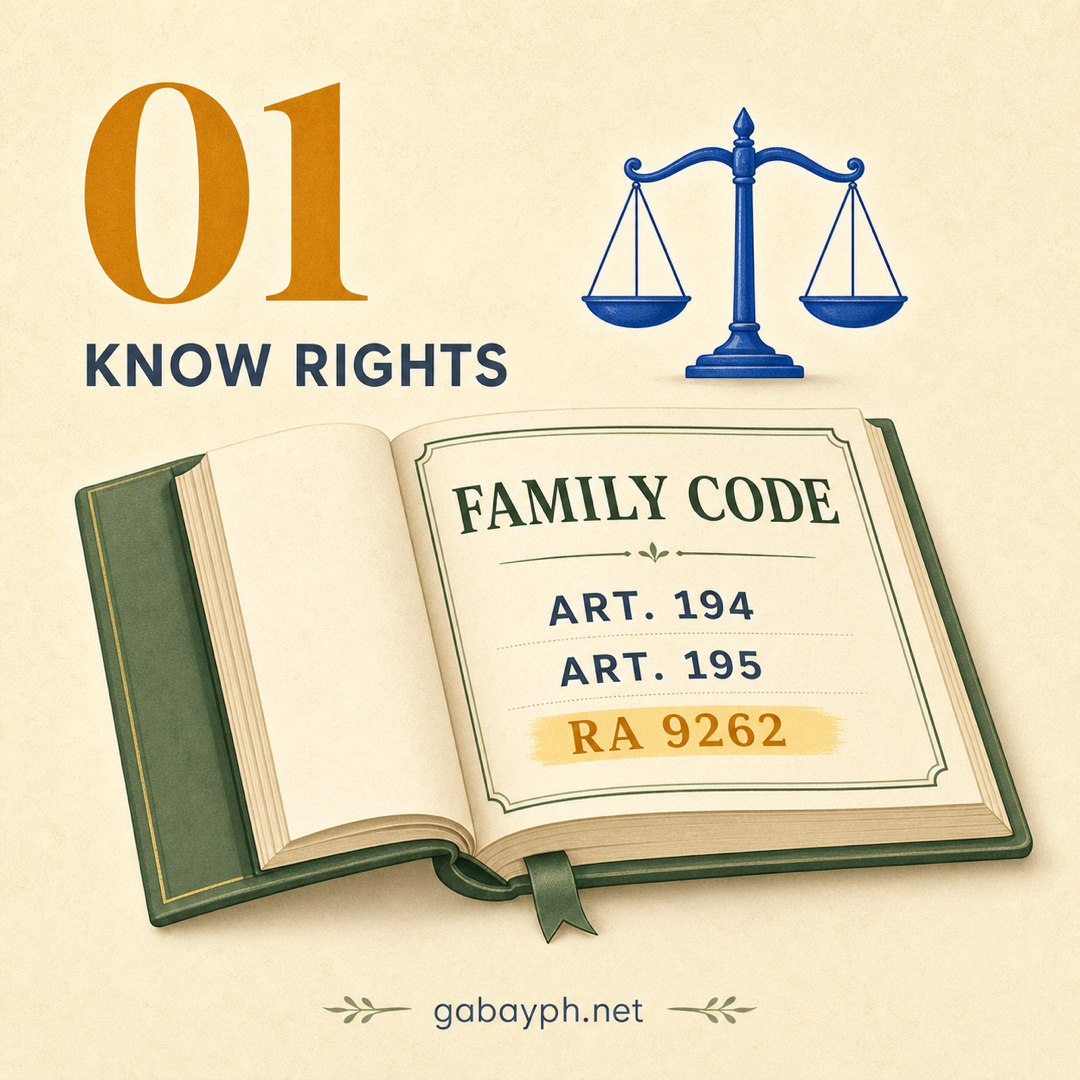
Under Article 195 of the Family Code, the following persons are obligated to support each other:
Sa ilalim ng Artikulo 195 ng Family Code, ang mga sumusunod ay obligadong mag-sustento sa isa’t isa:
- Spouses
- Parents and their legitimate children
- Parents and their illegitimate children
- Legitimate ascendants and descendants (grandparents if parents cannot pay)
- Legitimate brothers and sisters (as last resort, Article 196)
- Mag-asawa
- Mga magulang at kanilang mga lehitimong anak
- Mga magulang at kanilang mga illegitimate na anak
- Mga lehitimong lolo/lola at apo (kung hindi kaya ng magulang)
- Mga lehitimong magkakapatid (bilang huling paraan, Artikulo 196)
Legitimate vs. illegitimate children
Lehitimo vs. illegitimate na anak
Both legitimate and illegitimate children have the same right to receive support. The key difference is in inheritance: an illegitimate child receives half the share of a legitimate child. But for child support purposes, the obligation is equal — the father must provide regardless of marital status.
Parehong may karapatan sa sustento ang mga lehitimo at illegitimate na anak. Ang pagkakaiba ay sa mana: ang illegitimate na anak ay tumatanggap ng kalahati ng bahagi ng lehitimong anak. Pero pagdating sa sustento, pantay ang obligasyon — kailangang magbigay ng ama kahit walang kasal.
Economic abuse under RA 9262
Ekonomikong pang-aabuso sa ilalim ng RA 9262
Willful refusal to provide child support can be a criminal act. Under RA 9262 (Anti-VAWC Act), withholding financial support from a woman or her child constitutes economic abuse, punishable by 6 months to 6 years imprisonment and a fine of ₱100,000–₱300,000. This applies even if you were never married.
Ang sadyang pagtanggi na magbigay ng sustento ay maaaring maging criminal offense. Sa ilalim ng RA 9262 (Anti-VAWC Act), ang pagkait ng sustento sa babae o sa kanyang anak ay itinuturing na ekonomikong pang-aabuso, may parusa na 6 na buwan hanggang 6 na taon na pagkakulong at multa na ₱100,000–₱300,000. Nalalapat ito kahit hindi kayo nagpakasal.
Step 2: Calculate Support Needs
Hakbang 2: Kalkulahin ang Pangangailangan
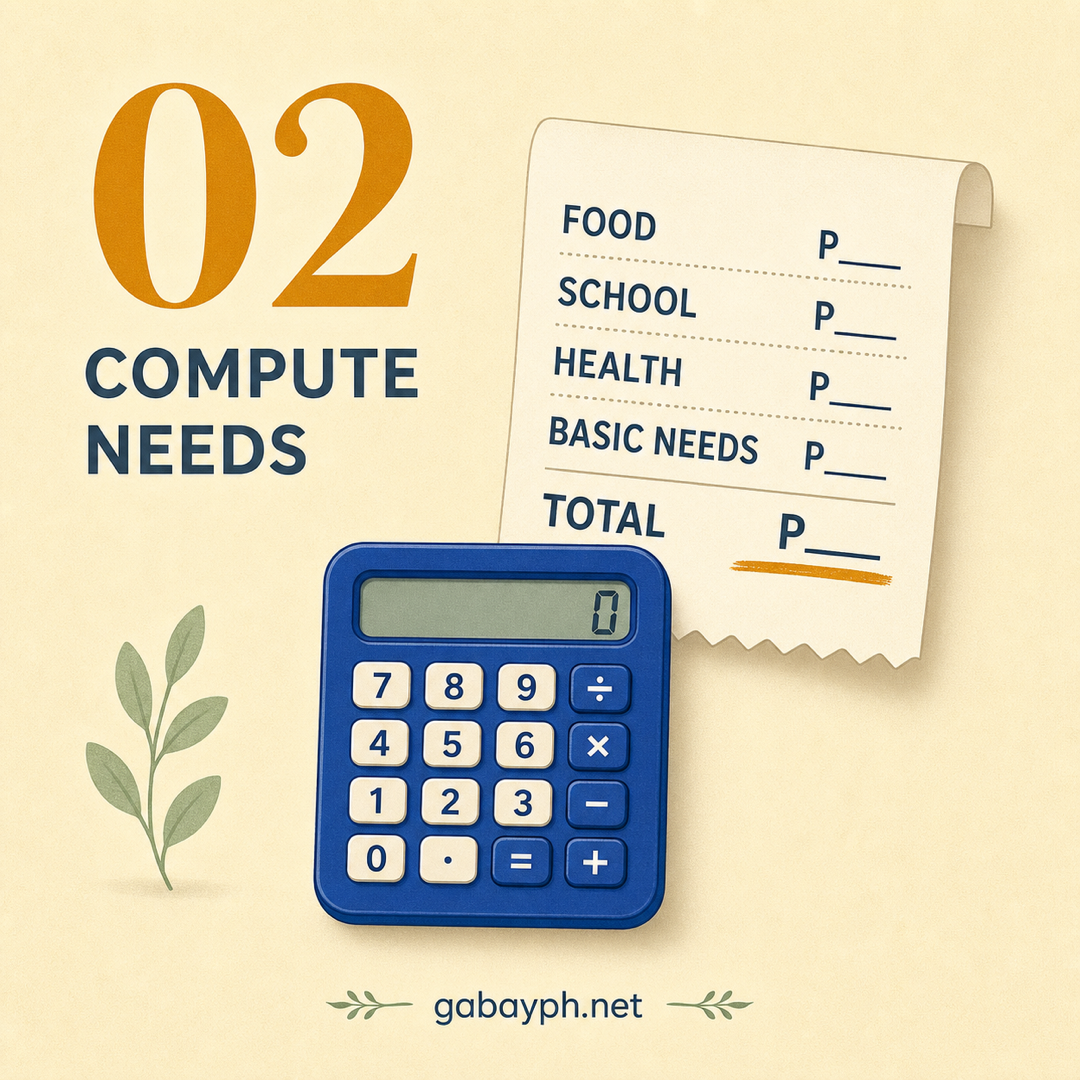
The Philippines has no fixed formula for computing child support. Under Article 201 of the Family Code, the amount depends on two factors: (1) the needs of the child, and (2) the financial capacity of the parent who must pay. Prepare an itemized list of monthly expenses:
Walang fixed na pormula ang Pilipinas para sa pagkuwenta ng sustento. Sa ilalim ng Artikulo 201 ng Family Code, ang halaga ay nakadepende sa dalawang bagay: (1) ang pangangailangan ng bata, at (2) ang kakayahang pinansyal ng magulang na dapat magbayad. Maghanda ng listahan ng buwanang gastos:
- Food — groceries, milk, school meals
- Education — tuition, school supplies, uniform, transportation to school
- Medical/health — check-ups, vitamins, medicine, dental, hospitalization
- Shelter — rent or housing share, utilities (electricity, water)
- Clothing — clothes, shoes
- Transportation — daily commute expenses
- Pagkain — groceries, gatas, school meals
- Edukasyon — tuition, school supplies, uniporme, pamasahe papunta sa eskwela
- Medikal/kalusugan — check-ups, bitamina, gamot, dental, ospital
- Tirahan — upa o bahagi sa bahay, utilities (kuryente, tubig)
- Damit — mga damit, sapatos
- Transportasyon — pang-araw-araw na pamasahe
Step 3: Attempt Barangay Mediation First
Hakbang 3: Subukan Muna ang Barangay Mediation
Before filing in court, you must generally go through Katarungang Pambarangay (barangay mediation) if both parties live in the same city or municipality. This is required by the Local Government Code.
Bago mag-file sa korte, kailangan mong dumaan muna sa Katarungang Pambarangay (barangay mediation) kung pareho kayong nakatira sa iisang lungsod o munisipalidad. Kinakailangan ito ng Local Government Code.
- Go to the Barangay Hall where the respondent (the parent who should pay) lives.
- File a complaint with the Lupon Tagapamayapa.
- The Punong Barangay will set a mediation meeting within 15 days.
- If mediation succeeds, you get an amicable settlement — a legally binding agreement with the force of a court judgment.
- If mediation fails, the Pangkat Tagapagkasundo (conciliation panel) has another 15 days to try.
- If no agreement is reached, the barangay issues a Certificate to File Action — this lets you proceed to court.
- Pumunta sa Barangay Hall kung saan nakatira ang respondent (ang magulang na dapat magbayad).
- Mag-file ng reklamo sa Lupon Tagapamayapa.
- Ang Punong Barangay ay magtatakda ng mediation meeting sa loob ng 15 araw.
- Kung matagumpay ang mediation, makakakuha ka ng amicable settlement — isang legally binding na kasunduan na may bisa ng court judgment.
- Kung mabigo ang mediation, ang Pangkat Tagapagkasundo ay may 15 araw pa para subukan.
- Kung walang kasunduan, mag-i-issue ang barangay ng Certificate to File Action — ito ang magpapahintulot sa iyo na pumunta sa korte.
Step 4: File a Petition for Support
Hakbang 4: Mag-file ng Petisyon para sa Sustento
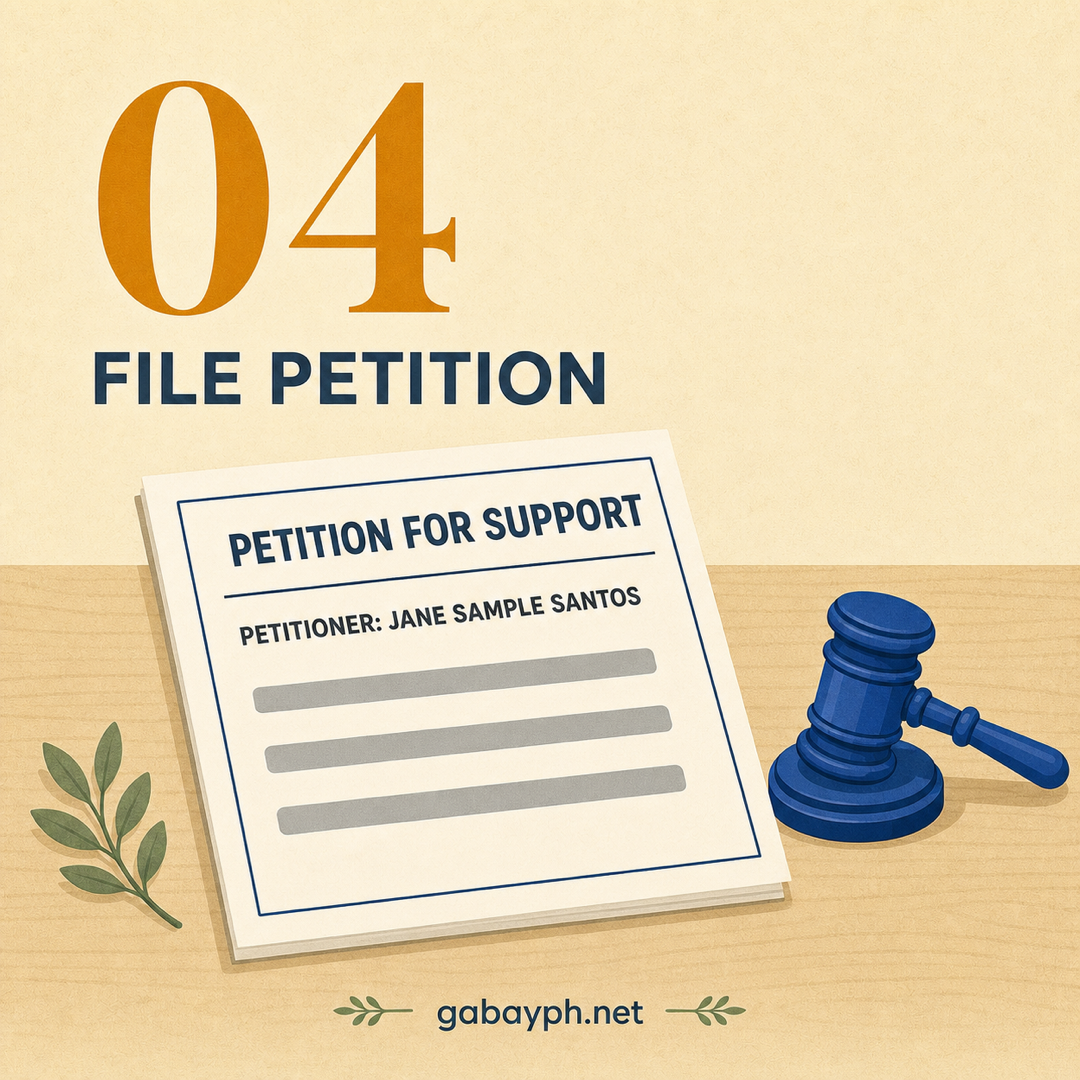
If barangay mediation fails (or is not required), file a Petition for Support in the proper court:
Kung mabigo ang barangay mediation (o hindi ito kinakailangan), mag-file ng Petisyon para sa Sustento sa tamang korte:
- Where to file: Family Court (Regional Trial Court) in the city/municipality where the child resides, or where the respondent resides.
- Who files: The custodial parent, legal guardian, or any person authorized on the child’s behalf. DSWD can also file.
- Filing fees: Based on the amount of support claimed. Courts can waive fees for indigent litigants (bring proof of income or Certificate of Indigency from barangay).
- Saan mag-file: Family Court (Regional Trial Court) sa lungsod/munisipalidad kung saan nakatira ang bata, o kung saan nakatira ang respondent.
- Sino ang mag-file: Ang custodial parent, legal guardian, o sinumang awtorisadong tao para sa bata. Maaari ring mag-file ang DSWD.
- Filing fees: Batay sa halaga ng sustentong hinihingi. Maaaring i-waive ng korte ang bayad para sa mga indigent litigants (magdala ng proof of income o Certificate of Indigency mula sa barangay).
Support Pendente Lite (Provisional Support)
Support Pendente Lite (Pansamantalang Sustento)
While the case is ongoing, you can request support pendente lite — provisional support that the court can order immediately so the child does not go hungry while waiting for the final decision. The court typically decides this within days of filing.
Habang umiiral ang kaso, maaari kang humiling ng support pendente lite — pansamantalang sustento na maaaring iutos ng korte agad para hindi magutom ang bata habang naghihintay ng final na desisyon. Kadalasang desisyunan ito ng korte sa loob ng ilang araw matapos mag-file.
Step 5: Get Free Legal Help
Hakbang 5: Kumuha ng Libreng Tulong Legal
You do not need to hire a private lawyer. Several agencies provide free legal assistance:
Hindi mo kailangang kumuha ng pribadong abogado. Maraming ahensya ang nagbibigay ng libreng tulong legal:
| Agency | Contact | Services |
|---|---|---|
| PAO (Public Attorney’s Office) | (02) 8929-9436 | Free lawyer for indigents (earning below ₱14,000/month for NCR). Court representation, document preparation. |
| IBP Legal Aid | Local IBP chapter | Free legal advice and referrals from the Integrated Bar of the Philippines. |
| DSWD | (02) 8931-8101 | Social worker assistance, case referrals, can file on behalf of child. |
| Law School Clinics | UP, Ateneo, San Beda, etc. | Free legal clinics run by supervised law students. |
| Ahensya | Contact | Serbisyo |
|---|---|---|
| PAO (Public Attorney’s Office) | (02) 8929-9436 | Libreng abogado para sa mga indigent (kumikita ng mas mababa sa ₱14,000/buwan sa NCR). Representasyon sa korte, paghahanda ng dokumento. |
| IBP Legal Aid | Lokal na IBP chapter | Libreng legal advice at referrals mula sa Integrated Bar of the Philippines. |
| DSWD | (02) 8931-8101 | Tulong ng social worker, case referrals, maaaring mag-file para sa bata. |
| Law School Clinics | UP, Ateneo, San Beda, atbp. | Libreng legal clinics na pinapatakbo ng mga supervised na law students. |
Step 6: Enforce the Court Order
Hakbang 6: Ipatupad ang Utos ng Korte
If the parent has a court order to pay but refuses, you have several enforcement options:
Kung ang magulang ay may utos ng korte na magbayad pero tumatanggi, may mga paraan ka para ipatupad ito:
- Writ of Execution: The court orders seizure of assets or garnishment of salary to satisfy the support obligation.
- Contempt of Court: A parent who willfully disobeys a support order can be imprisoned until they comply.
- Garnishment: The court can directly order the parent’s employer to withhold a portion of salary and remit it to you.
- RA 9262 Criminal Case: If the parent willfully withholds support, you can file a separate criminal case for economic abuse (6 months to 6 years imprisonment, ₱100,000–₱300,000 fine).
- Writ of Execution: Nag-uutos ang korte na kunin ang mga ari-arian o i-garnish ang sahod para tuparin ang obligasyon sa sustento.
- Contempt of Court: Ang magulang na sadyang sumusuway sa support order ay maaaring makulong hanggang sumunod.
- Garnishment: Maaaring direktang utusan ng korte ang employer ng magulang na ibawas ang bahagi ng sahod at ibigay sa iyo.
- RA 9262 Criminal Case: Kung sadyang kinakait ang sustento, maaari kang mag-file ng hiwalay na criminal case para sa economic abuse (6 na buwan hanggang 6 na taon na pagkakulong, ₱100,000–₱300,000 na multa).
Requirements Checklist
Listahan ng Requirements
- Child’s PSA Birth Certificate — proving parentage (father’s name must appear for illegitimate children)
- Valid government ID of the filing parent — any one: PhilSys, passport, driver’s license, UMID, postal ID, voter’s ID
- Proof of child’s expenses — receipts, enrollment forms, medical bills, rent contract, utility bills
- Proof of respondent’s income (if available) — pay slips, ITR, business records, social media posts showing lifestyle
- Certificate to File Action — from barangay (if mediation was attempted and failed)
- Certificate of Indigency — from barangay (if requesting waiver of court filing fees)
- Marriage certificate (if applicable) — or CENOMAR for unmarried parents
- Affidavit/narrative — your sworn statement of facts (PAO lawyer can help draft this)
- PSA Birth Certificate ng bata — patunay ng pagkakamag-anak (kailangang nakasulat ang pangalan ng ama para sa illegitimate children)
- Valid na government ID ng nagfa-file na magulang — kahit isa: PhilSys, passport, driver’s license, UMID, postal ID, voter’s ID
- Patunay ng gastos ng bata — mga resibo, enrollment forms, medical bills, rent contract, utility bills
- Patunay ng kita ng respondent (kung available) — pay slips, ITR, business records, social media posts na nagpapakita ng lifestyle
- Certificate to File Action — mula sa barangay (kung sinubukan at nabigo ang mediation)
- Certificate of Indigency — mula sa barangay (kung humihiling na i-waive ang court filing fees)
- Marriage certificate (kung applicable) — o CENOMAR para sa mga hindi kasal na magulang
- Affidavit/salaysay — iyong sinumpaang pahayag ng mga pangyayari (tutulong ang PAO lawyer na i-draft ito)
Pro Tips
Mga Payo
- Start with a demand letter. Before filing in court, send a written demand letter (through a lawyer or even on your own) requesting support. This creates a paper trail and shows the court you attempted to resolve it amicably. Support is demandable from the date of judicial or extra-judicial demand (Article 203).
- Document the other parent’s lifestyle on social media. If the parent claims they cannot afford support but posts vacations, new purchases, or dining out, screenshot everything. Courts accept social media as evidence of financial capacity.
- Request support pendente lite immediately when filing. This ensures your child receives provisional support while the case is being decided — courts typically act on this within days.
- An amicable settlement at the barangay has the force of a court judgment. If you reach an agreement, it is directly enforceable — no need for a separate court case. This is faster and free.
- The obligation does not end at 18 if the child is still studying. Under Article 194, education includes “schooling or training for some profession, trade, or vocation, even beyond the age of majority.”
- Magsimula sa demand letter. Bago mag-file sa korte, magpadala ng nakasulat na demand letter (sa pamamagitan ng abogado o kahit ikaw mismo) na humihiling ng sustento. Gumagawa ito ng paper trail at ipinapakita sa korte na sinubukan mong ayusin nang maayos. Ang sustento ay naidemanda mula sa petsa ng judicial o extra-judicial demand (Artikulo 203).
- I-document ang lifestyle ng kabilang magulang sa social media. Kung sinasabi ng magulang na hindi niya kaya ang sustento pero nagpo-post ng bakasyon, bagong bili, o kainan, i-screenshot ang lahat. Tinatanggap ng mga korte ang social media bilang ebidensya ng kakayahang pinansyal.
- Humiling agad ng support pendente lite kapag nag-file. Tinitiyak nito na makakatanggap ng pansamantalang sustento ang iyong anak habang dinidesisyunan ang kaso — kadalasang kikilos ang korte sa loob ng ilang araw.
- Ang amicable settlement sa barangay ay may bisa ng court judgment. Kung makarating kayo sa kasunduan, ito ay direktang maipapatupad — hindi na kailangan pa ng hiwalay na kaso sa korte. Mas mabilis ito at libre.
- Hindi natatapos ang obligasyon sa 18 kung nag-aaral pa ang anak. Sa ilalim ng Artikulo 194, kasama sa edukasyon ang “pag-aaral o pagsasanay para sa propesyon, trade, o bokasyon, kahit lampas na sa edad ng pagka-mayor de edad.”
Frequently Asked Questions
Mga Madalas Itanong
Can a father legally refuse to give child support?
No. Under the Family Code, both parents are legally obligated to support their children, whether legitimate or illegitimate. Willful refusal can lead to a court order, contempt charges, and even criminal prosecution for economic abuse under RA 9262.
Maaari bang legal na tumanggi ang ama na magbigay ng sustento?
Hindi. Sa ilalim ng Family Code, parehong legal na obligado ang magulang na suportahan ang kanilang mga anak, lehitimo man o illegitimate. Ang sadyang pagtanggi ay maaaring humantong sa utos ng korte, contempt charges, at maging criminal prosecution para sa economic abuse sa ilalim ng RA 9262.
What if the father is working abroad (OFW)?
You can still file a support case in the Philippines. The court can issue orders enforceable against the parent’s Philippine assets or bank accounts. You may also coordinate with the DSWD or OWWA for assistance in locating and communicating with the parent abroad.
Paano kung nagtatrabaho ang ama sa ibang bansa (OFW)?
Maaari ka pa ring mag-file ng support case sa Pilipinas. Maaaring mag-issue ang korte ng mga utos na maipapatupad laban sa mga ari-arian o bank accounts ng magulang sa Pilipinas. Maaari ka ring makipag-ugnayan sa DSWD o OWWA para sa tulong sa paghahanap at pakikipag-usap sa magulang na nasa ibang bansa.
At what age does child support end?
There is no automatic cutoff at age 18. Under Article 194, the obligation continues while the child is still in school or training for a profession, even beyond majority. It also continues if the child has a disability or cannot yet meet their own basic needs.
Hanggang anong edad ang sustento ng anak?
Walang awtomatikong cutoff sa edad 18. Sa ilalim ng Artikulo 194, nagpapatuloy ang obligasyon habang nag-aaral pa ang bata o nagsasanay para sa propesyon, kahit lampas na sa edad. Nagpapatuloy din ito kung may kapansanan ang bata o hindi pa kayang tustusan ang sarili.
How much child support will the court order?
There is no fixed percentage or formula. The court decides based on the child’s needs and the parent’s financial capacity (Article 201). Amounts typically range from ₱3,000 to ₱30,000+ per month, depending on the circumstances.
Magkano ang iuutos ng korte na sustento?
Walang nakatakdang porsyento o pormula. Ang korte ang magdedesisyon batay sa pangangailangan ng bata at kakayahang pinansyal ng magulang (Artikulo 201). Ang halaga ay karaniwang mula ₱3,000 hanggang ₱30,000+ bawat buwan, depende sa sitwasyon.
Can I file for child support if we were never married?
Yes. Article 195 explicitly obliges parents to support their illegitimate children. The father must be named on the birth certificate or paternity must be established. If the father did not acknowledge the child, you may need to file a separate action to establish paternity.
Maaari ba akong mag-file ng sustento kahit hindi kami kinasal?
Oo. Ang Artikulo 195 ay tahasang nag-oobliga sa mga magulang na suportahan ang kanilang illegitimate na mga anak. Kailangang nakapangalan ang ama sa birth certificate o kailangang maitatag ang paternity. Kung hindi kinilala ng ama ang bata, maaaring kailangan mong mag-file ng hiwalay na aksyon para maitatag ang paternity.
Can the support amount be changed later?
Yes. Under Article 202, the amount may be increased or reduced proportionately based on changes in the child’s needs or the parent’s financial capacity. Either party can file a motion for modification.
Maaari bang baguhin ang halaga ng sustento sa ibang pagkakataon?
Oo. Sa ilalim ng Artikulo 202, ang halaga ay maaaring dagdagan o bawasan nang proporsyonal batay sa mga pagbabago sa pangangailangan ng bata o kakayahang pinansyal ng magulang. Maaaring mag-file ng motion for modification ang alinmang partido.