

How to Correct Errors on a Birth Certificate in the Philippines (2026 Guide)
Paano Itama ang mga Mali sa Birth Certificate sa Pilipinas (2026 Gabay)

The 5-Step Walkthrough
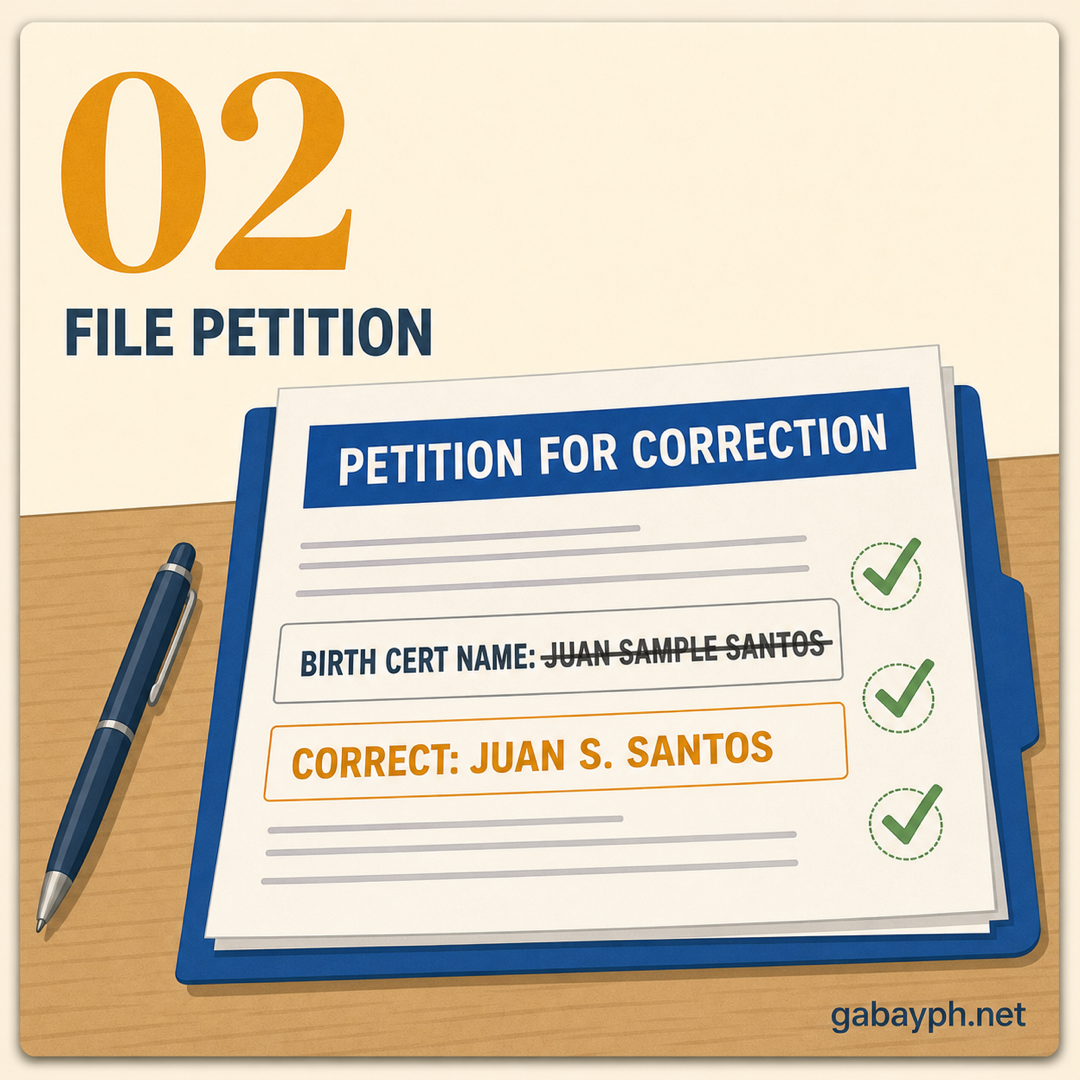
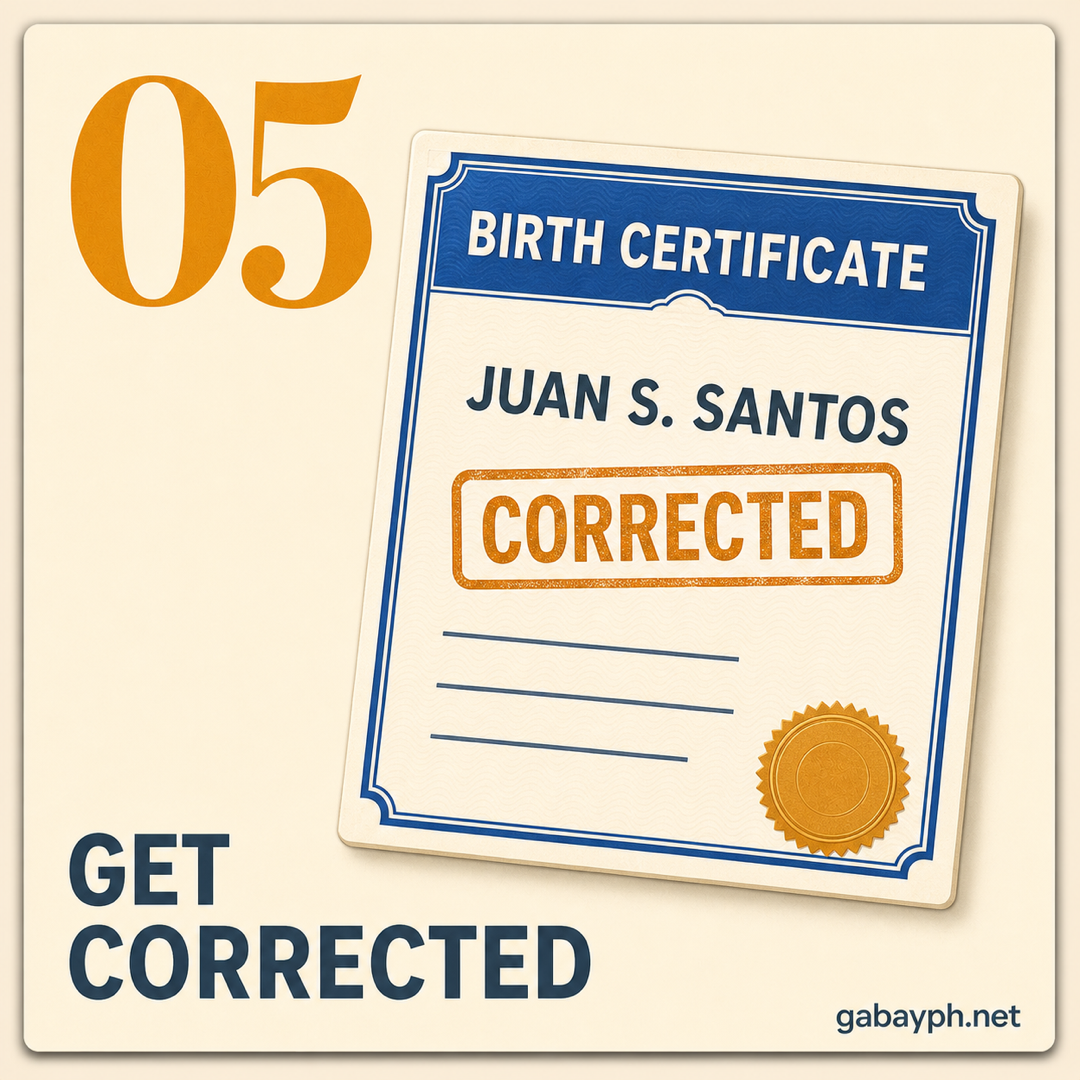
Birth cert correction in five steps.



Quick Summary
Mabilis na Buod
Table of Contents
- Overview: Common Birth Certificate Errors
- Types of Corrections
- Requirements for Administrative Correction (RA 9048)
- Step-by-Step: Administrative Correction at LCR
- Step-by-Step: Judicial Correction (Court Petition)
- PSA Annotation Process
- Common Errors and How to Fix Them
- Pro Tips
- Frequently Asked Questions
Talaan ng Nilalaman
- Pangkalahatang-tanaw: Mga Karaniwang Mali sa Birth Certificate
- Mga Uri ng Pagwawasto
- Mga Kailangan para sa Administrative Correction (RA 9048)
- Hakbang-Hakbang: Administrative Correction sa LCR
- Hakbang-Hakbang: Judicial Correction (Court Petition)
- Proseso ng PSA Annotation
- Mga Karaniwang Mali at Paano Itama
- Mga Payo
- Mga Madalas Itanong
Overview: Common Birth Certificate Errors
Pangkalahatang-tanaw: Mga Karaniwang Mali sa Birth Certificate
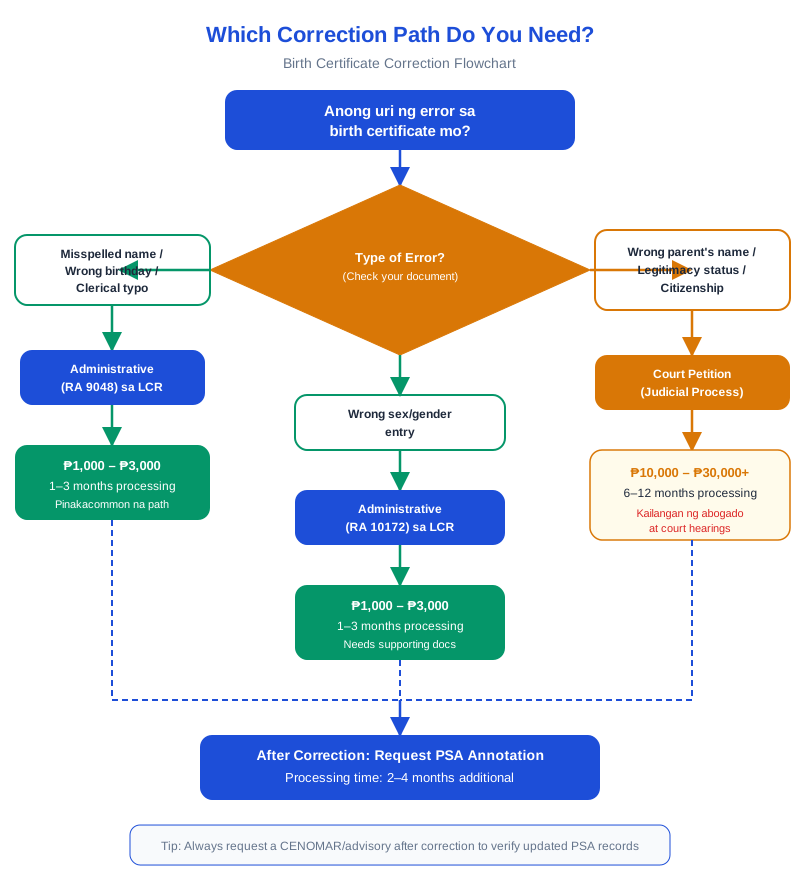
Errors on a Philippine birth certificate — misspelled names, wrong birthdays, incorrect sex — are common, especially in older handwritten records. There are two main paths to fix them:
Ang mga mali sa birth certificate sa Pilipinas — maling spelling ng pangalan, maling birthday, maling sex — ay karaniwan, lalo na sa mga lumang handwritten records. May dalawang pangunahing paraan para itama ang mga ito:
- Administrative correction (RA 9048 / RA 10172) — filed at the Local Civil Registrar (LCR) where the birth was registered. This is for clerical or typographical errors, first name changes, and corrections to sex/gender or day and month of birth. No court needed. Mas mabilis at mas mura ito.
- Judicial correction (court petition) — filed in the Regional Trial Court (RTC). Required for substantial errors like wrong parents' names, wrong citizenship, or legitimacy status. This involves a lawyer, court hearings, and takes significantly longer and costs more.
- Administrative correction (RA 9048 / RA 10172) — ini-file sa Local Civil Registrar (LCR) kung saan nakarehistro ang kapanganakan. Ito ay para sa clerical o typographical errors, pagpapalit ng first name, at pagwawasto ng sex/gender o araw at buwan ng kapanganakan. Hindi kailangan ng korte. Mas mabilis at mas mura ito.
- Judicial correction (court petition) — ini-file sa Regional Trial Court (RTC). Kinakailangan para sa malalaking pagkakamali tulad ng maling pangalan ng mga magulang, maling citizenship, o legitimacy status. Kailangan dito ng abogado, court hearings, at mas matagal at mas mahal ito.
Types of Corrections
Mga Uri ng Pagwawasto
1. Clerical or Typographical Errors (RA 9048)
1. Clerical o Typographical Errors (RA 9048)
Republic Act 9048, enacted in 2001, allows the correction of clerical or typographical errors in civil registry documents without going to court. This is the most common type of correction and the easiest to process. Clerical errors are mistakes that are obvious and harmless — like a misspelled first name, a wrong middle initial, or a transposed letter. Under RA 9048, you can also change your first name or nickname through an administrative petition at the LCR.
Ang Republic Act 9048, na ipinatupad noong 2001, ay nagpapahintulot sa pagwawasto ng clerical o typographical errors sa mga civil registry documents nang hindi pumupunta sa korte. Ito ang pinakakaraniwang uri ng pagwawasto at ang pinakamadaling i-proseso. Ang clerical errors ay mga pagkakamaling obvious at hindi nakapipinsala — tulad ng maling spelling ng first name, maling middle initial, o transposed letter. Sa ilalim ng RA 9048, maaari mo ring palitan ang iyong first name o palayaw sa pamamagitan ng administrative petition sa LCR.
Examples of clerical errors:
Mga halimbawa ng clerical errors:
- "Jhon" instead of "John""Jhon" sa halip na "John"
- "Marso 15" instead of "Marso 16" (obvious one-digit typo)"Marso 15" sa halip na "Marso 16" (obvious na one-digit typo)
- "Quezo City" instead of "Quezon City""Quezo City" sa halip na "Quezon City"
- Missing letter in a surname — "Sntos" instead of "Santos"Nawawalang letra sa apelyido — "Sntos" sa halip na "Santos"
2. First Name Change (RA 9048)
2. Pagpapalit ng First Name (RA 9048)
RA 9048 also covers petitions to change your first name. This is not just about fixing typos — you can petition to change your first name entirely if you have a valid reason, such as: the name is ridiculous or embarrassing, you have been habitually known by a different name, or you want to adopt a Filipino name. This is still done administratively at the LCR, but the filing fee is higher (around ₱3,000) and the process takes a bit longer because of additional posting requirements.
Sinasaklaw din ng RA 9048 ang mga petisyon para palitan ang iyong first name. Hindi lang ito tungkol sa pag-aayos ng typos — maaari kang mag-petisyon para palitan ang iyong first name nang buo kung may valid reason ka, tulad ng: ang pangalan ay nakakatawa o nakakahiya, kilala ka nang habitual sa ibang pangalan, o gusto mong mag-adopt ng Filipino name. Ginagawa pa rin ito nang administratibo sa LCR, pero mas mataas ang filing fee (mga ₱3,000) at medyo mas matagal ang proseso dahil sa dagdag na posting requirements.
3. Sex/Gender and Day or Month of Birth Correction (RA 10172)
3. Pagwawasto ng Sex/Gender at Araw o Buwan ng Kapanganakan (RA 10172)
Republic Act 10172, enacted in 2012, expanded RA 9048 to allow administrative correction of two additional entries: sex or gender and day and month of birth. Before RA 10172, these could only be corrected through a court petition. Now, if the error in your sex or birthday is clearly a clerical mistake (e.g., the hospital wrote "Female" but you are obviously male, or your birthday says "March" instead of "May"), you can correct it at the LCR.
Ang Republic Act 10172, na ipinatupad noong 2012, ay pinalawak ang RA 9048 para pahintulutan ang administrative correction ng dalawang karagdagang entry: sex o gender at araw at buwan ng kapanganakan. Bago ang RA 10172, ang mga ito ay maaari lang iwasto sa pamamagitan ng court petition. Ngayon, kung ang error sa iyong sex o birthday ay malinaw na clerical mistake (halimbawa, isinulat ng hospital na "Female" pero lalaki ka naman talaga, o ang birthday mo ay nakalagay na "March" sa halip na "May"), maaari mo itong iwasto sa LCR.
Important: RA 10172 does not allow changes to year of birth. If the year on your birth certificate is wrong, that requires a court petition. Also, this law does not cover changes in sex for gender identity reasons — it only covers clerical mistakes in the sex entry.
Mahalaga: Ang RA 10172 ay hindi nagpapahintulot ng pagbabago sa taon ng kapanganakan. Kung mali ang taon sa iyong birth certificate, kailangan ng court petition para doon. Gayundin, hindi sinasaklaw ng batas na ito ang pagbabago ng sex para sa gender identity reasons — sinasaklaw lang nito ang mga clerical mistakes sa sex entry.
4. Substantial Errors (Court Petition Required)
4. Malalaking Pagkakamali (Kailangan ng Court Petition)
Some errors are considered "substantial" and cannot be fixed through administrative processes. These require filing a petition for correction of entry in the Regional Trial Court (RTC) under Rule 108 of the Rules of Court. Substantial errors involve changes that affect civil status, nationality, filiation, or other material entries. You will need a lawyer for this.
Ang ibang mga error ay itinuturing na "substantial" at hindi maaaring iwasto sa pamamagitan ng administrative processes. Kailangan para sa mga ito ang pag-file ng petition for correction of entry sa Regional Trial Court (RTC) sa ilalim ng Rule 108 ng Rules of Court. Ang substantial errors ay mga pagbabago na nakakaapekto sa civil status, nationality, filiation, o iba pang material entries. Kakailanganin mo ng abogado para dito.
Examples of substantial errors that require court petition:
Mga halimbawa ng substantial errors na nangangailangan ng court petition:
- Wrong father's or mother's nameMaling pangalan ng ama o ina
- Wrong year of birthMaling taon ng kapanganakan
- Incorrect legitimacy statusMaling legitimacy status
- Wrong citizenshipMaling citizenship
- Missing middle nameNawawalang middle name
- Correction of surname (last name)Pagwawasto ng apelyido (last name)
Requirements for Administrative Correction (RA 9048)
Mga Kailangan para sa Administrative Correction (RA 9048)
- Petition form (available at the LCR) — the Local Civil Registrar will provide the official petition form. Some LCRs also have downloadable forms on their website.
- PSA-issued birth certificate with the error — get the latest certified copy from PSA (formerly NSO). This shows the official record that needs to be corrected. You can order online at psahelpline.ph or visit a PSA Serbilis outlet.
- At least two (2) supporting documents showing the correct information — these prove what the correct entry should be. Examples: baptismal certificate, school records (Form 137/SF10), voter's ID or registration record, passport, employment records, medical records, or any other government document showing the correct data.
- At least one (1) valid government-issued ID — original copy, not expired. Philippine passport, driver's license, UMID, PhilSys National ID, voter's ID, PRC ID, SSS ID, or Postal ID.
- Affidavit of discrepancy or correction — a notarized affidavit explaining the error and attesting to the correct information. Some LCRs provide a template; others require you to have it drafted by a notary public.
- Filing fee payment — ₱1,000 for clerical error correction, up to ₱3,000 for first name change. Exact amount varies by LCR.
- Publication fee (for first name change) — if you are changing your first name, the petition must be published in a newspaper of general circulation for one week. The newspaper publication fee is typically ₱3,000–₱5,000 and is paid separately.
- Additional documents for RA 10172 (sex/gender correction) — if correcting sex or gender, you may also need a medical certificate or certification from the attending physician at birth confirming the correct sex.
- Petition form (available sa LCR) — ang Local Civil Registrar ang magbibigay ng opisyal na petition form. Ang ilang LCR ay may downloadable forms din sa kanilang website.
- PSA-issued birth certificate na may error — kunin ang pinakabagong certified copy mula sa PSA (dating NSO). Ito ang nagpapakita ng opisyal na record na kailangang iwasto. Maaari kang mag-order online sa psahelpline.ph o bumisita sa PSA Serbilis outlet.
- Hindi bababa sa dalawang (2) supporting documents na nagpapakita ng tamang impormasyon — pinapatunayan nito kung ano ang tamang entry. Mga halimbawa: baptismal certificate, school records (Form 137/SF10), voter's ID o registration record, passport, employment records, medical records, o anumang government document na may tamang datos.
- Hindi bababa sa isang (1) valid na government-issued ID — original copy, hindi expired. Philippine passport, driver's license, UMID, PhilSys National ID, voter's ID, PRC ID, SSS ID, o Postal ID.
- Affidavit of discrepancy o correction — isang notarized affidavit na nagpapaliwanag ng mali at nagpapatunay ng tamang impormasyon. Ang ilang LCR ay nagbibigay ng template; ang iba ay nangangailangan na ipagawa mo ito sa notary public.
- Bayad sa filing fee — ₱1,000 para sa clerical error correction, hanggang ₱3,000 para sa first name change. Ang eksaktong halaga ay nag-iiba sa bawat LCR.
- Bayad sa publication (para sa first name change) — kung pinapalitan mo ang iyong first name, ang petisyon ay kailangang i-publish sa isang newspaper of general circulation sa loob ng isang linggo. Ang bayad sa newspaper publication ay karaniwang ₱3,000–₱5,000 at hiwalay na binabayaran.
- Karagdagang dokumento para sa RA 10172 (pagwawasto ng sex/gender) — kung iwinaswasto ang sex o gender, maaaring mangailangan ka rin ng medical certificate o certification mula sa attending physician sa kapanganakan na nagpapatunay ng tamang sex.
Step-by-Step: Administrative Correction at LCR
Hakbang-Hakbang: Administrative Correction sa LCR
-
Go to the LCR Where Your Birth Was Registered
Pumunta sa LCR Kung Saan Nakarehistro ang Iyong Kapanganakan
This is critical: you must file your petition at the Local Civil Registrar of the city or municipality where your birth was originally registered. Hindi mo ito pwedeng i-file sa kahit anong LCR — it must be the specific one that has your original birth record. Check your PSA birth certificate to see the place of registration. Kung ipinanganak ka sa Pasig City but your birth was registered in Marikina (because your parents lived there), then Marikina LCR ang puntahan mo.
Ito ay napakahalaga: kailangan mong i-file ang iyong petisyon sa Local Civil Registrar ng lungsod o munisipalidad kung saan orihinal na nakarehistro ang iyong kapanganakan. Hindi mo ito pwedeng i-file sa kahit anong LCR — kailangan ang specific na LCR na may hawak ng iyong original birth record. Tingnan ang iyong PSA birth certificate para makita ang lugar ng registration. Kung ipinanganak ka sa Pasig City pero nakarehistro ang kapanganakan mo sa Marikina (dahil doon nakatira ang mga magulang mo), sa Marikina LCR ka dapat pumunta.
Visit the LCR office and ask for the petition form for correction of clerical error under RA 9048 (or RA 10172 if you are correcting sex/gender or day/month of birth). The staff will check if your specific error qualifies for administrative correction.
Bumisita sa LCR office at humingi ng petition form para sa correction of clerical error sa ilalim ng RA 9048 (o RA 10172 kung iwinaswasto mo ang sex/gender o araw/buwan ng kapanganakan). Titingnan ng staff kung ang iyong specific na error ay qualify para sa administrative correction.
-
File the Petition with Supporting Documents
I-file ang Petisyon kasama ang mga Supporting Documents
Complete the petition form and submit it together with all your supporting documents. The LCR staff will review your submission to make sure everything is in order. They will check that your supporting documents clearly show the correct information that should appear on your birth certificate.
Kumpletuhin ang petition form at i-submit ito kasama ang lahat ng iyong supporting documents. Ire-review ng LCR staff ang iyong submission para matiyak na kumpleto at maayos ang lahat. Titingnan nila na ang iyong supporting documents ay malinaw na nagpapakita ng tamang impormasyon na dapat lumabas sa iyong birth certificate.
Bring at least two supporting documents that show the correct information. The more documents you have, the stronger your petition. For example, if you are correcting a misspelled first name, bring your baptismal certificate, school transcript, and voter's ID — all showing the correct spelling. Mas maraming proof, mas mabilis ang approval.
Magdala ng hindi bababa sa dalawang supporting documents na nagpapakita ng tamang impormasyon. Mas maraming dokumento ang meron ka, mas malakas ang iyong petisyon. Halimbawa, kung iwinaswasto mo ang maling spelling ng first name, magdala ng iyong baptismal certificate, school transcript, at voter's ID — lahat ay nagpapakita ng tamang spelling. Mas maraming proof, mas mabilis ang approval.
-
Pay the Filing Fee (₱1,000–₱3,000)
Magbayad ng Filing Fee (₱1,000–₱3,000)
After your petition is accepted, pay the required filing fee at the LCR cashier. The fee depends on your LCR and the type of correction:
Pagkatapos tanggapin ang iyong petisyon, bayaran ang kinakailangang filing fee sa LCR cashier. Ang bayad ay depende sa iyong LCR at sa uri ng pagwawasto:
- Clerical error correction: ₱1,000–₱1,500 (varies by LCR)Clerical error correction: ₱1,000–₱1,500 (nag-iiba sa bawat LCR)
- First name change: ₱3,000 (plus publication fee of ₱3,000–₱5,000)First name change: ₱3,000 (dagdag ang publication fee na ₱3,000–₱5,000)
- Sex/gender correction (RA 10172): ₱3,000 (plus publication fee)Sex/gender correction (RA 10172): ₱3,000 (dagdag ang publication fee)
Keep your official receipt — you will need this for follow-ups. Some LCRs accept cash only, so bring exact change to avoid any issues.
Itago ang iyong official receipt — kakailanganin mo ito para sa mga follow-up. Ang ilang LCR ay cash lang ang tinatanggap, kaya magdala ng tamang halaga para maiwasan ang anumang problema.
-
Wait for the 10-Day Posting Period
Maghintay para sa 10-Araw na Posting Period
After filing, the LCR is required to post your petition in a conspicuous place in the LCR office and at the city/municipal hall for 10 consecutive days. This is a legal requirement to give any interested party the chance to oppose the correction. In practice, almost nobody opposes clerical corrections — pero kailangan pa rin sundin ang proseso.
Pagkatapos mag-file, kinakailangan ng LCR na i-post ang iyong petisyon sa isang conspicuous na lugar sa LCR office at sa city/municipal hall sa loob ng 10 magkakasunod na araw. Ito ay legal requirement para bigyan ang sinumang may interes na i-oppose ang pagwawasto. Sa praktika, halos walang nag-ooppose sa clerical corrections — pero kailangan pa rin sundin ang proseso.
For first name changes and sex/gender corrections under RA 10172, the petition must also be published in a newspaper of general circulation once a week for two consecutive weeks. The LCR will tell you which newspaper to coordinate with. This is an additional expense (₱3,000–₱5,000) and adds time to the process.
Para sa first name changes at sex/gender corrections sa ilalim ng RA 10172, ang petisyon ay kailangang i-publish sa isang newspaper of general circulation isang beses sa isang linggo sa loob ng dalawang magkakasunod na linggo. Sasabihin ng LCR kung aling newspaper ang ka-coordinate mo. Ito ay dagdag na gastos (₱3,000–₱5,000) at nagdadagdag ng oras sa proseso.
-
LCR Approves and Issues Corrected Certificate
Nag-a-approve ang LCR at Naglalabas ng Corrected Certificate
After the posting period (and publication period, if applicable) is completed without any opposition, the City or Municipal Civil Registrar will approve the petition and annotate the civil registry record. The LCR will issue a corrected local copy of your birth certificate. This corrected local copy is your proof that the correction has been made at the local level.
Pagkatapos ng posting period (at publication period, kung applicable) na walang anumang opposisyon, ang City o Municipal Civil Registrar ay mag-a-approve ng petisyon at ia-annotate ang civil registry record. Maglalabas ang LCR ng corrected local copy ng iyong birth certificate. Ang corrected local copy na ito ang iyong patunay na nagawa na ang pagwawasto sa local level.
Processing time from filing to approval typically takes 1–3 months, depending on the workload of your LCR. Some LCRs in smaller municipalities are faster; others in big cities like Quezon City or Manila may take longer because of the volume of petitions. Follow up regularly — pumunta ka every 2–3 weeks to check the status kung walang text or call from the LCR.
Ang processing time mula sa pag-file hanggang sa approval ay karaniwang tumatagal ng 1–3 buwan, depende sa workload ng iyong LCR. Ang ilang LCR sa mas maliliit na munisipalidad ay mas mabilis; ang iba sa malalaking lungsod tulad ng Quezon City o Manila ay maaaring mas matagal dahil sa dami ng mga petisyon. Regular na mag-follow up — pumunta ka every 2–3 weeks para i-check ang status kung walang text o tawag mula sa LCR.
-
Request PSA Annotation (Updated PSA Copy)
Humingi ng PSA Annotation (Updated PSA Copy)
Once you have the corrected local copy from the LCR, you need to have the correction reflected in the PSA (Philippine Statistics Authority) national database. The LCR will forward the approved petition and annotated record to the PSA for annotation. After annotation, you can request a new PSA-certified birth certificate that shows the corrected information.
Kapag nakuha mo na ang corrected local copy mula sa LCR, kailangan mong i-reflect ang pagwawasto sa PSA (Philippine Statistics Authority) national database. Ipapadala ng LCR ang approved petition at annotated record sa PSA para sa annotation. Pagkatapos ng annotation, maaari kang humiling ng bagong PSA-certified birth certificate na nagpapakita ng corrected information.
This is important because most transactions (passport, visa, employment) require a PSA-issued copy, not just the local LCR copy. See the PSA Annotation section below for more details on this step.
Mahalaga ito dahil karamihan ng mga transaksyon (passport, visa, employment) ay nangangailangan ng PSA-issued na kopya, hindi lang ang local LCR copy. Tingnan ang PSA Annotation section sa ibaba para sa mas maraming detalye tungkol sa hakbang na ito.
Step-by-Step: Judicial Correction (Court Petition)
Hakbang-Hakbang: Judicial Correction (Court Petition)
If your error is substantial and cannot be fixed through RA 9048 or RA 10172, you will need to go through the courts. Mas matagal at mas mahal ito, pero sometimes walang ibang paraan. Here is the general process:
Kung substantial ang iyong error at hindi maaaring iwasto sa pamamagitan ng RA 9048 o RA 10172, kailangan mong dumaan sa korte. Mas matagal at mas mahal ito, pero minsan walang ibang paraan. Narito ang general process:
-
Hire a Lawyer
Kumuha ng Abogado
For judicial corrections, you must have legal representation. A lawyer will draft the petition, file it in court, and represent you during hearings. Lawyer's fees for birth certificate correction cases typically range from ₱10,000 to ₱30,000 or more, depending on the complexity of the case and your location. Metro Manila lawyers tend to charge higher than provincial lawyers.
Para sa judicial corrections, kailangan mong magkaroon ng legal representation. Ang abogado ang magdo-draft ng petisyon, mag-fi-file nito sa korte, at mag-re-represent sa iyo sa mga hearing. Ang bayad sa abogado para sa birth certificate correction cases ay karaniwang nasa ₱10,000 hanggang ₱30,000 o higit pa, depende sa complexity ng kaso at sa iyong lokasyon. Ang mga abogado sa Metro Manila ay karaniwang mas mahal kaysa sa mga provincial lawyers.
Tip: ask for a fixed fee arrangement instead of an hourly rate. Mas madali mong ma-budget kung alam mo agad ang total cost. Also, ask kung kasama na ang filing fees at other expenses sa quotation nila, or kung hiwalay pa. Some PAO (Public Attorney's Office) branches may assist qualified individuals for free — inquire if you are eligible.
Payo: humingi ng fixed fee arrangement sa halip na hourly rate. Mas madali mong ma-budget kung alam mo agad ang total cost. Tanungin din kung kasama na ang filing fees at ibang gastos sa quotation nila, o kung hiwalay pa. Ang ilang PAO (Public Attorney's Office) branches ay maaaring tumulong sa mga kwalipikadong indibidwal nang libre — mag-inquire kung eligible ka.
-
File the Petition in Regional Trial Court (RTC)
I-file ang Petisyon sa Regional Trial Court (RTC)
Your lawyer will file a verified petition under Rule 108 of the Rules of Court at the RTC that has jurisdiction over the city or municipality where the civil registry is located. The petition will detail the specific errors, the correct entries, and the supporting evidence.
Ang iyong abogado ang mag-fi-file ng verified petition sa ilalim ng Rule 108 ng Rules of Court sa RTC na may jurisdiction sa lungsod o munisipalidad kung saan matatagpuan ang civil registry. Ang petisyon ay magde-detalye ng mga specific na error, ang mga tamang entry, at ang supporting evidence.
The court will require you to pay filing fees (usually ₱2,000–₱5,000) and may require publication of the petition in a newspaper of general circulation. Your lawyer will handle these procedural requirements.
Mangangailangan ang korte na magbayad ka ng filing fees (karaniwang ₱2,000–₱5,000) at maaaring mangailangan ng publication ng petisyon sa isang newspaper of general circulation. Ang iyong abogado ang mag-ha-handle ng mga procedural requirements na ito.
-
Attend Court Hearings
Dumalo sa mga Court Hearing
The court will schedule hearings where you (and possibly your witnesses) will testify about the errors and present your supporting documents. The Office of the Solicitor General (OSG) or the city/provincial prosecutor will review the case and may appear at the hearings. In most straightforward correction cases, hearings are relatively quick and the government does not oppose the petition.
Magse-schedule ang korte ng mga hearing kung saan ikaw (at posibleng mga witness mo) ang magpapatunay tungkol sa mga error at magpapakita ng supporting documents. Ang Office of the Solicitor General (OSG) o ang city/provincial prosecutor ang mag-re-review ng kaso at maaaring dumalo sa mga hearing. Sa karamihan ng straightforward correction cases, ang mga hearing ay medyo mabilis at hindi inooppose ng gobyerno ang petisyon.
Expect 2–5 hearing dates spread over several months. Courts in the Philippines are notoriously slow, and hearings may be postponed or rescheduled. Be patient, but also be proactive — coordinate regularly with your lawyer to check on the status and upcoming schedules.
Mag-expect ng 2–5 hearing dates na nakakalat sa loob ng ilang buwan. Ang mga korte sa Pilipinas ay kilalang mabagal, at ang mga hearing ay maaaring ma-postpone o ma-reschedule. Maging matiyaga, pero maging proactive din — regular na makipag-coordinate sa iyong abogado para i-check ang status at mga darating na schedule.
-
Court Issues the Order for Correction
Naglalabas ang Korte ng Order para sa Pagwawasto
If the court is satisfied with your evidence, it will issue a court order directing the Local Civil Registrar to correct the specified entries in your birth certificate. This order is the legal basis for the correction. Once the order becomes final and executory (typically 15 days after issuance, if no appeal is filed), you can proceed to the next step.
Kung kuntento ang korte sa iyong ebidensya, maglalabas ito ng court order na nag-uutos sa Local Civil Registrar na iwasto ang mga tinukoy na entry sa iyong birth certificate. Ang order na ito ang legal basis para sa pagwawasto. Kapag naging final at executory na ang order (karaniwang 15 araw pagkatapos ilabas, kung walang nag-appeal), maaari kang magpatuloy sa susunod na hakbang.
-
Bring the Court Order to the LCR
Dalhin ang Court Order sa LCR
Once the court order is final, bring a certified true copy of the court order and a certificate of finality to the LCR where your birth was registered. The LCR will annotate your birth record based on the court order. After annotation, request a corrected local copy of your birth certificate from the LCR.
Kapag final na ang court order, dalhin ang certified true copy ng court order at isang certificate of finality sa LCR kung saan nakarehistro ang iyong kapanganakan. Ang LCR ang mag-a-annotate ng iyong birth record batay sa court order. Pagkatapos ng annotation, humingi ng corrected local copy ng iyong birth certificate mula sa LCR.
-
Request PSA Annotation for Updated Copy
Humingi ng PSA Annotation para sa Updated Copy
Just like with administrative corrections, you will need the PSA to update their national records. The LCR will forward the annotated record and court order to the PSA. After PSA annotation, you can order a new PSA-certified birth certificate online at psahelpline.ph or at any PSA Serbilis outlet. The whole judicial process — from filing to receiving your updated PSA copy — typically takes 3 to 12 months.
Gaya ng administrative corrections, kailangan mong i-update ng PSA ang kanilang national records. Ipapadala ng LCR ang annotated record at court order sa PSA. Pagkatapos ng PSA annotation, maaari kang mag-order ng bagong PSA-certified birth certificate online sa psahelpline.ph o sa anumang PSA Serbilis outlet. Ang buong judicial process — mula sa pag-file hanggang sa pagtanggap ng updated PSA copy — ay karaniwang tumatagal ng 3 hanggang 12 buwan.
PSA Annotation Process
Proseso ng PSA Annotation
Whether you went through administrative or judicial correction, the final step is always the same: getting the PSA to update their national database. This is called "annotation." Without PSA annotation, your corrected birth certificate is only recognized at the local level, and most transactions will still require the PSA copy. Kaya huwag kalimutan ang step na ito — maraming tao ang nag-stop pagkatapos makuha ang LCR correction, tapos nagulat na hindi pa pala updated ang PSA copy nila.
Kahit dumaan ka sa administrative o judicial correction, ang huling hakbang ay palaging pareho: i-update ng PSA ang kanilang national database. Ito ay tinatawag na "annotation." Kung walang PSA annotation, ang corrected birth certificate mo ay kinikilala lang sa local level, at karamihan ng mga transaksyon ay nangangailangan pa rin ng PSA copy. Kaya huwag kalimutan ang step na ito — maraming tao ang nag-stop pagkatapos makuha ang LCR correction, tapos nagulat na hindi pa pala updated ang PSA copy nila.
What You Need for PSA Annotation
Mga Kailangan para sa PSA Annotation
- LCR-certified corrected copy of your birth certificate (with the annotation from the Local Civil Registrar)
- Court order and certificate of finality (if judicial correction — certified true copies from the court)
- Endorsement letter from the LCR to the PSA (some LCRs prepare this automatically, others you may need to request)
- Valid ID (for identification at PSA office if you are following up in person)
- LCR-certified corrected copy ng iyong birth certificate (na may annotation mula sa Local Civil Registrar)
- Court order at certificate of finality (kung judicial correction — certified true copies mula sa korte)
- Endorsement letter mula sa LCR papunta sa PSA (ang ilang LCR ay awtomatikong inihahanda ito, sa iba ay kailangan mong hilingin)
- Valid ID (para sa identification sa PSA office kung mag-fo-follow up ka nang personal)
How Long Does PSA Annotation Take?
Gaano Katagal ang PSA Annotation?
PSA annotation typically takes 2 to 4 months after the LCR forwards the documents. The exact timeline depends on the PSA's workload and whether all documents are complete. After annotation is complete, you can order your new PSA-certified birth certificate through:
Ang PSA annotation ay karaniwang tumatagal ng 2 hanggang 4 na buwan pagkatapos maipadala ng LCR ang mga dokumento. Ang eksaktong timeline ay depende sa workload ng PSA at kung kumpleto ang lahat ng dokumento. Pagkatapos makumpleto ang annotation, maaari mong i-order ang iyong bagong PSA-certified birth certificate sa pamamagitan ng:
- PSAHelpline.ph — online ordering with delivery (₱365 + shipping)online ordering na may delivery (₱365 + shipping)
- PSA Serbilis outlets — walk-in at SM malls and other locations nationwidewalk-in sa SM malls at iba pang lokasyon sa buong bansa
When you order, the system will show the annotated/corrected version. If the old (incorrect) version still shows up, the annotation may not yet be reflected. Wait a few more weeks and try again, or contact PSA directly for a status update.
Kapag nag-order ka, makikita sa sistema ang annotated/corrected na bersyon. Kung lumabas pa rin ang luma (maling) bersyon, maaaring hindi pa nare-reflect ang annotation. Maghintay ng ilang linggo pa at subukan ulit, o direktang makipag-ugnayan sa PSA para sa status update.
Common Errors and How to Fix Them
Mga Karaniwang Mali at Paano Itama
Here is a quick reference for the most common birth certificate errors and which correction path to take:
Narito ang mabilis na reference para sa mga pinakakaraniwang birth certificate errors at kung anong correction path ang kailangang gawin:
Misspelled First Name or Last Name
Maling Spelling ng First Name o Last Name
Path: RA 9048 at LCR (administrative). File a petition for clerical error correction at the LCR with your baptismal certificate, school records, and other documents showing the correct spelling.
Paraan: RA 9048 sa LCR (administrative). Mag-file ng petition for clerical error correction sa LCR kasama ang iyong baptismal certificate, school records, at ibang dokumento na nagpapakita ng tamang spelling.
Wrong Birthday (Day or Month)
Maling Birthday (Araw o Buwan)
Path: RA 10172 at LCR (administrative) if it is an obvious typo in the day or month. For example, if your birthday is listed as "March 15" but all your other documents say "March 16," this can be corrected administratively. However, if the year is wrong (e.g., 1995 instead of 1996), that is a substantial error and requires a court petition.
Paraan: RA 10172 sa LCR (administrative) kung ito ay obvious na typo sa araw o buwan. Halimbawa, kung ang birthday mo ay nakalagay na "March 15" pero lahat ng iba mong dokumento ay nagsasabing "March 16," maaari itong iwasto nang administratibo. Gayunpaman, kung ang taon ang mali (halimbawa, 1995 sa halip na 1996), iyon ay substantial error at nangangailangan ng court petition.
Wrong Sex/Gender
Maling Sex/Gender
Path: RA 10172 at LCR (administrative). If the hospital or LCR recorded the wrong sex due to a clerical mistake, you can fix this at the LCR with a medical certificate or physician certification to support the correction.
Paraan: RA 10172 sa LCR (administrative). Kung nai-record ng hospital o LCR ang maling sex dahil sa clerical mistake, maaari mo itong itama sa LCR gamit ang medical certificate o physician certification para suportahan ang correction.
Wrong Parent's Name
Maling Pangalan ng Magulang
Path: Court petition (judicial). This is considered a substantial error because it involves filiation — the legal relationship between parent and child. Even if it is a misspelling of your mother's or father's name, many courts and LCRs will require a judicial process for this. Hire a lawyer and file in the RTC.
Paraan: Court petition (hudisyal). Ito ay itinuturing na substantial error dahil may kinalaman ito sa filiation — ang legal relationship sa pagitan ng magulang at anak. Kahit misspelling lang ito ng pangalan ng iyong ina o ama, maraming korte at LCR ang mangangailangan ng judicial process para dito. Kumuha ng abogado at mag-file sa RTC.
Missing Middle Name
Nawawalang Middle Name
Path: Court petition (judicial). Adding a middle name that was not originally recorded is considered a substantial change. This often happens when the parents did not include the mother's maiden name at the time of registration. A court petition is required to add the missing entry.
Paraan: Court petition (hudisyal). Ang pagdagdag ng middle name na hindi orihinal na nai-record ay itinuturing na substantial change. Madalas itong nangyayari kapag hindi isinama ng mga magulang ang maiden name ng ina sa oras ng registration. Kailangan ng court petition para idagdag ang nawawalang entry.
Pro Tips
Mga Payo
- Get all your supporting documents first before going to the LCR. Wala kang magagawa sa LCR kung kulang ka sa documents. Order your PSA birth certificate, get your baptismal certificate from the church, request school records (Form 137/SF10) from your school — have everything ready before you start the process. This saves you from multiple trips.
- Have your affidavit notarized properly. Find a notary public near the LCR — they usually charge ₱100–₱500 per affidavit. Make sure the affidavit clearly states the error and the correct information. Some LCRs provide a template, so ask first before going to a notary.
- Ask the LCR for their exact requirements. Requirements can vary slightly from one LCR to another. What applies in Pasig may be slightly different in Makati or Cebu. A quick visit or phone call to ask "Ano po ang requirements for correction of entry under RA 9048?" can save you a lot of time and hassle.
- Start early — check your birth certificate now. Even the administrative route takes 1–3 months at the LCR plus 2–4 months for PSA annotation. Order a PSA copy, review it, and if there are errors, start correcting them at least 6 months before any passport, visa, or job deadline.
- For judicial cases, ask about PAO (Public Attorney's Office) assistance. If you cannot afford a private lawyer, the PAO provides free legal assistance to qualified individuals. Visit the nearest PAO office to inquire about eligibility.
- Kumpletuhin muna ang lahat ng supporting documents bago pumunta sa LCR. Wala kang magagawa sa LCR kung kulang ka sa documents. Mag-order ng iyong PSA birth certificate, kumuha ng baptismal certificate mula sa simbahan, humiling ng school records (Form 137/SF10) mula sa iyong paaralan — ihanda ang lahat bago simulan ang proseso. Makakatipid ka ng maraming biyahe.
- Ipanotarize nang maayos ang iyong affidavit. Humanap ng notary public malapit sa LCR — karaniwang ₱100–₱500 ang singil nila bawat affidavit. Siguraduhing malinaw na nakalagay sa affidavit ang error at ang tamang impormasyon. Ang ilang LCR ay nagbibigay ng template, kaya magtanong muna bago pumunta sa notary.
- Tanungin sa LCR ang kanilang eksaktong requirements. Ang requirements ay maaaring mag-iba nang kaunti sa bawat LCR. Ang naaangkop sa Pasig ay maaaring medyo kaiba sa Makati o Cebu. Ang isang mabilis na bisita o tawag sa telepono para itanong ang "Ano po ang requirements for correction of entry under RA 9048?" ay makakatipid sa iyo ng maraming oras at hassle.
- Magsimula nang maaga — i-check ang iyong birth certificate ngayon. Kahit ang administrative route ay tumatagal ng 1–3 buwan sa LCR dagdag ang 2–4 na buwan para sa PSA annotation. Mag-order ng PSA copy, i-review ito, at kung may mali, simulan ang pagwawasto nang hindi bababa sa 6 na buwan bago ang anumang passport, visa, o job deadline.
- Para sa judicial cases, magtanong tungkol sa PAO (Public Attorney's Office) assistance. Kung hindi mo kayang mag-bayad ng private lawyer, nagbibigay ang PAO ng libreng legal assistance sa mga kwalipikadong indibidwal. Bumisita sa pinakamalapit na PAO office para mag-inquire tungkol sa eligibility.
Frequently Asked Questions
Mga Madalas Itanong
How much does birth certificate correction cost?
The cost depends on the type of correction. For administrative correction of clerical errors under RA 9048, the filing fee at the LCR is around ₱1,000–₱1,500. For first name change or sex/gender correction, expect to pay around ₱3,000 for the filing fee plus ₱3,000–₱5,000 for newspaper publication. For judicial corrections (court petition), the total cost including lawyer's fees, filing fees, and publication can range from ₱10,000 to ₱30,000 or more. Separate pa dito ang gastos sa PSA annotation at pag-order ng bagong PSA-certified copy (₱365 per copy).
Magkano ang pagwawasto ng birth certificate?
Ang gastos ay depende sa uri ng pagwawasto. Para sa administrative correction ng clerical errors sa ilalim ng RA 9048, ang filing fee sa LCR ay mga ₱1,000–₱1,500. Para sa first name change o sex/gender correction, mag-expect na magbayad ng mga ₱3,000 para sa filing fee dagdag ang ₱3,000–₱5,000 para sa newspaper publication. Para sa judicial corrections (court petition), ang kabuuang gastos kasama ang lawyer's fees, filing fees, at publication ay maaaring umabot ng ₱10,000 hanggang ₱30,000 o higit pa. Hiwalay pa dito ang gastos sa PSA annotation at pag-order ng bagong PSA-certified copy (₱365 bawat kopya).
How long does birth certificate correction take?
Administrative (RA 9048/10172): roughly 3–7 months total (1–3 months LCR + 2–4 months PSA annotation). Judicial: 5–16 months total. See the step-by-step sections above for detailed timelines.
Gaano katagal ang pagwawasto ng birth certificate?
Administrative (RA 9048/10172): mga 3–7 buwan kabuuan (1–3 buwan LCR + 2–4 buwan PSA annotation). Hudisyal: 5–16 buwan kabuuan. Tingnan ang mga hakbang-hakbang na seksyon sa itaas para sa mga detalyadong timeline.
Can I correct my birth certificate at any LCR?
No. You must file at the LCR of the city/municipality where your birth was originally registered. Check the "Place of Registration" on your PSA birth certificate. Filipinos abroad may file through the nearest Philippine Consulate.
Maaari ko bang iwasto ang aking birth certificate sa kahit anong LCR?
Hindi. Kailangan mong i-file sa LCR ng lungsod/munisipalidad kung saan orihinal na nakarehistro ang iyong kapanganakan. I-check ang "Place of Registration" sa iyong PSA birth certificate. Ang mga Pilipino sa ibang bansa ay maaaring mag-file sa pinakamalapit na Philippine Consulate.
What if I need the correction urgently for a passport?
The process cannot be significantly rushed — minimum 1–2 months for LCR correction alone. Explain the urgency to the LCR (bring proof of your deadline), submit a complete petition the first time, and follow up every 1–2 weeks. Start at least 6 months before any travel or deployment deadline.
Paano kung kailangan ko agad ang pagwawasto para sa passport?
Hindi maaaring pabilisin nang malaki ang proseso — minimum 1–2 buwan para sa LCR correction lang. Ipaliwanag ang urgency sa LCR (magdala ng proof ng deadline), mag-submit ng kumpletong petisyon sa unang pagkakataon, at mag-follow up tuwing 1–2 linggo. Magsimula nang hindi bababa sa 6 na buwan bago ang anumang travel o deployment deadline.
Do I need a lawyer for clerical errors?
No. RA 9048 lets you correct clerical errors yourself at the LCR — no lawyer, no court. You only need a lawyer for substantial errors that require a judicial petition.
Kailangan ko ba ng abogado para sa clerical errors?
Hindi. Pinapayagan ka ng RA 9048 na iwasto ang clerical errors nang mag-isa sa LCR — walang abogado, walang korte. Kailangan mo lang ng abogado para sa substantial errors na nangangailangan ng judicial petition.
What's the difference between RA 9048 and RA 10172?
RA 9048 (enacted 2001) authorizes the city or municipal civil registrar to correct clerical or typographical errors and to change first names in civil registry documents through an administrative process — no court needed. It covers misspellings, wrong entries that are clearly typographical, and first name changes. RA 10172 (enacted 2012) amended RA 9048 to expand the types of corrections that can be done administratively. Specifically, it added the correction of sex or gender and day and month of birth (but not year of birth). Before RA 10172, these corrections could only be done through a court petition. In short: RA 9048 = clerical errors and first name changes; RA 10172 = RA 9048 + sex/gender and day/month of birth corrections. Both are done at the LCR, both don't require a lawyer.
Ano ang pagkakaiba ng RA 9048 at RA 10172?
Ang RA 9048 (ipinatupad noong 2001) ay nag-aauthorize sa city o municipal civil registrar na iwasto ang clerical o typographical errors at palitan ang first names sa civil registry documents sa pamamagitan ng administrative process — hindi kailangan ng korte. Sinasaklaw nito ang mga maling spelling, maling entry na malinaw na typographical, at first name changes. Ang RA 10172 (ipinatupad noong 2012) ay nag-amend sa RA 9048 para palawakin ang mga uri ng corrections na maaaring gawin nang administratibo. Partikular, idinagdag nito ang pagwawasto ng sex o gender at araw at buwan ng kapanganakan (pero hindi ang taon ng kapanganakan). Bago ang RA 10172, ang mga correction na ito ay maaari lang gawin sa pamamagitan ng court petition. Sa madaling salita: RA 9048 = clerical errors at first name changes; RA 10172 = RA 9048 + sex/gender at araw/buwan ng kapanganakan corrections. Parehong ginagawa sa LCR, parehong hindi nangangailangan ng abogado.