

Annulment, Legal Separation & Declaration of Nullity: A Plain-Language Philippine Guide (2026)
Annulment, Legal Separation at Declaration of Nullity: Isang Malinaw na Gabay (2026)

5 Things to Know
Annulment vs Legal Separation in five facts.
Quick Summary
Mabilis na Buod
Legal Disclaimer
This guide is for informational purposes only and is not legal advice. Family law is highly fact-specific — the correct procedure (legal separation vs annulment vs nullity) depends on the details of your situation. Consult a licensed Philippine attorney before filing any petition. Laws, Supreme Court rulings, and court procedures can change. GabayPH is not a law firm and does not represent any party.
Legal Disclaimer
Ang gabay na ito ay pang-impormasyon lamang at hindi legal advice. Ang family law ay sensitibo sa detalye — depende sa sitwasyon kung alin (legal separation, annulment, o nullity). Kumunsulta sa lisensyadong Pilipinong abogado bago mag-file. Maaaring magbago ang mga batas, desisyon ng Korte Suprema, at court procedures. Ang GabayPH ay hindi law firm at hindi kumakatawan sa sinuman.
Table of Contents
- The Three Legal Concepts at a Glance
- Legal Separation (Art. 55-67)
- Annulment (Art. 45) — Voidable Marriage
- Declaration of Nullity (Art. 35, 36, 37, 38)
- Psychological Incapacity (Art. 36) — Tan-Andal Doctrine
- Recognition of Foreign Divorce
- Step-by-Step Process (Annulment/Nullity)
- Cost Breakdown (2026)
- After the Decree
- Absolute Divorce Bill Status
- Pro Tips
- Frequently Asked Questions
Talaan ng Nilalaman
- Ang Tatlong Konsepto
- Legal Separation (Art. 55-67)
- Annulment (Art. 45)
- Declaration of Nullity (Art. 35, 36, 37, 38)
- Psychological Incapacity (Tan-Andal)
- Recognition of Foreign Divorce
- Proseso (Hakbang-Hakbang)
- Gastos (2026)
- Pagkatapos ng Decree
- Absolute Divorce Bill Status
- Mga Payo
- Mga Madalas Itanong
The Three Legal Concepts at a Glance
Ang Tatlong Konsepto
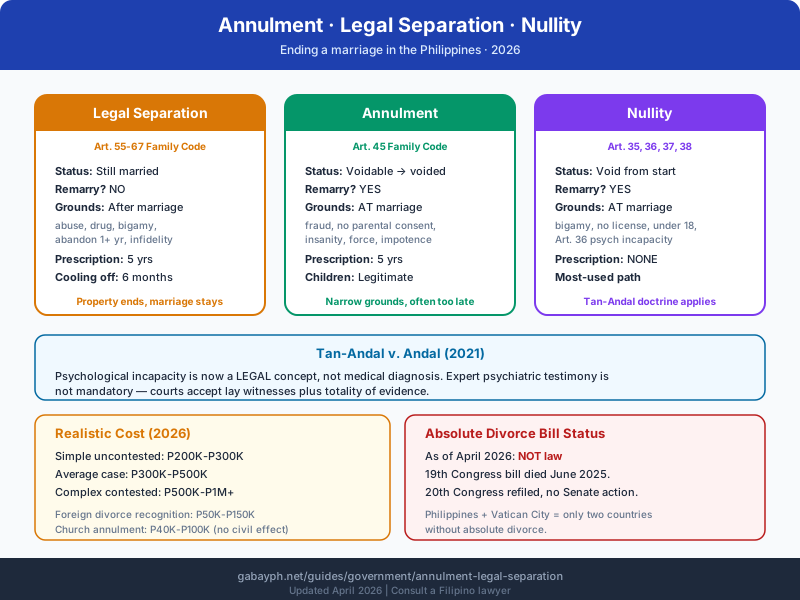
Filipinos often use these three terms interchangeably. They are not. Picking the wrong one can add years and hundreds of thousands of pesos to your case.
Ginagamit na magkaparehas ang tatlong termino, pero hindi sila pareho. Ang maling pagpili ay pwedeng magdagdag ng taon at daang libong piso sa kaso.
| Legal SeparationLegal Separation | Annulment | Declaration of NullityDeclaration of Nullity | |
|---|---|---|---|
| Marriage statusStatus ng kasal | Still legally marriedKasal pa rin | Valid but voidable → voidedValid pero voidable → na-void | Void from the startVoid mula umpisa |
| Can remarry?Pwedeng mag-asawang muli? | NOHINDI | YES (after decree)OO (matapos ng decree) | YES (after decree)OO (matapos ng decree) |
| Grounds must existKailan lumitaw ang dahilan | After marriageMatapos ng kasal | AT time of marriageSA oras ng kasal | AT time of marriageSA oras ng kasal |
| Prescriptive periodDeadline | 5 years from ground5 taon mula paglitaw | 5 years (various triggers)5 taon (iba-ibang trigger) | No prescriptionWalang prescription |
| Children's legitimacyPagka-legitimate ng mga anak | PreservedPreserved | PreservedPreserved | Preserved (Art. 36) or NOT (others)Preserved (Art. 36) o HINDI |
Legal Separation (Art. 55-67)
Legal Separation (Art. 55-67)
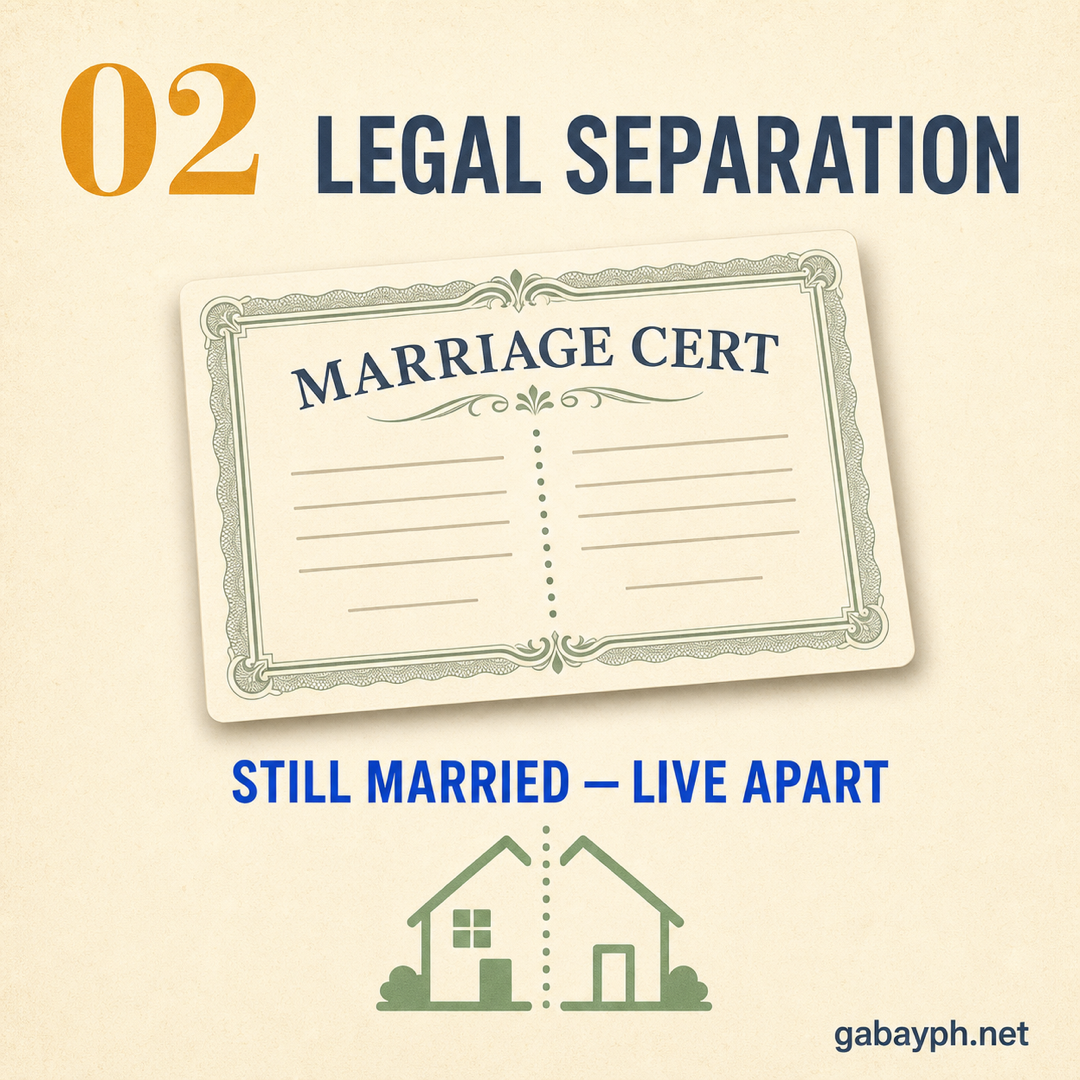
The marriage bond is NOT dissolved. You remain legally married and cannot remarry. What ends: the property relations (conjugal/absolute community) are dissolved and liquidated; spouses can live separately; custody and support are addressed by the court.
Hindi napuputol ang kasal. Kasal ka pa rin at hindi ka pwedeng mag-asawang muli. Ang natatapos: ang property relations (conjugal/absolute community) at pwede nang magkahiwalay na tirahan; hinahatulan ng korte ang custody at support.
Grounds (Art. 55)
Mga Dahilan (Art. 55)
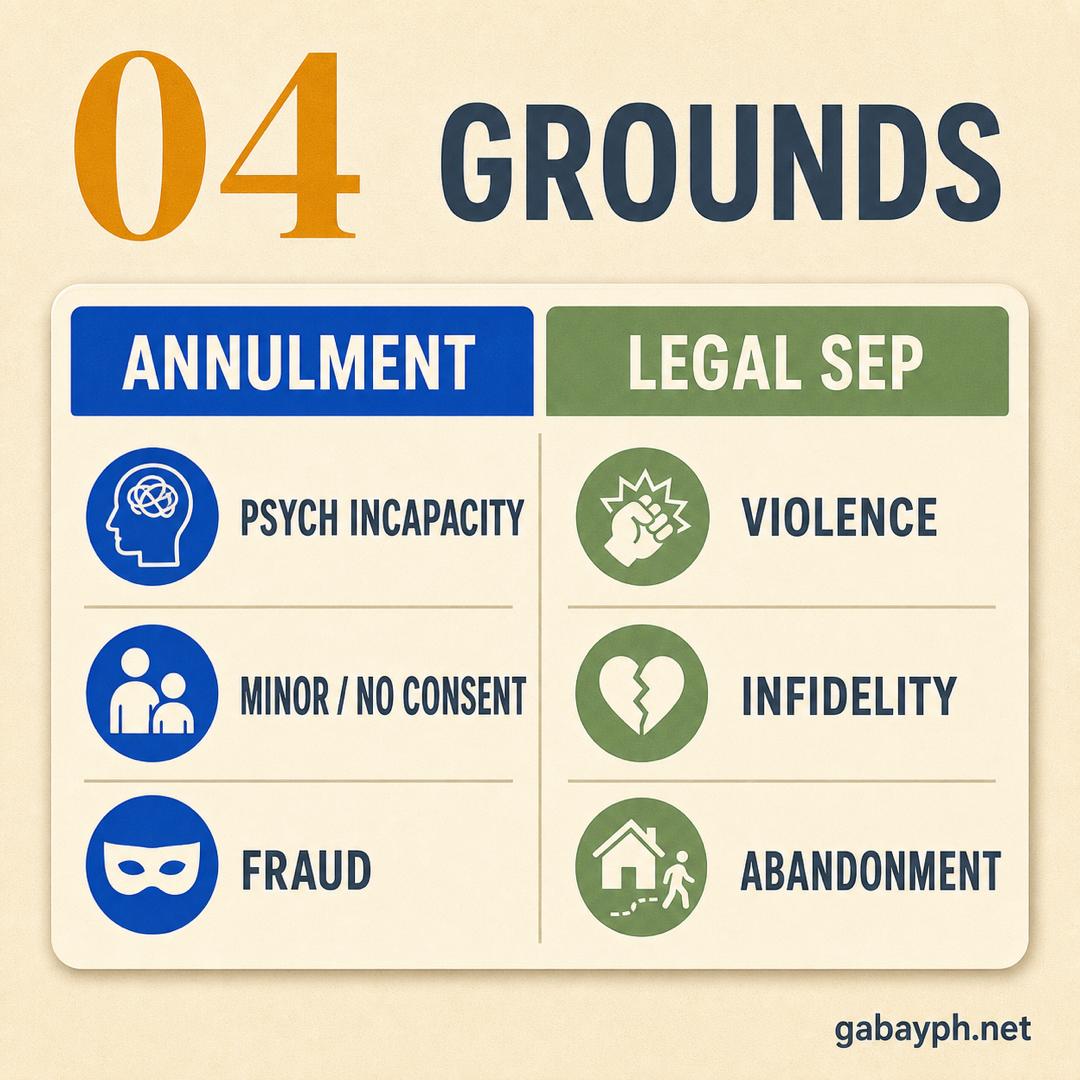
- Physical violence or grossly abusive conduct
- Physical violence o grossly abusive conduct
- Moral pressure to change religious or political affiliation
- Moral pressure para magbago ng relihiyon o pulitika
- Attempt to corrupt or induce to prostitution
- Pagtulak sa prostitusyon
- Conviction of a crime with imprisonment of more than 6 years
- Nahatulan sa krimen na higit sa 6 na taon
- Drug addiction or habitual alcoholism
- Drug addiction o habitual alcoholism
- Lesbianism or homosexuality (as written in Art. 55; application in practice is narrower and subject to ongoing legal debate)
- Lesbianism o homosexuality (ayon sa teksto ng Art. 55; mas makipot ang aktwal na aplikasyon at patuloy na legal debate)
- Contracting a bigamous marriage
- Pag-asawa nang dalawang beses (bigamous)
- Sexual infidelity or perversion
- Pangangaliwa o sexual perversion
- Attempt against the life of petitioner or a child
- Pagtatangkang pumatay sa kabiyak o anak
- Abandonment for more than 1 year without justifiable cause
- Pag-abandona nang higit sa 1 taon nang walang dahilan
Key procedural rules: 5-year prescriptive period from the occurrence of the ground. Mandatory 6-month cooling-off period (Art. 58) — courts cannot hear the case within 6 months of filing. Only the innocent spouse may file.
Mahahalagang rules: 5-year prescriptive period mula paglitaw ng ground. May 6-month cooling-off period (Art. 58) — hindi maaaring dinggin ng korte sa loob ng 6 buwan mula pag-file. Ang innocent spouse lang ang pwedeng mag-file.
Annulment (Art. 45) — Voidable Marriage
Annulment (Art. 45) — Voidable Marriage
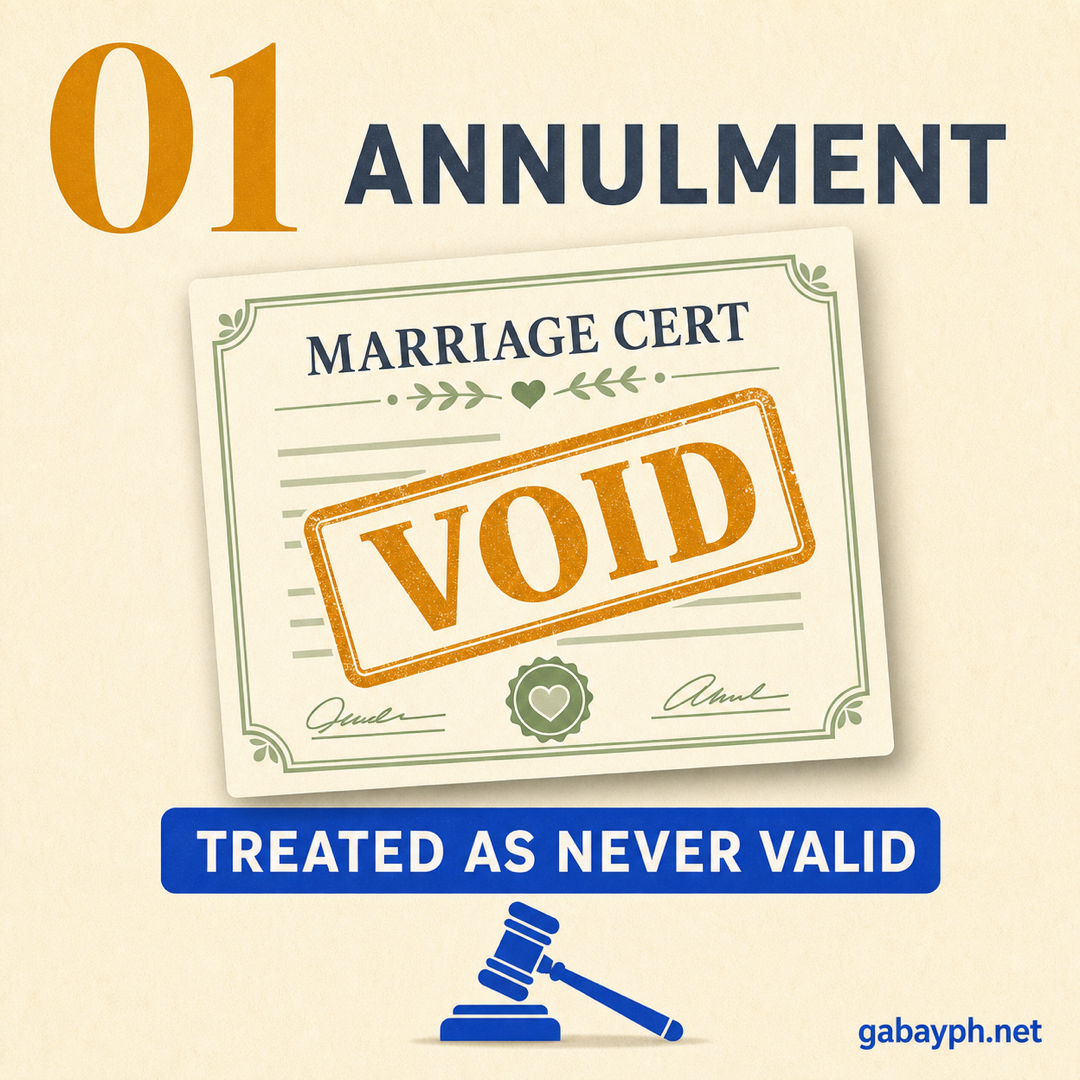
The marriage was valid when contracted but can be voided due to a defect that existed at the time of marriage. After the decree, both parties can remarry. Children remain legitimate.
Valid ang kasal nang ginawa pero pwedeng i-void dahil sa depekto na umiiral sa oras ng kasal. Matapos ng decree, pwedeng mag-asawa ang dalawa. Legitimate pa rin ang mga anak.
Grounds (All must pre-exist the marriage)
Mga Dahilan (Lahat dapat bago ng kasal)
- Lack of parental consent (party was 18-21 at time of marriage) — prescriptive: 5 years after reaching 21
- Walang parental consent (18-21 sa oras ng kasal) — prescriptive: 5 taon matapos mag-21
- Insanity of either party — filed by sane spouse anytime, or by insane party during lucid interval
- Insanity — pwedeng i-file ng sane spouse anumang oras, o ng insane party sa lucid interval
- Fraud (hiding an STD, drug addiction, homosexuality, pregnancy by another man) — 5 years from discovery of fraud
- Pandaraya (pagtatago ng STD, drug addiction, homosexuality, buntis na ng iba) — 5 taon mula pagkatuklas
- Force, intimidation, or undue influence — 5 years from cessation
- Puwersa, pang-iintimida, o undue influence — 5 taon mula tinigilan
- Incurable physical impotence — 5 years from marriage
- Incurable physical impotence — 5 taon mula kasal
- Serious and incurable STD — 5 years from marriage
- Serious at incurable STD — 5 taon mula kasal
In practice: annulment is less commonly used than nullity because grounds are narrow and prescriptive periods run quickly. Most cases filed as "annulment" are actually nullity under Art. 36.
Sa praktis: bihirang gamitin ang annulment kumpara sa nullity dahil makipot ang grounds at mabilis ang prescription. Karamihan ng sinasabing "annulment" ay nullity sa Art. 36.
Declaration of Nullity (Art. 35, 36, 37, 38) — Void Marriage
Declaration of Nullity (Art. 35, 36, 37, 38) — Void Marriage
The marriage was VOID from the start — as if it never legally existed. After the decree, parties can remarry. Children are preserved as legitimate only if psychological incapacity (Art. 36) is the ground; otherwise they may be illegitimate.
VOID ang kasal mula sa umpisa — parang walang kasal na nangyari. Matapos ng decree, pwede mag-asawa. Legitimate ang mga anak kung psychological incapacity (Art. 36) ang dahilan; kung ibang ground, maaaring illegitimate sila.
Grounds
Mga Dahilan
- Art. 35: party below 18 even with parental consent; no valid marriage license; solemnized by unauthorized person; bigamous; mistake as to identity; subsequent marriages void under Art. 53
- Art. 35: under 18 kahit may parental consent; walang valid marriage license; solemnized ng unauthorized; bigamous; mali sa identity
- Art. 36: Psychological Incapacity — most common ground filed (see next section)
- Art. 36: Psychological Incapacity — pinaka-ginagamit na ground (tingnan sa susunod)
- Art. 37: Incestuous marriages (ascending/descending line, brothers/sisters)
- Art. 37: Incestuous (magkapamilya)
- Art. 38: Void for public policy (step-parent/step-child, adopter/adopted, surviving spouse of adopter/adopted, etc.)
- Art. 38: Void for public policy (step-parent/step-child, adopter/adopted, atbp)
No prescriptive period for nullity — can be filed anytime.
Walang prescription sa nullity — pwedeng i-file anumang oras.
Psychological Incapacity (Art. 36) — Tan-Andal Doctrine
Psychological Incapacity (Art. 36) — Tan-Andal Doctrine
This is the most common ground in Filipino nullity cases. The controlling doctrine is Tan-Andal v. Andal, G.R. No. 196359 (May 11, 2021) — the Supreme Court en banc decision that significantly reshaped how these cases are proven.
Ito ang pinakaginagamit na ground sa mga nullity case ng mga Pilipino. Ang controlling doctrine ay Tan-Andal v. Andal, G.R. No. 196359 (May 11, 2021) — ang desisyon ng Korte Suprema en banc na nagbago ng paraan ng patunay.
Key Shifts from the Old Molina Guidelines
Mga Pagbabago mula sa Lumang Molina Guidelines
- Psychological incapacity is now a LEGAL concept, not a clinical/medical diagnosis. No DSM classification required.
- Ang psychological incapacity ay LEGAL concept, hindi medical diagnosis. Walang DSM classification na kailangan.
- Expert psychiatric testimony is NOT mandatory. Courts can rely on lay witnesses, behavior patterns, and totality of evidence.
- Hindi kinakailangan ang expert psychiatric testimony. Puwedeng umasa sa lay witnesses, behavior patterns, at totality of evidence.
- Incurability is legal (permanent relative to the specific marriage), not medical — no need to prove permanent mental illness.
- Legal ang incurability (permanent relative sa specific marriage), hindi medical — hindi kailangan patunayan ang permanent mental illness.
- Antecedence still required (must exist before marriage) but may be inferred from behavior patterns.
- Kailangan pa rin ang antecedence (umiiral bago ng kasal) pero pwedeng i-infer sa behavior patterns.
- Standard of proof: clear and convincing evidence (higher than preponderance, lower than beyond reasonable doubt).
- Standard ng proof: clear and convincing evidence.
Typical grounds proven under Art. 36: chronic irresponsibility, pathological lying, abandonment, drug dependency, extreme emotional immaturity, inability to support family.
Karaniwang grounds sa Art. 36: chronic irresponsibility, pathological lying, pag-abandona, drug dependency, extreme emotional immaturity, hindi kayang suportahan ang pamilya.
Practical effect of Tan-Andal: cases are now less dependent on expensive psychiatric experts. Many practicing lawyers still advise getting a psychological evaluation for evidentiary weight (₱25K-₱60K) — but it's no longer mandatory.
Epekto ng Tan-Andal: nabawasan ang dependence sa mahal na psychiatric experts. Maraming abogado pa rin ang nagrerekomenda ng psychological evaluation para sa evidentiary weight (₱25K-₱60K) — pero hindi na mandatory.
Recognition of Foreign Divorce
Recognition of Foreign Divorce
If you or your foreign spouse obtained a valid divorce abroad, you can file a Petition for Recognition of Foreign Divorce in the Philippine RTC. The basis is Republic v. Manalo, G.R. No. 221029 (April 24, 2018), which expanded Article 26(2) of the Family Code.
Kung ikaw o ang foreign spouse mo ay may valid divorce abroad, puwedeng mag-file ng Petition for Recognition of Foreign Divorce sa Philippine RTC. Ang basehan ay Republic v. Manalo, G.R. No. 221029 (April 24, 2018), na nagpalawak sa Article 26(2) ng Family Code.
Key rule from Manalo: It doesn't matter which spouse initiated the foreign divorce — the Filipino spouse benefits in either case.
Mahalagang rule sa Manalo: Kahit sinuman sa dalawa ang nag-initiate ng foreign divorce — nakikinabang ang Filipino spouse.
Proof required: foreign divorce decree must be authenticated per Rules of Evidence (Rule 132, Secs. 24-25) — typically an apostille or authentication by the Philippine Embassy/Consulate where divorce was obtained.
Proof: authenticated ang foreign divorce decree (Rule 132, Secs. 24-25) — karaniwang apostille o authentication ng Philippine Embassy/Consulate.
Cost: typically ₱50,000-₱150,000 total — significantly cheaper than annulment because no psychiatric evaluation is needed and the process is shorter (typically 1-2 years).
Halaga: karaniwang ₱50,000-₱150,000 — mas mura kaysa annulment dahil walang psychiatric evaluation at mas maikli (1-2 taon).
Step-by-Step Process (Annulment / Nullity)
Proseso (Hakbang-Hakbang)
-
Consult a Licensed Attorney
Preparation phase: 1-3 months. You will need to gather documents (PSA marriage cert, PSA birth certs of children, proof of grounds, financial records, witness statements), identify the correct ground, and retain counsel. Acceptance fee: ₱50,000-₱150,000 typically.
-
Draft and File Petition at RTC
File at the Regional Trial Court of the province or city where the petitioner has resided for at least 6 months. Filing fees: ₱4,000-₱15,000 depending on the court's schedule. Wrong venue filing = dismissal and forced re-filing.
-
Summons Served on Respondent
Respondent has 15 days to file an Answer. If respondent cannot be located, substituted service (via publication) may be used.
-
Collusion Investigation by Public Prosecutor
The fiscal (prosecutor) conducts a collusion investigation — checks that the case is real, not fabricated, and that both parties are not colluding to "fake" a ground. This takes 1-2 months and is critical. If collusion is found, the case is derailed.
-
Pre-Trial Conference
Parties and counsel meet with the judge. Issues are narrowed, exhibits marked, witnesses listed. A final attempt at reconciliation is made.
-
Trial
Petitioner presents witnesses and evidence. Respondent may counter-present. For Art. 36 cases: lay witnesses plus optionally a psychologist. Trial runs 6-18 months depending on court docket.
-
Decision, Appeal Period, Entry of Judgment
Judge rules. 15-day appeal window begins. The Office of the Solicitor General (OSG) often appeals to protect the marriage — adding 1-2+ years if it goes to the Court of Appeals. Once appeal period lapses or is resolved, Entry of Judgment is issued.
-
Registration and PSA Annotation
The court clerk transmits the decree to the Local Civil Registrar (LCR) where the marriage was registered. LCR transmits to PSA. PSA annotates the marriage certificate and the birth certificates of children. Order the annotated PSA certificate via PSA Serbilis after ~3-6 months.
Do not remarry until the PSA annotated certificate is in hand — otherwise you risk bigamy charges even with the court decree.
-
Kumonsulta sa Lisensyadong Abogado
Preparation: 1-3 buwan. Tipunin ang dokumento (PSA marriage cert, PSA birth certs ng mga anak, proof ng grounds, financial records, witness statements), tukuyin ang tamang ground, at kumuha ng abogado. Acceptance fee: ₱50,000-₱150,000 karaniwan.
-
Mag-draft at Mag-file ng Petition sa RTC
File sa Regional Trial Court ng probinsya o siyudad kung saan nanirahan ang petitioner nang hindi bababa sa 6 na buwan. Filing fees: ₱4,000-₱15,000. Maling venue = dismissal, kailangang i-file ulit.
-
Summons sa Respondent
May 15 araw ang respondent para mag-Answer. Kung hindi mahanap, pwede ang substituted service (via publication).
-
Collusion Investigation ng Fiscal
Cine-check ng fiscal na totoo ang kaso, hindi fabricated, at hindi kasabwat ang dalawa para mag-"fake" ng ground. 1-2 buwan. Kung may collusion, babagsak ang kaso.
-
Pre-Trial Conference
Nagkikita ang parties, counsel, at hukom. Pineplano ang issues, marked ang exhibits, listahan ng witnesses. May final reconciliation attempt.
-
Trial
Pinapakita ng petitioner ang mga witness at ebidensya. Pwedeng tumugon ang respondent. Para sa Art. 36: lay witnesses plus optional psychologist. Tagal: 6-18 buwan depende sa court docket.
-
Desisyon, Appeal Period, Entry of Judgment
Nagbaba ng hatol ang hukom. 15-day appeal window. Madalas mag-appeal ang OSG (Office of the Solicitor General) para ipagtanggol ang kasal — dagdag 1-2+ na taon sa Court of Appeals. Pag lumipas o nare-resolve ang appeal, nagla-labas ng Entry of Judgment.
-
Pagpaparehistro at PSA Annotation
Ipapasa ng court clerk ang decree sa Local Civil Registrar (LCR) ng kasal. Mula LCR papunta sa PSA. I-a-annotate ng PSA ang marriage certificate at birth certificates ng mga anak. Order ng annotated PSA certificate ~3-6 buwan matapos.
Huwag mag-asawang muli bago makuha ang annotated PSA certificate — maaari kang pagbintangan ng bigamy kahit may court decree.
Cost Breakdown (2026 Realistic Ranges)
Gastos (2026 Realistic)
| ItemGastusin | LowMura | HighMahal |
|---|---|---|
| Attorney acceptance feeAttorney acceptance fee | ₱50,000 | ₱150,000 |
| Appearance fees (per hearing)Appearance fees (per hearing) | ₱5,000 | ₱10,000 |
| Attorney milestone fees (filing, pre-trial, decree)Attorney milestone fees (filing, pre-trial, decree) | ₱50,000 | ₱200,000 |
| Court filing/docket feeCourt filing/docket fee | ₱4,000 | ₱15,000 |
| Psychiatric evaluation (per spouse)Psychiatric evaluation (per asawa) | ₱25,000 | ₱60,000 |
| Expert testimony (per appearance)Expert testimony (per appearance) | ₱10,000 | ₱20,000 |
| Publication (if needed)Publication (kung kailangan) | ₱5,000 | ₱15,000 |
| Miscellaneous (transcripts, notary, travel)Iba pang gastos | ₱10,000 | ₱30,000 |
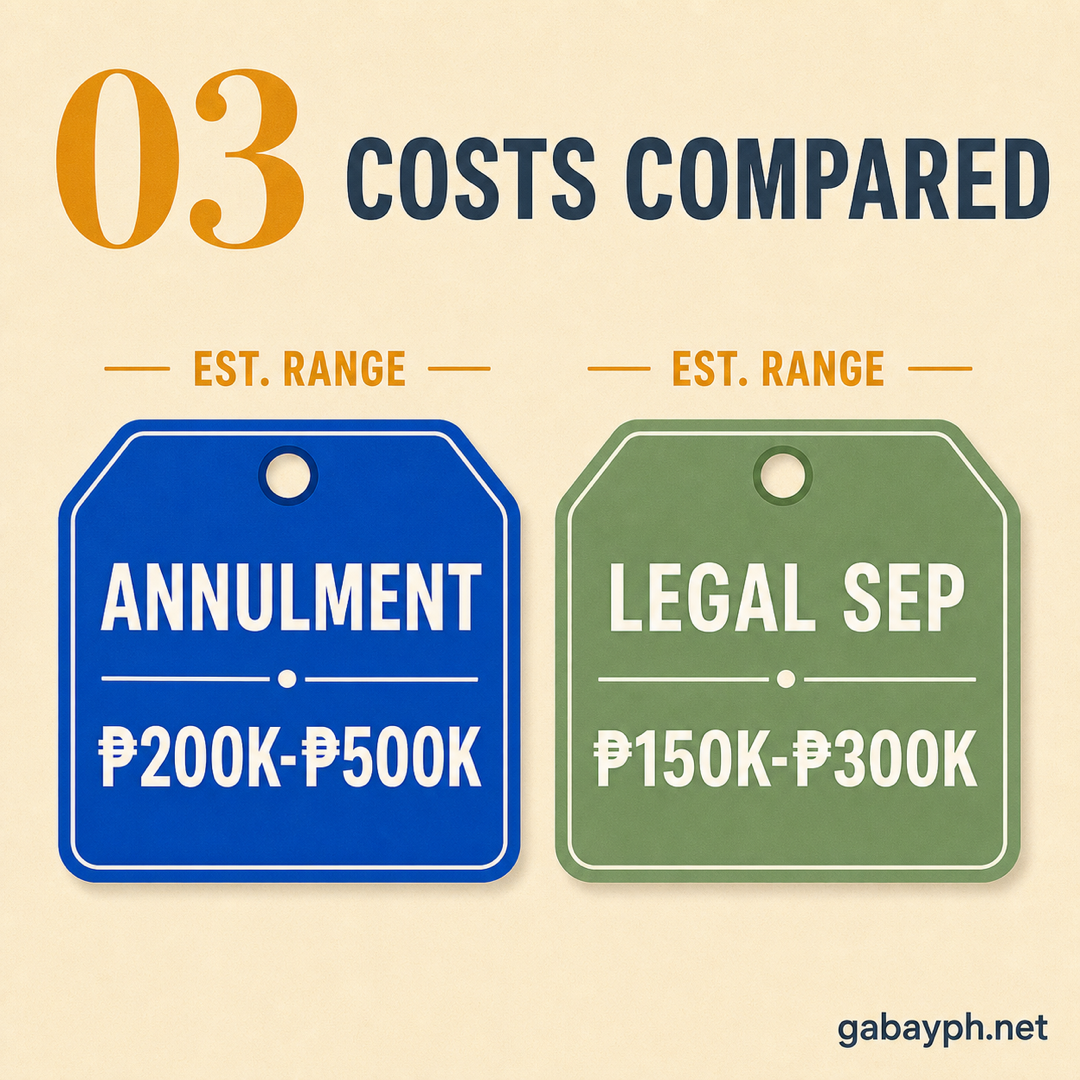
| TOTAL (simple, uncontested)KABUUAN (simple, hindi contested) | ₱200,000 | ₱300,000 |
| TOTAL (average case)KABUUAN (karaniwan) | ₱300,000 | ₱500,000 |
| TOTAL (complex/contested)KABUUAN (complex o may away) | ₱500,000 | ₱1,000,000+ |
Cheaper alternatives: Recognition of Foreign Divorce ₱50K-₱150K (if valid foreign divorce exists). Church annulment (Canon Law) ₱40K-₱100K — but has NO civil legal effect.
Mas murang alternatibo: Recognition of Foreign Divorce ₱50K-₱150K (kung may valid foreign divorce). Church annulment ₱40K-₱100K — pero WALANG civil legal effect.
After the Decree
Pagkatapos ng Decree
- Secure the annotated PSA marriage certificate — takes 3-6 months after court registration. Order via PSA Serbilis.
- Kunin ang annotated PSA marriage certificate — 3-6 buwan matapos ng court registration. Order sa PSA Serbilis.
- Property: conjugal/absolute community is dissolved; each party entitled to their share per Family Code and court decision.
- Property: nawawala ang conjugal/absolute community; may hati ayon sa Family Code at hatol ng korte.
- Custody & child support: court decides. Support obligations continue regardless of nullity status.
- Custody at child support: hinahatulan ng korte. Nagpapatuloy ang support regardless of nullity.
- Children's legitimacy: generally preserved under Art. 54 for good faith parties; check your specific decree.
- Pagka-legitimate ng anak: karaniwang preserved sa Art. 54 para sa good faith parties; tingnan ang decree.
- Remarriage: allowed after annulment or declaration of nullity — NOT after legal separation. Wait for PSA annotated certificate before remarrying.
- Pag-aasawang muli: pwede matapos ng annulment o declaration of nullity — HINDI pwede sa legal separation. Hintaying makuha ang annotated PSA bago mag-asawa.
Church (Canonical) Annulment
Church (Canonical) Annulment
Processed through the Diocesan Tribunal, not civil courts. Canonical annulment is separate from civil annulment and does NOT allow civil remarriage in the Philippines. Some Catholic couples pursue both civil and canonical annulment in parallel. Church annulment costs ₱40,000-₱100,000 typically; timeline 12-24 months. Paupers can request reduced or waived stipends under Canon 1649.
Pinoproseso sa Diocesan Tribunal, hindi civil court. Hiwalay ang canonical annulment sa civil at HINDI pinapayagang mag-asawang muli sa Pilipinas. May mga Katolikong mag-asawa na tinutugunan ang dalawa nang sabay. ₱40,000-₱100,000 ang gastos; 12-24 buwan. Pwede pong mag-request ng reduced o waived stipend ang paupers sa Canon 1649.
Absolute Divorce Bill Status (as of April 2026)
Absolute Divorce Bill Status (Abril 2026)
As of April 25, 2026, absolute divorce is NOT law in the Philippines.
Timeline: The 19th Congress House approved HB 9349 on May 22, 2024 (131-109-20), but the Senate declined to act on it and the bill died at the end of the 19th Congress in June 2025. Multiple new bills have been filed in the 20th Congress (HB 108, HB 210, others) but as of early 2026, no Senate action. CBCP (Catholic Bishops' Conference) opposition and Senate leadership hesitation remain the binding constraints.
The Philippines remains one of only two countries in the world without absolute divorce (the other being Vatican City). Until and unless a bill is signed into law, the only options are the three described in this guide: legal separation, annulment, or declaration of nullity — plus recognition of foreign divorce when applicable.
Sa April 25, 2026, HINDI PA batas ang absolute divorce sa Pilipinas.
Timeline: Inaprubahan ng 19th Congress House ang HB 9349 noong May 22, 2024 (131-109-20), pero hindi kinilos ng Senate at namatay ang bill sa katapusan ng 19th Congress noong June 2025. May mga bagong bill sa 20th Congress (HB 108, HB 210, iba pa) pero wala pang Senate action hanggang early 2026. Ang oposisyon ng CBCP at alinlangan ng Senate leadership ang pumipigil.
Isa pa rin ang Pilipinas sa dalawang bansa sa mundo na walang absolute divorce (kasama ng Vatican City). Hanggang hindi napipirmahan ang bill, ang tatlong options sa gabay na ito ang available — plus recognition of foreign divorce kung applicable.
Pro Tips
Mga Payo
- Most "annulment" cases are actually declaration of nullity. Use the right term with your lawyer — nullity under Art. 36 (psych incapacity) is what most people actually need, not annulment under Art. 45.
- Karamihan ng sinasabing "annulment" ay declaration of nullity. Gamitin ang tamang termino sa abogado — Art. 36 (psych incapacity) nullity ang kailangan ng marami, hindi Art. 45 annulment.
- If your foreign spouse already divorced you abroad, don't file annulment. File a Petition for Recognition of Foreign Divorce instead — ₱50K-₱150K vs ₱300K+, and 1-2 years vs 2-5 years. Massive savings.
- Kung may foreign divorce na ang foreign spouse mo, huwag mag-annulment. Mag-file ng Petition for Recognition of Foreign Divorce — ₱50K-₱150K kumpara ₱300K+, at 1-2 taon kumpara 2-5 taon.
- The 6-month cooling-off period for legal separation is strictly enforced. Courts don't schedule trial dates within the first 6 months of filing. If you want faster action, legal separation is not the path.
- Mahigpit ang 6-month cooling-off period sa legal separation. Hindi nagsi-schedule ng trial ang korte sa loob ng unang 6 buwan. Kung gusto mo ng mabilisan, hindi legal separation ang dapat.
- Don't skip psychiatric evaluation for contested Art. 36 cases. Tan-Andal removed the REQUIREMENT, but experts still strengthen the "totality of evidence." For uncontested cases, lay witnesses can suffice.
- Huwag laktawan ang psychiatric evaluation sa contested Art. 36. Inalis ng Tan-Andal ang REQUIREMENT, pero pinapatibay pa rin ng experts ang "totality of evidence." Sa uncontested, sapat na ang lay witnesses.
- Pay attention to venue. File in the RTC where petitioner has resided for at least 6 months. Wrong venue = case dismissed, forcing re-filing with the fees paid again.
- Tamang venue. File sa RTC kung saan nanirahan ang petitioner nang hindi bababa sa 6 buwan. Maling venue = dismissed, kailangang i-file ulit at bayaran ulit ang fees.
- Don't remarry before the PSA annotation is complete. The court decree is not sufficient documentation. PSA annotation takes 3-6 months after finality. Remarrying in this gap exposes you to bigamy charges.
- Huwag mag-asawang muli hanggang wala pa ang PSA annotation. Hindi sapat ang court decree lang. 3-6 buwan matapos ng finality ang PSA annotation. Kung mag-asawa ka sa gap na ito, maaaring pagbintangan ka ng bigamy.
- Church annulment alone does not allow civil remarriage. It is a separate canonical matter with no effect on Philippine civil law. Don't let a canonical decree give you a false sense of freedom to remarry.
- Hindi sapat ang church annulment para mag-asawang muli sa civil. Hiwalay ang canonical at walang epekto sa civil law ng Pilipinas. Huwag magpadala sa canonical decree.
Frequently Asked Questions
Mga Madalas Itanong
Can I get an annulment if my spouse and I have been separated for 10 years?
Not automatically — length of separation is not a ground. You'll need one of the Art. 45 (annulment) or Art. 36 (nullity via psychological incapacity) grounds. Long separation alone doesn't qualify. However, abandonment for over 1 year IS a ground for legal separation.
Pwede bang mag-annulment kung 10 taon na kaming hiwalay?
Hindi automatic — hindi ground ang tagal ng paghihiwalay. Kailangan ng Art. 45 (annulment) o Art. 36 (nullity via psych incapacity) ground. Hindi sapat na matagal nang hiwalay. Pero ang pag-abandona nang higit sa 1 taon AY ground para sa legal separation.
My spouse and I never got a marriage license — are we even married?
A marriage without a valid license is VOID under Article 35 of the Family Code. You can file a declaration of nullity to formalize this. Since the marriage was void from the start, you can remarry after the court decree and PSA annotation. Process is faster than Art. 36 nullity.
Hindi kami nag-kuha ng marriage license — kasal ba talaga kami?
Ang kasal na walang valid license ay VOID sa ilalim ng Article 35. Pwede kang mag-file ng declaration of nullity para i-formalize. Dahil void mula umpisa, pwede kang mag-asawang muli matapos ng decree at PSA annotation. Mas mabilis kaysa Art. 36 nullity.
Can I file annulment without my spouse's consent?
Yes. You file as petitioner and the court summons your spouse as respondent. If respondent refuses to cooperate, the case can still proceed — default judgment is possible. However, an uncooperative respondent extends the timeline and can appeal.
Pwede bang mag-file ng annulment nang walang consent ng asawa?
Oo. Ikaw ang magfa-file bilang petitioner at ipapadala ng korte ang summons sa respondent. Kahit hindi makipagtulungan, tumutuloy ang kaso — maaaring default judgment. Pero ang hindi tumutulong na respondent ay nagpapatagal at pwedeng mag-appeal.
Is "church annulment" enough to get married again?
No. A canonical (church) annulment has no effect on Philippine civil law. You cannot remarry civilly based on a church annulment alone. The PSA will not annotate your marriage certificate without a civil court decree.
Sapat ba ang "church annulment" para mag-asawang muli?
Hindi. Walang epekto sa Philippine civil law ang canonical (church) annulment. Hindi ka pwedeng mag-asawang muli sa civil batay lang sa church annulment. Hindi mag-a-annotate ang PSA ng marriage certificate kung walang civil court decree.
How long does an annulment case really take?
2-5 years for uncontested cases. Contested cases with OSG appeal or multiple witnesses can take 5-10 years. The timeline depends heavily on court docket, OSG posture, and whether the respondent contests or cooperates.
Gaano katagal talaga ang annulment case?
2-5 taon sa uncontested. Kung contested at may OSG appeal o maraming witness, 5-10 taon. Depende sa court docket, OSG posture, at kung tumutugon o nakikipagtulungan ang respondent.
Are common-law partners required to file annulment?
No. If you were never legally married (no ceremony, no marriage license), you have no marriage to annul. Child support, property, and custody issues are governed by different rules (Family Code provisions on support, RA 9255 for voluntary recognition, etc.).
Kailangan bang mag-annulment ang common-law partners?
Hindi. Kung hindi kayo legal na kasal (walang seremonya, walang marriage license), walang kasal na i-a-annul. Ang child support, property, at custody ay may ibang rules (Family Code, RA 9255 para sa voluntary recognition, atbp).