

How to Invest in Mutual Funds and UITFs in the Philippines (2026 Guide)
Paano Mag-invest sa Mutual Funds at UITFs sa Pilipinas (2026 Gabay)

5 Things to Know
Mutual funds in five facts.
Quick Summary
Mabilis na Buod
Important Disclaimer
This guide is for educational purposes only and does not constitute investment advice. GabayPH is not a licensed financial advisor, broker, or fund manager. Mutual fund and UITF investments are not deposit accounts and are not guaranteed by the PDIC. Past performance does not guarantee future results. All investments carry risk, including the possible loss of principal. Consult a licensed financial advisor before making investment decisions. GabayPH has no paid relationship with any fund manager, bank, or platform mentioned in this guide.
Mahalagang Disclaimer
Ang gabay na ito ay para sa layuning pang-edukasyon lamang at hindi bumubuo ng investment advice. Ang GabayPH ay hindi isang lisensyadong financial advisor, broker, o fund manager. Ang mutual fund at UITF investments ay hindi deposit accounts at hindi ginagarantiyahan ng PDIC. Ang nakaraang performance ay hindi ginagarantiyahan ang hinaharap na resulta. Lahat ng investments ay may panganib, kasama ang posibleng pagkawala ng principal. Kumonsulta sa isang lisensyadong financial advisor bago gumawa ng investment decisions. Walang bayad na relasyon ang GabayPH sa kahit anong fund manager, bangko, o platform na binanggit sa gabay na ito.
Table of Contents
Talaan ng Nilalaman
- Ano ang Mutual Funds at UITFs?
- Mutual Funds vs UITFs vs Stocks
- Mga Uri ng Funds
- Paano Pumili ng Fund
- Mga Nangungunang Fund Manager sa Pilipinas
- Mga Kakailanganin Mo
- Hakbang-Hakbang: Paano Magsimulang Mag-invest
- Pag-unawa sa mga Bayarin
- Mga Implikasyon sa Buwis
- Pag-IBIG MP2 Bilang Alternatibo
- Mga Payo
- Mga Madalas Itanong
What Are Mutual Funds & UITFs?
Ano ang Mutual Funds at UITFs?
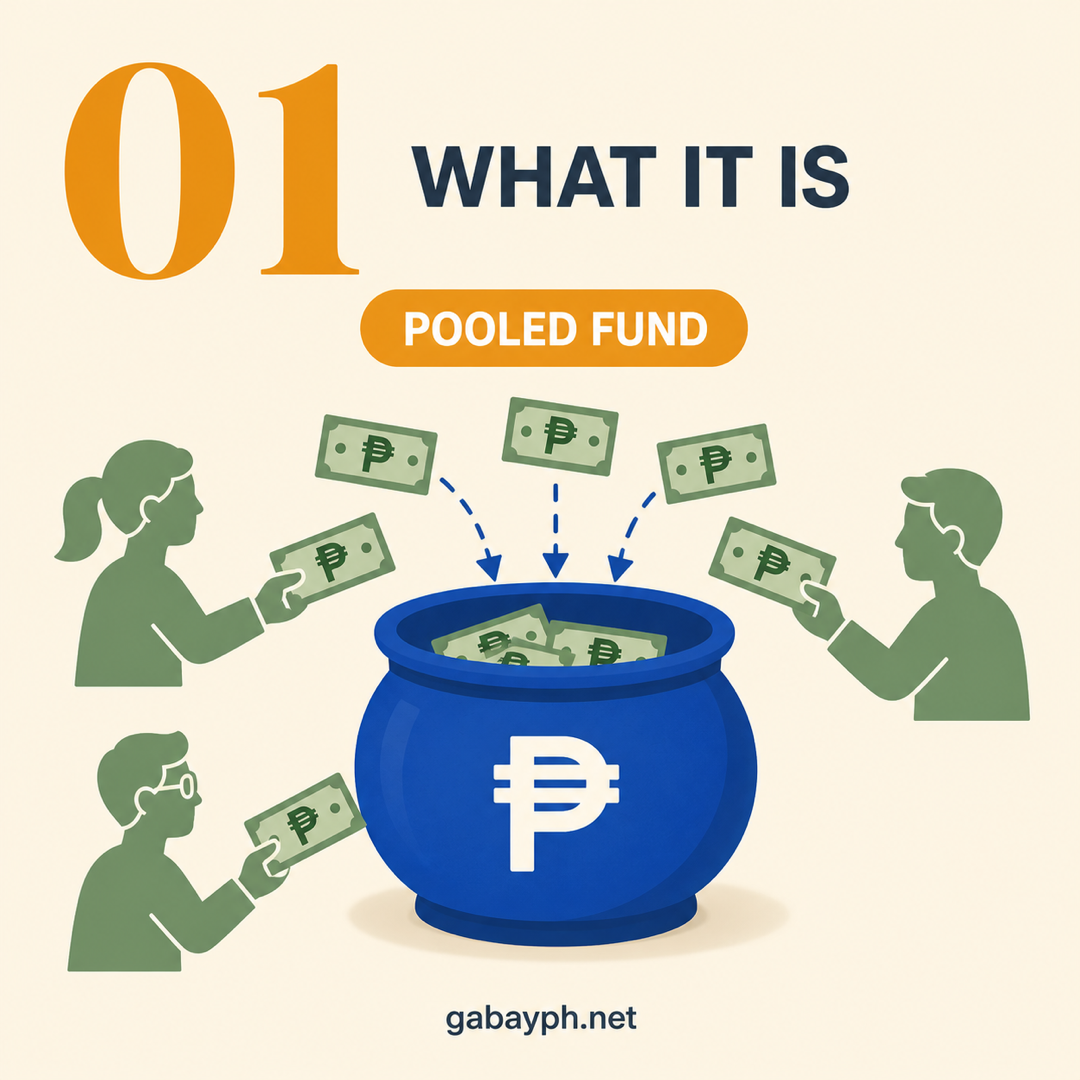
Both are pooled investment products — your money is combined with thousands of other investors and managed by a professional fund manager. Mutual funds are SEC-regulated and offered by investment companies (Sun Life, ATRAM, Philam). UITFs are BSP-regulated and offered by banks (BDO, BPI, Metrobank). Both offer professional management, instant diversification, and low minimums (₱1,000-₱5,000) — perfect for hands-off investors.
Pareho silang pooled investment products — pinagsasama ang pera mo kasama ng libo-libong investors at pinapamahalaan ng professional fund manager. Ang mutual funds ay SEC-regulated at ino-offer ng investment companies (Sun Life, ATRAM, Philam). Ang UITFs ay BSP-regulated at ino-offer ng mga bangko (BDO, BPI, Metrobank). Parehong may professional management, instant diversification, at mababang minimum (₱1,000-₱5,000) — perpekto para sa hands-off investors.
Mutual Funds vs UITFs vs Stocks
Mutual Funds vs UITFs vs Stocks
Hindi lahat ng investment product ay magkapareho. Here's a side-by-side comparison to help you decide which one fits your needs:
| Feature | Mutual Funds | UITFs | Stocks |
|---|---|---|---|
| Regulator | SEC | BSP | SEC / PSE |
| Offered by | Investment companies (Sun Life, ATRAM, Philam) | Banks (BDO, BPI, Metrobank) | Stockbrokers (COL, BPI Trade) |
| Minimum | ₱1,000 - ₱5,000 | ₱1,000 - ₱10,000 | ₱1,000 - ₱5,000 |
| Risk Level | Low to High (depends on fund type) | Low to High (depends on fund type) | High |
| Management | Professional fund manager | Professional fund manager | Self-managed (ikaw ang pipili) |
| Liquidity | Redeem in 3-7 business days | Redeem in 1-3 business days | Sell anytime during market hours (T+2 settlement) |
| Effort Required | Low (passive) | Low (passive) | High (active research needed) |
| Best For | Beginners, busy professionals | Beginners, existing bank customers | Experienced, hands-on investors |
Bottom line: If you want a hands-off investment where professionals manage your money, go with mutual funds or UITFs. If you want full control and are willing to learn, try stocks. Many investors actually use all three as part of a diversified strategy.
Hindi lahat ng investment product ay magkapareho. Narito ang side-by-side comparison para matulungan kang magdesisyon kung alin ang akma sa mga pangangailangan mo:
| Feature | Mutual Funds | UITFs | Stocks |
|---|---|---|---|
| Regulator | SEC | BSP | SEC / PSE |
| Ino-offer ng | Investment companies (Sun Life, ATRAM, Philam) | Mga bangko (BDO, BPI, Metrobank) | Mga stockbroker (COL, BPI Trade) |
| Minimum | ₱1,000 - ₱5,000 | ₱1,000 - ₱10,000 | ₱1,000 - ₱5,000 |
| Antas ng Panganib | Mababa hanggang Mataas (depende sa uri ng fund) | Mababa hanggang Mataas (depende sa uri ng fund) | Mataas |
| Pamamahala | Professional fund manager | Professional fund manager | Sarili mo (ikaw ang pipili) |
| Liquidity | Redeem sa 3-7 business days | Redeem sa 1-3 business days | Ibenta anytime sa market hours (T+2 settlement) |
| Effort na Kailangan | Mababa (passive) | Mababa (passive) | Mataas (kailangan ng active research) |
| Pinakaakma Para sa | Mga baguhan, busy professionals | Mga baguhan, existing bank customers | Mga may-karanasan, hands-on investors |
Sa madaling salita: Kung gusto mo ng hands-off investment na pinapamahalaan ng mga propesyonal ang pera mo, pumili ng mutual funds o UITFs. Kung gusto mo ng full control at handang matuto, subukan ang stocks. Maraming investors ang gumagamit ng tatlong ito bilang bahagi ng diversified strategy.
Types of Funds
Mga Uri ng Funds
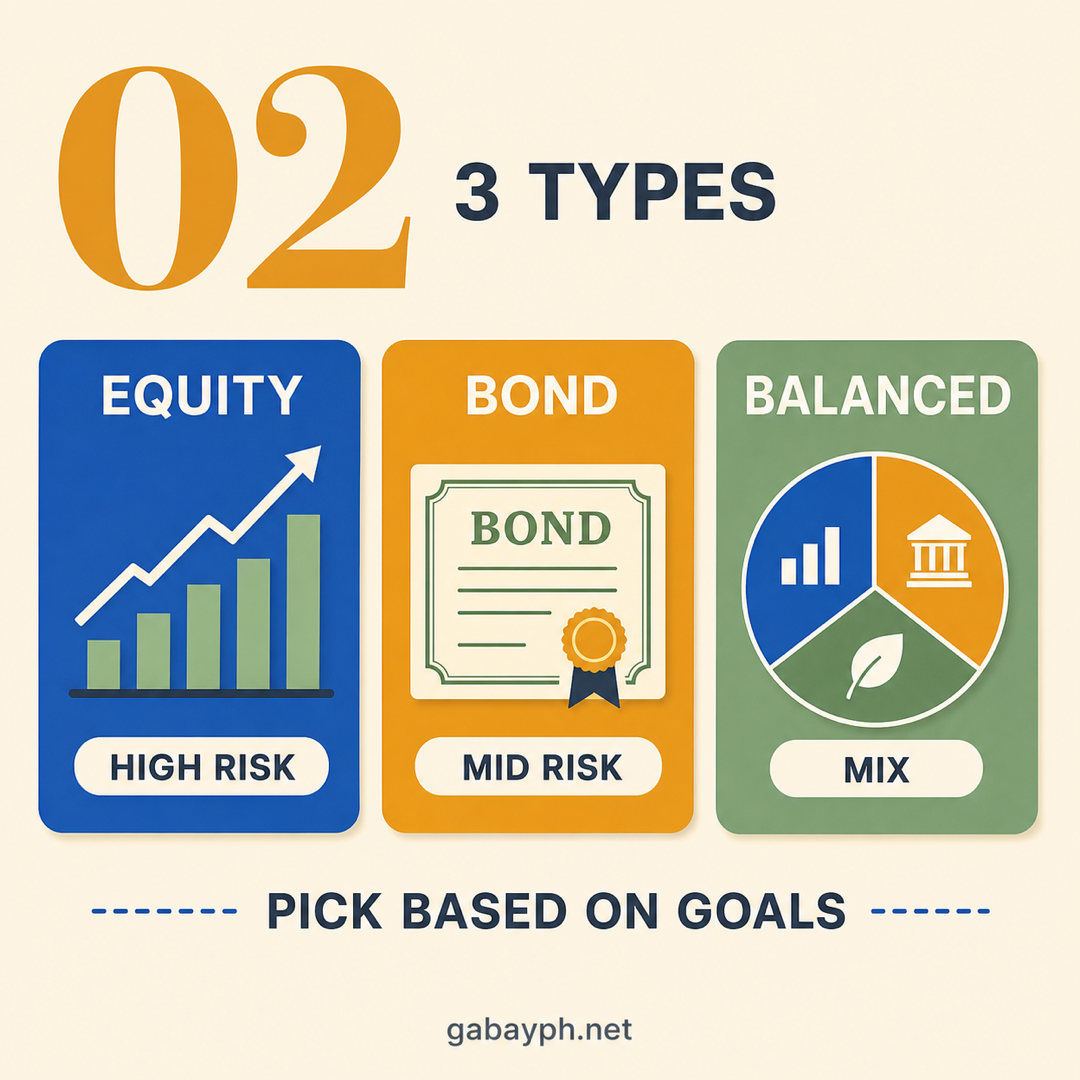
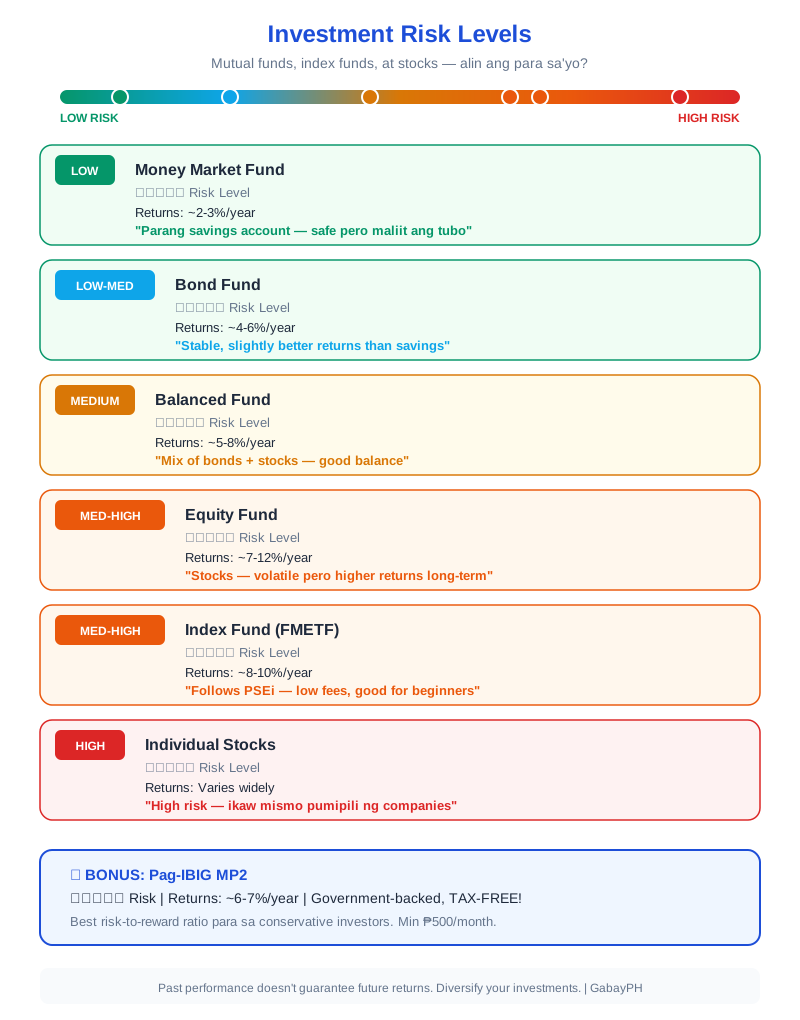
Both mutual funds and UITFs come in several categories depending on where the fund invests your money. Understanding these types is key to choosing the right fund for your risk appetite and time horizon.
1. Money Market Funds
- Risk: Very Low
- Expected return: 2-4% per year
- Invests in: Short-term government securities (Treasury bills), bank deposits, commercial papers
- Best for: Parking emergency funds, short-term savings (less than 1 year), very conservative investors
- Think of it as: A savings account na may konting mas mataas na interest
2. Bond Funds
- Risk: Low to Moderate
- Expected return: 4-6% per year
- Invests in: Government bonds (Treasury bonds, RTBs), corporate bonds
- Best for: Medium-term goals (1-3 years), conservative to moderate investors who want steady income
- Think of it as: Lending money to the government or big companies na may regular interest payments
3. Balanced Funds
- Risk: Moderate
- Expected return: 5-8% per year
- Invests in: A mix of stocks and bonds (typically 50-60% stocks, 40-50% bonds)
- Best for: Medium to long-term goals (3-5 years), investors who want growth but with some cushion against volatility
- Think of it as: The "goldilocks" option — not too aggressive, not too conservative
4. Equity Funds
- Risk: High
- Expected return: 7-12% per year (long-term average, with significant year-to-year variation)
- Invests in: Primarily Philippine stocks (blue chips, growth companies)
- Best for: Long-term goals (5+ years), investors with high risk tolerance who can stomach market ups and downs
- Think of it as: Hiring a professional to pick stocks for you
5. Index Funds
- Risk: High (same as equity funds)
- Expected return: 7-10% per year (mirrors the PSEi)
- Invests in: All 30 companies in the PSE Index, automatically matching the market
- Best for: Long-term investors who believe the overall market will grow, and who want the lowest fees
- Think of it as: Betting on the Philippine economy as a whole rather than individual companies
General rule: The longer your investment horizon, the more risk you can afford to take. If you need the money in less than a year, stick with money market funds. If you won't touch the money for 5+ years, equity or index funds are your best bet for growth.
Ang mutual funds at UITFs ay may iba't ibang kategorya depende sa kung saan ini-invest ng fund ang pera mo. Ang pag-unawa sa mga uri na ito ang susi sa pagpili ng tamang fund para sa risk appetite at time horizon mo.
1. Money Market Funds
- Panganib: Napakababa
- Inaasahang kita: 2-4% kada taon
- Ini-invest sa: Short-term government securities (Treasury bills), bank deposits, commercial papers
- Pinakaakma para sa: Pag-park ng emergency funds, short-term savings (mas mababa sa 1 taon), napaka-conservative na investors
- Isipin mo na parang: Savings account na may konting mas mataas na interest
2. Bond Funds
- Panganib: Mababa hanggang Katamtaman
- Inaasahang kita: 4-6% kada taon
- Ini-invest sa: Government bonds (Treasury bonds, RTBs), corporate bonds
- Pinakaakma para sa: Medium-term goals (1-3 taon), conservative hanggang moderate investors na gusto ng steady income
- Isipin mo na parang: Pagpapahiram ng pera sa gobyerno o malalaking kumpanya na may regular na interest payments
3. Balanced Funds
- Panganib: Katamtaman
- Inaasahang kita: 5-8% kada taon
- Ini-invest sa: Halo-halong stocks at bonds (karaniwan 50-60% stocks, 40-50% bonds)
- Pinakaakma para sa: Medium hanggang long-term goals (3-5 taon), investors na gusto ng growth pero may konting cushion laban sa volatility
- Isipin mo na parang: Ang "goldilocks" option — hindi masyadong aggressive, hindi rin masyadong conservative
4. Equity Funds
- Panganib: Mataas
- Inaasahang kita: 7-12% kada taon (long-term average, may malaking variation taun-taon)
- Ini-invest sa: Pangunahing Philippine stocks (blue chips, growth companies)
- Pinakaakma para sa: Long-term goals (5+ taon), investors na may mataas na risk tolerance na kayang tiisin ang pag-ahon at pagbaba ng market
- Isipin mo na parang: Pag-hire ng professional para pumili ng stocks para sa iyo
5. Index Funds
- Panganib: Mataas (katulad ng equity funds)
- Inaasahang kita: 7-10% kada taon (sinusundan ang PSEi)
- Ini-invest sa: Lahat ng 30 kumpanya sa PSE Index, automatic na tumutugma sa market
- Pinakaakma para sa: Long-term investors na naniniwala na lalago ang overall market, at gusto ng pinakamababang fees
- Isipin mo na parang: Pag-bet sa Philippine economy sa kabuuan sa halip na sa individual companies
Pangkalahatang panuntunan: Kung mas mahaba ang investment horizon mo, mas maraming risk ang kayang tanggapin mo. Kung kailangan mo ang pera sa loob ng mas mababa sa isang taon, manatili sa money market funds. Kung hindi mo gagalawin ang pera sa loob ng 5+ taon, ang equity o index funds ang pinakamahusay na opsyon para sa growth.
How to Choose a Fund
Paano Pumili ng Fund
With dozens of funds available, choosing the right one can feel overwhelming. Here are the key factors to consider:
1. Know Your Risk Tolerance
Be honest with yourself. If seeing your investment drop by 20% would make you panic-sell, equity funds are not for you — stick with bond or balanced funds. If you can handle short-term losses because you're in it for the long haul, equity and index funds give you better growth potential.
2. Define Your Time Horizon
- Less than 1 year: Money market fund
- 1-3 years: Bond fund
- 3-5 years: Balanced fund
- 5+ years: Equity or index fund
3. Compare Fees and Expenses
Fees eat into your returns over time. Pay attention to:
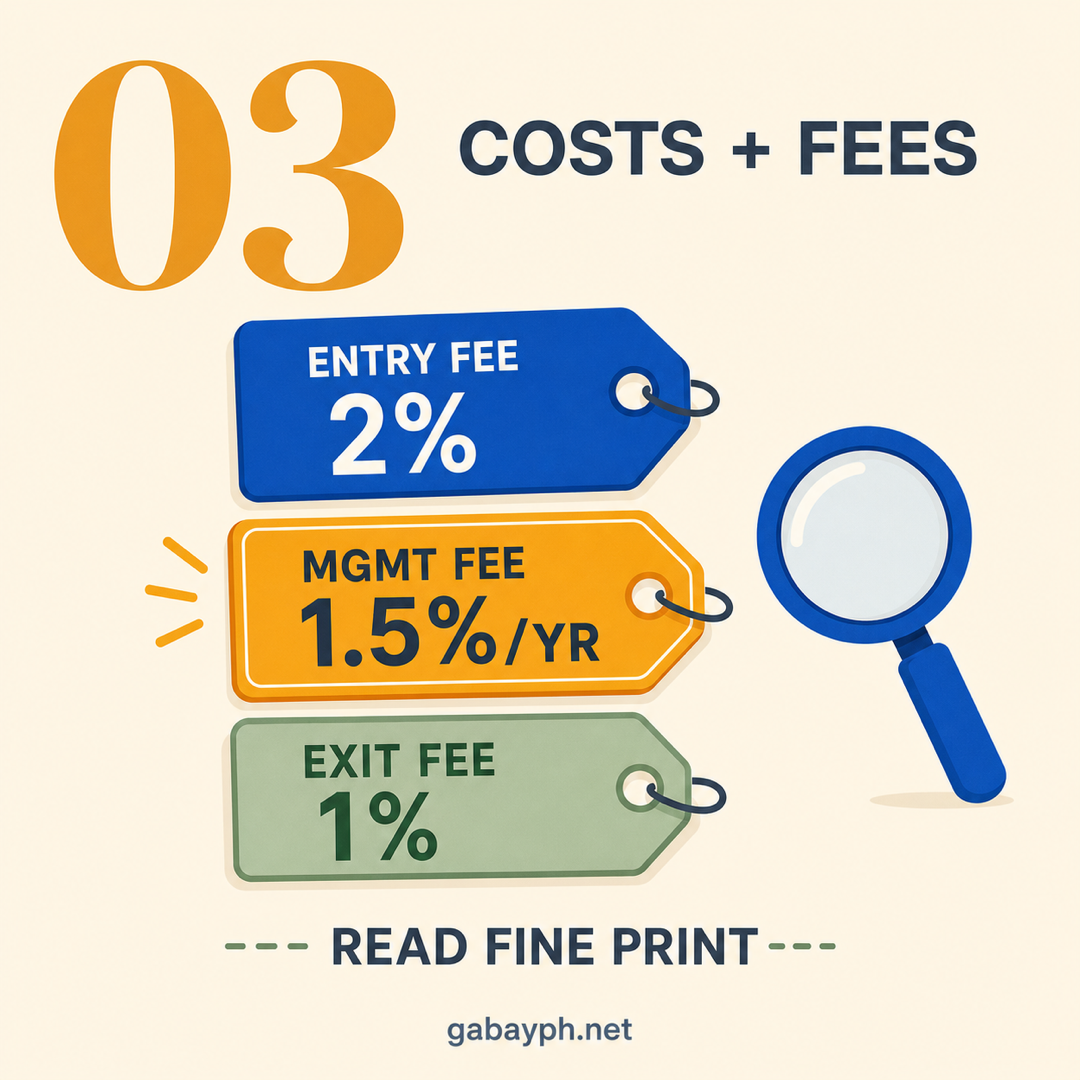
- Management fee — The annual fee charged by the fund manager (typically 0.5-2% per year, already factored into the NAVPU)
- Entry/sales load fee — A one-time fee when you invest (0-2%, some funds have no entry fee)
- Exit/redemption fee — A fee when you withdraw (0-2%, often waived after a holding period of 30-180 days)
Index funds and UITFs generally have lower fees than actively managed mutual funds. Over 10-20 years, even a 1% difference in fees can result in significantly different returns.
4. Check Past Performance (But Don't Rely on It Alone)
Look at the fund's 1-year, 3-year, and 5-year returns. Compare them against the benchmark index (usually the PSEi for equity funds). A fund that consistently beats its benchmark may indicate good management — pero tandaan, past performance does not guarantee future results.
5. Check the Fund's NAVPU Trend
The NAVPU (Net Asset Value Per Unit) tells you the current price per unit/share of the fund. Look at the trend over time. An upward trend suggests the fund has been growing, but expect dips during market downturns — that's normal.
Sa dami ng available na funds, ang pagpili ng tama ay pwedeng nakakalula. Narito ang mga pangunahing factor na dapat isaalang-alang:
1. Alamin ang Risk Tolerance Mo
Maging totoo sa sarili mo. Kung ang makita na bumaba ng 20% ang investment mo ay magpapanic-sell sa iyo, hindi para sa iyo ang equity funds — manatili sa bond o balanced funds. Kung kaya mong tiisin ang short-term losses dahil pangmatagalan ang plano mo, ang equity at index funds ay nagbibigay ng mas magandang growth potential.
2. Tukuyin ang Time Horizon Mo
- Mas mababa sa 1 taon: Money market fund
- 1-3 taon: Bond fund
- 3-5 taon: Balanced fund
- 5+ taon: Equity o index fund
3. Ikumpara ang mga Bayarin at Gastos
Ang mga bayarin ay kumakain sa returns mo sa paglipas ng panahon. Bigyang-pansin ang:
- Management fee — Ang taunang bayarin na sinisingil ng fund manager (karaniwan 0.5-2% kada taon, kasama na sa NAVPU)
- Entry/sales load fee — Isang beses lang na bayarin kapag nag-invest ka (0-2%, may mga funds na walang entry fee)
- Exit/redemption fee — Bayarin kapag nag-withdraw ka (0-2%, kadalasang inaalis pagkatapos ng holding period na 30-180 araw)
Ang index funds at UITFs ay karaniwang may mas mababang bayarin kaysa sa actively managed mutual funds. Sa loob ng 10-20 taon, kahit 1% na pagkakaiba sa bayarin ay pwedeng magresulta sa malaking pagkakaiba sa returns.
4. I-check ang Nakaraang Performance (Pero Huwag Umasa Dito Lang)
Tingnan ang 1-year, 3-year, at 5-year returns ng fund. Ikumpara ang mga ito sa benchmark index (karaniwan ang PSEi para sa equity funds). Ang fund na consistent na natatalo ang benchmark nito ay posibleng palatandaan ng magandang management — pero tandaan, ang nakaraang performance ay hindi ginagarantiyahan ang hinaharap na resulta.
5. I-check ang Trend ng NAVPU ng Fund
Ang NAVPU (Net Asset Value Per Unit) ay sinasabi sa iyo ang kasalukuyang presyo bawat unit/share ng fund. Tingnan ang trend sa paglipas ng panahon. Ang pataas na trend ay nagpapahiwatig na lumalaki ang fund, pero asahan ang mga pagbaba sa panahon ng market downturns — normal lang iyon.
Top Fund Managers in the Philippines
Mga Nangungunang Fund Manager sa Pilipinas
- BPI (UITFs) — Via BPI app/online. Min ₱1,000. Invest directly from savings account.
- BDO (UITFs) — Largest UITF portfolio. Via BDO Online/branches. Min ₱1,000-₱10,000.
- Sun Life (Mutual Funds) — Prosperity Funds series. Via Sun Life app or advisors. Min ₱1,000-₱5,000.
- Metrobank (UITFs) — Via Metrobank Online/branches. Min ₱5,000-₱10,000.
- Pag-IBIG MP2 — Not a fund, but a government-backed savings program with 6-7% tax-free dividends. Min ₱500. Details below.
- ATRAM (Mutual/Feeder Funds) — Global and PH funds via online platform. Good for international diversification.
- BPI (UITFs) — Sa BPI app/online. Min ₱1,000. Mag-invest direkta mula sa savings account.
- BDO (UITFs) — Pinakamalaking UITF portfolio. Sa BDO Online/branches. Min ₱1,000-₱10,000.
- Sun Life (Mutual Funds) — Prosperity Funds series. Sa Sun Life app o advisors. Min ₱1,000-₱5,000.
- Metrobank (UITFs) — Sa Metrobank Online/branches. Min ₱5,000-₱10,000.
- Pag-IBIG MP2 — Hindi fund, pero government-backed savings program na may 6-7% tax-free dividends. Min ₱500. Detalye sa ibaba.
- ATRAM (Mutual/Feeder Funds) — Global at PH funds sa online platform. Maganda para sa international diversification.
What You Need to Get Started
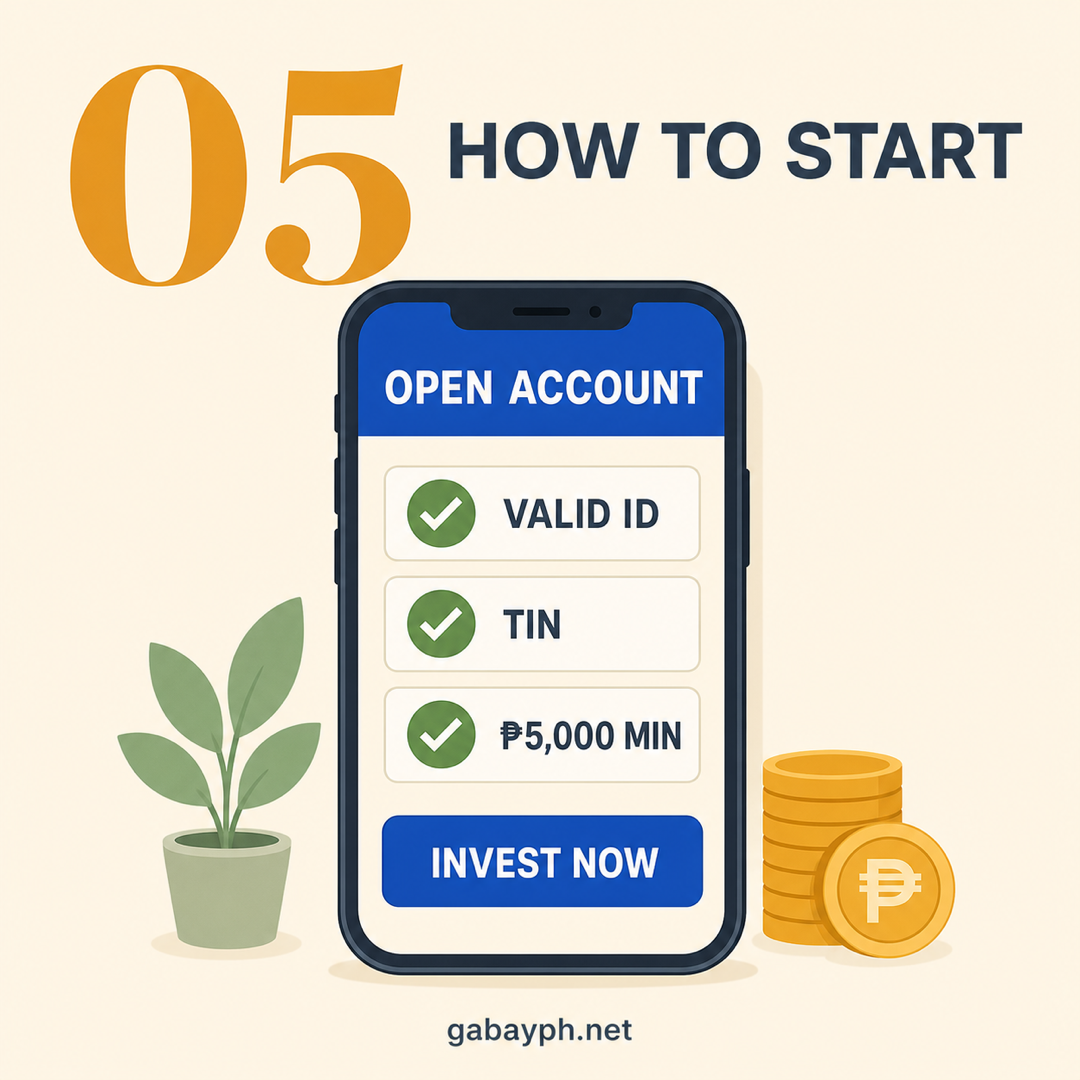
- Valid government ID — Passport, driver's license, PhilSys ID, UMID, or PRC ID. Your bank may already have this on file if you're opening a UITF.
- Bank account or e-wallet — For funding your investment and receiving redemptions. Most UITF accounts are linked directly to your existing savings account.
- Initial investment amount — ₱500 (MP2), ₱1,000 (most UITFs and mutual funds), or ₱5,000-₱10,000 (some bank UITFs)
Mga Kakailanganin Mo
- Valid na government ID — Passport, driver's license, PhilSys ID, UMID, o PRC ID. Posibleng naka-file na ito sa bangko mo kung UITF ang bubuksan mo.
- Bank account o e-wallet — Para sa pagpondo ng investment mo at pagtanggap ng redemptions. Karamihan ng UITF accounts ay naka-link direkta sa existing savings account mo.
- Initial investment amount — ₱500 (MP2), ₱1,000 (karamihan ng UITFs at mutual funds), o ₱5,000-₱10,000 (ilang bank UITFs)
Step-by-Step: How to Start Investing
Hakbang-Hakbang: Paano Magsimulang Mag-invest
The process is nearly identical for UITFs and mutual funds. The main difference is where you go: UITFs are opened through your bank app (BDO, BPI, Metrobank), while mutual funds are opened through the fund company's app (Sun Life, ATRAM) or a financial advisor.
Halos magkapareho ang proseso para sa UITFs at mutual funds. Ang pangunahing pagkakaiba ay kung saan ka pupunta: ang UITFs ay binubuksan sa bank app mo (BDO, BPI, Metrobank), habang ang mutual funds ay binubuksan sa app ng fund company (Sun Life, ATRAM) o sa pamamagitan ng financial advisor.
Open the Platform
For UITFs: Log in to your bank's app or website (e.g., BDO Online, BPI app). For mutual funds: Download the fund company's app (e.g., My Sun Life) and create an account with a valid government ID. Verification takes 1-3 business days.
Complete the Risk Profile Assessment
Answer 10-15 questions about your financial goals, income, and risk tolerance. You'll be classified as Conservative, Moderate, or Aggressive — the platform will only show funds that match your profile.
Choose Your Fund
Browse available funds and compare NAVPU/NAVPS, historical performance (1-year, 3-year), minimum investment, and fees. You can invest in multiple funds to diversify.
Invest and Confirm
Enter your amount (min ₱1,000-₱5,000). UITFs debit directly from your savings account. Mutual funds accept bank transfer, GCash, Maya, or OTC deposit. Review, accept the KIIDS, and confirm. Processed within 1-2 business days.
Monitor and Top Up
Track your current value, units, and unrealized gain/loss in the app. Top up anytime (min ₱1,000 additional). To withdraw: use "Redeem" — UITFs credit in 1-3 days, mutual funds in 3-7 days.
Buksan ang Platform
Para sa UITFs: Mag-log in sa bank app o website mo (hal., BDO Online, BPI app). Para sa mutual funds: I-download ang app ng fund company (hal., My Sun Life) at gumawa ng account gamit ang valid government ID. Ang verification ay tumatagal ng 1-3 business days.
Sagutan ang Risk Profile Assessment
Sagutin ang 10-15 tanong tungkol sa financial goals, kita, at risk tolerance mo. Ikla-classify ka bilang Conservative, Moderate, o Aggressive — ipapakita lang ng platform ang funds na tumutugma sa profile mo.
Pumili ng Fund
I-browse ang available na funds at ikumpara ang NAVPU/NAVPS, historical performance (1-year, 3-year), minimum investment, at mga bayarin. Pwede kang mag-invest sa maraming funds para mag-diversify.
Mag-invest at I-confirm
Ilagay ang halaga mo (min ₱1,000-₱5,000). Ang UITFs ay dine-debit direkta mula sa savings account mo. Ang mutual funds ay tumatanggap ng bank transfer, GCash, Maya, o OTC deposit. I-review, tanggapin ang KIIDS, at i-confirm. Na-process sa loob ng 1-2 business days.
I-monitor at Mag-top Up
I-track ang current value, units, at unrealized gain/loss sa app. Mag-top up anumang oras (min ₱1,000 additional). Para mag-withdraw: gamitin ang "Redeem" — ang UITFs ay iki-credit sa 1-3 araw, mutual funds sa 3-7 araw.
Understanding Fees
Pag-unawa sa mga Bayarin
Fees are the silent killer of investment returns. Kahit mukhang maliit, compounding makes even a 1-2% annual fee devastating over decades. Here's what to watch for:
Management Fee (Trust Fee)
This is the annual fee charged by the fund manager for handling your money. It's expressed as a percentage and is already deducted from the NAVPU daily — so you don't pay it separately. Typical ranges:
- Money market funds: 0.25-0.5% per year
- Bond funds: 0.5-1.0% per year
- Balanced funds: 1.0-1.75% per year
- Equity funds: 1.5-2.0% per year
- Index funds: 0.5-1.0% per year (lower because they just track the index)
Entry Fee (Sales Load / Front-End Load)
A one-time fee charged when you invest. For example, if you invest ₱10,000 with a 2% entry fee, only ₱9,800 actually goes into the fund. Many UITFs have no entry fee, which is one of their advantages. Some mutual funds charge 1-2%.
Exit Fee (Redemption Fee / Back-End Load)
A fee charged when you redeem (withdraw) your investment. Often 0.25-1% if you redeem within the first 30-180 days, then 0% after the holding period. This discourages short-term "in and out" investing.
How to Minimize Fees
- Choose no-load UITFs or index funds — Zero entry fees and lower management fees
- Hold beyond the minimum period — Exit fees are typically waived after 30-180 days
Ang mga bayarin ang tahimik na pumapatay sa investment returns. Kahit mukhang maliit, ang compounding ay gumagawa kahit sa 1-2% annual fee na mapaminsala sa loob ng mga dekada. Narito ang mga dapat bantayan:
Management Fee (Trust Fee)
Ito ang taunang bayarin na sinisingil ng fund manager para sa pangangasiwa ng pera mo. Ipinapahayag ito bilang porsyento at dine-deduct na mula sa NAVPU araw-araw — kaya hindi mo ito binabayaran nang hiwalay. Karaniwang hanay:
- Money market funds: 0.25-0.5% kada taon
- Bond funds: 0.5-1.0% kada taon
- Balanced funds: 1.0-1.75% kada taon
- Equity funds: 1.5-2.0% kada taon
- Index funds: 0.5-1.0% kada taon (mas mababa dahil sinusubaybayan lang nila ang index)
Entry Fee (Sales Load / Front-End Load)
Isang beses na bayarin na sinisingil kapag nag-invest ka. Halimbawa, kung mag-invest ka ng ₱10,000 na may 2% entry fee, ₱9,800 lang ang totoong napupunta sa fund. Maraming UITFs ang walang entry fee, na isa sa mga advantages nila. Ang ilang mutual funds ay sumisingil ng 1-2%.
Exit Fee (Redemption Fee / Back-End Load)
Bayarin na sinisingil kapag nire-redeem (withdraw) mo ang investment mo. Kadalasan 0.25-1% kung nire-redeem sa loob ng unang 30-180 araw, tapos 0% pagkatapos ng holding period. Dinidiscourage nito ang short-term na "pasok at labas" na investing.
Paano I-minimize ang mga Bayarin
- Pumili ng no-load UITFs o index funds — Walang entry fees at mas mababang management fees
- Hawakan lampas sa minimum period — Ang exit fees ay karaniwang inaalis pagkatapos ng 30-180 araw
Tax Implications
Mga Implikasyon sa Buwis
Good news: investing in mutual funds and UITFs in the Philippines has relatively favorable tax treatment compared to many other countries.
For UITFs
- No capital gains tax — Gains from UITF redemptions are not subject to capital gains tax. The growth in NAVPU is yours to keep.
- 20% final tax on interest income — If the UITF invests in deposits or deposit substitutes, the 20% final tax is automatically deducted at the fund level. This mainly affects money market and bond funds.
- Documentary stamp tax (DST) — Some UITFs may pass on a small DST charge.
For Mutual Funds
- No capital gains tax on redemption — Similar to UITFs, gains from redeeming mutual fund shares are not subject to capital gains tax.
- 10% final tax on dividends — If the mutual fund distributes dividends (which most Philippine mutual funds do not — they reinvest instead), a 10% withholding tax applies.
For Pag-IBIG MP2
- Completely tax-free — MP2 dividends are exempt from tax. This is one of the biggest advantages of MP2 over other investments.
Key takeaway: Unlike stocks (which have a 0.6% stock transaction tax on every sell), mutual funds and UITFs have no tax when you redeem at a profit. This makes them very tax-efficient for long-term investors. Combined with the tax-free status of MP2, you can build a very efficient investment portfolio.
Magandang balita: ang pag-invest sa mutual funds at UITFs sa Pilipinas ay may medyo paborableng tax treatment kumpara sa maraming ibang bansa.
Para sa UITFs
- Walang capital gains tax — Ang mga gains mula sa UITF redemptions ay hindi subject sa capital gains tax. Sa iyo ang paglago ng NAVPU.
- 20% final tax sa interest income — Kung ang UITF ay nag-i-invest sa deposits o deposit substitutes, ang 20% final tax ay automatic na dine-deduct sa fund level. Pangunahing nakakaapekto ito sa money market at bond funds.
- Documentary stamp tax (DST) — Ang ilang UITFs ay pwedeng magpasa ng maliit na DST charge.
Para sa Mutual Funds
- Walang capital gains tax sa redemption — Katulad ng UITFs, ang mga gains mula sa pag-redeem ng mutual fund shares ay hindi subject sa capital gains tax.
- 10% final tax sa dividends — Kung nagdi-distribute ng dividends ang mutual fund (na karamihan ng Philippine mutual funds ay hindi — nire-reinvest nila sa halip), 10% withholding tax ang applicable.
Para sa Pag-IBIG MP2
- Ganap na tax-free — Ang MP2 dividends ay exempt sa buwis. Isa ito sa pinakamalaking advantages ng MP2 kumpara sa ibang investments.
Pangunahing takeaway: Hindi tulad ng stocks (na may 0.6% stock transaction tax sa bawat sell), ang mutual funds at UITFs ay walang buwis kapag nag-redeem ka na may tubo. Kaya naman very tax-efficient ang mga ito para sa long-term investors. Combined sa tax-free status ng MP2, pwede kang bumuo ng napaka-efficient na investment portfolio.
Pag-IBIG MP2 as Alternative
Pag-IBIG MP2 Bilang Alternatibo
If you want a safe, high-yield, tax-free investment without the volatility of stocks or equity funds, Pag-IBIG MP2 is hands down one of the best options available to Filipinos.
What is MP2?
The Modified Pag-IBIG 2 (MP2) Savings Program is a voluntary savings program offered by the Pag-IBIG Fund (HDMF). It's separate from your mandatory Pag-IBIG contributions and is designed specifically as a savings and investment vehicle.
Why MP2 is Exceptional
- High returns: MP2 has consistently delivered 6-7% annual dividends in recent years (7.03% in 2023, 6.27% in 2024). Compare that to savings accounts at 0.25-2% — halos triple ang kita.
- Tax-free: Unlike UITFs and mutual funds, MP2 dividends are 100% exempt from tax. What you earn is what you keep.
- Government-backed: Your money is with the Pag-IBIG Fund, a government institution. Very low default risk.
- Low minimum: You can start with as little as ₱500 per month.
- Flexible contributions: No required monthly amount — save as much or as little as you want, whenever you want.
- 5-year maturity: Your savings are locked in for 5 years, but you can choose to receive dividends annually or let them compound.
How to Open an MP2 Account
- Be an active Pag-IBIG member — You must have at least one (1) monthly contribution. See our Pag-IBIG guide if you're not yet a member.
- Register online via the Virtual Pag-IBIG portal (virtualpagibig.com) or visit any Pag-IBIG branch.
- Fill out the MP2 application form and choose your dividend option: annual payout or compounding (compounding is recommended for maximum growth).
- Make your first savings — Pay via Pag-IBIG Online, GCash, Maya, banks, or payment centers. Minimum ₱500.
MP2 vs Money Market Funds vs Savings Accounts
| Feature | MP2 | Money Market Fund | Savings Account |
|---|---|---|---|
| Return | 6-7% | 2-4% | 0.25-2% |
| Tax | Tax-free | 20% on interest | 20% on interest |
| Lock-in | 5 years | None (redeem anytime) | None |
| Risk | Very low (government) | Very low | Almost zero (PDIC insured) |
Verdict: If you have money you won't need for 5 years and want the safest possible high return, MP2 is hard to beat. Many savvy Filipino investors use MP2 as the "safe" portion of their portfolio alongside equity funds or stocks for growth.
Kung gusto mo ng ligtas, mataas na kita, at tax-free na investment nang walang volatility ng stocks o equity funds, ang Pag-IBIG MP2 ay walang-kapantay na isa sa pinakamahusay na opsyon na available sa mga Pilipino.
Ano ang MP2?
Ang Modified Pag-IBIG 2 (MP2) Savings Program ay isang voluntary savings program na ino-offer ng Pag-IBIG Fund (HDMF). Hiwalay ito sa mandatory Pag-IBIG contributions mo at dinisenyo espesipiko bilang savings at investment vehicle.
Bakit Exceptional ang MP2
- Mataas na kita: Consistent na nagbibigay ang MP2 ng 6-7% annual dividends sa mga nakaraang taon (7.03% noong 2023, 6.27% noong 2024). Ikumpara mo sa savings accounts na 0.25-2% — halos triple ang kita.
- Tax-free: Hindi tulad ng UITFs at mutual funds, ang MP2 dividends ay 100% exempt sa buwis. Ang kinikita mo ang sa iyo.
- Government-backed: Ang pera mo ay nasa Pag-IBIG Fund, isang institusyon ng gobyerno. Napakababa ng default risk.
- Mababang minimum: Pwede kang magsimula sa kasing liit ng ₱500 kada buwan.
- Flexible contributions: Walang kinakailangang buwanang halaga — mag-save ng kahit magkano, kahit kailan mo gusto.
- 5-year maturity: Naka-lock in ang savings mo sa loob ng 5 taon, pero pwede kang pumiling makatanggap ng dividends taun-taon o hayaang mag-compound.
Paano Magbukas ng MP2 Account
- Maging active Pag-IBIG member — Kailangan mong may kahit isa (1) na buwanang contribution. Tingnan ang Pag-IBIG guide namin kung hindi ka pa member.
- Magpa-register online sa Virtual Pag-IBIG portal (virtualpagibig.com) o pumunta sa kahit anong Pag-IBIG branch.
- Sagutan ang MP2 application form at piliin ang dividend option mo: annual payout o compounding (inirerekomenda ang compounding para sa maximum growth).
- Gawin ang unang savings mo — Magbayad sa Pag-IBIG Online, GCash, Maya, mga bangko, o payment centers. Minimum ₱500.
MP2 vs Money Market Funds vs Savings Accounts
| Feature | MP2 | Money Market Fund | Savings Account |
|---|---|---|---|
| Kita | 6-7% | 2-4% | 0.25-2% |
| Buwis | Tax-free | 20% sa interest | 20% sa interest |
| Lock-in | 5 taon | Wala (redeem anytime) | Wala |
| Panganib | Napakababa (gobyerno) | Napakababa | Halos wala (PDIC insured) |
Hatol: Kung may pera ka na hindi mo kakailanganin sa loob ng 5 taon at gusto mo ng pinakaligtas na mataas na kita, mahirap talunin ang MP2. Maraming matatalinong Filipino investors ang gumagamit ng MP2 bilang "safe" portion ng portfolio nila kasama ng equity funds o stocks para sa growth.
Pro Tips
Mga Payo
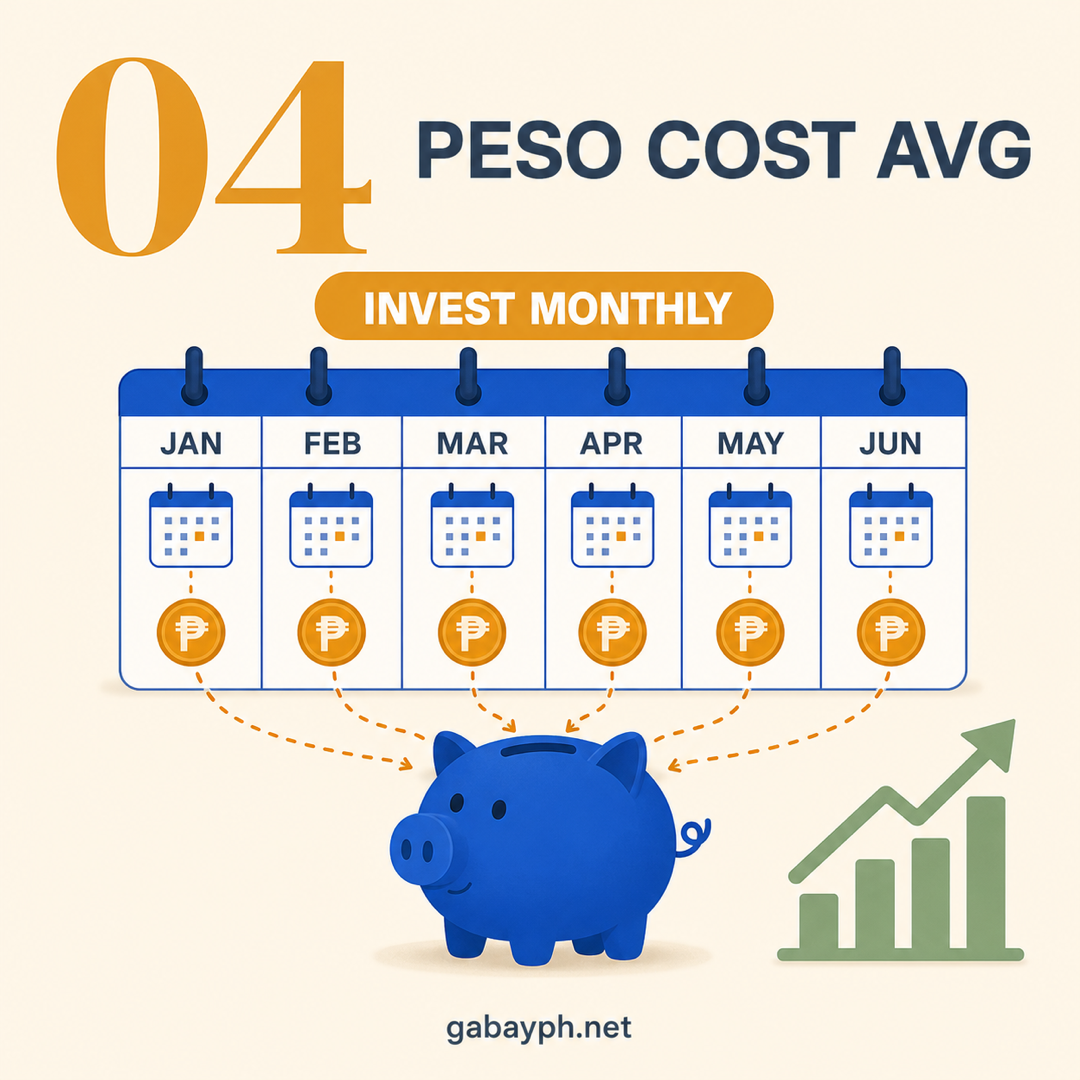
- Automate your investments — Use your bank's auto-invest feature to deduct a fixed amount every payday. Consistency matters more than the amount.
- Diversify across fund types — A simple portfolio: 50% equity fund (growth), 30% bond fund (stability), 20% MP2 (safe, tax-free income).
- Don't chase past performance — A fund that returned 15% last year might return -5% this year. Focus on your long-term strategy.
- Build your emergency fund first — Have 3-6 months of expenses in a liquid account before putting money into equity or balanced funds.
- Read the KIIDS — The Key Information and Investment Disclosure Statement tells you the fund's objective, risk level, fees, and performance in plain language.
- I-automate ang investments mo — Gamitin ang auto-invest feature ng bangko mo para automatic na i-deduct ang fixed na halaga tuwing payday. Mas mahalaga ang consistency kaysa sa halaga.
- Mag-diversify sa iba't ibang uri ng fund — Simpleng portfolio: 50% equity fund (growth), 30% bond fund (stability), 20% MP2 (safe, tax-free income).
- Huwag habulin ang nakaraang performance — Ang fund na nagbalik ng 15% noong nakaraang taon ay pwedeng magbalik ng -5% ngayong taon. Mag-focus sa long-term strategy mo.
- Buuin muna ang emergency fund mo — Magkaroon ng 3-6 buwan ng gastusin sa liquid na account bago maglagay ng pera sa equity o balanced funds.
- Basahin ang KIIDS — Ang Key Information and Investment Disclosure Statement ay nagsasabi ng layunin ng fund, panganib, bayarin, at performance sa simpleng wika.
Frequently Asked Questions
Mga Madalas Itanong
What's the difference between a mutual fund and a UITF?
Mutual funds are SEC-regulated, offered by investment companies (Sun Life, ATRAM). UITFs are BSP-regulated, offered by banks (BDO, BPI). In practice they work the same way — UITFs just have slightly faster redemption (1-3 days vs 3-7) and are easiest if you already have a bank account.
Ano ang pagkakaiba ng mutual fund at UITF?
Ang mutual funds ay SEC-regulated, ino-offer ng investment companies (Sun Life, ATRAM). Ang UITFs ay BSP-regulated, ino-offer ng mga bangko (BDO, BPI). Sa praktika pareho ang proseso — ang UITFs lang ay may bahagyang mas mabilis na redemption (1-3 araw vs 3-7) at pinakamadali kung may bank account ka na.
Can I lose money in mutual funds or UITFs?
Yes, you can lose money. Mutual funds and UITFs are not deposit accounts and are not insured by PDIC. The value of your investment fluctuates based on market conditions. Equity funds can drop 10-30% during market downturns, and even bond funds can experience temporary losses.
However, historically, well-diversified funds recover over time. The key is to match the fund type to your time horizon — kung kailangan mo ang pera sa loob ng 1 taon, huwag ilagay sa equity fund. If you're investing for 5+ years, short-term drops usually smooth out into positive returns.
Pwede ba akong mawalan ng pera sa mutual funds o UITFs?
Oo, pwede kang mawalan ng pera. Ang mutual funds at UITFs ay hindi deposit accounts at hindi insured ng PDIC. Ang halaga ng investment mo ay nagbabago batay sa market conditions. Ang equity funds ay pwedeng bumaba ng 10-30% sa panahon ng market downturns, at kahit ang bond funds ay pwedeng makaranas ng pansamantalang pagkalugi.
Gayunpaman, historically, ang well-diversified funds ay naka-recover sa paglipas ng panahon. Ang susi ay itugma ang uri ng fund sa time horizon mo — kung kailangan mo ang pera sa loob ng 1 taon, huwag ilagay sa equity fund. Kung 5+ taon ang investment mo, kadalasang nababalanse ang short-term drops sa positive returns.
How much should I invest per month?
Even ₱1,000-₱2,000/month makes a real difference. A ₱2,000 monthly investment at 7% becomes roughly ₱347,000 after 10 years. Consistency matters more than the amount — start with what you can, and the compounding does the rest.
Magkano ang dapat kong i-invest bawat buwan?
Kahit ₱1,000-₱2,000/buwan ay malaking pagkakaiba. Ang ₱2,000 buwanang investment sa 7% ay magiging ₱347,000 pagkatapos ng 10 taon. Mas mahalaga ang consistency kaysa sa halaga — magsimula sa kaya mo, at ang compounding ang gagawa ng trabaho.
Is Pag-IBIG MP2 better than mutual funds?
It depends on your goals. MP2 is better for safety and guaranteed high returns — 6-7% tax-free, government-backed, very low risk. It's ideal for conservative investors or for the "safe" portion of your portfolio.
Equity mutual funds/UITFs are better for growth potential — they can return 7-12% per year over the long term, but come with more volatility and risk. They're better suited for money you won't need for 5+ years.
Maraming smart investors ang gumagamit ng both: MP2 for stability and tax-free returns, plus equity funds for long-term growth. The best investment depends on your specific financial situation, timeline, and risk tolerance.
Mas maganda ba ang Pag-IBIG MP2 kaysa sa mutual funds?
Depende sa goals mo. Mas maganda ang MP2 para sa kaligtasan at garantisadong mataas na kita — 6-7% na tax-free, government-backed, napakababang panganib. Mainam ito para sa mga conservative investors o para sa "safe" na bahagi ng portfolio mo.
Mas maganda ang equity mutual funds/UITFs para sa growth potential — pwedeng magbalik ng 7-12% bawat taon sa matagalang panahon, pero may kasama itong mas maraming volatility at panganib. Mas angkop ang mga ito para sa perang hindi mo kakailanganin sa loob ng 5+ taon.
Maraming matatalinong investors ang gumagamit ng dalawa: MP2 para sa stability at tax-free returns, kasama ang equity funds para sa long-term growth. Ang pinakamahusay na investment ay depende sa specific na financial situation, timeline, at risk tolerance mo.
How do I withdraw (redeem) my investment?
For UITFs: Log in to your bank's online platform, go to the UITF section, and select "Redeem" or "Withdraw." Enter the amount or number of units you want to redeem. The proceeds will be credited to your linked savings account within 1-3 business days for most funds. Check if there's an exit fee if you're redeeming before the minimum holding period.
For mutual funds: Log in to the fund's app or website, go to your portfolio, and request a redemption. Proceeds are typically credited to your bank account within 3-7 business days. You can also call your financial advisor to process the redemption.
For MP2: You can only withdraw after the 5-year maturity period. After maturity, you can request full withdrawal or renew for another 5 years. File your claim at any Pag-IBIG branch or through Virtual Pag-IBIG.
Paano ko wi-withdraw (i-redeem) ang investment ko?
Para sa UITFs: Mag-log in sa online platform ng bangko mo, pumunta sa UITF section, at piliin ang "Redeem" o "Withdraw." Ilagay ang halaga o bilang ng units na gusto mong i-redeem. Ang proceeds ay iki-credit sa linked savings account mo sa loob ng 1-3 business days para sa karamihan ng funds. I-check kung may exit fee kung nire-redeem bago ang minimum holding period.
Para sa mutual funds: Mag-log in sa app o website ng fund, pumunta sa portfolio mo, at mag-request ng redemption. Ang proceeds ay karaniwang iki-credit sa bank account mo sa loob ng 3-7 business days. Pwede ka ring tumawag sa financial advisor mo para i-process ang redemption.
Para sa MP2: Pwede ka lang mag-withdraw pagkatapos ng 5-year maturity period. Pagkatapos ng maturity, pwede kang mag-request ng full withdrawal o mag-renew para sa isa pang 5 taon. Mag-file ng claim sa kahit anong Pag-IBIG branch o sa Virtual Pag-IBIG.
Do I need a TIN to invest in mutual funds or UITFs?
For UITFs, you typically don't need to provide a TIN separately — your bank already has your TIN on file from when you opened your savings account. The UITF account is linked to your existing bank relationship.
For mutual funds, some providers may ask for your TIN during the application process, but it's not always required. It depends on the mutual fund company's KYC requirements.
For MP2, you don't need a TIN — you only need your Pag-IBIG MID number.
That said, having a TIN is generally good practice since it's required for filing taxes. If you don't have one yet, check our TIN guide.
Kailangan ko ba ng TIN para mag-invest sa mutual funds o UITFs?
Para sa UITFs, karaniwang hindi mo kailangang magbigay ng TIN nang hiwalay — nasa file na ng bangko mo ang TIN mo mula nang magbukas ka ng savings account. Ang UITF account ay naka-link sa existing bank relationship mo.
Para sa mutual funds, ang ibang providers ay pwedeng humiling ng TIN mo sa application process, pero hindi laging kailangan. Depende ito sa KYC requirements ng mutual fund company.
Para sa MP2, hindi mo kailangan ng TIN — kailangan mo lang ang Pag-IBIG MID number mo.
Kahit ganoon, magandang practice ang pagkakaroon ng TIN dahil kailangan ito para sa pag-file ng taxes. Kung wala ka pa, tingnan ang TIN guide namin.