

How to Register with BIR as a Freelancer in the Philippines (2026 Guide)
Paano Mag-register sa BIR Bilang Freelancer sa Pilipinas (2026 Gabay)

The 5-Step Walkthrough
Freelancer BIR registration in five steps.

Quick Summary
Mabilis na Buod
Important Disclaimer
This guide is for educational and informational purposes only and does not constitute tax advice, legal advice, or professional accounting services. GabayPH is not a licensed tax consultant, certified public accountant (CPA), or tax attorney. Tax situations vary by individual — what applies to one taxpayer may not apply to another. Consult a licensed tax professional or CPA for advice specific to your situation. GabayPH is not liable for any errors, penalties, or losses resulting from reliance on this guide.
Mahalagang Disclaimer
Ang gabay na ito ay para sa layuning pang-edukasyon at pang-impormasyon lamang at hindi bumubuo ng tax advice, legal advice, o propesyonal na serbisyong accounting. Ang GabayPH ay hindi lisensyadong tax consultant, certified public accountant (CPA), o tax attorney. Iba-iba ang sitwasyon sa buwis ng bawat tao — ang naaangkop sa isang taxpayer ay maaaring hindi naaangkop sa iba. Kumonsulta sa isang lisensyadong tax professional o CPA para sa payo na partikular sa iyong sitwasyon. Ang GabayPH ay hindi mananagot para sa anumang pagkakamali, multa, o pagkalugi na resulta ng pag-asa sa gabay na ito.
Table of Contents
- Why Freelancers Need to Register with BIR
- Who This Guide Is For
- Choosing Your Tax Option: 8% vs Graduated Rates
- Requirements for BIR Registration
- Step-by-Step: BIR Registration
- Quarterly Filing Schedule
- Record-Keeping for Freelancers
- Handling USD/Foreign Income
- Common Deductions (Graduated Rate Filers)
- Pro Tips
- Frequently Asked Questions
Talaan ng Nilalaman
- Bakit Kailangang Mag-register ng Freelancer sa BIR
- Para Kanino ang Gabay na Ito
- Pagpili ng Tax Option: 8% vs Graduated Rates
- Mga Kailangan para sa BIR Registration
- Hakbang-Hakbang: BIR Registration
- Schedule ng Quarterly Filing
- Pag-iingat ng Records para sa Freelancers
- Pag-handle ng USD/Foreign Income
- Mga Karaniwang Deductions (Graduated Rate Filers)
- Mga Payo
- Mga Madalas Itanong
Why Freelancers Need to Register with BIR
Bakit Kailangang Mag-register ng Freelancer sa BIR
If you earn income as a freelancer in the Philippines — whether from local or international clients — you are legally required to register with the Bureau of Internal Revenue (BIR). This is not optional. Under the National Internal Revenue Code (NIRC), all persons engaged in trade or business, or earning income from the practice of a profession, must register with the BIR. "Freelancing" falls under self-employment, which means you are considered a sole proprietor or professional for tax purposes.
Kung kumikita ka bilang freelancer sa Pilipinas — mula man sa local o international na kliyente — legal na kinakailangan mong mag-register sa Bureau of Internal Revenue (BIR). Hindi ito opsyonal. Sa ilalim ng National Internal Revenue Code (NIRC), lahat ng taong nasa trade o business, o kumikita mula sa pagsasagawa ng isang propesyon, ay kailangang mag-register sa BIR. Ang "freelancing" ay nasa ilalim ng self-employment, na nangangahulugang ikaw ay itinuturing na sole proprietor o propesyonal para sa layuning buwis.
What happens if you do not register?
Ano ang mangyayari kung hindi ka mag-register?
- Penalties and fines: Failure to register can result in a fine of ₱5,000 to ₱20,000 and/or imprisonment of up to 2 years under the Tax Code. The BIR can also impose surcharges and interest on unpaid taxes.
- Back taxes: If the BIR discovers you have been earning without registration, they can assess you for all unpaid taxes from previous years — plus penalties and interest. The BIR now has access to bank data and digital payment records, so it is increasingly difficult to fly under the radar.
- No legitimate invoices: Without BIR registration, you cannot issue BIR-registered invoices. Under the EOPT Act (RA 11976, effective Jan 22, 2024), the invoice is now the primary sales document — many corporate clients and agencies require a BIR invoice before they can process your payment.
- Multa at penalties: Ang hindi pagre-register ay maaaring magresulta sa multa na ₱5,000 hanggang ₱20,000 at/o pagkakulong ng hanggang 2 taon sa ilalim ng Tax Code. Pwede ring magpataw ang BIR ng surcharges at interest sa mga hindi nabayarang buwis.
- Back taxes: Kung madiskubre ng BIR na kumikita ka nang walang registration, maaari ka nilang tasahan para sa lahat ng hindi nabayarang buwis mula sa mga nakaraang taon — dagdag pa ang mga penalties at interest. Ang BIR ngayon ay may access sa bank data at digital payment records, kaya mas mahirap nang makalusot.
- Walang legitimate invoices: Kung walang BIR registration, hindi ka makakapag-issue ng BIR-registered invoices. Sa ilalim ng EOPT Act (RA 11976, effective Jan 22, 2024), ang invoice na ang primary sales document — maraming corporate clients at agencies ang nangangailangan ng BIR invoice bago nila ma-process ang iyong bayad.
Benefits of registering
Mga benepisyo ng pagre-register
- You can issue BIR-registered invoices — Under the EOPT Act, the invoice is the primary sales document (ORs are supplementary only). This opens doors to corporate clients who require BIR invoices, and your COR + filed ITRs serve as proof of income for bank loans, credit cards, and visa applications.
- Peace of mind — Wala kang iiwasan, wala kang tatakasan. Being tax-compliant means you will not have to worry about BIR audits or penalties down the road.
- Makakapag-issue ka ng BIR-registered invoices — Sa ilalim ng EOPT Act, ang invoice na ang primary sales document (supplementary na lang ang ORs). Magbubukas ito ng pinto sa mga corporate clients na nangangailangan ng BIR invoice, at ang iyong COR + filed ITRs ay nagsisilbing patunay ng income para sa mga bank loan, credit card, at visa application.
- Peace of mind — Wala kang iiwasan, wala kang tatakasan. Ang pagiging tax-compliant ay nangangahulugang hindi ka na mag-aalala tungkol sa mga BIR audit o penalties sa hinaharap.
Who This Guide Is For
Para Kanino ang Gabay na Ito
This guide is specifically for freelancers and independent contractors who need to register with the BIR for the first time. If you already have your BIR Certificate of Registration and just need help filing your annual tax return, check our How to File and Pay Taxes guide instead. This guide covers the initial setup — getting registered, choosing your tax option, and understanding your obligations.
Ang gabay na ito ay partikular para sa mga freelancer at independent contractor na kailangang mag-register sa BIR sa unang pagkakataon. Kung mayroon ka nang BIR Certificate of Registration at kailangan mo lang ng tulong sa pag-file ng iyong annual tax return, tingnan ang aming gabay na Paano Mag-file at Magbayad ng Buwis sa halip. Ang gabay na ito ay tungkol sa initial setup — ang pagre-register, pagpili ng tax option mo, at pag-unawa sa mga obligasyon mo.
This includes VAs, content creators, online sellers, designers, developers, tutors, Upwork/Fiverr workers, consultants, and anyone earning as an independent contractor. Basically, kung kumikita ka ng pera nang hindi employed ng isang kumpanya — even if it is just a side hustle — you need to register with the BIR.
Kasama dito ang mga VA, content creator, online seller, designer, developer, tutor, Upwork/Fiverr worker, consultant, at sinumang kumikita bilang independent contractor. Basically, kung kumikita ka ng pera nang hindi employed ng isang kumpanya — kahit side hustle lang ito — kailangan mong mag-register sa BIR.
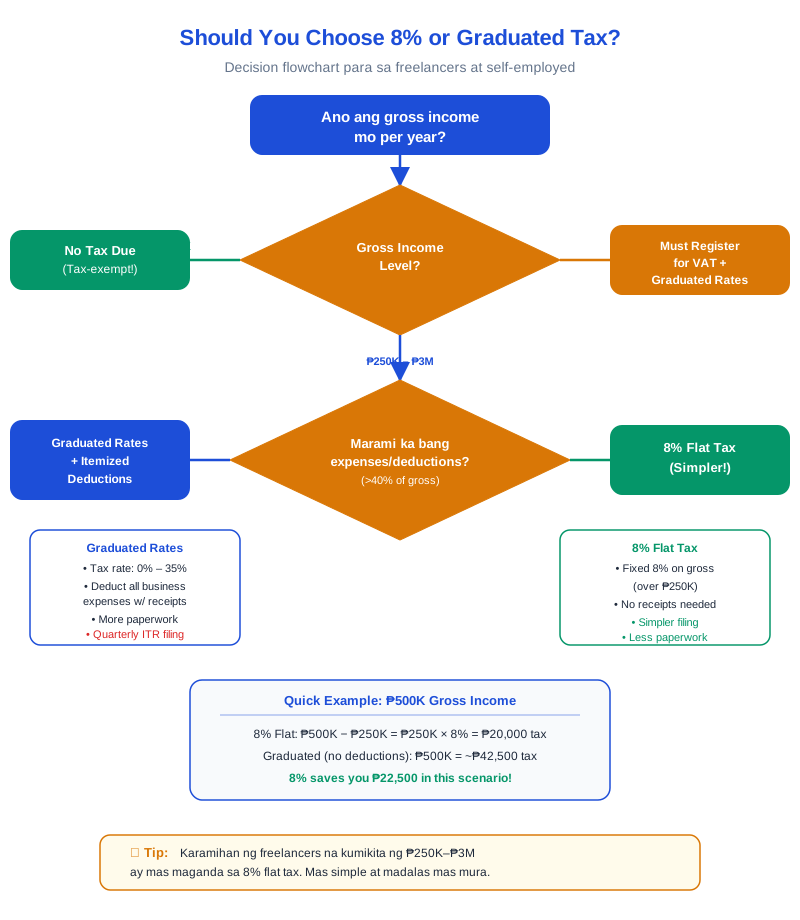
Choosing Your Tax Option: 8% vs Graduated Rates
Pagpili ng Tax Option Mo: 8% vs Graduated Rates
One of the most important decisions you will make during BIR registration is choosing your tax option. As a freelancer with gross annual sales/receipts of ₱3,000,000 or less, you can choose between two tax computation methods:
Isa sa pinakamahalagang desisyon na gagawin mo sa BIR registration ay ang pagpili ng iyong tax option. Bilang freelancer na may gross annual sales/receipts na ₱3,000,000 o mas mababa, maaari kang pumili sa dalawang paraan ng pagkuwenta ng buwis:
Option 1: 8% Flat Tax Rate
Opsyon 1: 8% Flat Tax Rate
- Pay 8% of your gross income exceeding ₱250,000 per year
- No need to track deductions or expenses for tax purposes
- Replaces both income tax and percentage tax (3%) — you only pay one tax
- Much simpler computation and filing
- Use BIR Form 1701A (simplified form)
- Best for freelancers whose expenses are less than 40% of gross income
- Magbayad ng 8% ng gross income na lampas sa ₱250,000 bawat taon
- Hindi na kailangan mag-track ng mga deductions o expenses para sa buwis
- Pinapalitan nito ang parehong income tax at percentage tax (3%) — isang buwis lang ang babayaran mo
- Mas simpleng computation at filing
- Gamitin ang BIR Form 1701A (simplified form)
- Pinakamainam para sa mga freelancer na ang gastusin ay mas mababa sa 40% ng gross income
Option 2: Graduated Income Tax Rates (with Deductions)
Opsyon 2: Graduated Income Tax Rates (may Deductions)
- Tax rates range from 0% to 35% depending on your taxable income bracket
- First ₱250,000 of taxable income is exempt (0%)
- You can claim deductions: either Optional Standard Deduction (OSD) at 40% of gross income, or itemized deductions (actual documented expenses)
- You also pay 3% percentage tax on gross receipts quarterly (BIR Form 2551Q) — this is in addition to income tax
- More paperwork but potentially lower tax if you have high deductible expenses
- Use BIR Form 1701A (if OSD) or BIR Form 1701 (if itemized deductions)
- Ang mga tax rate ay mula 0% hanggang 35% depende sa iyong taxable income bracket
- Ang unang ₱250,000 ng taxable income ay exempt (0%)
- Maaari kang mag-claim ng deductions: alinman sa Optional Standard Deduction (OSD) na 40% ng gross income, o itemized deductions (aktwal na na-document na gastos)
- Magbabayad ka rin ng 3% na percentage tax sa gross receipts bawat quarter (BIR Form 2551Q) — ito ay dagdag sa income tax
- Mas maraming paperwork pero posibleng mas mababang buwis kung marami kang deductible expenses
- Gamitin ang BIR Form 1701A (kung OSD) o BIR Form 1701 (kung itemized deductions)
Comparison: Which Is Better at Different Income Levels?
Paghahambing: Alin ang Mas Mabuti sa Iba't ibang Antas ng Kita?
Here is a simplified comparison assuming the freelancer uses OSD (40% deduction) for the graduated option. Actual results may vary based on your real expenses.
Narito ang simplified comparison kung saan ang freelancer ay gumagamit ng OSD (40% deduction) para sa graduated option. Ang aktwal na resulta ay maaaring mag-iba batay sa iyong tunay na gastos.
- Gross income ₱800,000/year (~₱67K/month): 8% tax = ₱44,000 | Graduated + OSD = ₱38,500 + ₱24,000 percentage tax = ₱62,500 total. Winner: 8% flat tax.
- Gross income ₱1,500,000/year (~₱125K/month): 8% tax = ₱100,000 | Graduated + OSD = ₱127,500 + ₱45,000 percentage tax = ₱172,500 total. Winner: 8% flat tax.
- Gross income ₱2,500,000/year (~₱208K/month): 8% tax = ₱180,000 | Graduated + OSD = ₱252,500 + ₱75,000 percentage tax = ₱327,500 total. Winner: 8% flat tax.
- Gross income ₱800,000/taon (~₱67K/buwan): 8% tax = ₱44,000 | Graduated + OSD = ₱38,500 + ₱24,000 percentage tax = ₱62,500 kabuuan. Panalo: 8% flat tax.
- Gross income ₱1,500,000/taon (~₱125K/buwan): 8% tax = ₱100,000 | Graduated + OSD = ₱127,500 + ₱45,000 percentage tax = ₱172,500 kabuuan. Panalo: 8% flat tax.
- Gross income ₱2,500,000/taon (~₱208K/buwan): 8% tax = ₱180,000 | Graduated + OSD = ₱252,500 + ₱75,000 percentage tax = ₱327,500 kabuuan. Panalo: 8% flat tax.
Bottom line: For most freelancers earning under ₱3M gross, the 8% flat tax is almost always the simpler and cheaper option when compared to graduated rates with OSD. The graduated option only becomes better if you have very high actual expenses (more than 40% of gross) and you choose itemized deductions — and you must have the official receipts to prove those expenses. Kung first-time mo mag-register, the 8% flat tax is the safe and simple choice.
Sa madaling salita: Para sa karamihan ng mga freelancer na kumikita ng below ₱3M gross, ang 8% flat tax ay halos palaging mas simple at mas murang option kumpara sa graduated rates na may OSD. Ang graduated option ay nagiging mas mabuti lang kung mayroon kang napakataas na aktwal na gastos (higit sa 40% ng gross) at pumili ka ng itemized deductions — at kailangan mong magkaroon ng mga opisyal na resibo para patunayan ang mga gastos na iyon. Kung first-time mo mag-register, ang 8% flat tax ang safe at simpleng pagpipilian.
Requirements for BIR Registration
Mga Kailangan para sa BIR Registration
- TIN (Tax Identification Number) — If you do not have a TIN yet, you will get one during the registration process by filing BIR Form 1901. If you already have a TIN (e.g., from a previous employer), you will use BIR Form 1905 to update your registration from employee to self-employed. Important: Every person can only have ONE TIN. Do not apply for a new TIN if you already have one — having multiple TINs is a violation.
- DTI Business Name Registration (optional for professionals) — If you will use a trade name for your freelance business (e.g., "Juan's Design Studio"), you need to register it with the Department of Trade and Industry (DTI). If you will operate under your own personal name, this is not required. Cost is around ₱200–₱1,000 depending on scope (barangay, city, regional, or national).
- Barangay Clearance — Get this from the barangay hall where your business or home office is located. This certifies that your barangay allows your business operation. Cost is typically ₱100–₱500. Bring a valid ID and proof of address.
- Lease contract or proof of address — If you rent an office, bring a copy of your lease contract. If you work from home, bring a proof of your home address such as a utility bill (electricity, water) in your name, or a barangay certificate of residency.
- BIR Form 1901 or 1905 — Form 1901 is for new registrants (never been registered with BIR before). Form 1905 is for updating your existing registration (e.g., you already have a TIN from employment and are now adding self-employment). Download from bir.gov.ph or get a copy at your RDO.
- TIN (Tax Identification Number) — Kung wala ka pang TIN, makukuha mo ito sa proseso ng registration sa pag-file ng BIR Form 1901. Kung mayroon ka nang TIN (hal., mula sa dating employer), gagamitin mo ang BIR Form 1905 para i-update ang iyong registration mula empleyado patungong self-employed. Mahalaga: Bawat tao ay pwede lang magkaroon ng ISANG TIN. Huwag mag-apply ng bagong TIN kung mayroon ka na — ang pagkakaroon ng maraming TIN ay paglabag.
- DTI Business Name Registration (opsyonal para sa mga propesyonal) — Kung gagamit ka ng trade name para sa iyong freelance business (hal., "Juan's Design Studio"), kailangan mo itong i-register sa Department of Trade and Industry (DTI). Kung gagamit ka sa ilalim ng sarili mong personal na pangalan, hindi ito kinakailangan. Ang gastos ay mga ₱200–₱1,000 depende sa saklaw (barangay, lungsod, rehiyonal, o pambansa).
- Barangay Clearance — Kunin ito sa barangay hall kung saan matatagpuan ang iyong negosyo o home office. Pinapatunayan nito na pinapayagan ng iyong barangay ang iyong operasyon. Ang gastos ay karaniwang ₱100–₱500. Magdala ng valid ID at proof of address.
- Lease contract o proof of address — Kung umuupa ka ng opisina, magdala ng kopya ng iyong lease contract. Kung nagtatrabaho ka mula sa bahay, magdala ng patunay ng iyong address tulad ng utility bill (kuryente, tubig) sa iyong pangalan, o barangay certificate of residency.
- BIR Form 1901 o 1905 — Ang Form 1901 ay para sa bagong registrant (hindi pa naka-register sa BIR dati). Ang Form 1905 ay para sa pag-update ng iyong existing registration (hal., mayroon ka nang TIN mula sa employment at nagdadagdag na ng self-employment). I-download mula sa bir.gov.ph o kumuha ng kopya sa iyong RDO.
Step-by-Step: BIR Registration for Freelancers
Hakbang-Hakbang: BIR Registration para sa mga Freelancer
-
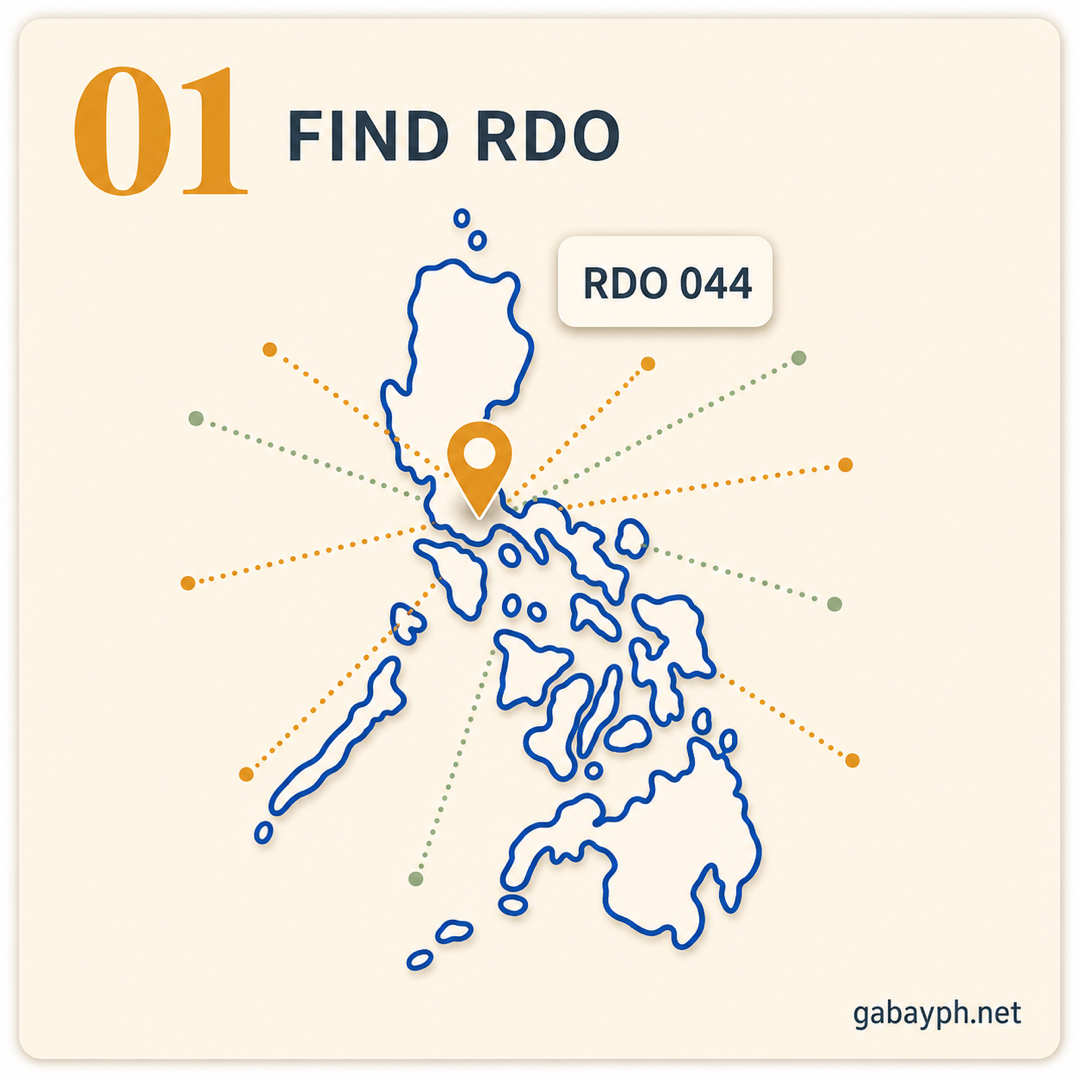
Determine Your RDO (Revenue District Office)
Alamin ang Iyong RDO (Revenue District Office)
Your RDO is the BIR office that has jurisdiction over your area. You must register at the RDO where your business or home office is located — not where you live (unless you work from home, in which case they are the same). To find your RDO, visit the BIR website at bir.gov.ph and look for the RDO directory, or call the BIR hotline at 8538-3200.
Ang iyong RDO ay ang BIR office na may hurisdiksyon sa iyong lugar. Kailangan mong mag-register sa RDO kung saan matatagpuan ang iyong negosyo o home office — hindi kung saan ka nakatira (maliban kung nagtatrabaho ka mula sa bahay, kung saan pareho sila). Para malaman ang iyong RDO, bisitahin ang BIR website sa bir.gov.ph at hanapin ang RDO directory, o tumawag sa BIR hotline sa 8538-3200.
If you already have a TIN from a previous employer and your current home address is in a different RDO, you may need to file BIR Form 1905 to transfer your TIN to the correct RDO first. Do this before proceeding with the rest of the registration.
Kung mayroon ka nang TIN mula sa dating employer at ang kasalukuyan mong address ay nasa ibang RDO, maaaring kailangan mong mag-file ng BIR Form 1905 para ilipat ang iyong TIN sa tamang RDO muna. Gawin ito bago magpatuloy sa natitirang registration.
-
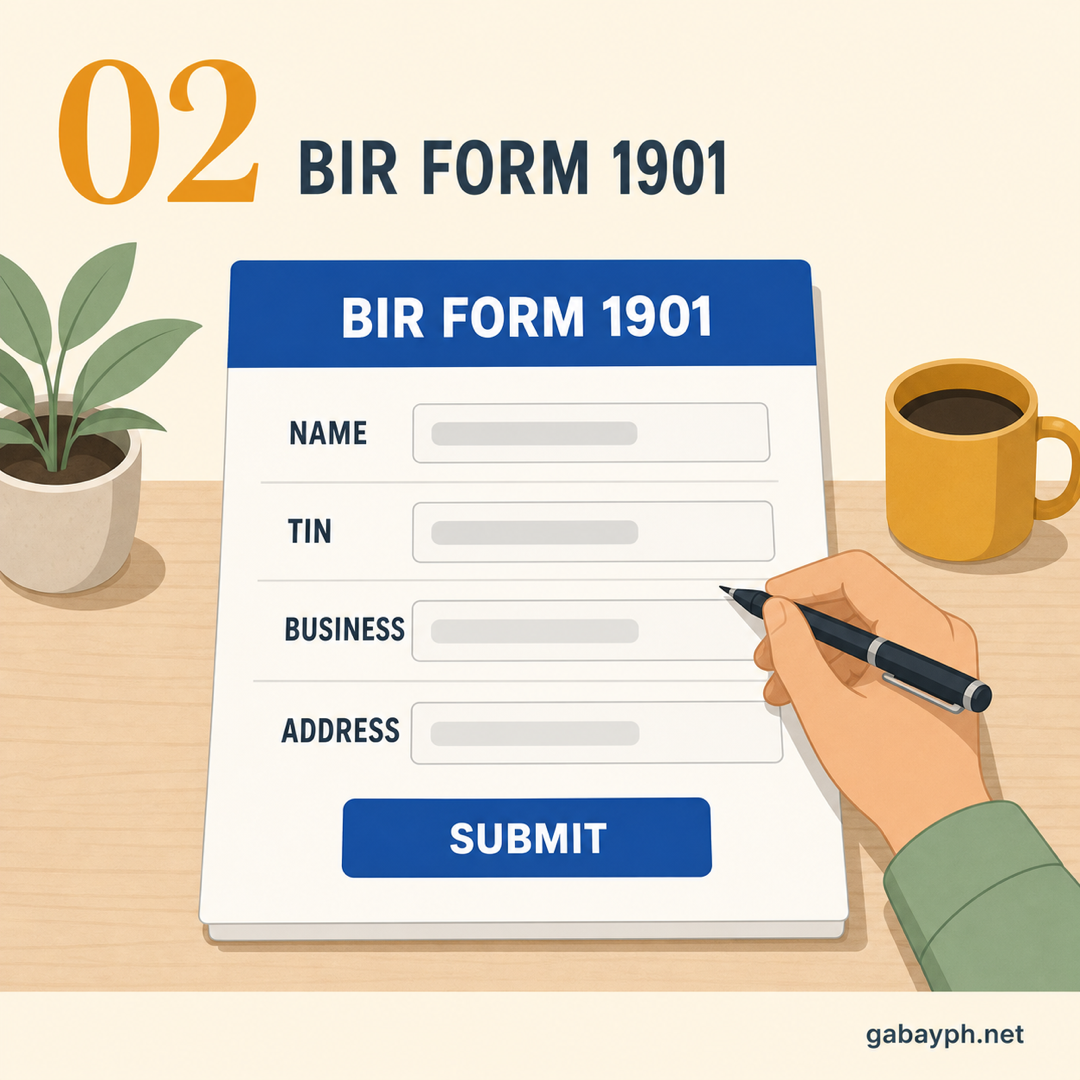
Fill Out and Submit BIR Form 1901 (or 1905)
Sagutan at I-submit ang BIR Form 1901 (o 1905)
Go to your RDO and submit the appropriate form along with your supporting documents:
Pumunta sa iyong RDO at i-submit ang angkop na form kasama ang iyong mga sumusuportang dokumento:
- BIR Form 1901 — If you are registering for the first time (no existing TIN). This form is your application for TIN and registration of self-employment/professional activity.
- BIR Form 1905 — If you already have a TIN (from employment) and are updating your registration to include self-employment. Check the box for "Update registration information" and indicate the changes.
- BIR Form 1901 — Kung unang beses mo mag-register (walang existing TIN). Ang form na ito ay ang iyong application para sa TIN at registration ng self-employment/professional activity.
- BIR Form 1905 — Kung mayroon ka nang TIN (mula sa employment) at ina-update mo ang iyong registration para isama ang self-employment. I-check ang box para sa "Update registration information" at ipahiwatig ang mga pagbabago.
On the form, you will be asked to indicate your tax type and line of business. For freelancers, common descriptions include: "Freelance Writer," "Virtual Assistant," "Graphic Designer," "IT Consultant," "Online Tutor," etc. You will also be asked to choose your tax option here — this is where you select the 8% flat tax or graduated rates.
Sa form, hihilingin kang ipahiwatig ang iyong tax type at line of business. Para sa mga freelancer, kasama sa mga karaniwang description ang: "Freelance Writer," "Virtual Assistant," "Graphic Designer," "IT Consultant," "Online Tutor," atbp. Hihilingin din sa iyo na piliin ang iyong tax option dito — dito ka pipili ng 8% flat tax o graduated rates.
-
Check the Annual Registration Fee Status (abolished)
I-check ang Annual Registration Fee Status (abolished)
The ₱500 annual registration fee is abolished under RA 11976 (EOPT Act). You no longer need to pay the ₱500 annual registration fee or file BIR Form 0605.
Ang ₱500 annual registration fee ay abolished sa ilalim ng RA 11976 (EOPT Act). Hindi mo na kailangang magbayad ng ₱500 annual registration fee o mag-file ng BIR Form 0605.
Note: This change took effect on January 22, 2024. Kung exempted ka na, mas mabuti — ₱500 na matitipid mo bawat taon.
Paalala: Naging epektibo ang pagbabagong ito noong January 22, 2024. Kung exempted ka na, mas mabuti — ₱500 na matitipid mo bawat taon.
-
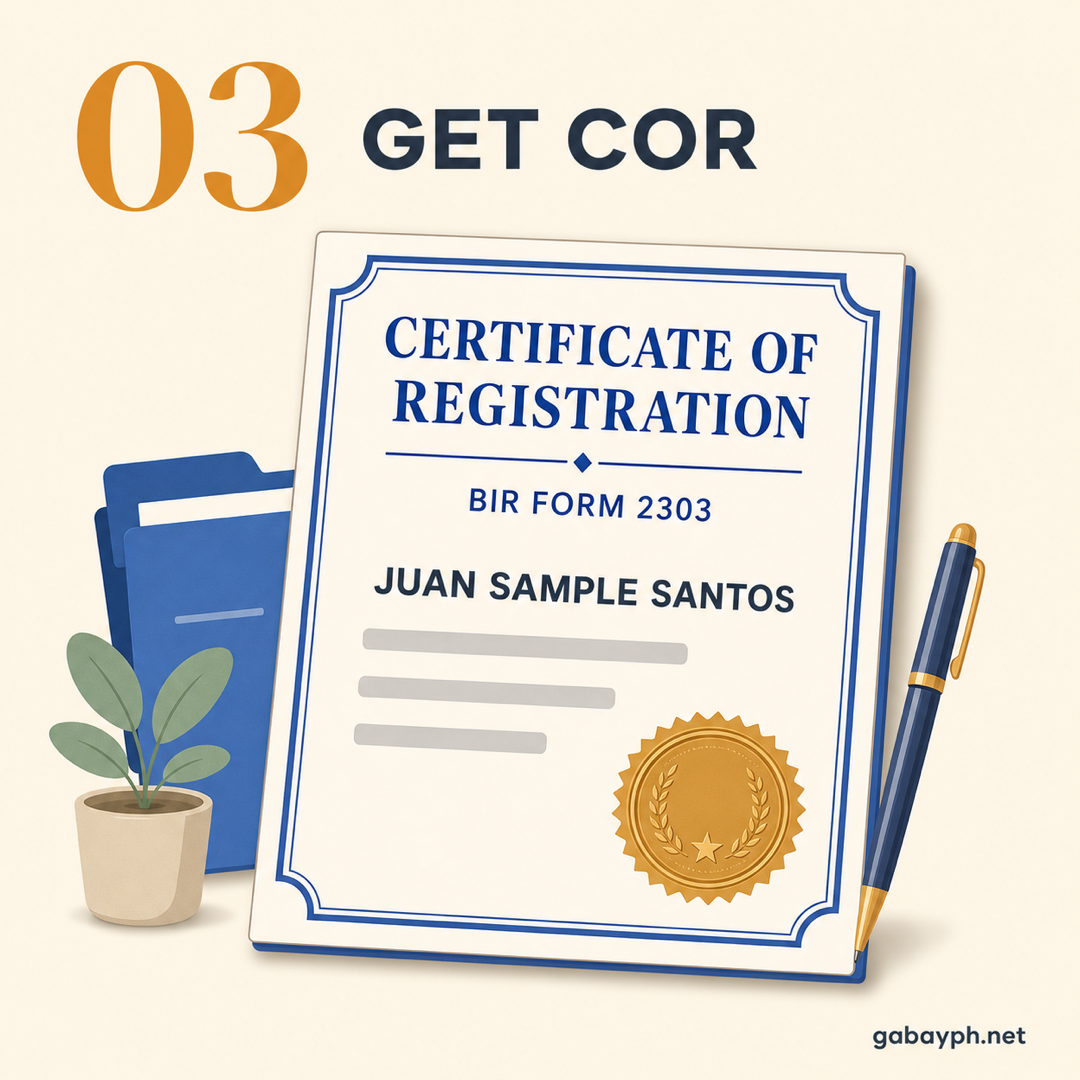
Get Your Certificate of Registration (COR / BIR Form 2303)
Kunin ang Iyong Certificate of Registration (COR / BIR Form 2303)
After processing your application and payment, the BIR will issue your Certificate of Registration (COR), also known as BIR Form 2303. This is the most important document from the registration process. It contains:
Pagkatapos i-process ang iyong application at bayad, mag-iisyu ang BIR ng iyong Certificate of Registration (COR), kilala rin bilang BIR Form 2303. Ito ang pinakamahalagang dokumento mula sa proseso ng registration. Nilalaman nito ang:
- Your TIN
- Your registered name and business address
- Your registered line of business/profession
- The tax types you are required to file (income tax, percentage tax, etc.)
- Your chosen tax option (8% flat or graduated)
- Filing and payment deadlines
- Ang iyong TIN
- Ang iyong registered name at business address
- Ang iyong registered line of business/propesyon
- Ang mga uri ng buwis na kailangan mong i-file (income tax, percentage tax, atbp.)
- Ang iyong piniling tax option (8% flat o graduated)
- Mga deadline ng filing at pagbabayad
Display your COR prominently. The BIR requires that your COR be posted in a conspicuous place at your business address. If you work from home, keep it displayed in your workspace. Lagi itong naka-display — baka magkaroon ng BIR inspection. Processing usually takes 1–3 working days, depending on the RDO.
I-display ang iyong COR nang prominente. Kinakailangan ng BIR na ang iyong COR ay naka-post sa isang conspicuous na lugar sa iyong business address. Kung nagtatrabaho ka mula sa bahay, panatilihin itong naka-display sa iyong workspace. Lagi itong naka-display — baka magkaroon ng BIR inspection. Ang processing ay karaniwang tumatagal ng 1–3 working days, depende sa RDO.
-
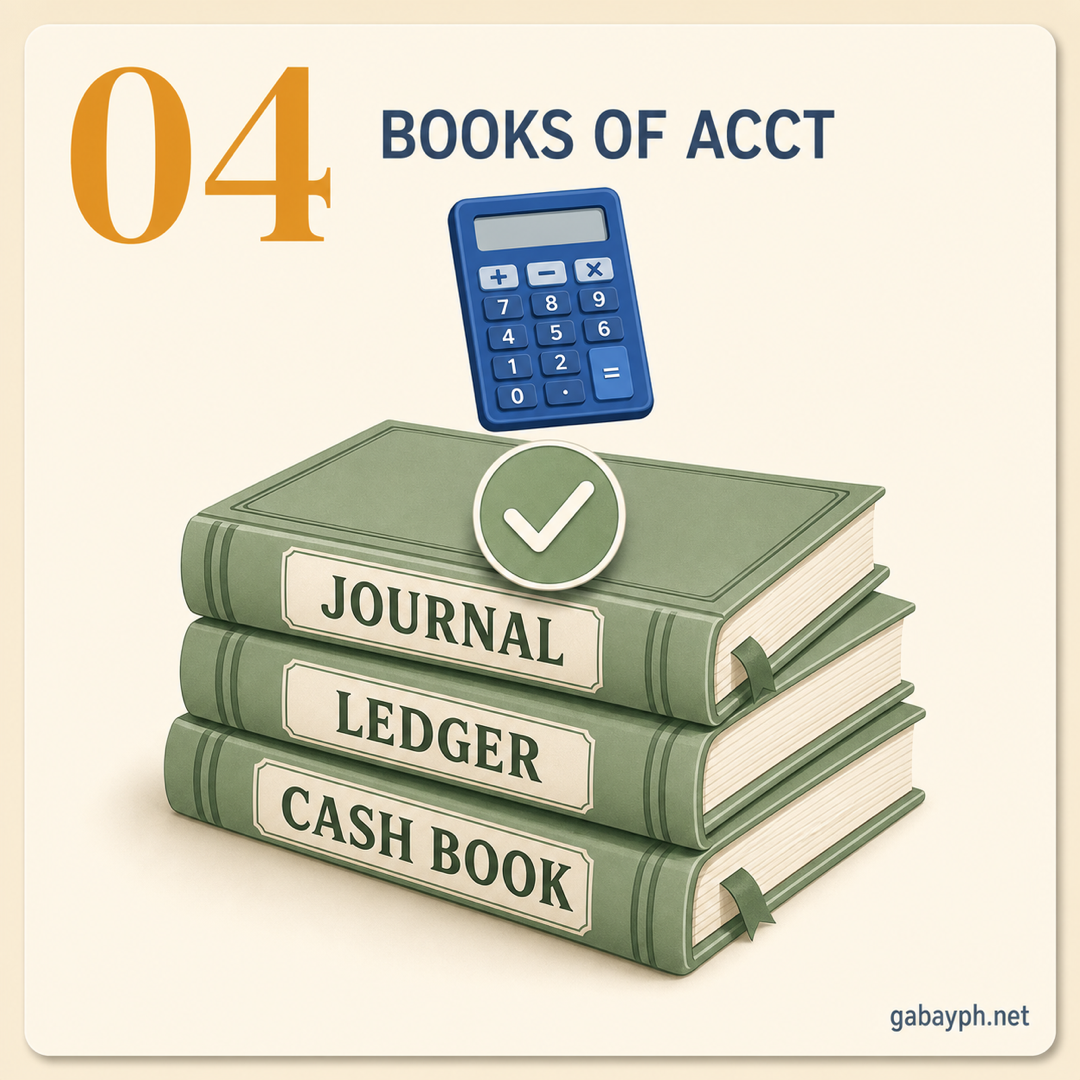
Register Your Books of Accounts
I-register ang Iyong Books of Accounts
You are required to register and maintain books of accounts to record your income and expenses. For freelancers who chose the 8% flat tax, you typically only need:
Kinakailangan mong mag-register at mag-maintain ng mga libro ng accounts para i-record ang iyong income at expenses. Para sa mga freelancer na pumili ng 8% flat tax, karaniwang kailangan mo lang ng:
- Journal — A record of all transactions in chronological order
- Ledger — A summary of transactions organized by account
- Journal — Isang record ng lahat ng transaksyon sa chronological order
- Ledger — Isang buod ng mga transaksyon na nakaayos ayon sa account
You can buy bound accounting books (the ones with numbered pages) from bookstores like National Bookstore. Bring them to your RDO for stamping and registration. Alternatively, you can use computerized books of accounts — but you need to apply for a Permit to Use (PTU) computerized accounting system with the BIR. For most freelancers, the manual bound books are simpler and sufficient.
Maaari kang bumili ng bound accounting books (yung mga may numbered pages) mula sa mga bookstore tulad ng National Bookstore. Dalhin ito sa iyong RDO para sa stamping at registration. Bilang kahalili, maaari kang gumamit ng computerized books of accounts — pero kailangan mong mag-apply ng Permit to Use (PTU) computerized accounting system sa BIR. Para sa karamihan ng mga freelancer, ang manual bound books ay mas simple at sapat na.
-
Get Authority to Print Receipts/Invoices (or Register for eReceipts)
Kumuha ng Authority to Print ng mga Resibo/Invoice (o Mag-register para sa eReceipts)
As a registered self-employed individual, you need to issue invoices, while official receipts are supplementary document only for every transaction. To get physical receipts printed, you must first secure an Authority to Print (ATP) from the BIR. Here is the process:
Bilang registered self-employed individual, kailangan mong mag-issue ng invoices, habang ang official receipts ay supplementary document only para sa bawat transaksyon. Para magpa-print ng physical receipts, kailangan mong kumuha muna ng Authority to Print (ATP) mula sa BIR. Narito ang proseso:
- File BIR Form 1906 (Application for Authority to Print Receipts and Invoices) at your RDO
- Once approved, bring the ATP to a BIR-accredited printer to have your invoices printed
- The printed receipts will have your TIN, business name, address, and the ATP number
- Mag-file ng BIR Form 1906 (Application for Authority to Print Receipts and Invoices) sa iyong RDO
- Kapag na-approve na, dalhin ang ATP sa isang BIR-accredited printer para magpa-print ng iyong invoices
- Ang mga naka-print na resibo ay magkakaroon ng iyong TIN, business name, address, at ATP number
Alternative: eReceipts/eInvoices. Under newer BIR regulations, taxpayers can apply to use electronic receipts and invoices. This is done through the BIR's eInvoicing/eReceipt System (EIS). If you prefer digital over paper, ask your RDO about the process to register for eReceipts. Hindi lahat ng RDO ay may same process for this, so it is best to ask directly.
Alternatibo: eReceipts/eInvoices. Sa ilalim ng mga bagong regulasyon ng BIR, maaaring mag-apply ang mga taxpayer na gumamit ng electronic receipts at invoices. Ito ay ginagawa sa pamamagitan ng eInvoicing/eReceipt System (EIS) ng BIR. Kung mas gusto mo ang digital kaysa sa papel, tanungin ang iyong RDO tungkol sa proseso para mag-register ng eReceipts. Hindi lahat ng RDO ay may same process para dito, kaya pinakamainam na magtanong nang diretso.
Quarterly Filing Schedule
Schedule ng Quarterly Filing
Once registered, you are required to file and pay taxes on a quarterly and annual basis. Here is the filing schedule every freelancer needs to remember:
Kapag nakarehistro na, kinakailangan mong mag-file at magbayad ng buwis sa quarterly at taunang batayan. Narito ang filing schedule na kailangang tandaan ng bawat freelancer:
Quarterly Income Tax Return (BIR Form 1701Q)
Quarterly Income Tax Return (BIR Form 1701Q)
- 1st Quarter (Jan–Mar): File and pay by May 15
- 2nd Quarter (Apr–Jun): File and pay by August 15
- 3rd Quarter (Jul–Sep): File and pay by November 15
- Annual ITR (Jan–Dec): File BIR Form 1701 or 1701A and pay by April 15 of the following year
- 1st Quarter (Ene–Mar): Mag-file at magbayad bago ang Mayo 15
- 2nd Quarter (Abr–Hun): Mag-file at magbayad bago ang Agosto 15
- 3rd Quarter (Hul–Set): Mag-file at magbayad bago ang Nobyembre 15
- Taunang ITR (Ene–Dis): Mag-file ng BIR Form 1701 o 1701A at magbayad bago ang Abril 15 ng susunod na taon
Quarterly Percentage Tax (BIR Form 2551Q) — Only for Graduated Rate Filers
Quarterly Percentage Tax (BIR Form 2551Q) — Para Lang sa mga Graduated Rate Filer
If you chose the graduated tax rates (not the 8% flat tax), you also need to file and pay the 3% percentage tax every quarter. The deadlines are the same as above: April 15, August 15, November 15, and January 15 (for Q4). If you chose the 8% flat tax, you do NOT need to file the 2551Q — the 8% already covers both income tax and percentage tax.
Kung pinili mo ang graduated tax rates (hindi ang 8% flat tax), kailangan mo ring mag-file at magbayad ng 3% percentage tax bawat quarter. Ang mga deadline ay pareho sa itaas: Abril 15, Agosto 15, Nobyembre 15, at Enero 15 (para sa Q4). Kung pinili mo ang 8% flat tax, HINDI mo kailangang mag-file ng 2551Q — ang 8% ay sumasaklaw na sa parehong income tax at percentage tax.
For a detailed walkthrough of how to actually file your taxes using eBIRForms, compute your tax, and pay via GCash or bank, see our complete guide: How to File and Pay Taxes in the Philippines.
Para sa detalyadong walkthrough kung paano aktwal na mag-file ng iyong buwis gamit ang eBIRForms, i-compute ang iyong buwis, at magbayad sa pamamagitan ng GCash o bangko, tingnan ang aming kumpletong gabay: Paano Mag-file at Magbayad ng Buwis sa Pilipinas.
Record-Keeping for Freelancers
Pag-iingat ng Records para sa mga Freelancer
Good record-keeping is not just a BIR requirement — it is the foundation of managing your freelance finances. Whether you chose the 8% flat tax or graduated rates, you need to track your income and expenses. Here is what to keep and how:
Ang maayos na pag-iingat ng records ay hindi lang BIR requirement — ito ang pundasyon ng pag-manage ng iyong freelance finances. Kahit pinili mo ang 8% flat tax o graduated rates, kailangan mong i-track ang iyong income at expenses. Narito kung ano ang dapat itago at paano:
What to Track
Ano ang Dapat I-track
- All income received — Client payments, platform payouts (Upwork, Fiverr, etc.), bank transfers, PayPal/Wise/Payoneer deposits. Record the date, client name, amount in PHP (or foreign currency + PHP equivalent), and invoice number.
- All business expenses — Rent, internet, phone, equipment, software subscriptions, office supplies, transportation, professional development courses. Keep all official receipts.
- Official receipts you issued — Keep the duplicate copy of every OR you issue to clients.
- BIR Form 2307 certificates — Withholding tax certificates from clients who withheld taxes from your payments. These are credits against your tax due.
- Lahat ng income na natanggap — Mga bayad ng kliyente, platform payouts (Upwork, Fiverr, atbp.), bank transfers, PayPal/Wise/Payoneer deposits. I-record ang petsa, pangalan ng kliyente, halaga sa PHP (o foreign currency + PHP equivalent), at invoice number.
- Lahat ng business expenses — Upa, internet, telepono, kagamitan, software subscriptions, office supplies, transportasyon, professional development courses. Itago ang lahat ng official receipts.
- Official receipts na inisyu mo — Itago ang duplicate copy ng bawat OR na inisyu mo sa mga kliyente.
- BIR Form 2307 certificates — Mga withholding tax certificates mula sa mga kliyente na nag-withhold ng buwis mula sa iyong mga bayad. Ito ang mga credits laban sa iyong buwis na dapat bayaran.
Tools: A simple Google Sheets file works for most freelancers. For automation, try Taxumo (Philippine-specific, integrates with BIR filing) or JuanTax.
Tools: Isang simpleng Google Sheets file ay sapat para sa karamihan ng mga freelancer. Para sa automation, subukan ang Taxumo (Philippine-specific, may integration sa BIR filing) o JuanTax.
How Long to Keep Records
Gaano Katagal Itago ang mga Record
The BIR requires you to keep all books of accounts, receipts, invoices, and other tax-related records for ten (10) years from the due date of the tax return. This means your 2025 records should be kept until at least 2036. Huwag itapon ang mga lumang resibo — digital backup is your friend. Scan everything and store it in the cloud for safekeeping.
Kinakailangan ng BIR na itago mo ang lahat ng books of accounts, receipts, invoices, at iba pang tax-related records sa loob ng sampung (10) taon mula sa due date ng tax return. Ibig sabihin nito, ang iyong 2025 records ay dapat itago hanggang hindi bababa sa 2036. Huwag itapon ang mga lumang resibo — digital backup is your friend. I-scan ang lahat at i-store sa cloud para sa safekeeping.
Handling USD/Foreign Income
Pag-handle ng USD/Foreign Income
Many Filipino freelancers earn in US dollars or other foreign currencies through platforms like Upwork, Fiverr, Toptal, or direct clients abroad. Here is how to handle foreign income for tax purposes:
Maraming Pilipinong freelancer ang kumikita sa US dollars o iba pang foreign currencies sa pamamagitan ng mga platform tulad ng Upwork, Fiverr, Toptal, o direktang mga kliyente sa abroad. Narito kung paano pangasiwaan ang foreign income para sa mga layuning buwis:
Exchange Rate for Tax Computation
Exchange Rate para sa Tax Computation
When computing your tax, convert your foreign income to Philippine Pesos using the Bangko Sentral ng Pilipinas (BSP) exchange rate on the date you received the payment. For example, if you received $500 from Upwork on March 15, 2026, and the BSP rate was ₱56.50 = $1.00 on that date, your income for that transaction is ₱28,250. You can check BSP exchange rates at bsp.gov.ph.
Kapag kinukuwenta ang iyong buwis, i-convert ang iyong foreign income sa Philippine Pesos gamit ang exchange rate ng Bangko Sentral ng Pilipinas (BSP) sa petsa na natanggap mo ang bayad. Halimbawa, kung nakatanggap ka ng $500 mula sa Upwork noong Marso 15, 2026, at ang BSP rate ay ₱56.50 = $1.00 sa petsang iyon, ang iyong income para sa transaksyong iyon ay ₱28,250. Pwede mong i-check ang BSP exchange rates sa bsp.gov.ph.
Declaring Upwork/PayPal/Payoneer Income
Pag-declare ng Upwork/PayPal/Payoneer Income
All income earned by a Filipino citizen residing in the Philippines is taxable — regardless of where the client is based or what platform you use. This includes:
Lahat ng kita na kinikita ng isang Pilipinong mamamayan na naninirahan sa Pilipinas ay taxable — anuman kung saan nakabase ang kliyente o anong platform ang ginagamit mo. Kasama dito ang:
- Upwork earnings (even though Upwork is a US company)
- PayPal payments from foreign clients
- Payoneer and Wise (TransferWise) transfers
- Direct bank wire transfers from abroad
- Cryptocurrency payments converted to fiat
- Upwork earnings (kahit na ang Upwork ay isang US company)
- PayPal payments mula sa mga foreign clients
- Payoneer at Wise (TransferWise) transfers
- Direct bank wire transfers mula sa abroad
- Cryptocurrency payments na na-convert sa fiat
The fact that the money comes from abroad does not make it tax-exempt. Filipino residents are taxed on worldwide income. Declare all of it.
Ang katotohanang ang pera ay galing sa abroad ay hindi nangangahulugang tax-exempt ito. Ang mga Pilipinong residente ay binu-buwis sa worldwide income. I-declare ang lahat.
No Double Taxation (Usually)
Walang Double Taxation (Karaniwan)
If your foreign client did not withhold any taxes in their country (which is typical for most freelance platforms like Upwork), then there is no double taxation issue — you simply pay Philippine taxes on the full amount. The Philippines has tax treaties with many countries, but these mostly apply to situations where taxes were actually withheld by the foreign country. If you received the full payment without any foreign tax deduction, you just declare and pay in the Philippines.
Kung ang iyong foreign client ay hindi nag-withhold ng anumang buwis sa kanilang bansa (na karaniwan para sa karamihan ng freelance platforms tulad ng Upwork), walang isyu ng double taxation — nagbabayad ka lang ng Philippine taxes sa buong halaga. Ang Pilipinas ay may tax treaties sa maraming bansa, pero karamihan nito ay naaangkop sa mga sitwasyon kung saan aktwal na nag-withhold ng buwis ang dayuhang bansa. Kung natanggap mo ang buong bayad nang walang anumang foreign tax deduction, i-declare at magbayad ka lang sa Pilipinas.
Common Deductions for Graduated Rate Filers
Mga Karaniwang Deduction para sa Graduated Rate Filers
If you chose the graduated income tax rates with itemized deductions (not the 8% flat tax or OSD), you can deduct legitimate business expenses from your gross income to lower your taxable income. Here are the most common deductions for freelancers:
Kung pinili mo ang graduated income tax rates na may itemized deductions (hindi ang 8% flat tax o OSD), maaari mong ibawas ang mga lehitimong business expenses mula sa iyong gross income para mabawasan ang iyong taxable income. Narito ang mga pinakakaraniwang deduction para sa mga freelancer:
- Home office expenses (proportional): If you use a dedicated portion of your home as your workspace, you can deduct a proportional share of rent, electricity, and water. For example, if your home office takes up 20% of your condo unit's floor area, you can deduct 20% of your rent and utilities. You need a reasonable basis for the proportion.
- Internet and phone bills: The business portion of your internet and mobile phone bills is deductible. If you use your internet 80% for work, you can deduct 80% of the monthly bill. Keep all billing statements.
- Computer and equipment (depreciation): Laptops, monitors, printers, webcams, headsets, and other equipment used for work can be deducted — but not as a one-time expense. Instead, you depreciate them over their useful life (typically 3–5 years). For example, a ₱60,000 laptop depreciated over 3 years = ₱20,000 deduction per year.
- Software subscriptions: Adobe Creative Cloud, Microsoft 365, Canva Pro, Grammarly, Zoom, project management tools — all deductible if used for your freelance work.
- Transportation expenses: Grab/taxi fares, gas, and parking fees for business-related travel. Keep receipts or digital records (Grab receipts are sent via email).
- Professional development: Online courses, certifications, books, and training programs related to your profession. Investing in yourself is tax-deductible.
- Professional fees: CPA fees, legal consultation fees, bookkeeper costs — these are all deductible.
- Home office expenses (proportional): Kung gumagamit ka ng dedicated na bahagi ng iyong bahay bilang workspace, maaari mong ibawas ang proportional share ng upa, kuryente, at tubig. Halimbawa, kung ang iyong home office ay sumasakop ng 20% ng floor area ng iyong condo unit, maaari mong ibawas ang 20% ng iyong upa at utilities. Kailangan mo ng makatwirang batayan para sa proporsyon.
- Internet at phone bills: Ang bahaging pang-negosyo ng iyong internet at mobile phone bills ay deductible. Kung ginagamit mo ang iyong internet na 80% para sa trabaho, maaari mong ibawas ang 80% ng buwanang bill. Itago ang lahat ng billing statements.
- Computer at kagamitan (depreciation): Mga laptop, monitor, printer, webcam, headset, at iba pang kagamitan na ginagamit sa trabaho ay maaaring ibawas — pero hindi bilang one-time expense. Sa halip, dine-depreciate mo ang mga ito sa loob ng kanilang useful life (karaniwang 3–5 taon). Halimbawa, isang ₱60,000 laptop na dine-depreciate sa loob ng 3 taon = ₱20,000 deduction bawat taon.
- Software subscriptions: Adobe Creative Cloud, Microsoft 365, Canva Pro, Grammarly, Zoom, project management tools — lahat ay deductible kung ginagamit para sa iyong freelance work.
- Transportation expenses: Grab/taxi fares, gas, at parking fees para sa business-related travel. Itago ang mga resibo o digital records (ang Grab receipts ay ipinapadala sa email).
- Professional development: Mga online courses, certifications, mga libro, at training programs na may kaugnayan sa iyong propesyon. Ang pag-invest sa sarili mo ay tax-deductible.
- Professional fees: CPA fees, legal consultation fees, bookkeeper costs — lahat ng ito ay deductible.
Important: To claim itemized deductions, you must have official receipts (ORs) for every expense. No OR = no deduction. This is why many freelancers prefer the 8% flat tax or OSD — it avoids the hassle of collecting receipts for every single business expense. Kung hindi ka masipag mag-keep ng resibo, do not choose itemized deductions.
Mahalaga: Para mag-claim ng itemized deductions, kailangan mong magkaroon ng official receipts (ORs) para sa bawat gastos. Walang OR = walang deduction. Kaya naman mas gusto ng maraming freelancer ang 8% flat tax o OSD — inaiwasan nito ang abala ng pag-collect ng mga resibo para sa bawat isang business expense. Kung hindi ka masipag mag-keep ng resibo, huwag pumili ng itemized deductions.
Pro Tips for Freelancer BIR Registration
Mga Payo para sa Freelancer BIR Registration
- Always get receipts. Even if you are on the 8% flat tax, keep receipts for your own records — they are useful during BIR audits or if you switch to deductions later.
- You can switch tax options at the start of each year. File BIR Form 1905 before the first quarterly filing deadline. Compare both options annually to see which saves you more.
- Consider hiring a bookkeeper if you earn ₱500K+ per year. A CPA costs around ₱2,000–₱5,000 per quarter and handles all filing and computation. Mas mahal ang multa kaysa sa CPA fee.
- Join freelancer communities. Facebook groups like "Filipino Freelancers" and "Taxumo Users" are great for real-world BIR advice and CPA recommendations.
- Laging kumuha ng resibo. Kahit nasa 8% flat tax ka, itago ang mga resibo para sa iyong sariling records — kapaki-pakinabang ang mga ito sa BIR audit o kung mag-switch ka sa deductions sa hinaharap.
- Pwede kang mag-switch ng tax options sa simula ng bawat taon. Mag-file ng BIR Form 1905 bago ang unang quarterly filing deadline. Ihambing ang parehong options bawat taon para makita kung alin ang mas nakakatipid.
- Isaalang-alang ang pagkuha ng bookkeeper kung kumikita ka ng ₱500K+ bawat taon. Isang CPA ay nagkakahalaga ng mga ₱2,000–₱5,000 bawat quarter at inaasikaso ang lahat ng filing at computation. Mas mahal ang multa kaysa sa CPA fee.
- Sumali sa mga freelancer communities. Ang mga Facebook group tulad ng "Filipino Freelancers" at "Taxumo Users" ay mahusay para sa real-world BIR advice at CPA recommendations.
Frequently Asked Questions
Mga Madalas Itanong
Do I need to register with BIR if I earn from Upwork?
Yes. All income earned by a Philippine resident is taxable regardless of where the client or platform is based. This applies to Upwork, Fiverr, Toptal, OnlineJobs.ph, and any other platform. Hindi porke galing sa abroad ang pera ay hindi na taxable.
Kailangan ko bang mag-register sa BIR kung kumikita ako sa Upwork?
Oo. Lahat ng kita na kinikita ng isang Philippine resident ay taxable anuman kung saan nakabase ang kliyente o platform. Naaangkop ito sa Upwork, Fiverr, Toptal, OnlineJobs.ph, at anumang ibang platform. Hindi porke galing sa abroad ang pera ay hindi na taxable.
What's the 8% flat tax and how does it work?
You pay 8% of gross income exceeding ₱250,000 (available if gross annual sales are ₱3M or less). It replaces both income tax and percentage tax — one rate, one computation, no need to track deductions. See the Choosing Your Tax Option section above for the full comparison.
Ano ang 8% flat tax at paano ito gumagana?
Nagbabayad ka ng 8% ng gross income na lampas sa ₱250,000 (available kung ang gross annual sales ay ₱3M o mas mababa). Pinapalitan nito ang parehong income tax at percentage tax — isang rate, isang computation, hindi kailangan mag-track ng deductions. Tingnan ang Pagpili ng Tax Option section sa itaas para sa buong paghahambing.
Can I register with BIR online?
Partially. You can get a TIN online via the BIR eREG system (ereg.bir.gov.ph). However, the full registration — submitting Form 1901/1905, getting your COR, registering books of accounts — still requires a personal visit to your RDO as of 2026. Check your RDO's Facebook page or call ahead for appointment requirements.
Pwede ba akong mag-register sa BIR online?
Bahagya. Pwede kang kumuha ng TIN online sa BIR eREG system (ereg.bir.gov.ph). Pero ang buong registration — pag-submit ng Form 1901/1905, pagkuha ng COR, pag-register ng books of accounts — ay nangangailangan pa rin ng personal na pagbisita sa iyong RDO as of 2026. I-check ang Facebook page ng iyong RDO o tumawag muna para sa appointment requirements.
What if I've been freelancing without BIR registration?
Register as soon as possible. Consult a CPA to assess back taxes, then follow the steps in this guide. The BIR occasionally runs voluntary compliance programs that reduce penalties. The BIR now has data-matching with banks and digital platforms — hindi pwedeng mag-tago forever.
Paano kung matagal na akong nag-freelance nang walang BIR registration?
Mag-register kaagad. Kumonsulta sa CPA para tasahan ang back taxes, pagkatapos sundin ang mga hakbang sa gabay na ito. Ang BIR ay paminsan-minsang nagpapatakbo ng voluntary compliance programs na nagbabawas ng penalties. Ang BIR ngayon ay may data-matching sa mga bangko at digital platforms — hindi pwedeng mag-tago forever.
Do I need to issue official receipts as a freelancer?
Yes. You are required to issue ORs for every payment received. Corporate clients often require them, and they are key documents during BIR audits. See Step 6 above for how to secure your Authority to Print (ATP).
Kailangan ko bang mag-issue ng official receipts bilang freelancer?
Oo. Kinakailangan mong mag-issue ng ORs para sa bawat bayad na natanggap. Madalas itong kinakailangan ng corporate clients, at isa ito sa mga pangunahing dokumento sa BIR audit. Tingnan ang Hakbang 6 sa itaas kung paano kumuha ng Authority to Print (ATP).
How much tax will I actually pay as a freelancer?
With the 8% flat tax, the formula is simple: 8% x (gross income – ₱250,000). Example: earning ₱40,000/month (₱480,000/year) = ₱18,400/year in tax (~₱1,533/month). See the tax comparison section above for more income levels. For graduated rates, consult a CPA or use an online tax calculator.
Magkano ang talagang buwis na babayaran ko bilang freelancer?
Sa 8% flat tax, simple ang formula: 8% x (gross income – ₱250,000). Halimbawa: kumikita ng ₱40,000/buwan (₱480,000/taon) = ₱18,400/taon na buwis (~₱1,533/buwan). Tingnan ang paghahambing ng buwis section sa itaas para sa iba pang income levels. Para sa graduated rates, kumonsulta sa CPA o gumamit ng online tax calculator.