

How to Write a Resume & Ace Your Interview in the Philippines (2026 Guide)
Paano Gumawa ng Resume & Pumasa sa Interview sa Pilipinas (2026 Gabay)

5 Things to Know
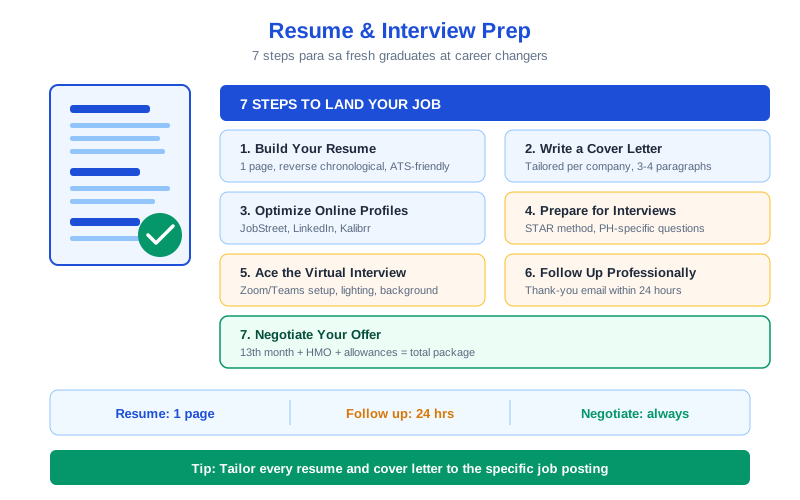
Resume + interview in five facts.
Quick Summary
Mabilis na Buod
Philippine employers screen resumes in under 30 seconds. This guide covers exactly how to build a resume that passes ATS filters, write cover letters that get read, prepare for in-person and virtual interviews, and negotiate a compensation package that goes beyond base salary.
Hindi aabutin ng 30 segundo ang mga Philippine employer sa pag-screen ng resume. Saklaw ng gabay na ito kung paano gumawa ng resume na pumapasa sa ATS filters, sumulat ng cover letter na mababasa talaga, maghanda para sa in-person at virtual interviews, at makipag-negotiate ng compensation package na higit pa sa base salary.
Table of Contents
- What You Need Before Applying
- Step 1: Build Your Resume
- Step 2: Write a Cover Letter That Works
- Step 3: Optimize Your Online Profiles
- Step 4: Prepare for Common Interview Questions
- Step 5: Ace the Virtual Interview
- Step 6: Follow Up Professionally
- Step 7: Negotiate Your Offer
- Pro Tips
- Frequently Asked Questions
- Related Guides
Talaan ng Nilalaman
- Mga Kailangan Bago Mag-apply
- Hakbang 1: Gumawa ng Resume
- Hakbang 2: Sumulat ng Epektibong Cover Letter
- Hakbang 3: I-optimize ang Online Profiles Mo
- Hakbang 4: Maghanda sa mga Karaniwang Interview Questions
- Hakbang 5: Pumasa sa Virtual Interview
- Hakbang 6: Mag-follow Up nang Propesyonal
- Hakbang 7: I-negotiate ang Offer Mo
- Mga Payo
- Mga Madalas Itanong
- Mga Kaugnay na Gabay
What You Need Before Applying
Mga Kailangan Bago Mag-apply
- Updated resume (1 page for fresh grads, max 2 for career changers)
- Professional email address (firstname.lastname format — not cutie_girl2003@)
- Government IDs ready (see our Job Seeker Checklist)
- LinkedIn profile with professional photo
- Laptop or smartphone with stable internet for virtual interviews
- Transcript of Records / Diploma (fresh grads)
- Portfolio or work samples (if applicable to your field)
- Updated na resume (1 page para sa fresh grads, max 2 para sa career changers)
- Propesyonal na email address (firstname.lastname format — hindi cutie_girl2003@)
- Mga government ID na handa na (tingnan ang aming Job Seeker Checklist)
- LinkedIn profile na may propesyonal na litrato
- Laptop o smartphone na may stable na internet para sa virtual interviews
- Transcript of Records / Diploma (fresh grads)
- Portfolio o work samples (kung applicable sa field mo)
-
Build Your Resume
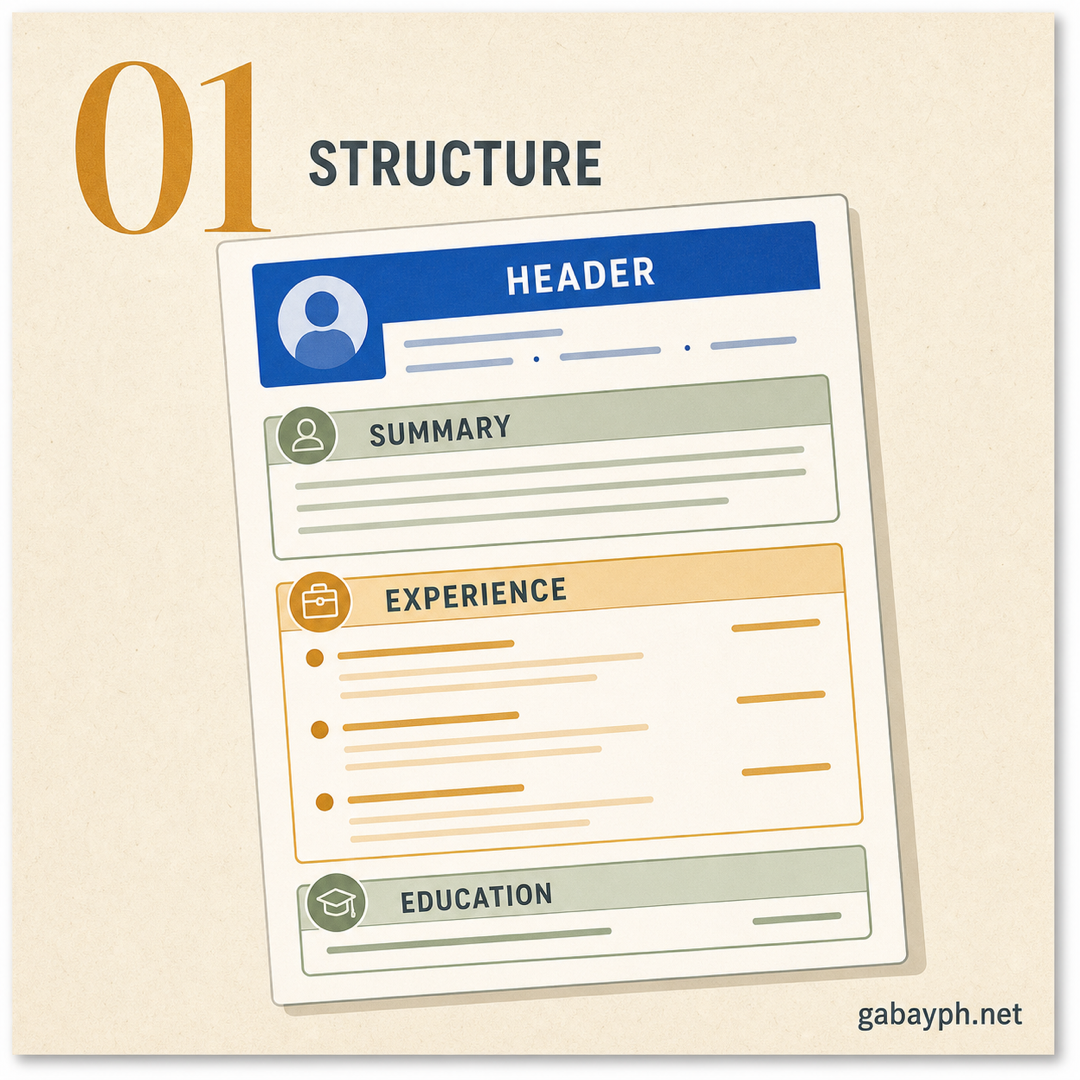
Use reverse chronological format (most recent experience first). For fresh graduates, lead with Education, followed by OJT/Internship Experience, Skills, and Extracurriculars/Volunteer Work. Career changers should lead with a Professional Summary (2-3 sentences) highlighting transferable skills.
Format rules for PH employers:
- Length: 1 page for fresh grads. 2 pages max if you have 5+ years of experience.
- Language: English for 95% of jobs. Only use Filipino if the posting is in Filipino.
- File format: PDF (preserves formatting). Name it LastName_FirstName_Resume.pdf.
- No photo unless the job posting specifically asks for one. ATS software cannot read images.
- No personal info like age, religion, height/weight, or civil status. These are outdated PH resume habits that waste space.
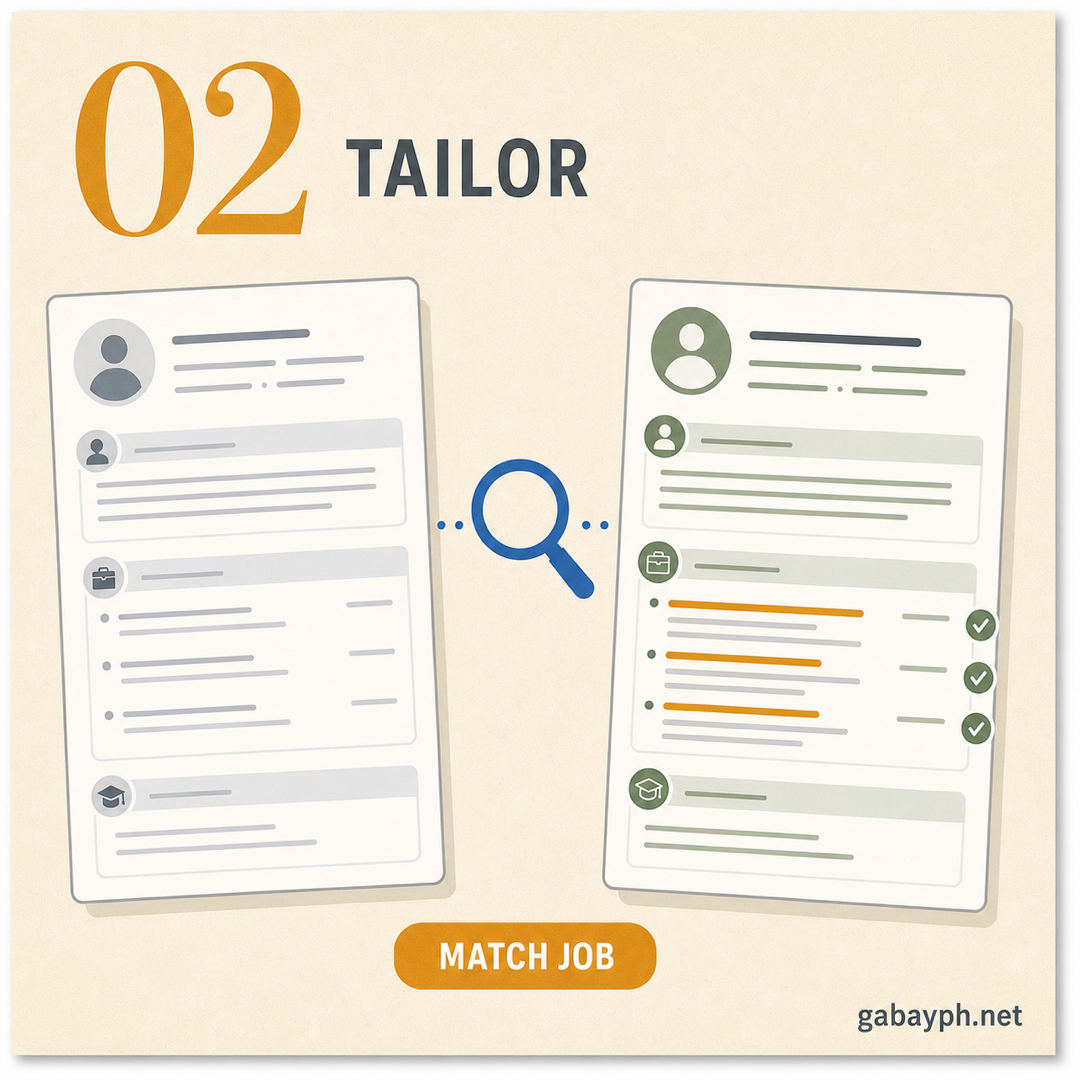
- Include a Skills section split into Technical Skills (Excel, Python, AutoCAD, etc.) and Soft Skills (communication, leadership). Use exact keywords from the job posting.
Fresh grad tip: OJT experience counts. List your company, role, dates, and 2-3 bullet points starting with action verbs (developed, organized, assisted, created). Academic projects and thesis work also count — describe the problem, your role, and the result.
-
Write a Cover Letter That Works
Most Filipino job seekers skip the cover letter. That is exactly why writing one gives you an edge. Keep it to 3-4 short paragraphs:
- Paragraph 1: State the exact position and where you found it. One sentence on why this company interests you.
- Paragraph 2: Your strongest qualification that matches the job description. Use a specific example — not just “I am hardworking.”
- Paragraph 3: One more skill or experience that adds value. Mention relevant coursework, OJT, or certifications.
- Paragraph 4: Thank them, state your availability for an interview, and include your phone number.
Write a new cover letter for each company. Reusing a generic letter is worse than sending none — recruiters can tell immediately.
-
Optimize Your Online Profiles
Set up accounts on the platforms where PH employers actually hire:
- JobStreet (SEEK) — largest PH job board with 50,000+ active listings. Complete your profile to 100% — recruiters filter by completeness. Upload your resume as a PDF.
- LinkedIn — best for corporate, tech, and mid-to-senior roles. Use a professional headshot (plain background, good lighting). Write a headline beyond just “Fresh Graduate” — try “BS Accountancy Graduate | CPA Board Passer | Open to Audit & Tax Roles.”
- Kalibrr — strong for tech, startups, and BPO. Skills-based matching helps if you lack traditional experience.
- Indeed PH — aggregates jobs from multiple sites. Set up job alerts with your target keywords.
- OnlineJobs.ph — if you want remote work for international clients (VA, content writing, design, dev).
Set your profiles to “Open to Work” and enable job alerts. Apply within the first 48 hours of a posting — early applicants get more attention.
-
Prepare for Common Interview Questions
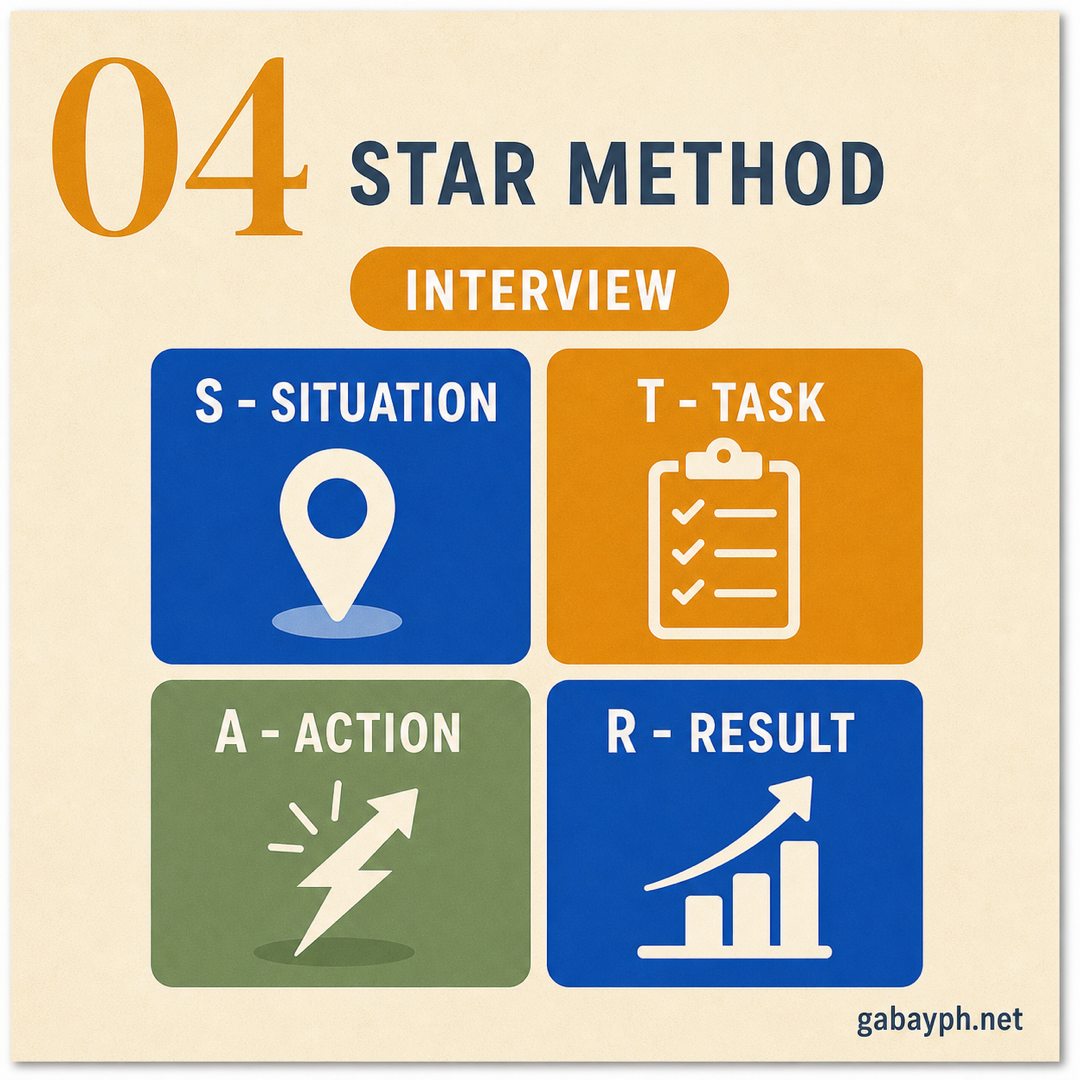
Philippine employers ask a predictable set of questions. Prepare answers using the STAR method (Situation, Task, Action, Result) for behavioral questions:
- “Tell me about yourself.” — Give a 2-minute summary: education, relevant experience, why you are here. Not your life story.
- “Why should we hire you?” — Match 2-3 of your skills directly to the job description. Be specific.
- “What is your expected salary?” — Research the market rate on JobStreet or Glassdoor first. Give a range, not a single number. (More on this in Step 7.)
- “What is your weakness?” — Name a real weakness and explain what you are doing to improve it. Do not say “perfectionist” or “workaholic.”
- “Where do you see yourself in 5 years?” — Show ambition aligned with the role. Saying “in your position” is not charming — say what skills you want to develop.
- “Do you have questions for us?” — Always say yes. Ask about team structure, training programs, or what success looks like in the first 6 months.
For BPO roles: Expect a voice assessment and mock customer call. Practice speaking clearly in English with a neutral accent. Call center interviews often include a typing test (minimum 35 WPM).
-
Ace the Virtual Interview
Over 65% of initial interviews in the Philippines now happen via Zoom, Microsoft Teams, or Google Meet. Your setup matters as much as your answers:
- Test everything 24 hours before: camera, microphone, internet speed (minimum 5 Mbps), and the specific platform the recruiter mentioned. Download the app in advance.
- Lighting: Face a window or place a lamp in front of you at a 45-degree angle. Never sit with a window behind you — you will appear as a silhouette.
- Background: Plain wall or tidy bookshelf. Use a virtual background only if your real background is distracting — they can look glitchy on slow internet.
- Camera angle: Position at eye level (stack books under your laptop if needed). Center your face in the upper-middle portion of the frame.
- Eye contact: Look at the camera lens when speaking, not at the interviewer's face on screen. This creates genuine eye contact for the other person.
- Backup plan: Have your phone hotspot ready. If the connection drops, rejoin immediately and briefly apologize. Interviewers in PH understand — internet issues are common.
Dress professionally from head to toe. You may need to stand up unexpectedly during the call.
-
Follow Up Professionally
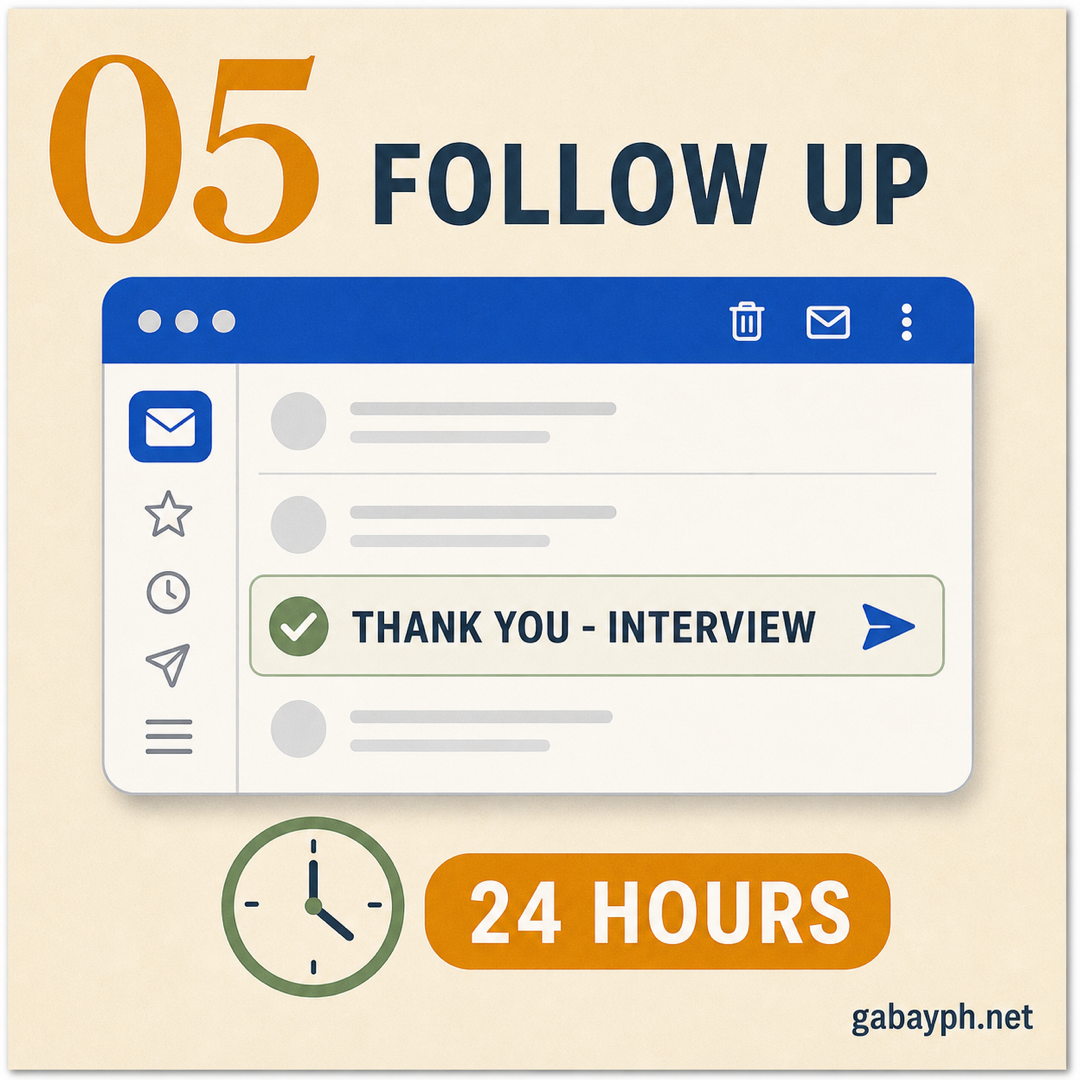
Send a thank-you email within 24 hours of your interview. Keep it brief — 3 to 5 sentences:
- Thank the interviewer by name for their time.
- Reference one specific topic you discussed to show you were engaged.
- Restate your enthusiasm for the role.
- Subject line: “Thank You — [Position Title] Interview”
If you have not heard back after 1 week, send a polite follow-up asking about the timeline. After 2 weeks with no response, move on and keep applying. Do not send more than 2 follow-ups for a single application.
-
Negotiate Your Offer
In the Philippines, your total compensation package includes much more than your monthly salary. Here is what to evaluate and negotiate:
- 13th Month Pay: This is mandatory by law (PD 851). Every employer must pay it. It equals your total basic salary for the year divided by 12, paid on or before December 24. This is NOT a bonus — it is your legal right.
- HMO Coverage: Ask which provider (Maxicare, Intellicare, Medicard), the coverage amount, and whether dependents are included. HMO is often more valuable than a ₱2,000-3,000 salary bump.
- SSS, PhilHealth, Pag-IBIG: Employer contributions are mandatory. Check that the company registers you on Day 1, not after probation.
- Allowances: Rice subsidy (up to ₱2,000/month), transportation allowance (₱2,000/month), uniform/clothing (₱6,000/year), and similar "de minimis" benefits are tax-exempt under BIR RR 11-2018, each with its own cap — there is no ₱10,000 catch-all. Ask which de minimis items the company offers and confirm caps with HR.
- Leave benefits: 5 days Service Incentive Leave is the legal minimum. Many companies offer 15-20 days. Ask about sick leave, vacation leave, and whether unused leave is convertible to cash.
- Bonuses: Performance bonuses, 14th month pay, mid-year bonuses — these vary by company. Ask what the typical payout was last year.
When giving your expected salary, research the market rate first using JobStreet Salary Guide or Glassdoor. Provide a range where the bottom of your range is your actual target. Aim for 10-20% above the initial offer, especially if you are switching from another company.
-
Gumawa ng Resume
Gamitin ang reverse chronological format (pinakabagong experience muna). Para sa fresh graduates, unahin ang Education, sundan ng OJT/Internship Experience, Skills, at Extracurriculars/Volunteer Work. Ang mga career changers ay dapat magsimula sa Professional Summary (2-3 pangungusap) na nagha-highlight ng transferable skills.
Mga format rules para sa PH employers:
- Haba: 1 page para sa fresh grads. Maximum 2 pages kung may 5+ taon na experience.
- Wika: English para sa 95% ng trabaho. Gamitin lang ang Filipino kung Filipino ang job posting.
- File format: PDF (napapanatili ang formatting). Pangalanan ito ng LastName_FirstName_Resume.pdf.
- Walang litrato maliban kung specifically hinihingi ng job posting. Hindi mabasa ng ATS software ang mga images.
- Walang personal info tulad ng edad, relihiyon, height/weight, o civil status. Outdated na PH resume habits ang mga ito na nag-aaksaya ng espasyo.
- Maglagay ng Skills section na hatiin sa Technical Skills (Excel, Python, AutoCAD, atbp.) at Soft Skills (communication, leadership). Gamitin ang mismong keywords mula sa job posting.
Fresh grad tip: Counts ang OJT experience. I-lista ang company, role, dates, at 2-3 bullet points na nagsisimula sa action verbs (developed, organized, assisted, created). Ang mga academic projects at thesis work ay counted din — ilarawan ang problema, ang role mo, at ang resulta.
-
Sumulat ng Epektibong Cover Letter
Karamihan ng Filipino job seekers ay nag-skip ng cover letter. Iyan mismo ang dahilan kung bakit ang pagsulat nito ay nagbibigay ng edge sa iyo. Panatilihin sa 3-4 maikling talata:
- Talata 1: Sabihin ang eksaktong posisyon at kung saan mo ito nakita. Isang pangungusap kung bakit interesado ka sa company.
- Talata 2: Ang pinakamalakas mong qualification na tumutugma sa job description. Gumamit ng specific na halimbawa — hindi lang “masipag ako.”
- Talata 3: Isa pang skill o experience na nagdadagdag ng value. Banggitin ang relevant coursework, OJT, o certifications.
- Talata 4: Pasalamatan sila, sabihin ang availability mo para sa interview, at isama ang phone number mo.
Sumulat ng bagong cover letter para sa bawat company. Mas masama pa ang pag-recycle ng generic letter kaysa walang ipadala — agad na malalaman ng recruiters.
-
I-optimize ang Online Profiles Mo
Mag-set up ng accounts sa mga platform kung saan talaga nagha-hire ang PH employers:
- JobStreet (SEEK) — pinakamalaking PH job board na may 50,000+ active listings. Kumpletuhin ang profile mo sa 100% — ini-filter ng recruiters ayon sa completeness. I-upload ang resume mo bilang PDF.
- LinkedIn — pinakamahusay para sa corporate, tech, at mid-to-senior roles. Gumamit ng propesyonal na headshot (plain background, maayos na lighting). Sumulat ng headline na higit pa sa “Fresh Graduate” lang — subukan ang “BS Accountancy Graduate | CPA Board Passer | Open to Audit & Tax Roles.”
- Kalibrr — malakas para sa tech, startups, at BPO. Ang skills-based matching ay nakakatulong kung kulang ang traditional experience mo.
- Indeed PH — nag-a-aggregate ng mga trabaho mula sa maraming sites. Mag-set up ng job alerts gamit ang target keywords mo.
- OnlineJobs.ph — kung gusto mo ng remote work para sa international clients (VA, content writing, design, dev).
I-set ang profiles mo sa “Open to Work” at i-enable ang job alerts. Mag-apply sa loob ng unang 48 oras ng posting — mas maraming pansin ang nakukuha ng mga naunang nag-apply.
-
Maghanda sa mga Karaniwang Interview Questions
Nagtatanong ang mga Philippine employer ng predictable na set ng mga tanong. Maghanda ng mga sagot gamit ang STAR method (Situation, Task, Action, Result) para sa behavioral questions:
- “Tell me about yourself.” — Magbigay ng 2-minutong summary: education, relevant experience, bakit nandito ka. Hindi ang buong buhay mo.
- “Why should we hire you?” — I-match ang 2-3 skills mo directly sa job description. Maging specific.
- “What is your expected salary?” — I-research muna ang market rate sa JobStreet o Glassdoor. Magbigay ng range, hindi isang numero. (Mas maraming detalye sa Hakbang 7.)
- “What is your weakness?” — Pangalanan ang totoong weakness at ipaliwanag kung ano ang ginagawa mo para mapabuti ito. Huwag sabihing “perfectionist” o “workaholic.”
- “Where do you see yourself in 5 years?” — Ipakita ang ambisyon na naka-align sa role. Hindi cute ang sabihing “nasa posisyon mo” — sabihin kung anong skills ang gusto mong ma-develop.
- “Do you have questions for us?” — Palaging sabihing oo. Magtanong tungkol sa team structure, training programs, o kung ano ang success sa unang 6 na buwan.
Para sa BPO roles: Mag-expect ng voice assessment at mock customer call. Mag-practice ng malinaw na English na may neutral accent. Ang call center interviews ay madalas may typing test (minimum 35 WPM).
-
Pumasa sa Virtual Interview
Higit sa 65% ng mga initial interviews sa Pilipinas ngayon ay nangyayari sa Zoom, Microsoft Teams, o Google Meet. Importante ang setup mo katulad ng mga sagot mo:
- I-test ang lahat 24 oras bago: camera, microphone, internet speed (minimum 5 Mbps), at ang specific platform na binanggit ng recruiter. I-download ang app nang maaga.
- Lighting: Humarap sa bintana o maglagay ng lamp sa harap mo sa 45-degree angle. Huwag kailanman umupo na may bintana sa likod mo — magiging silhouette ka.
- Background: Plain na pader o maayos na bookshelf. Gumamit ng virtual background kung nakakaistorbo talaga ang real background mo — pero maaaring mag-glitch ito sa mabagal na internet.
- Camera angle: Ilagay sa eye level (mag-stack ng mga libro sa ilalim ng laptop kung kailangan). I-center ang mukha mo sa upper-middle portion ng frame.
- Eye contact: Tumingin sa camera lens kapag nagsasalita, hindi sa mukha ng interviewer sa screen. Ito ang gumagawa ng genuine eye contact para sa kausap mo.
- Backup plan: Ihanda ang phone hotspot mo. Kung mawalan ng connection, bumalik agad at mag-sorry nang maikli. Naiintindihan ng mga interviewer sa PH — karaniwan ang internet issues.
Mag-dress nang propesyonal mula ulo hanggang paa. Maaaring kailanganin mong tumayo nang biglaan habang nasa call.
-
Mag-follow Up nang Propesyonal
Magpadala ng thank-you email sa loob ng 24 oras pagkatapos ng interview. Panatilihing maikli — 3 hanggang 5 pangungusap:
- Pasalamatan ang interviewer gamit ang pangalan nila para sa oras nila.
- Banggitin ang isang specific na topic na pinag-usapan para ipakitang engaged ka.
- Ulitin ang enthusiasm mo para sa role.
- Subject line: “Thank You — [Position Title] Interview”
Kung walang balita pagkatapos ng 1 linggo, magpadala ng maayos na follow-up na nagtatanong tungkol sa timeline. Pagkatapos ng 2 linggo na walang sagot, magpatuloy at patuloy na mag-apply. Huwag magpadala ng higit sa 2 follow-ups para sa isang application.
-
I-negotiate ang Offer Mo
Sa Pilipinas, ang total compensation package mo ay higit pa sa monthly salary mo. Narito ang dapat mong i-evaluate at i-negotiate:
- 13th Month Pay: Mandatory ito ayon sa batas (PD 851). Lahat ng employer ay kailangang magbayad nito. Katumbas ito ng total basic salary mo sa buong taon na hinati sa 12, ibinabayad bago o sa December 24. Hindi ito BONUS — karapatan mo ito ayon sa batas.
- HMO Coverage: Tanungin kung aling provider (Maxicare, Intellicare, Medicard), ang coverage amount, at kung kasama ang mga dependents. Mas mahalaga ang HMO kaysa sa ₱2,000-3,000 na dagdag sa sahod.
- SSS, PhilHealth, Pag-IBIG: Mandatory ang employer contributions. I-check na irerehistro ka ng company sa Day 1, hindi pagkatapos ng probation.
- Mga Allowance: Ang rice subsidy (hanggang ₱2,000/buwan), transportation allowance (₱2,000/buwan), uniform/clothing (₱6,000/taon), at iba pang "de minimis" benefits ay tax-exempt sa ilalim ng BIR RR 11-2018, na may sariling cap bawat isa — walang ₱10,000 catch-all. Tanungin kung anong de minimis items ang ino-offer ng company at i-confirm sa HR ang caps.
- Leave benefits: 5 araw na Service Incentive Leave ang legal minimum. Maraming company ang nag-o-offer ng 15-20 araw. Tanungin tungkol sa sick leave, vacation leave, at kung convertible to cash ang unused leave.
- Bonuses: Performance bonuses, 14th month pay, mid-year bonuses — iba-iba sa bawat company. Tanungin kung ano ang typical payout noong nakaraang taon.
Kapag nagbibigay ng expected salary, i-research muna ang market rate gamit ang JobStreet Salary Guide o Glassdoor. Magbigay ng range kung saan ang ibaba ng range mo ay ang actual target mo. Mag-aim ng 10-20% na mas mataas sa initial offer, lalo na kung nagpapalit ka ng company.
Pro Tips
Mga Payo
- Use Canva’s free resume templates carefully. They look great but many are not ATS-compatible. If using Canva, always also save a plain-text version in Word or Google Docs. When in doubt, a simple single-column format in Google Docs beats a fancy template that gets rejected by ATS.
- Check your social media before applying. Philippine HR teams commonly search for applicants on Facebook. Set party photos and political rants to “Friends Only.” Your Facebook profile is your unofficial second resume in the Philippines.
- Practice interview answers out loud, not just in your head. Record yourself on your phone and play it back. You will catch filler words (“um,” “like,” “ano”), awkward pauses, and unclear explanations that you would miss when rehearsing silently.
- Fresh grads: your thesis, org leadership, and volunteer work ARE valid experience. Organized a school event for 200 people? That is project management. Managed an org’s social media? That is digital marketing. Reframe academic work as professional achievements.
- Ask for the offer in writing before resigning. Verbal offers in the Philippines do not always hold up. Wait for the official offer letter or employment contract with the salary, benefits, and start date before giving your current employer notice.
- Gamitin nang maingat ang Canva free resume templates. Maganda ang hitsura pero marami ang hindi ATS-compatible. Kung gumagamit ng Canva, palaging mag-save din ng plain-text version sa Word o Google Docs. Kapag hindi sigurado, mas maganda ang simpleng single-column format sa Google Docs kaysa sa magandang template na nire-reject ng ATS.
- I-check ang social media mo bago mag-apply. Karaniwang hinahanap ng Philippine HR teams ang mga applicant sa Facebook. I-set ang mga party photos at political rants sa “Friends Only.” Ang Facebook profile mo ang unofficial second resume mo sa Pilipinas.
- I-practice ang interview answers nang malakas, hindi lang sa isip. I-record ang sarili mo sa phone at pakinggan. Mahuhuli mo ang filler words (“um,” “like,” “ano”), awkward pauses, at hindi malinaw na mga paliwanag na hindi mo mapapansin kapag tahimik na nagpe-practice.
- Fresh grads: ang thesis, org leadership, at volunteer work mo AY valid na experience. Nag-organize ng school event para sa 200 tao? Project management iyan. Nag-manage ng social media ng org? Digital marketing iyan. I-reframe ang academic work bilang professional achievements.
- Humingi ng offer na nakasulat bago mag-resign. Ang mga verbal offers sa Pilipinas ay hindi palaging tumutupad. Hintayin ang official offer letter o employment contract na may salary, benefits, at start date bago magbigay ng notice sa kasalukuyang employer.
Frequently Asked Questions
Mga Madalas Itanong
Should I include my photo on my resume?
Only if the job posting specifically requests it. ATS software cannot read photos, and they take up space better used for your skills and experience. International companies and BPOs generally prefer no photo.
Dapat ko bang isama ang litrato ko sa resume?
Kung specifically hinihingi lang ng job posting. Hindi mabasa ng ATS software ang mga litrato, at kumakain ito ng espasyong mas maganda sanang gamitin para sa skills at experience mo. Ang mga international companies at BPOs ay karaniwang mas gusto ang walang litrato.
How do I answer "expected salary" with no work experience?
Research the entry-level range for your role on JobStreet or Glassdoor. Give a range (e.g., ₱18,000-22,000) and add “negotiable depending on the total benefits package.” This shows you did your homework without locking yourself into a number.
Paano ko sasagutin ang "expected salary" kung walang work experience?
I-research ang entry-level range para sa role mo sa JobStreet o Glassdoor. Magbigay ng range (hal., ₱18,000-22,000) at idagdag ang “negotiable depende sa total benefits package.” Ipinakikita nito na nag-research ka nang hindi ka naka-lock sa isang numero.
Is it okay to apply to multiple jobs at the same company?
Yes, but limit to 2-3 related roles. Applying to 10 different positions signals desperation. Tailor each application to the specific job description.
Okay lang ba mag-apply sa maraming trabaho sa iisang company?
Oo, pero limitahan sa 2-3 magkakaugnay na roles. Ang pag-apply sa 10 iba't ibang posisyon ay nagpapakita ng desperasyon. I-tailor ang bawat application sa specific na job description.
What if I have gaps in my employment history?
Be honest but frame it positively. Caregiving, freelancing, self-study, or health recovery are all valid. Mention any skills you developed during the gap. Philippine employers are increasingly understanding about career breaks, especially post-pandemic.
Paano kung may gaps sa employment history ko?
Maging tapat pero i-frame nang positibo. Ang caregiving, freelancing, self-study, o health recovery ay lahat valid. Banggitin ang anumang skills na na-develop mo sa panahon ng gap. Lalong naiintindihan ng mga Philippine employer ang career breaks, lalo na pagkatapos ng pandemic.
Should I bring printed resumes to a virtual interview?
No, but keep a copy open on your screen for quick reference. For in-person interviews, bring 3-5 printed copies in a clear folder along with your pre-employment documents.
Dapat ba akong magdala ng printed resumes sa virtual interview?
Hindi, pero panatilihing nakabukas ang isang copy sa screen mo para sa mabilis na reference. Para sa in-person interviews, magdala ng 3-5 printed copies sa clear folder kasama ang iyong pre-employment documents.
Can I negotiate salary as a fresh graduate?
Yes. Negotiate politely by asking about the total package (HMO, allowances, leave) rather than demanding a higher base salary. Even a ₱1,000 monthly increase compounds to ₱13,000 extra per year including 13th month pay.
Maaari ba akong mag-negotiate ng salary bilang fresh graduate?
Oo. Mag-negotiate nang magalang sa pamamagitan ng pagtatanong tungkol sa total package (HMO, allowances, leave) sa halip na mag-demand ng mas mataas na base salary. Kahit ₱1,000 na monthly increase ay nagiging ₱13,000 extra bawat taon kasama ang 13th month pay.